
Idea 1
Quality and the Search for Meaning
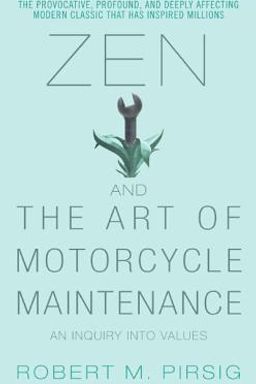
How do you live and work with real excellence in a world that splits reason from feeling? In Zen and the Art of Motorcycle Maintenance, Robert Pirsig answers by proposing that Quality—an indefinable yet recognizable presence—is the true foundation of both life and knowledge. The book fuses autobiography, philosophy, and travel narrative to show how Quality underlies every act of care, thought, and creation. It’s not a property we measure but an experience we recognize, the moment something feels right before we can explain why.
The narrator, a middle-aged father riding across the American West with his son Chris, recounts the life and ideas of his former self—Phaedrus, a brilliant but obsessive academic who pursued the question “What is Quality?” until it led to madness. The physical journey unfolds alongside an inward one, a meditation on work, truth, and sanity. (Note: Pirsig’s narrative deliberately blurs the line between philosophical dialogue and memoir to dramatize how abstract thought reshapes personal life.)
The question that breaks definitions
Phaedrus begins with a classroom challenge: define Quality. His students can’t. The more he and they try, the more absurd it becomes. Yet everyone knows what good writing—or good work—feels like. This contradiction is crucial. If Quality can be recognized but not defined, then it precedes intellect. It is a pre-intellectual event, the moment of contact where mind and world meet before analysis divides them. Subtract Quality from experience and all meaning evaporates: art, science, persuasion, even laughter cease to exist. Pirsig calls this the central insight that overturns Western thought’s split between subject and object.
Riding through dualism
The motorcycle journey provides the book’s second axis. Riding exposes you to wind, smell, and temperature; the road becomes immediate and continuous. The narrator contrasts this with car travel, where you observe from behind glass. The motif isn’t nostalgia—it’s an experiment in presence. On the bike, the boundary between thought and environment blurs, preparing the reader to feel what Quality is rather than only think about it. Every engine tune-up becomes a meditation on mindfulness, patience, and relationship. “The Buddha,” he insists, “can dwell as easily in a circuit as on a mountain top.”
Classical and romantic ways of knowing
Pirsig divides the human mind into two complementary modes. The classical mind seeks underlying structure: schematics, definitions, rational order. The romantic mind delights in immediate beauty, emotional resonance, and surface experience. These modes often clash—John Sutherland rides for feeling, while the narrator sees maintenance as care—but both are partial expressions of Quality. The central task, illustrated again and again through repair scenes and conversations, is to unite them into a harmonious awareness that balances precision with presence.
Science, academia, and the ghost of reason
Phaedrus pushes his inquiry into science itself. In laboratory work he realizes that the number of plausible hypotheses explaining any event tends toward infinity—proof that science discovers no final truths, only provisional ones. Rationality thus creates the very indeterminacy it was meant to solve. Pirsig calls the cultural faith in pure reason the “ghost of rationality.” His critique of the modern university—the “Church of Reason”—shows how institutions confuse intellectual integrity with bureaucratic form. Grades, tenure, and jargon replace genuine care for truth. Phaedrus’s experiment of teaching without grades exposes this behavioral corruption and seeks to restore learning for its own sake.
The collapse and rebirth of insight
The narrative’s psychological drama hinges on the split between the cautious narrator and Phaedrus, the fearless seeker within him. Their reunion—symbolized by Chris’s question about sanity—marks not resolution but reintegration. Phaedrus’s breakdown represents intellect disconnected from compassion; his return suggests that sanity requires valuing Quality through care, not domination. Later reflections on Poincaré’s aesthetic reasoning and the mechanic’s intuitive “feel” confirm that even the most rational acts depend on pre-intellectual recognition. Knowledge without love of craft, Pirsig implies, collapses into alienation. Love without structure decays into chaos. Only by attending to Quality, moment by moment, can the two sustain each other.
What this means for you
To engage with Quality is to live with care, awareness, and integrity in whatever you do—repairing a machine, composing an essay, teaching a class, raising a child. The book’s closing ride across the mountains is less about reaching a destination than discovering a mode of attention that transforms each act into art. By uniting classical order and romantic presence, and by letting Quality—not ego or convention—be the guiding measure, you can turn everyday labor into a path of peace and meaning.