
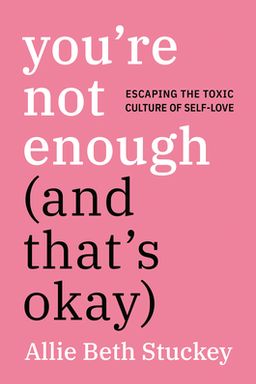
You''re Not Enough (And That''s Okay) cover

You''re Not Enough (And That''s Okay)

by Allie Beth Stuckey

You''re Not Enough (And That''s Okay) challenges the self-love narrative by revealing its shortcomings and offering a powerful alternative: embracing God''s love. Allie Beth Stuckey guides readers to genuine joy and fulfillment, freeing them from the exhausting pursuit of self-sufficiency.

You're Not Enough—And That's Okay

When was the last time you told yourself, “I’m enough”? Maybe it was after scrolling through a motivational quote or watching a video of someone proclaiming self-love. But in You’re Not Enough (And That’s Okay), Allie Beth Stuckey argues that this comforting mantra is perhaps one of the most destructive lies modern culture feeds us. Her central claim is that the idea of self-sufficiency—believing that happiness, purpose, and strength can be found within—leads not to fulfillment, but to exhaustion. Instead, she offers a radically different truth: we are not enough, and that realization is the gateway to peace, purpose, and true joy through God’s sufficiency.

Stuckey sees the “toxic culture of self-love” as the most pervasive philosophy shaping modern women. Through Instagram influencers, best-selling self-help books, and popular preachers, women are told that they already have everything they need inside themselves—that confidence, manifestation, and positivity will unlock happiness. Yet this belief system, she insists, only deepens insecurity. Our endless pursuit of being “enough” turns us into our own gods, leaving us fatigued, lonely, and spiritually deprived. Her book dismantles five cultural myths—“You Are Enough,” “You Determine Your Truth,” “You’re Perfect the Way You Are,” “You’re Entitled to Your Dreams,” and “You Can’t Love Others Until You Love Yourself”—each exposing how self-love culture contradicts biblical truth.

The Mirage of Self-Sufficiency

From childhood, Stuckey notes, women are raised on affirmations of uniqueness and power. We’re taught that self-esteem unlocks success and that independence guarantees happiness. But the statistics tell another story: our generation is more anxious, depressed, and purposeless than ever. The contradiction reveals a core truth—self-adoration doesn’t work. The self, she writes, cannot be both the problem and the solution.

Through candid stories of her own life, including struggles with eating disorders, unhealthy relationships, and career disappointments, Stuckey demonstrates how chasing self-love’s promises left her hollow. Her turning point arrived when she realized that peace does not come from self-discovery but from surrender—acknowledging weakness and accepting reliance on God. “If we were enough,” she writes, “we wouldn’t need Jesus.”

The Real Alternative: God’s Sufficiency

To replace cultural myths with enduring truths, Stuckey presents a distinctly Christian worldview: only God can supply the sufficiency we seek from ourselves. While the self-help gospel tells you to “manifest your best self,” the Gospel of Christ tells you to deny yourself and follow Him. This paradigm shift—from self-centered empowerment to God-centered humility—reshapes everything: purpose, identity, relationships, and even ambition.

She divides her message across five myths that mirror the moral framework of modern culture. Each myth reveals how deeply secular self-worship has infiltrated even Christian spaces: in motivational preaching that avoids sin, in “manifesting” disguised as prayer, and in redefining truth as feelings rather than Scripture. Her antidote is both countercultural and liberating: life’s fulfillment rests not in self-affirmation but in divine dependence.

Why This Message Matters

Stuckey’s argument isn’t simply theological—it’s social and psychological. The self-love gospel, she argues, has bred an epidemic of narcissism masked as empowerment. By convincing women to prioritize “self-care” above service, and self-validation above humility, culture has made us lonelier while promising connection. Her critique aligns with thinkers like C. S. Lewis and Tim Keller, who define true humility not as self-hatred but as self-forgetfulness—a freedom from fixation on oneself. Where modern feminism demands self-worship, Stuckey champions surrender as strength.

Throughout the book, she weaves in the experiences of others—from mothers drowning in the pressure to be perfect to young women enslaved by body image and damaged relationships. Each story reinforces her point: attempts to be “enough” inevitably collapse. The biblical alternative—reliance on an unchanging God—frees us from self-obsession and reorients our lives toward love, purpose, and peace.

A New Definition of Strength

In essence, You’re Not Enough (And That’s Okay) calls for a reformation of what strength means. Cultural strength is self-assertion; biblical strength is self-surrender. Where the world glorifies authenticity and autonomy, Stuckey redefines freedom as obedience to God. Her message confronts the counterfeit spirituality of self-love with the assurance that the only unshakable foundation is divine truth. The relief, she promises, is immense—you no longer have to hustle to be “enough.” You were never meant to be.

“Self-love is unreliable, conditional, and limited. Chasing after it always brings us to a dead end. Our sufficiency isn’t the answer to insecurity, and self-love isn’t the antidote to self-loathing.”

By grounding her critique in both Scripture and lived experience, Stuckey’s book stands as both a warning and a liberation. Rejecting the hollow comfort of self-worship, she invites readers into something deeper—the freedom that comes from admitting “I am not enough, and that’s perfectly okay.”


Myth #1: You Are Enough

Stuckey begins with what she calls the most pervasive and poisonous myth: the idea that you are enough just as you are. She personalizes this lie through her own story—a young woman chasing validation and control. After a breakup in college, she fell into disordered eating, drinking, and self-destructive behavior. Her counselor’s stark warning—“You’re going to die”—forced her to confront the truth: she could not rescue herself. This moment of collapse revealed what many miss: self-reliance is fatal to the soul.

The Trap of the Cult of Self-Affirmation

Stuckey describes modern self-help trends as a popular religion—the Cult of Self-Affirmation. Its priests are influencers, gurus, and even pastors who proclaim salvation through self-discovery. Its commandments are authenticity and autonomy: be true to yourself and do what feels right. But this ideology enslaves rather than frees. By making the self both savior and sinner, it sets an impossible standard—one that leaves you guilt-ridden when self-care doesn’t cure your emptiness.

This cult manifests in slogans like “Do you,” “Follow your heart,” or “Cut out toxic people.” It extends even into politics, where bodily autonomy justifies abortion as empowerment, and gender identity becomes self-defined truth. In every context, the self becomes supreme. But as Stuckey contends, “We make terrible gods.”

A Case Study: Cecily’s Breaking Point

Cecily, one of Stuckey’s real-life examples, illustrates the collapse of this worldview. Abused as a child and desperate for love, she sought perfection as a mother to prove her worth. Social media’s “self-love” messages told her to take her life back—to love herself more. But these mantras only deepened her despair until, finally, she contemplated suicide. In that lowest moment, she realized she didn’t need more self-affirmation; she needed divine rescue. Accepting that she wasn’t enough freed her to rest in God’s strength instead of her own.

Dependence: The Way to Real Fulfillment

Stuckey argues that this is the heart of Christianity: dependency is not weakness but design. God created us needy so that we would turn to Him. Through Scriptures like Ephesians 2 and 2 Corinthians 12, she reminds readers that our insufficiency magnifies God’s power. Rather than pretending to have it all together, we are called to “cast all our anxieties on Him, because He cares for us.”

“Our culture’s self-help strategies promise empowerment but deliver exhaustion. Only God’s grace gives the strength we keep trying to manufacture.”

The chapter closes by reclaiming weakness as the path to wholeness. Real liberation, Stuckey insists, is not in believing “I am enough,” but in resting in the truth that He is enough—for every wound, every failure, and every longing you carry.


Myth #2: You Determine Your Truth

What happens when truth becomes personal preference? In today’s culture, “my truth” reigns as the moral law. But Stuckey declares that subjective truth isn’t liberating—it’s chaos disguised as compassion. Through real stories and cultural critique, she exposes how the rejection of objective morality leads to suffering, confusion, and moral relativism.

From “My Truth” to Misery

Chloe’s story anchors this chapter. After enduring sexual assault, Chloe sought healing by traveling the world and “living her truth.” Her social media fed the illusion of empowerment—but in reality, she spiraled into addiction, promiscuity, and isolation until she faced pregnancy alone. Her journey reveals that feelings, left unmoored from absolute truth, are unreliable guides. Stuckey notes, “Our thoughts confuse us. Our intuition is often wrong. Our feelings deceive us.”

The remedy? Recognizing that truth is not invented but revealed—by God, through His Word. When we make the self the arbiter of truth, morality becomes fluid, molded by emotion, politics, or public opinion. Without an anchor, even churches drift, replacing theology with what Stuckey calls meology—a gospel centered on the self instead of on Christ.

The Problem of Meology

Meology brands itself with inspirational sermons and devotionals that replace God’s character with personal affirmation. Prosperity preachers, she argues, promise health and wealth in exchange for faith, turning God into a spiritual vending machine. The other version—“Hipster Jesus Christianity”—reduces Christ to a feel-good friend who demands nothing and condemns no sin. Both distortions comfort us temporarily but strip Scripture of its authority.

Stuckey contrasts this with biblical Christianity, which teaches that freedom comes not from redefining morality but from living according to God’s unchanging truth. She encourages believers to study the Bible deeply, not seek soundbites that affirm their desires. The goal is transformation, not validation.

Objective Truth and Cultural Confusion

She extends this critique into cultural territory—from Cancel Culture’s mob morality to the ideology of social justice. Without a transcendent moral lawgiver, justice becomes subjective—a product of social outrage, not righteousness. Her analysis is provocative: moral relativism fuels ideological division, identity politics, and the loss of compassion. Real justice, she argues, is rooted in divine standards that judge without partiality (Leviticus 19:15).

By the end, the message is clear: your truth will enslave you, but the truth—God’s truth—will set you free. As Stuckey writes, “Isn’t it a relief to know we don’t have to see every country, kiss every guy, and take every turn on the road of self-discovery to find truth? It’s available here and now, in Christ.”


Myth #3: You’re Perfect the Way You Are

The third myth targets a popular feel-good message: “You’re perfect just as you are.” For Stuckey, this slogan is not encouragement but delusion—it denies sin, rejects growth, and numbs us to grace. Using humor, personal anecdotes, and biblical teaching, she uncovers how perfectionism hides beneath self-acceptance culture.

The Paradox of Perfection

From slashing her eyebrow as a middle-schooler to chasing online self-help mantras, Stuckey recalls how women are told they’re “enough” while constantly bombarded with new ways to become better. She calls this the “paradox of perfection” —the contradiction of being told you need no improvement, yet being offered endless programs to fix yourself. This paradox keeps us striving but never satisfied.

Self-love influencers tell you that society—the patriarchy, capitalism, or “toxic relationships”—is the problem. But Stuckey offers a harsher, liberating truth: the problem is within us. Our “true selves,” apart from God, are not divine but depraved. She contrasts this cultural gospel with Scripture’s depiction of the old self and new self: the former enslaved to sin; the latter redeemed in Christ. True perfection doesn’t come from uncovering your inner goddess but from receiving His righteousness.

Why Feelings and Tests Can’t Define You

Stuckey warns of the obsession with introspection through tools like the Enneagram. What appears to be self-understanding, she explains, often crosses into self-idolatry. These tests promise transcendence through self-knowledge, yet their origins—from 20th-century occultists—reveal the spiritual dangers behind them. “To constantly focus on our unique attributes,” she cautions, “is to miss what God calls us to do: be like Christ.”

Even emotions, often declared “valid,” must be tested against truth. Feelings may be real, but not all are valid. Anger, jealousy, lust, and fear can be rooted in lies. The biblical response isn’t self-validation—it’s discernment and repentance. She roots this argument in Proverbs and the Gospel teaching that sin begins in the heart, reminding readers that ungoverned feelings can be sinful, not sacred.

Body Positivity and Real Confidence

Addressing body positivity movements, Stuckey empathizes with women’s desire for acceptance but critiques their shallow solutions. After enduring online bullying over pregnancy weight, she resisted the “love yourself no matter what” platitudes and instead grounded her worth in God’s design: our bodies are gifts to steward, not idols to perfect. Confidence, she insists, “is not something to be achieved; it’s a gift from God to accept.”

Her conclusion: denying imperfection denies grace. “You’re not perfect—and that’s okay,” she writes. Only by admitting our flaws can we experience God’s mercy and the lasting joy perfectionism can never grant.


Myth #4: You’re Entitled to Your Dreams

Who doesn’t love the sound of “dream big”? For Stuckey, the trouble isn’t ambition—it’s entitlement. This myth, ingrained in both self-help culture and modern feminism, tells us that our desires are our destiny. Stuckey dismantles this belief through her experiences in career failure and success, revealing that God calls us not to self-fulfillment but to faithful work.

Dreaming Without Entitlement

Raised in a self-improvement household, Stuckey absorbed motivational messages equating hard work with guaranteed success. “You deserve everything you want,” read a shirt she saw—and she believed it, until professional setbacks proved otherwise. From crying at her PR desk over missed deadlines to realizing success doesn’t come easily, she discovered the theology of work: human effort matters, but outcomes are God’s to give.

The Biblical View of Work

Stuckey reclaims work as a divine calling, not a personal brand. Drawing on Genesis 2 and Colossians 3, she emphasizes that work existed before sin—meaning labor is inherently good but not guaranteed to fulfill us. She contrasts the biblical ethic of diligence with modern socialism’s “entitlement to comfort.” Quoting Alexandria Ocasio-Cortez, she reveals how the quest for effort-free living contradicts Scripture’s command to “work heartily, as for the Lord.”

True value, she explains, lies not in dream realization but in obedience. Whether you’re a CEO or a stay-at-home parent, your work can glorify God if done with integrity, meeting real needs, and helping others. Achievement is not about glamorous titles but faithfulness in small tasks.

When Dreams Come True—and Still Disappoint

Ironically, Stuckey’s own success—speaking, writing, hosting a nationally known podcast—taught her that even “dream jobs” can leave you restless. The applause fades; the pressure mounts. Success exposed her dependence on public approval. Her turning point came with motherhood, which reoriented her sense of purpose. As she puts it, “There are no better earthly titles than ‘wife’ and ‘mom.’ But even these cannot replace the longing only God can meet.”

The myth that “you’re entitled to your dreams” collapses under biblical truth: God calls us not to chase personal destiny but to pursue faithful obedience. We can find peace whether dreams flourish or fail because fulfillment isn’t found in achievement, but in abiding in Him.


Myth #5: You Can’t Love Others Until You Love Yourself

Perhaps the most seductive lie of all, Stuckey argues, is the notion that self-love is the precondition for loving others. From church pulpits to Instagram captions, this message sounds biblical but distorts Jesus’s command to “love your neighbor as yourself.” She insists Jesus wasn’t commanding self-love—He was assuming it. The real obstacle isn’t that we don’t love ourselves enough, but that we love ourselves too much.

Self-Love vs. Self-Forgetfulness

Drawing from Blaise Pascal and C. S. Lewis, Stuckey explains how humans are born self-focused, always pursuing our own interest—even in self-loathing. She distinguishes between high self-esteem and the Christian alternative: humility. Quoting Tim Keller’s The Freedom of Self-Forgetfulness, she says the goal is not to think less of yourself but to think of yourself less. True freedom comes when one’s attention shifts from the mirror to others.

In practical terms, that means rejecting the narcissistic logic that delays compassion until we’re “healed enough.” Stuckey uses her time at Camp Barnabas—a ministry serving people with disabilities—to illustrate how serving others reshapes our hearts. Love matures not through introspection but through action.

The Radical Call to Self-Denial

Stuckey’s personal reflections on marriage and motherhood bring theology to life. Early in her marriage, she realized genuine love requires daily self-denial—biting your tongue, forgiving, choosing patience. She pairs this with examples of Christian martyrs and missionaries whose love transcended comfort. From these, she draws her thesis: love rooted in self-sacrifice, not self-adoration, mirrors Christ’s heart.

She also confronts cultural delays in marriage and motherhood, arguing that fear of “losing oneself” blinds many to the joy of family. “You don’t have to love yourself before you can love others,” she writes. “God’s love is already enough to equip you.” Parenting, she says, reveals this truth more profoundly than anything else—motherhood forces radical selflessness that, though hard, is sanctifying and beautiful.

Why Sacrificial Love Heals More Than Self-Care

In a society paralyzed by loneliness, Stuckey concludes, the answer isn’t higher self-esteem—it’s Christ’s love working through us. “While the thief comes only to steal and destroy,” she writes, “Jesus came that we may have abundant life.” That abundance grows not in self-focus but through giving, forgiving, serving, and surrendering. To love others well, stop waiting to be perfect—just start loving, and you’ll find yourself transformed along the way.

Ultimately, Stuckey reframes love as obedience rather than emotion. The world says love feels good; Scripture says love gives even when it hurts. In living this way, we discover God’s steady promise: His love is sufficient—for us and for those we’re called to serve.

Dig Deeper

Get personalized prompts to apply these lessons to your life and deepen your understanding.

Go Deeper

Get the Full Experience

Download Insight Books for AI-powered reflections, quizzes, and more.