
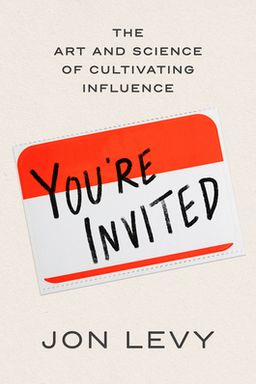
You''re Invited cover

You''re Invited

by Jon Levy

You''re Invited reveals the secrets of cultivating influence through genuine connections and community building. Discover how behavioral psychology can guide you in designing impactful events that align with your values and create meaningful change.

The Art and Science of Human Connection

When was the last time you felt truly connected—to your colleagues, friends, or community? In You’re Invited, behavioral scientist Jon Levy argues that real success, fulfillment, and influence come not from social media metrics or networking events, but from cultivating meaningful relationships and communities. Drawing on psychology, neuroscience, and decades of experimentation through his acclaimed “Influencers Dinner” experiences, Levy reveals how we can systematically build connection, trust, and belonging in both personal and professional settings.

At the heart of the book lies what Levy calls the Influence Equation: Influence = (Connection × Trust) × Sense of Community. He contends that the most successful individuals and organizations thrive because they know how to connect deeply with others, build authentic trust, and foster that irreplaceable sense of belonging. Whether it’s achieving career growth, nurturing friendships, leading teams, or inspiring social movements, it all begins with understanding how people connect and cooperate.

Why Connection Matters More Than Ever

Levy begins by exposing a paradox of our hyperconnected age: although we have more digital tools to stay in touch, rates of loneliness and isolation have never been higher. Using the research of Dr. Bruce Alexander’s “Rat Park” experiments and Matt Lieberman’s work on social pain, Levy shows that disconnection harms us deeply—biologically, emotionally, and mentally. We are wired for belonging, and without it, our health and happiness deteriorate. Communities, whether family units or professional groups, serve as the lifeblood of human well-being.

Levy connects these insights to his own journey—from a struggling, debt-ridden 20-something to a world-renowned behavioral scientist who built a community of Nobel laureates, Olympians, and artists. Using relationships as his leverage, he didn’t just improve his own circumstances; he helped others thrive by creating trusted spaces of collaboration and belonging.

The Three Forces Behind Influence

The book’s central framework, the Influence Equation, proposes that every lasting form of influence—the type that shapes careers, movements, or communities—arises from three intertwined forces:

  • Connection — the degree to which people relate and engage emotionally.
  • Trust — the willingness to be vulnerable and believe in mutual goodwill.
  • Sense of Community — the shared identity, purpose, and belonging that creates lasting bonds.

Levy uses stories—from the founding of Weight Watchers by Jean Nidetch to the abolitionist movement led by Frederick Douglass—to show that these forces have driven some of the greatest social changes in history. Jean Nidetch’s early Weight Watchers meetings, for example, succeeded not because of diet tips but because she created a judgment-free community where women could speak honestly about their struggles.

In contrast to transactional networking, which often feels “dirty” and superficial (as Francesca Gino and Tiziana Casciaro’s research confirms), Levy’s model promotes relationship-building rooted in benevolence, shared experiences, and vulnerability. Through cleverly designed group experiments—like having high achievers cook dinner together without revealing their identities—Levy discovered that trust and belonging can be engineered through shared effort and play.

Why This Matters—And How We Can Use It

The book arrives at a crucial time. Remote work, social fragmentation, and pandemic-induced isolation have made community-building both harder and more vital. Levy’s research provides a roadmap for people who want to bring others together—leaders cultivating company culture, nonprofits growing donor bases, or individuals seeking meaningful friendships. His stories—from the South African Springboks rebuilding trust after apartheid to the comic book fans of Comic-Con creating global subcultures—illustrate how belonging transforms performance, creativity, and resilience.

Ultimately, Levy’s message is both practical and uplifting: you don’t have to be famous or powerful to have influence. If you can connect authentically, build trust through shared experience, and give people a place to belong, you can change lives—including your own. The book’s later chapters act as a step-by-step guide for designing experiences, events, and communities that naturally nurture these dynamics.

Through vivid case studies—from Red Bull’s revolutionary brand communities to the CreativeMornings design network—Levy shows how the small, consistent acts of invitation and generosity compound over time into large-scale impact. As he concludes, influence and belonging are infinite games. You don’t play to win; you play to keep connecting. The reward is the community itself—the shared trust, joy, and purpose that make us human.


The Science of Trust and Connection

Trust, Levy explains, is not built overnight or through flashy displays of charisma—it’s earned through small, benevolent actions that signal reliability and care. Drawing upon behavioral science and neuroscience, he reveals why trust has three core pillars: competence (the ability to deliver), honesty (truthfulness and integrity), and benevolence (concern for others’ well-being).

When benevolence is missing, everything else collapses. Levy cites shocking real-world cases like British doctor Harold Shipman—the trusted community physician who murdered his patients—to show how misplaced trust based on perceived competence can have devastating consequences. In contrast, brands and people flourish when others feel their motives are kind and transparent. (This echoes Stephen Covey’s idea in The Speed of Trust that sincerity accelerates collaboration.)

How We Decide to Trust

Humans make trust judgments incredibly fast—within milliseconds of seeing a face. We’re guided by mental shortcuts and biases: facial features, tone of voice, and cultural cues shape who we find credible. While we can’t change our cheekbones, we can convey trust through consistency, integrity, and care. The most sustainable kind of trust comes from showing genuine investment in others’ success.

The IKEA Effect and Vulnerability Loops

To deepen trust quickly, Levy draws from the IKEA effect—the psychological bias that makes us love things we help build. In group settings, shared work and small cooperative challenges (like the Influencers Dinner’s joint meal preparation) foster rapid bonding. This mirrors what Marine boot camps or sorority initiations achieve under pressure: through shared effort and vulnerability, strangers become allies.

Levy also introduces the concept of vulnerability loops, first studied by Jeffrey Polzer at Harvard. Vulnerability, he argues, precedes trust—not the other way around. When one person admits a weakness and another responds supportively, both experience a burst of oxytocin—the “moral molecule” that triggers empathy and generosity. Repeating these loops solidifies emotional safety just as Google’s Project Aristotle later identified psychological safety as the top predictor of effective teams.

Turning Trust into Influence

Levy concludes that the key to accelerating trust is to create contexts of shared effort and benevolence. Whether you’re leading employees or courting clients, skip the fancy dinners and focus on doing something together—a volunteer project, workshop, or hike—where vulnerability and cooperation emerge naturally. By mastering these micro-moments, you lay the neurological and emotional groundwork for long-term collaboration, loyalty, and collective success.


From Networking to Real Relationships

Levy dismantles the myth of traditional “networking,” explaining why it often feels manipulative or transactional. Building relationships shouldn’t be a “numbers game” but a process of genuine connection. Research by Francesca Gino and Tiziana Casciaro shows that people literally feel physically “dirty” after forced professional networking because it lacks authenticity and reciprocity.

In contrast, true relationships arise from curiosity, shared experiences, and consistency. Levy transformed his social and professional life with the Influencers Dinner—secret gatherings where high achievers cooked a meal together without revealing their careers until dinner was served. The constraints removed hierarchy and allowed guests to bond human-to-human before realizing they were dining with Nobel laureates, Grammy winners, or Olympians.

Multiplex Relationships and Belonging

One reason these events worked is what social scientists call multiplex relationships—connections that intersect across multiple life domains. When you share not only a professional interest but meals, humor, or vulnerability, each layer reinforces the others. These deeper relationships outperform transactional ones because they cultivate a genuine sense of belonging and shared narrative.

Networking turns people into assets; community turns them into allies. Levy urges you to stop chasing contacts and start creating environments where people can connect as whole human beings. As Jean Nidetch’s early Weight Watchers groups and Frederick Douglass’s abolitionist meetings proved, bringing people together with purpose can transform both individual lives and entire societies.


The Structure of Community

In one of the book’s most research-driven sections, Levy unpacks the classic 1986 framework by psychologists David McMillan and David Chavis, who identified the four essential elements that make people feel they belong: Membership, Influence, Integration and Fulfillment of Needs, and Shared Emotional Connection. Levy demonstrates each with captivating modern examples that range from prison rehabilitation to pop-culture fandom.

Membership

Membership defines who’s “inside” and who’s “outside.” It’s created through boundaries, safety, and belonging. The story of South Africa’s Springboks rugby team illustrates this perfectly. Under coach Jake White and captain John Smit, the players overcame racial divides by forming one brotherhood anchored in trust and protection. Every player felt valued and irreplaceable, which led them to win the 2007 Rugby World Cup.

Influence

True communities let members actively shape them. Levy uses the example of Wikipedia editors arguing over whether “Star Trek Into Darkness” should capitalize the ‘I’. It sounds trivial, but the 40,000-word debate demonstrates what belonging really means: caring enough to influence outcomes. Influence flows both ways—the community shapes you, and you shape it.

Integration and Fulfillment of Needs

To survive, a community must meet members’ needs while serving its mission. Coss Marte’s ConBody—a fitness company staffed entirely by formerly incarcerated trainers—shows this principle in action. It provides jobs (their need) and helps clients get healthy (the community’s mission), aligning both goals into a shared value structure.

Shared Emotional Connection

Finally, communities endure through shared history, rituals, or mythology. The story of Gareb Shamus and Wizard magazine illustrates how fan culture blossomed into Comic-Con—an international home for millions of geeks and cosplayers who finally felt “seen.” As Levy notes, whether in faith groups, fandoms, or friend circles, shared journeys and traditions transform loose associations into true communities.


Designing the Path to Belonging

Even when we understand connection and trust, Levy argues, success depends on designing the path that guides people from discovery to engagement to membership. Borrowing from behavioral economics and Disney’s design brilliance, he shows how small, well-structured journeys can align people’s emotions and actions with your purpose.

Reverse-Engineering Experiences

Levy advises beginning with the end in mind. Ask: “What do I want people to feel at the moment of belonging?” From there, work backward. He highlights Valorie Kondos Field (“Miss Val”), the UCLA gymnastics coach who transformed a failing team by rejecting authoritarian methods. Instead, she cultivated “champions in life,” creating a supportive journey that built character and trust before focusing on medals. This backward design applies in business, leadership, and community life alike.

The Elephant and the Rider

To explain human behavior, Levy borrows Jonathan Haidt’s metaphor of the elephant (our emotions) and rider (our rational mind). You can’t rely on logic alone to move people—you must design environments that guide both emotion and reason down the same path. Disney’s twenty-three-minute ferry ride before entering the Magic Kingdom, for instance, dissipates buyer’s remorse and primes families for joy. Thoughtful design can turn anxiety into anticipation.

The Aesthetic Scentability Brunch

Levy’s “Aesthetic Scentability Brunch” for UrbanStems illustrates this process beautifully. Guests were invited to an event full of mystery and cooperation. Only later did they discover they were crafting bouquets alongside Dr. Ruth Westheimer and Hollywood producers—culminating in the surprise of seeing their flowers delivered in real time to loved ones. The emotional high created lasting bonds between brand and guest, proving that thoughtful paths—when aligned with values—turn one-time interactions into enduring relationships.


Building Communities that Last

Creating community isn’t magic—it’s structure, consistency, and values. In the final chapters, Levy showcases how movements like CreativeMornings, the National Multiple Sclerosis Society, and Salesforce sustain belonging through ritual and routine, not just novelty. Founder Tina Roth-Eisenberg, for example, grew a small morning gathering of artists into 200 global chapters by focusing on free access, inspiration, and trust rather than exclusivity. Her consistency—monthly events for over a decade—proved that belonging isn’t a campaign; it’s a commitment.

Community Structure: Flagship, Offshoot, and Gathering

Levy proposes three tiers of recurring events: flagships (regular gatherings like weekly workouts or monthly dinners), offshoots (smaller subcommunity projects), and large gatherings (annual or symbolic events). This structure mirrors religion, sports fandom, and organizational culture—offering frequency for familiarity and scale for inspiration. Each level deepens trust and gives members chances to contribute.

Playing the Infinite Game

Borrowing from James P. Carse’s Finite and Infinite Games (and echoed by Simon Sinek), Levy insists that meaning-driven communities aren’t “won”—they’re played indefinitely. When companies like Volkswagen or Wells Fargo cheat to boost short-term metrics, they’re playing finite games and destroy trust. True communities, however, aim to keep the game going by focusing on joy, generosity, and values. Each gathering should make members want to return, not “close a deal.”

Practical Tools for Organizers

Levy provides dozens of replicable models—from “Fuckup Nights” celebrating failure to Red Bull’s Music Academy, which helped creatives SOAR by giving them skills, opportunities, access, and resources. The principle is simple: design consistent, human-centered experiences around shared values, and you’ll cultivate influence without manipulation. Whether you’re building a social club, corporate culture, or cause-based movement, the same logic holds: invite, include, encourage, repeat.


An Invitation to Change Lives

Levy closes with one of the book’s most moving stories: Daryl Davis, a Black blues musician who befriended hundreds of Ku Klux Klan members—not to argue, but to understand. Through honest conversation and exposure, Davis inspired over fifty Klansmen to renounce hate and hand him their robes. His lesson: people hate what they don’t know. The antidote to fear is invitation.

For Levy, Davis embodies the ultimate power of connection and trust. By approaching others with courage and curiosity rather than judgment, Davis played the infinite game of humanity—inviting people to transform through relationship. The same recipe applies in every domain, from political divides to boardrooms: invite people to belong before you ask them to change.

As the book ends, Levy himself extends that invitation to readers: start small. Host dinners, walks, or creative mornings. Build rituals of generosity and inclusion. Each act of invitation is a step toward healing the loneliness epidemic and unlocking your own influence. Community is not something you join; it’s something you create, over and over, together.

Dig Deeper

Get personalized prompts to apply these lessons to your life and deepen your understanding.

Go Deeper

Get the Full Experience

Download Insight Books for AI-powered reflections, quizzes, and more.