
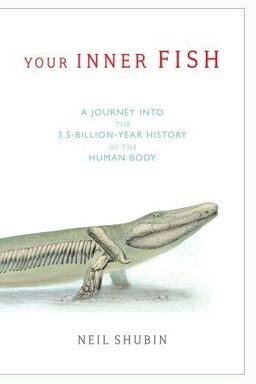
Your Inner Fish cover

Your Inner Fish

by Neil Shubin

Your Inner Fish takes you on a captivating journey through the 3.5-billion-year history of the human body. Neil Shubin reveals the evolutionary connections between us and our ancient ancestors, illustrating how our anatomy and sensory systems evolved. Through the lens of paleontology, genetics, and developmental biology, this book uncovers the hidden links to our fishy past.

Discovering the Fish Within You

Have you ever wondered why your limbs move the way they do, or why your body sometimes seems oddly fragile despite millions of years of evolution? In Your Inner Fish, paleontologist Neil Shubin takes you on a mesmerizing journey that reveals how our human bodies are deeply connected to ancient fish, worms, and even single-celled organisms. Shubin’s central argument is that the blueprints of everything that makes us human — from our limbs to our ears and our DNA — were laid down hundreds of millions of years before humans ever existed.

This is not just another book about evolution; it’s a detective story that bridges fossils, anatomy, and genetics to uncover how our bodies came to be. Shubin contends that the best way to understand ourselves — our quirks, our vulnerabilities, even our diseases — is to look back through deep time at our prehistoric ancestors. By tracing how fish learned to crawl onto land or how worms developed sensory structures that became our heads, Shubin invites you to see your own flesh as living history.

From Fossils to DNA: Finding Our Deep Roots

Shubin’s story begins in one of the most remote corners of the world. On Ellesmere Island in the Canadian Arctic, his team discovered Tiktaalik roseae — a 375-million-year-old fossilized creature half fish and half land animal. With fins containing wrist bones and shoulders freed from its head, Tiktaalik stood as the long-sought missing link between finned and limbed animals. The discovery was no stroke of luck; Shubin and his colleagues used a predictive method — combining biology, geology, and evolutionary theory — to pinpoint where such transitional fossils should exist. Their discovery proved that evolution leaves visible, testable clues in Earth’s rocks.

But Shubin doesn’t stop at bones. He shows how our anatomy can only be understood when paired with developmental biology and genetics. The same genes that guide a fish in forming fins also build our arms and hands. In fact, the DNA sequences that pattern our limbs first appeared in ancient aquatic animals hundreds of millions of years ago. This startling genetic continuity blurs the boundary between species; rather than being unique organisms, we are elaborations on ancient templates.

The Body as a Map of Time

Throughout the book, Shubin treats the human body as a living fossil record. Each organ or structure — our limbs, teeth, heads, and senses — carries the imprint of earlier forms. Our hands are modified fins; our jaws evolved from gill arches; our ears trace to the vibrations processed by primitive fish. Even diseases like hernias or hiccups bear the consequences of these ancient modifications. Shubin’s insight mirrors the themes of evolutionary biologist Stephen Jay Gould: history is layered within us, making every body both a product of adaptation and accident.

The beauty of this approach lies in its unifying vision — from the fossil record to molecular biology. Whether he describes the miracle of embryonic development or the awkward quirks of our skeletal wiring, Shubin’s voice conveys the wonder that human anatomy is not separate from the rest of life but deeply embedded in the same history. To know yourself biologically, you must accept that you are not just human; you are also part fish, reptile, and worm.

Why Your Inner Fish Matters

Understanding our evolutionary origins isn’t just enlightening; it’s profoundly practical. Shubin argues that medicine, health, and even psychology make more sense when viewed through the lens of our evolutionary past. Why do we sprain ankles and tear menisci? Because our skeletons still reflect quadrupedal origins. Why do we get hiccups or varicose veins? Because parts of our anatomy were adapted for creatures that no longer walk upright or eat our diets. The vestiges of ancient designs reveal why our bodies are so extraordinary — and so imperfect.

Ultimately, Your Inner Fish isn’t just about fossils or genes. It’s a radical reframing of what it means to be human. By weaving together discoveries from paleontology, embryology, and molecular genetics, Shubin presents a vision of life as one continuous tapestry stretching across billions of years. You emerge from this story not diminished, but enriched — a creature whose every gesture carries the memory of ancient seas and vanished worlds.


Digging Up the First Land Walker

When Neil Shubin set out to find the missing link between fish and land animals, he didn’t rely on luck — he relied on logic and data. Field paleontology, he explains, is about asking the right questions of the rocks. He and his team wanted to locate a creature that had fins robust enough to support weight but primitive enough to retain aquatic traits. They knew from fossils like Eusthenopteron and early amphibians such as Acanthostega that the transition happened around 375 million years ago. So Shubin looked for sedimentary rocks of exactly that age formed in freshwater environments. The result? The Arctic, not a tropical paradise, turned out to be the window to our origins.

Serendipity Meets Science

Shubin’s most famous discovery, Tiktaalik roseae, emerged from six years of planning, failure, and dedication. On Ellesmere Island, undergraduate Jason Downs stumbled upon bones protruding from the shale, leading to one of evolution’s most iconic revelations. Tiktaalik had lungs and gills, fins with wrist and finger-like bones, and a neck — a combination never seen before. The fossil was literally the moment life took its first push-up onto land. Preschoolers could see its message, Shubin notes: it’s part fish, part amphibian — and part human.

This find confirmed that evolutionary transitions are not random miracles but predictable events guided by principles. Just as astronomers can forecast planetary movements, paleontologists can predict where transitional fossils may lie. Tiktaalik validated centuries of evolutionary reasoning by bridging the anatomical gap between finned fish and four-limbed animals — including us.

Lessons from Field Science

Shubin’s expedition exemplified the delicate dance between preparation and serendipity. As he quips, planning is essential, but plans are useless. Weather, bears, and luck all conspire to undermine control — yet success favors those who know where to look. Each Arctic summer required weeks of logistics, from helicopter drops to rationed meals. Finding Tiktaalik was the culmination of countless “failures,” each teaching the team more about where not to search. The story captures science’s essence: curiosity, resilience, and humility before nature’s vastness.

But Tiktaalik’s significance extends beyond fossils. When Shubin traced its bone patterns — one bone, two bones, little blobs, fingers — he recognized Owen’s 19th-century “divine” limb blueprint as a historical sequence, not an imposed design. Evolution transforms old structures for new functions. The fins once used for paddling became our forearms and hands. In that single fossil lies the ancestry of every handshake, every piano chord, and every written word you’ll ever create.


Our Hands: Tools Forged by Evolution

Few features define our humanity as much as our hands. Shubin begins the story in the anatomy lab, where his detachment shatters upon unwrapping a cadaver’s hand — a moment that transforms sterile learning into deep connection. Hands, he writes, are the instruments of our identity: they build, create, and connect. But their complex beauty — one bone, two bones, lotsa blobs, digits — originates not in divine perfection, but in ancient fish.

From Fins to Fingers

Comparative anatomy revealed long ago that every limb — whether a bat’s wing, whale’s flipper, or human arm — shares the same underlying pattern. Richard Owen saw this as evidence of God’s archetype. Charles Darwin supplied the revolutionary twist: such unity arises from shared ancestry. Shubin’s own fossils proved this lineage literally. Fish such as Eusthenopteron and Tiktaalik already had bones analogous to our humerus, radius, and ulna. Inside fins that once propelled through mud lay the precursors of our wrists and palms. By mapping these transitions, Shubin connects our gestures directly to Devonian life forms.

Why the Human Hand Matters

Our thumbs, wrists, and forearms carry millions of years of improvisation. The ability to rotate your wrist — a movement so ordinary you barely notice it — first appeared in Tiktaalik’s push-up routine. Later refinements in amphibians and mammals brought about tools, painting, and writing. Likewise, the skeletal turning of knees versus elbows — one facing forward, one backward — is a reengineered relic of quadrupedal ancestors. Shubin marvels that we didn’t invent these parts; we inherited them, and creativity emerged from constraint.

Through the hand, Shubin ties art, surgery, and evolution together. To understand the blueprints of our motor skills, he suggests looking to fish fins rather than human uniqueness. The next time you grip a mug or type a sentence, you’re channeling long-extinct swimmers — proving, once again, that evolution’s most transformative designs come from repurposing the past.


Genes That Build Our Bodies

While fossils reveal what changed, genetics reveals how. Shubin introduces readers to the microscopic architects inside our DNA — the genes that instruct a fertilized egg to become a full human body. He focuses on one star player: the Sonic hedgehog gene, humorously named but critically important. Active in limb buds of chicken, mouse, and fish embryos alike, this gene determines why you have five fingers instead of twelve or none.

The Universal Genetic Orchestra

All animal development follows a genetic symphony where genes switch on and off in precise timing. Experiments from the mid-20th century — moving tissue in chicken embryos or applying retinoic acid (vitamin A) — showed how positional information creates organized limbs. When modern scientists traced this pattern to DNA, Sonic hedgehog emerged as the master conductor. Expressed in a small patch of tissue called the ZPA (zone of polarizing activity), it tells cells where the pinky side of the hand should form.

Shubin’s colleague Randy Dahn tested just how universal this code is. Working with skate embryos (close cousins of sharks), he injected them with vitamin A and even mouse versions of the Sonic hedgehog protein. The result? The fins duplicated themselves—mirror-image copies, like extra fingers. The astonishing conclusion: the same genetic toolkit that shapes a shark’s fin patterns the human hand. Nature doesn’t reinvent; it reuses and modifies.

Ancient DNA, New Structures

Rather than inventing new genes for limbs, evolution simply redeployed ancient ones. As cells learned to interpret Sonic hedgehog’s signals differently, fins became limbs, wings, and flippers. This principle — that novelty arises through old genes used in new ways — anchors the book’s scientific worldview. It echoes Sean B. Carroll’s idea of “endless forms most beautiful”: the innovation is in regulation, not reinvention. Your hands, your eyes, even your sense of smell run on versions of the same ancient code written in the genomes of fish, flies, and worms.


Bones, Teeth, and the Hard Stuff of Life

Teeth may seem minor compared to brains or hearts, but Shubin calls them nature’s time capsules. Their durability makes them the best storytellers in the fossil record. From the earliest jawless fish with tooth-like structures to mammals with molars and incisors, teeth reveal not only diets but evolutionary pathways. The enamel, made of hydroxyapatite crystals, forms connections to our ancient past and explains why hard tissues evolved — not for defense, but for eating.

The First Bite in History

Conodont fossils, tiny tooth-like spikes found worldwide, puzzled scientists for over a century until whole animals were discovered. These soft-bodied, jawless fish showed that “hard parts” first evolved as teeth, not bones. In Shubin’s telling, life’s first arms race began when some creatures developed structures to bite — prompting others to develop armor. From these microscopic mouthparts arose skeletons, predators, and ultimately us.

Later, as vertebrates diversified, teeth became intricate cutting machines. Mammals were defined by precise occlusion — the alignment of upper and lower teeth — which early species like Morganucodon achieved 200 million years ago. This transformation in feeding led to changes in skull structure, jaw joints, and even muscles of facial expression. The simple act of chewing, Shubin shows, is a symphony orchestrated over eons.

Teeth That Became Feathers and Glands

Remarkably, the same tissue interactions that generate teeth — between inner and outer layers of skin — also produce hair, feathers, and mammary glands. Evolution recycled one mechanism to fabricate many different organs. We could say that without teeth, there would be no breasts or feathers. The genetic and developmental processes behind these features are deeply linked, reminding us that bodies are economies, not inventions. Every new trait is a remix of something ancient.


Heads, Ears, and the Architecture of Ancestors

Shubin admits that few things are as perplexing to students as the human head — a dense tangle of nerves, muscles, and bones. Yet beneath the apparent chaos lies elegant logic: our heads were once fish heads. By tracing the four embryonic swellings called gill arches, he uncovers how the jaws, ears, and throats of vertebrates all develop from the same blueprint. The trigeminal and facial nerves, which seem to loop aimlessly in our skulls, make perfect sense once you see them as ancient gill nerves repurposed.

Gill Arches and Modern Faces

Each arch gives rise to predictable structures: the first forms jaws and ear bones like the malleus and incus; the second shapes the stapes and muscles of facial expression; the third and fourth become parts of the throat and larynx. In sharks, those same arches support gills. The revelation that our smiling muscles and ear ossicles descend from gill structures illuminates both our biology and our medical vulnerabilities. When those arches fail to form correctly during development, congenital disorders emerge—a reminder that embryology and ancestry intertwine.

Genes such as Hox and Otx act as molecular architects, assigning each arch its identity. When researchers experimentally alter these genes in embryos, frogs can grow extra jaws or reshaped skulls. Evolution, it turns out, tinkers with addresses in the genetic “map” more than with materials. From fish gills to human speech, the same underlying segments have been repeatedly redeployed and reimagined.

In tracing our skull’s origin through creatures like Amphioxus, a headless worm with gill slits, Shubin reveals that even our most human feature—the head—is a mosaic assembled from parts billions of years old. The next time you swallow, smile, or hear, remember: you’re using reconfigured gill arches, the evolutionary gifts of your inner shark.


The Blueprint of All Bodies

Every animal body follows a plan: top and bottom, front and back, left and right. Shubin recounts how 19th-century embryologists like Karl Ernst von Baer and Christian Pander uncovered the three germ layers — ectoderm, mesoderm, and endoderm — that give rise to every organ in all vertebrates. Whether you’re a fish, frog, or human, your heart, brain, and limbs originate from these same embryonic tissues. Development, he emphasizes, is history in motion.

Experiments That Mapped the Body

Shubin honors the brilliant and tragic Hilde Mangold, whose 1920s experiment with newt embryos revealed the “Organizer” — a tiny patch of tissue that instructs cells where to build the body plan. Her discovery proved that every organism carries internal coordinates encoded by chemical signals. Decades later, geneticists found the same system shaped by DNA sequences called Hox genes — a universal molecular toolkit for constructing bodies.

Even jellyfish and sea anemones possess primitive versions of these genes, shaping their radial forms. Between worms, flies, and us, evolution merely altered when and where genes switched on. In fact, when scientists swap these genes across species — inserting mouse genes into fly embryos — the result still guides development correctly. Nature's language is syntactically universal.

A Shared Recipe for Life

This discovery reshapes our sense of kinship. The patterns that carve our spinal cords are ancient dialogues between molecules first active in primitive sea creatures over 600 million years ago. Our bodies, Shubin concludes, are variations on old blueprints — endlessly innovative, yet inherently historical. When you look at your reflection, you’re seeing not just a person but an evolved map of the planet’s biological memory.


How Bodies First Came to Be

Before there were humans, mammals, or fish, life on Earth was single-celled. For billions of years, bodies didn’t exist. Shubin narrates how that changed — how solitary microbes combined their skills to form cooperative organisms. The first fossils of multicellular life, such as the Ediacaran creatures discovered by Reginald Sprigg, show fronds and disks appearing 600 million years ago. But the biological revolution began earlier, when single-celled organisms evolved new ways to stick together, communicate, and share resources.

From Cells to Self

For a collection of cells to become a body, they need adhesion molecules (biological glue), cell-to-cell communication (like chemical emails), and a supporting scaffold (collagen and proteoglycans). Shubin likens collagen to the ropes and beams of a biological bridge — the most common protein in animal life. Even primitive sponges contain early versions of these components, allowing them to coordinate feeding and movement. Modern researcher Nicole King found that the genes for adhesion and signaling existed even before bodies — in solitary microbes called choanoflagellates. The potential for bodies predated bodies themselves.

The Perfect Storm for Bodies

Bodies appeared, Shubin argues, when biology met environment. As Earth’s oxygen levels rose about a billion years ago, cells could finally sustain the energy demands of complex organisms. Predation added evolutionary pressure: when microbes began eating one another, size and collaboration became survival strategies. A famous experiment by Martin Boraas even replicated this: under threat from predators, single-celled algae evolved into eight-celled colonies within 200 generations. Cooperation, once a gamble, became the winning formula.

From those humble algae and sponges came every organism you’ve ever seen — and you yourself. Bodies, Shubin reminds us, are ancient experiments in teamwork that succeeded spectacularly. Each of us is a city of cells, an evolutionary collaboration locked in harmony for nearly a billion years.


The Zoo Inside You

Shubin closes his exploration by connecting every biological thread into a single insight — that your body is a living museum of life on Earth. Each part, from your spine to your DNA, forms a branching tree of connection back through mammals, reptiles, fish, and microbes. Using the logic of descent with modification — every organism as a modified descendant of its parents — he reveals how evolution is both simple and profound.

Nested Histories and Hidden Relatives

Like the nested sets of Russian dolls or his humorous "bozo family" analogy, species form groups within groups. You share a direct ancestry with mammals (our hair and milk), deeper ancestry with fish (our spines and limbs), and even deeper connections with jellyfish (our body axes). This pattern aligns perfectly with the fossil record: the oldest multicellular fossils date 600 million years back, tetrapods about 365 million, and mammals less than 200 million. Evolution’s chronology unfolds like the layers of your own body.

The Human Paradox

Shubin’s final chapters confront what our evolutionary legacy means today. Every modern ailment — knee injuries, hernias, obesity, even hiccups — reflects compromises from past designs. Our spines ache because they evolved for four-legged postures. Our arteries and nerves take absurd detours because fish ancestors arranged them differently. Hiccups are leftover neurological reflexes from amphibian gill breathing. The very flaws that plague us affirm our shared history with ancient forms of life. Evolution, Shubin emphasizes, is an engineer constrained by history, not a designer starting from scratch.

A Science of Wonder

Ultimately, Your Inner Fish is a love letter to science itself — a testament to curiosity and discovery. Just as Apollo 8 revealed Earth’s place in the cosmos, evolutionary biology reveals our place in life’s continuum. Shubin invites readers to see themselves as part of a grand cosmic story: made from the same molecules, powered by the same genes, and bound by the same history as every creature that ever lived. The next time you breathe, smile, or listen to music, remember — you’re hearing with a fish’s ear, smiling with a shark’s gill muscles, and thinking with a brain built by worms. Evolution is not just our past; it’s our present reality, incarnate in every cell of our bodies.

Dig Deeper

Get personalized prompts to apply these lessons to your life and deepen your understanding.

Go Deeper

Get the Full Experience

Download Insight Books for AI-powered reflections, quizzes, and more.