
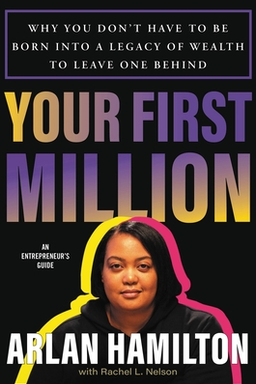
Your First Million cover

Your First Million

by Arlan Hamilton

Your First Million by Arlan Hamilton reveals the importance of multiple income streams for financial resilience. It empowers readers to achieve financial independence by leveraging their skills and passions, making wealth accessible to all, regardless of background.

The Audacity to Build Your First Million

Have you ever looked at someone successful and wondered, “Why not me?” In Your First Million, Arlan Hamilton challenges you to ask exactly that—and then take action to make the answer a resounding yes. This is not a get-rich-quick manual; it’s a manifesto for underestimated dreamers, builders, and innovators who want to claim their rightful space in the world of wealth creation. Hamilton, who went from homelessness to becoming a leading venture capitalist, argues that every person can create their first million—not just in dollars, but in impact, influence, and ownership.

Her central claim is bold: underestimated people—women, people of color, LGBTQ+ folks, and others excluded from traditional power structures—can shape the future of business if they cultivate audacity, ownership, collaboration, and impact. This book offers a roadmap for transforming personal circumstance into generational change through entrepreneurship and self-belief.

Audacity, Ownership, and Catalyzation

Hamilton’s framework unfolds across five major themes. Part One explores what she calls “The Audacity of You”—the courage to believe radically in your own worth when the world doesn’t. This begins with shuffling the deck, rejecting scarcity, and understanding that failure is part of the process. Part Two dives into ownership, the backbone of wealth creation: owning the wealth you build, your finances, your company, your profits, and your expertise. Hamilton emphasizes that control—not cash—is the true measure of freedom.

Part Three, “Many Mini Empires,” shows how collaboration multiplies success. You can’t do it alone, she warns, but you can build networks and teams where power circulates instead of concentrates. This section advocates for distributed success: creating a thousand millionaires rather than one billionaire, and transforming your relationships into catalysts for change.

Redefining Success and Creating Impact

In Part Four, Hamilton redefines success. She pushes against the Silicon Valley obsession with unicorns—a billion-dollar valuation—and opts for impact over hype. Her concept of success isn’t about comparison or FOMO (fear of missing out); it’s about building something that uplifts others and sustains the community around you. Finally, in Part Five, “Catalyzing,” she turns wealth into motion: investing in impact, giving power to others, and designing new systems for equity. Her idea of catalyzation anticipates a chain reaction—empower one person so they empower another, creating a ripple effect of economic justice.

Why This Matters Now

Hamilton wrote Your First Million in a world still reeling from pandemic upheaval and systemic inequity. Black-owned businesses were hit hardest by COVID-19, while corporate wealth surged. Hamilton’s message is a direct counterpoint: if underestimated communities learn ownership and cooperation, they can rewrite the power narrative. Her argument ties economics to liberation, declaring that wealth is not just a financial tool—it’s a social weapon for fairness and visibility.

“We inherited this world. The only fair thing to do now is to claim our share of it.”

Through that declaration, Hamilton reframes money as agency. She sees entrepreneurship as citizenship, and self-belief as revolution.

Preview of What You’ll Learn

Across the coming ideas, you’ll discover how radical self-belief breaks impostor syndrome, why expertise isn’t defined by degrees, and how authentic collaboration creates equitable empires. You’ll learn practical lessons about managing finances, choosing investors wisely, and generating income streams that align with your values. Finally, you’ll see how Hamilton’s approach to catalyzation—investing in others, redistributing opportunity, and redefining success—can transform not only your first million but the world it touches.

Ultimately, Hamilton’s argument is bigger than business: she wants readers to imagine a world where power and profit are shared, not hoarded; where underestimated voices lead industries; and where success becomes a communal act of creation. This book is both playbook and rallying cry for anyone ready to stop asking for permission and start building their empire.


Radical Self-Belief as a Superpower

At the heart of Arlan Hamilton’s philosophy is one idea: You must believe in yourself more fiercely than anyone else ever will. Radical self-belief isn’t just optimism—it’s armor. She developed it not in boardrooms but while sleeping on the floor of airports, pitching investors who didn’t believe she belonged in the room. Self-belief, she explains, is what sustained her from homelessness to running Backstage Capital and investing in more than two hundred underestimated founders.

Escaping the Scarcity Mindset

Radical self-belief begins by rejecting the scarcity narrative—the notion that there’s only room for one successful person from any given background. In her words, “We must stop believing there can be only one.” For those raised on limited examples of success, Hamilton pushes for entitlement, not modesty. She argues that it’s okay, even necessary, to claim wealth and respect unapologetically. Her approach echoes the confidence championed by Shonda Rhimes and Michelle Obama, both of whom reframed ambition as duty rather than arrogance.

From Impostor Syndrome to Audacity

Hamilton describes impostor syndrome as systemic—a mirror held up by those who underestimate you. When someone assumes you don’t belong, the antidote isn’t proving them wrong but proving yourself right. She recounts declaring in 2015 that she would invest in one hundred companies founded by women, people of color, or LGBTQ+ founders by 2020. People laughed; two years ahead of schedule, she did it. Radical self-belief isn’t fantasy—it’s a plan written as if it’s already real.

The Audacity of Knowing Your Worth

Hamilton insists that underestimated people undervalue themselves financially and emotionally. “Whatever you’re being paid, it’s not enough,” she declares. Her tone is part mentorship, part revolution. By believing in your capacity beyond current compensation, you begin to act in ways that invite opportunity. As Vice President Kamala Harris famously said, “I’m speaking”—a quote Hamilton embraces as emblematic of taking up space unapologetically.

“Entitlement isn’t arrogance when it’s earned through survival.”

Hamilton celebrates the idea of seeing more entitled Black women in business—those who demand attention not as exceptions but as norms.

Acting Despite Doubt

Radical belief doesn’t erase fear—it reframes it. When Hamilton walked into rooms of venture capitalists with no college degree or tech pedigree, she reminded herself that nobody present was smarter than her, only luckier. Like authors Carol Dweck (Mindset) or Brené Brown (Daring Greatly), she treats mindset as strategy—something that can be trained. Belief becomes muscle memory through action, each brave choice reinforcing the next.

The takeaway? Radical self-belief is contagious. When you demonstrate confidence publicly, you normalize it for others. Hamilton’s voice is not modest because modesty never made history. By owning your narrative and expecting success, you invite possibility into rooms where it was previously unwelcome—and you begin to dismantle the structures that said you shouldn’t be there at all.


Everyone’s an Expert in Something

Hamilton’s next lesson dismantles a gatekeeping myth: expertise doesn’t require a degree. “Your life is your education,” she writes, reminding readers that resilience, survival, and resourcefulness teach better than business school. She herself learned finance through budgeting $5 for Taco Bell dinners while planning a multimillion-dollar venture firm.

Reframing Poverty as Literacy

Hamilton flips the conventional script on poverty. People living with scarcity, she argues, are often the most financially literate because they track every penny. “Being poor is incredibly expensive,” she reminds, because credit systems punish poverty with higher fees and interest rates. Those life experiences make you financially sharp, not ignorant. If you can manage a household while juggling bills, loans, and groceries, you can manage a business.

Experience as Qualification

From working in a pizza shop at fifteen to leading Backstage Capital, Hamilton’s lesson is simple: every role teaches transferable skills. Time management from hourly jobs becomes discipline for entrepreneurship. Conflict resolution from customer service becomes leadership currency. She compares real-world skill-building to the entrepreneurial philosophy found in The Lean Startup by Eric Ries—success is about iteration and adaptation, not certifications.

“Everyone’s an expert in something—and expertise is valuable currency.”

Turning Experience into Entrepreneurship

You become an expert by identifying pain points in your own world and solving them. Founders like Melissa Hanna (Mahmee) turned personal frustrations about maternal health into profitable innovation. Hamilton urges readers to start where they are—listen to their communities, observe everyday struggles, and treat lived experience as market research. Because underestimated people intimately understand problems that traditional power ignores, their innovations often create deeper social change.

In essence, Hamilton encourages you to stop waiting for external validation and begin monetizing what you already know. Whether you’re a master logistician from parenting or a social connector from community organizing, your perspective is both unique and valuable. Expertise, in her world, is not handed down—it’s built from living fully and paying attention.


Owning Money and the Wealth You Create

Hamilton insists that true wealth begins with ownership. After decades below the poverty line, she learned that money is just a tool—it doesn’t own you. Part Two of her book explores reclaiming financial power by managing money intentionally, diversifying income, and building assets that generate autonomy.

From Survival to Stewardship

Her journey through food stamps and homelessness fuels one central insight: control over money is psychological before it’s financial. When she first raised $50,000 from her first investor, Susan Kimberlin, Hamilton pledged never to be hungry again—and began treating every dollar as strategy. Following Dr. Pamela Jolly’s idea that “people with generational wealth own things and cooperate,” Hamilton calls for underestimated people to build legacies, not just transactions.

Diversifying Income Streams

Drawing from real experience, Hamilton lists her seven income streams: managing Backstage Capital, book publishing, ROI from investments, speaking engagements, media deals, online courses, and consulting. The message is clear—you must be CEO of your own finances. Like Robert Kiyosaki (Rich Dad Poor Dad), she advocates seeing money as a workforce you control rather than a paycheck you chase. Each stream makes you less vulnerable to crisis, more self-sufficient, and better able to help others.

Ownership as Liberation

Owning your company protects your vision and your profits. Hamilton teaches the mechanics of equity—how fundraising dilutes ownership—and warns that taking too much outside capital can cost control. Bootstrapping, she argues, provides creative freedom and moral clarity: “Money makes you powerful, but ownership makes you free.” Entrepreneurs like Casey Kelley (Blended Designs) prove her point, building multimillion-dollar companies rooted in representation while holding majority equity.

Hamilton reframes financial mastery as activism. Every dollar you manage well becomes a vote for independence. Owning your wealth, your company, and your expertise means rewriting the rules that kept wealth exclusive. It’s a movement from hustling for survival to strategizing for sovereignty—a shift that begins the moment you decide money will work for you, not the other way around.


Many Mini Empires and the Power of Collaboration

No one is self-made, Hamilton declares. Every empire is built through collaboration. Her concept of “Many Mini Empires” envisions a future where underestimated entrepreneurs form networks that replace monopoly with community wealth. Collaboration isn’t weakness—it’s the ultimate growth hack.

Creating Winners Everywhere

Hamilton wants to inspire a thousand millionaires instead of one billionaire. That vision manifested in Backstage Accelerator, which opened hubs in Los Angeles, Philadelphia, London, and Detroit. She intentionally distributed opportunity geographically to counter Silicon Valley elitism. In her vision, success decentralizes; power moves closer to the people historically locked out. (This parallels Rutger Bregman’s Utopia for Realists, which imagines systemic redesign for equality.)

Smart Matchmaking and Team Building

Collaboration thrives when you choose the right partners. Hamilton shares cautionary tales of early investors who bulldozed her vision, and she contrasts that with nourishing partnerships like Natasha Case of Coolhaus, whose creative brand alliances prove synergy multiplies reach. Whether you’re partnering with a corporation or building a small team, equality and shared values matter more than large sums of money.

Networking as Capital

Hamilton teaches that your network—built through curiosity, authenticity, and generosity—is real currency. Mark Cuban invested $6 million in her fund not because of her wealth but because, as he said, “You’re in rooms I’ll never be in.” Relationships open impossible doors. Networking horizontally—among peers—often yields faster advancement than chasing vertical connections with power brokers. Every authentic interaction compounds over time like interest on social capital.

“Collaboration isn’t giving up control—it’s multiplying power.”

By building your own table and pulling up chairs for others, you transform individual wins into collective victory. Each mini empire—each entrepreneur empowered, each network formed—becomes part of a larger revolution toward equitable wealth distribution. For Hamilton, collaboration isn’t the opposite of ambition; it’s how ambition evolves into legacy.


Redefining Success: Impact Over Unicorns

Hamilton dismantles Silicon Valley’s obsession with unicorns—start-ups valued at over $1 billion—and replaces it with a new measure: impact. Success, she argues, isn’t measured in market caps but in how deeply your work changes lives. “Money is the tool,” she writes. “Success is the action it enables.”

From Comparison to Contribution

She warns against chasing status symbols or comparing yourself to influencers flaunting wealth online. In her experience, real satisfaction comes from doing meaningful work sustainably. Instead of chasing unicorn fantasies, build steady six- or seven-figure enterprises that enrich communities and endure. This philosophy aligns with authors like Cal Newport (So Good They Can’t Ignore You), who emphasize mastery and purpose over popularity.

Ditching FOMO

Fear of missing out, Hamilton explains, is the enemy of focus. Every industry has its VIP rooms and hidden circles, but prestige without purpose is hollow. She recounts being left off early magazine covers celebrating influential investors, yet she refused resentment—her time came later, when she landed the cover of Fast Company as the first Black woman non-celebrity to do so. Success comes when it’s earned, not envied.

Shared Success

For Hamilton, success is communal. Through companies like Partake Foods (founded by Denise Woodard), she shows how shared success helps entire communities thrive. Partake partners with nonprofits and educates consumers on food equity, proving that inclusive capitalism works. Hamilton’s refrain: “Success is meant to be shared.” Helping others climb isn’t charity—it’s sustainability.

“True success isn’t a headline—it’s a ripple effect.”

In redefining success, Hamilton makes business personal again. When your work lifts others, creates equitable access, and catalyzes change, you build more than capital; you build legacy. The millionaire she wants you to become isn’t a statistic—it’s a catalyst whose wealth moves like energy, changing everything it touches.


Catalyzing Change: Invest, Empower, and Educate

The final stage of Hamilton’s roadmap is catalyzation—the transformation of success into a chain reaction of empowerment. Her aim isn’t simply to make money but to use it to fuel generational change: investing in impact, giving power to others, and creating opportunities for learning that multiply far beyond her reach.

Investing in Impact

In 2021, Hamilton pioneered crowdfunding within venture capital through Backstage Crowd, a platform that allowed everyday investors to co-own companies previously accessible only to millionaires. By raising $5 million in seven days from over six thousand small investors, she proved that democratized finance is possible. Her premise: money should empower communities, not gatekeepers. Every participant becomes an investor in change.

Giving Power to Others

Hamilton’s partnership with Mark Cuban exemplifies this philosophy. Cuban’s $6 million investment wasn’t charity—it was trust. He allowed her to invest it freely, proving what happens when powerful men share influence instead of hoarding it. Empowerment is contagious; Hamilton then extended opportunities to Serena Williams, who co-invested in Mahmee, further bridging wealth and justice. Power grows through redistribution, not retention.

Catalyzing Learning

Education ensures change lasts. Hamilton established scholarships at Oxford University and Dillard University, funded aspiring pilots and activists, and launched Arlan’s Academy to teach entrepreneurship skills. Her apprenticeships even came with small stakes in Backstage Capital, proving that education can literally build equity. Like Muhammad Yunus’s model of microfinance, her approach makes learning a tool of inclusion, not privilege.

“Sometimes the seed doesn’t see the petal—but plant the garden anyway.”

To catalyze is to spark others so they can shine too. Whether through financial investment, mentorship, or simply visibility, Hamilton turns her own success into fuel for the next generation. Her closing challenge is audacious yet simple: help create one thousand new millionaires who reflect the diversity of America. If we do, she says, “wealth won’t just be a privilege—it will be proof of possibility.”

Dig Deeper

Get personalized prompts to apply these lessons to your life and deepen your understanding.

Go Deeper

Get the Full Experience

Download Insight Books for AI-powered reflections, quizzes, and more.