
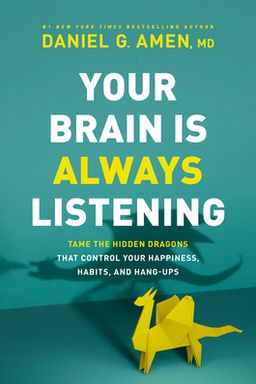
Your Brain Is Always Listening cover

Your Brain Is Always Listening

by Daniel G Amen

In ''Your Brain Is Always Listening,'' Dr. Daniel G. Amen explores the hidden forces within our brains that affect our happiness and behaviors. This insightful guide offers actionable steps to recognize and tame these internal dragons, fostering a life filled with greater joy and mental well-being.

Your Brain Is Always Listening: How Hidden Dragons Shape Your Life

Have you ever wondered why certain fears, habits, or emotional reactions seem to control you no matter how much willpower you summon? In Your Brain Is Always Listening, Dr. Daniel Amen argues that these invisible forces—what he calls “dragons”—continuously whisper to your brain, influencing how you think, feel, and act. Drawing from over 40 years of neuroscientific research and more than 175,000 brain scans, Amen contends that most emotional suffering is not simply mental illness but the manifestation of an untrained, biologically influenced brain that keeps listening to old fears and negative patterns.

Dr. Amen uses vivid metaphors to make brain science personal and accessible. Each dragon represents a type of experience, trauma, or thought pattern that lives in your neurochemistry and shapes your daily decisions. Just as fantasy heroes must tame dragons before claiming peace, you too must confront—and befriend— your mental dragons to restore happiness, focus, and resilience. These dragons include those from the past (like abandonment or trauma), those belonging to others (like parents or partners), the thought-fueling ANTs—Automatic Negative Thoughts—that infest your mind, and societal schemers pushing habits that hijack your brain.

Why This Matters Now

Amen frames his book in the context of crisis—the global COVID-19 pandemic, social unrest, and collective anxiety of recent years. His introduction begins with real stories, such as his conversation with entertainer Miley Cyrus who experienced heightened anxiety during the pandemic, and his own grief over losing his father to COVID-19. These challenges make clear that under stress, our brains awaken the hidden dragons of fear, anxiety, judgment, and loss. By using the techniques he calls “dragon taming,” readers can restore their emotional health rather than being ruled by instinctive responses or inherited pain.

A Brain-Based Model for Emotional Healing

At the heart of Amen’s work is the idea that there is no separation between mind and brain. Emotions are not intangible feelings floating in space—they are rooted in specific neural networks that respond to triggers from our environment and history. Amen introduces readers to the six major brain systems, including the prefrontal cortex (responsible for judgment and self-control), amygdala (fear detection), hippocampus (memory and mood), and basal ganglia (habit formation). When these systems are out of balance, our dragons roar louder.

You learn to think of your brain as a symphony of biological, psychological, social, and spiritual influences. What you eat, how you sleep, the relationships you maintain, and your sense of purpose all interact to determine which dragons you awaken. Amen’s framework, called the Four Circles of Health—biological, psychological, social, and spiritual—reminds you that true wellbeing involves every layer of your existence. (Interestingly, this holistic model parallels perspectives from functional medicine and mindfulness-based therapies.)

The Dragons That Rule Your Mind

Throughout the book, Amen expands his dragon metaphor into seven families of influences: (1) Dragons from the Past, (2) They, Them, and Other Dragons (how other people’s issues affect you), (3) Thought-Fueling Dragons (the ANTs), (4) Bad Habit Dragons, (5) Scheming Dragons (advertisers and cultural forces), (6) Addicted Dragons, and (7) the Dragon Tamer (the part of your brain that must regain control). Each chapter offers brain-based tools and affirmations to calm specific dragons—like anxious breathing techniques, the REACH method of forgiveness, or the habit-breaking system of tracking triggers and rewards.

One of Amen’s key lessons is that awareness is the antidote. When you become aware of which dragon is breathing fire on you, you gain the power to calm it. Instead of suppressing emotion, you learn to listen to what your brain is trying to tell you through anxiety, anger, or guilt. Using brain imaging case studies, Amen illustrates how trauma, head injury, or toxic substances alter blood flow patterns that correspond to distinct emotional challenges—a physical view of what psychology calls the subconscious.

The Promise of Dragon Taming

Amen’s vision is profoundly hopeful. By combining neuroscience with compassion and practical habit change, he reframes emotional suffering as a solvable brain health issue, not a moral or personal failure. The practical tools you’ll find in this book—breathing patterns, forgiveness practices, diet optimization, and eliminating “ANT” thinking—are designed not only to heal anxiety or depression but to awaken a more awakened, disciplined mind. He concludes that when you share these tools with your community, you create ripple effects of resilience, turning people into “dragon tamers” who reinforce each other’s peace.

In essence, Dr. Amen’s message is both scientific and spiritual: your brain is always listening to every thought, memory, and emotional echo. But if you train your attention and nourish your brain properly, you can redirect what it hears—and in doing so, transform what you experience as reality. The dragons will always whisper. The question is: will you listen, or will you tame them?


Taming the Dragons from the Past

Your past is not dead—it lives inside your brain as electricity and memory, shaping how you react to today’s challenges. Dr. Amen identifies thirteen primary “Dragons from the Past,” each born from distinct forms of childhood experience: abandonment, shame, anger, fear, trauma, and more. These dragons breathe emotional fire when something in your present resembles an old hurt. Instead of ignoring or denying their power, Amen teaches you to name them, learn their triggers, and then retrain your brain’s response.

The Thirteen Dragons

Some of the most common include the Abandoned, Invisible, or Insignificant Dragon (born from neglect or not feeling seen), the Anxious Dragon (born from unpredictability or danger), and the Should and Shaming Dragon (fueled by guilt and perfectionism). Each one leaves a neural footprint in the emotional centers of the brain—particularly in the amygdala and temporal lobes. For example, growing up with a critical parent may literally prime your limbic system to overfire at signs of disapproval.

Amen models empathy by sharing his own dragons: as a middle child in a large Lebanese family, he often felt invisible and unwanted. Rather than repressing those feelings, he used them as motivation to achieve significance and serve others—a demonstration of how dragons, once understood, can drive meaning instead of misery.

Practical Tools for Healing

Each dragon chapter concludes with a series of brain-based interventions. These include journaling exercises like the “Break the Bonds of the Past” timeline (recalling when your feelings first formed), rewriting narratives through adult reasoning, and practicing daily affirmations such as “I am safe” or “I am significant.” Amen also cites neuroscience-supported methods like EMDR (Eye Movement Desensitization and Reprocessing), which can calm overactive limbic circuits after trauma, and narrative exposure therapy, which balances memory by mixing grief with gratitude.

Dr. Amen parallels principles shared by trauma experts such as Bessel van der Kolk in The Body Keeps the Score: you cannot think your way out of trauma—you must soothe the body and brain that remember it. Whether through structured breathing, hypnosis, or gentle mindfulness, the goal is to rebalance your nervous system and teach your emotional brain that the danger has passed.

Why It Matters

Recognizing which dragon from the past is influencing you today transforms self-blame into curiosity. Instead of seeing anxiety or anger as defects, you begin to see them as signals—your brain communicating an old story. By taming these dragons, you break cycles of inherited pain and create new neural pathways for compassion. As Amen writes, “Your history is not your destiny.” When you soothe the dragons, their fire fuels your purpose rather than destroys it.


Taming Automatic Negative Thoughts (ANTs)

If dragons are your emotions, ANTs are their food. Dr. Amen coined the term Automatic Negative Thoughts in the early 1990s to describe the mental pests that infest your mind—recurring, distorted thoughts that trigger negative emotions. Using cognitive-behavioral principles blended with neuroscience, he shows how to swat these ANTs before they multiply and paralyze you.

The Nine ANT Species

  • All-or-Nothing ANTs: seeing everything as total success or failure.
  • Less-Than ANTs: comparing yourself negatively to others.
  • Just-the-Bad ANTs: filtering out anything positive.
  • Guilt-Beating ANTs: “should,” “must,” and “ought” thinking.
  • Labeling ANTs: calling yourself or others names.
  • Fortune-Telling ANTs: predicting disaster without evidence.
  • Mind-Reading ANTs: assuming you know others’ motives.
  • If-Only/I’ll-Be-Happy-When ANTs: regretting the past or delaying joy.
  • Blaming ANTs: refusing responsibility by assigning guilt elsewhere.

Each one feeds different dragons—All-or-Nothing ANTs fuel Judgmental Dragons, Less-Than ANTs feed feelings of inferiority, and Fortune-Telling ANTs inflame anxiety. Left unchallenged, they cascade through your brain’s emotional centers, especially the amygdala, reinforcing the same electrical grooves of fear and guilt.

The Five Questions That Kill ANTs

Borrowing from Byron Katie’s philosophy of “The Work,” Amen teaches five questions to disinfect a thought: Is it true? Is it absolutely true? How do I feel when I believe it? How would I feel if I couldn’t think this thought? What’s the opposite, and could that be truer? Repeating this process literally rewires your brain to favor accurate, calm thinking rather than reactionary panic.

From Cognitive Control to Compassion

By externalizing ANTs rather than identifying with them, you strengthen your “Dragon Tamer” in the prefrontal cortex. Patients like Jimmy, the anxious executive introduced earlier, learned that after tracking his ANTs each day and responding to them with reason, his brain scans showed calmer limbic activity. You can think of this as emotional strength training: each time you question an ANT, your PFC gets a workout.

The ANT process transforms cognitive behavioral therapy into a daily spiritual practice. It’s not about blind positive thinking—it’s about truthful thinking. Over time, your inner voice changes from enemy to ally, and you stop feeding the dragons that keep you stuck.


Breaking Bad Habit Dragons

We all have automatic behaviors that sabotage our best intentions—saying yes when we want to rest, arguing reflexively, procrastinating, overeating. Dr. Amen calls these Bad Habit Dragons and locates them in the brain’s basal ganglia, the neural seat of automation. His point: habits aren’t moral failings; they’re circuits that can either serve or enslave you.

The 10 Common Dragons

Amen lists ten habits that hijack happiness—from the “Saying Yes When You Should Say No” dragon (driven by anxiety and approval-seeking) to the “Let’s Have a Problem” dragon (conflict-seeking when bored). Each is maintained by specific triggers and short-term rewards. The key is not punishment but understanding: your brain loves predictability. By identifying the cue, routine, and reward, you can rewrite the habit loop.

The Five-Step Habit Rewiring Plan

  • Identify and track the habit for 30 days.
  • Decode triggers (time, place, emotion, social context).
  • Analyze rewards—what need does it meet?
  • Replace it with a healthier behavior that provides the same reward.
  • Reinforce with conscious repetition and accountability.

He advises using the mantra “Only love behaviors that love you back.” For instance, saying no to alcohol or bread in a restaurant becomes easier when you remember that these substances lower prefrontal cortex blood flow—the opposite of love for your brain. By turning one healthy choice into a cornerstone habit, you can replace dozens of unhealthy ones through positive momentum (similar to James Clear’s Atomic Habits practice of “habit stacking”).

From Discipline to Identity

Habit change, Amen insists, is not about superhuman discipline but identity training: you must believe you’re a person who does the healthy thing automatically. When you pair that belief with an optimized brain—balanced sleep, nutrition, and oxygenation—you turn effort into effortless action. The brain learns by repetition, and over time every “no” to a bad habit strengthens your Dragon Tamer’s control over the fire.


Outfoxing Society’s Scheming Dragons

Even if you tame your personal dragons, there’s an entire world of predatory influences surrounding you. Amen labels these the Scheming Dragons—powerful cultural and corporate forces that exploit your biology for profit. Food companies engineer sugar addictions, tech giants design devices for dopamine overuse, and media outlets flood you with fear to keep you watching. Recognizing these manipulative ecosystems, he argues, is essential for mental sovereignty in the digital age.

Five Modern Scheming Dragons

  • Food Pushers: Junk food marketers who exploit brain chemistry using sugar-fat “bliss point” science.
  • Substance and Toxin Pushers: Alcohol, marijuana, and consumer toxin industries masquerading as wellness.
  • Digital Dragons: The news, social media, streaming, and gaming companies that monetize your attention and addiction.
  • Contact Sports and Holiday Dragons: Cultural rituals that glamorize injury or overconsumption as normal bonding.

Amen blends humor and neuroscience to expose how these dragons “hack” your basal ganglia and reward system. For example, variable rewards on social media mirror casino slot-machine design. Processed-food chemists calibrate salt, sugar, and fat to drive insulin spikes that mimic cocaine hits. These are not accidents—they’re engineered addictions.

Regaining Control

To outfox the schemers, Amen prescribes media fasting, conscious consumerism, and the repeated question: “Is this good for my brain or bad for it?” These habits activate your prefrontal cortex before you succumb. He also suggests nurturing positive dopamine sources—exercise, laughter, sunlight, gratitude—to drip rather than dump pleasure chemicals. This subtle shift keeps your brain’s reward system balanced and resilient rather than overworked and anxious.

Ultimately, taming societal dragons is moral as much as mental: by choosing to think and buy consciously, you deny toxic systems their fuel. Amen’s vision extends from self-care to civic mindfulness—every healthy choice is an act of quiet rebellion against industries that profit from your pain.


Rewriting the Addicted Brain

When Bad Habit and Scheming Dragons rule long enough, they evolve into Addicted Dragons. Amen modernizes and expands the classic 12-step model by applying neuroscience to every stage of recovery. Addiction, he emphasizes, is not a moral flaw but a damaged brain seeking balance through harmful means. Healing begins not in shame but in brain repair.

The 12-Step Brain-Based Recovery

Unlike traditional Alcoholics Anonymous programs, Amen’s revamped framework starts with biology: Step 1—Know what you want. Motivation, not self-loathing, drives sustainable recovery. Later steps include caring for your brain’s chemistry, understanding your brain type through imaging or assessment, identifying cravings, and cultivating forgiveness. Visualization, diet, and targeted supplements replace mere abstinence rituals.

The book follows vivid case studies, such as Jose, a compulsive cheater whose SPECT scans revealed both traumatic brain injury and hyperactivity in impulse-control circuits. Once his physical brain healed through nutrition, sleep, and therapy, his destructive behavior subsided. Amen’s point is unmistakable: you can’t reprogram software on damaged hardware.

Locking Up the Craving Dragons

He details nine evidence-based methods—from stabilizing blood sugar and managing stress to cultivating reward balance and using supplements like N-acetyl-cysteine—to quiet cravings. His notion of “dripping dopamine not dumping it” reframes pleasure as a renewable resource rather than a binge-fueled high. This echoes Anna Lembke’s Dopamine Nation, though Amen roots it in SPECT image data showing how excess pleasure stimuli flatten the brain’s responsiveness.

Recovery ends not with abstinence but with generativity: helping others heal. Step 12—carry the message of brain health—turns sobriety into community transformation. By repairing your brain and sharing the science, you fortify your prefrontal cortex and make relapse less likely. Addiction, he concludes, is simply your brain searching for belonging; teach it to belong to health instead of chaos.


The Dragon Tamer: Strengthening Your Prefrontal Cortex

Every strategy in Amen’s system revolves around empowering your internal guardian—the Dragon Tamer. This is his metaphor for the prefrontal cortex (PFC), the executive of your brain that governs focus, planning, impulse control, and moral judgment. When your PFC is strong, dragons obey. When it’s weak or overactive, chaos reigns.

When the Tamer Sleeps

Low activity in the PFC—caused by sleep deprivation, trauma, poor diet, toxins, or ADHD—removes the brakes on your emotions and impulses. Amen describes patients with weak PFCs as impulsive, disorganized, and easily distracted. Conversely, an overcontrolling PFC leads to obsessive worry and perfectionism—the mind’s handbrake stuck “on.” The goal is balance: calm under pressure, focused yet flexible.

Strengthening Strategies

  • Consistent sleep (7–8 hours) to allow the brain to detoxify.
  • Brain-nourishing diets rich in omega-3s, antioxidants, and clean proteins.
  • Regular exercise and learning new skills to stimulate neuroplasticity.
  • Mindful decision-making using the question, “Does this behavior get me what I want?”

He formalizes this through the One Page Miracle, a goal-setting tool where you list what you want for your relationships, work, finances, and health, and then daily match your behavior against those priorities. This reprograms your PFC to act like the CEO of your life rather than a distracted employee.

The Brain as Moral Compass

Amen ends with an ethical insight: spiritual vitality is not separate from brain health. The more disciplined and nourished your prefrontal cortex, the more love, empathy, and purpose flow through your choices. When your Tamer is awake, life becomes less about fighting dragons and more about guiding them, transforming fear into focus. In that balance lies both peace of mind and moral clarity—a brain that listens wisely instead of impulsively.

Dig Deeper

Get personalized prompts to apply these lessons to your life and deepen your understanding.

Go Deeper

Get the Full Experience

Download Insight Books for AI-powered reflections, quizzes, and more.