
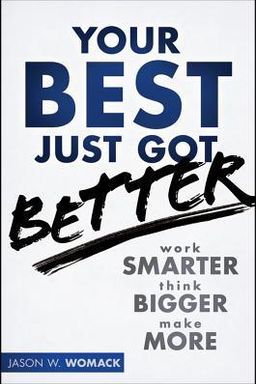
Your Best Just Got Better cover

Your Best Just Got Better

by Jason W Womack

Your Best Just Got Better by Jason W. Womack guides you to work smarter by setting clear goals, eliminating distractions, and valuing your time. Discover how to boost your motivation and productivity, transforming ambition into achievement with actionable strategies.

Making Your Best Even Better

When was the last time you felt truly at your best—focused, productive, and fulfilled in your work and life? In Your Best Just Got Better, workplace performance expert Jason W. Womack asks this deceptively simple question and then shows you how to build a life where your best continually becomes better. Womack argues that most people aren’t struggling because they lack motivation or talent—they struggle because they’ve stopped reflecting on how they work and what they believe is possible. The book’s central claim is that making your best better isn’t about doing more—it’s about working smarter, thinking bigger, and making more in ways that align with your purpose.

Across ten chapters structured into three parts—Work Smarter, Think Bigger, and Make More—Womack builds a roadmap for sustainable performance improvement. He begins by teaching you to identify your own habits and patterns, then moves toward expanding your sense of what’s possible, and finally, he explains how to reinforce your growth through feedback, focus, and practice. The book blends psychology, experiential coaching, productivity techniques, and personal anecdotes to help readers redesign how they approach work and life.

Working Smarter: The Foundation of Personal Effectiveness

Womack’s first section addresses the need to understand your habits. He makes the case that small, repeated actions—rather than grand resolutions—build lasting improvement. Through frameworks like the I.D.E.A. method (Identify, Develop, Experiment, Assess) and the concept of Most Important Things (MITs), he helps you map which behaviors drive results and which merely fill time. The early chapters use stories from his teaching days and coaching experiences to show how self-awareness sparks progress. Womack’s approach recalls David Allen’s Getting Things Done but adds more human psychology and reflection. For instance, he encourages readers to track their “I’m at my best when…” statements to observe patterns of personal energy and focus. This concrete self-inquiry is where working smarter begins.

Thinking Bigger: Expanding Possibility Through Belief and Connection

Once you understand your existing patterns, Womack turns to belief—what psychologists call self-efficacy. Drawing on ideas from Lou Tice at The Pacific Institute and studies of mindset, he argues that believing you can achieve something changes the scope of what you attempt. In his words, “If you think you can, you probably can.” He illustrates this through personal stories: coaching executives who discover hundreds of unfinished ideas by writing them down, or realizing how self-talk shapes performance. This section also dives into how social networks amplify or limit belief. Chapter 5, “If You Want to Go Far, Fast, Go Together,” explains how to build Team You—a network of mentors, colleagues, and friends who challenge and support your growth. Womack compares this to Jim Collins’s principle in Good to Great: start with the right “who” before the “what.” Your connections reflect and magnify your mindset.

Making More: Reinforcing Growth Through Reflection, Practice, and Focus

The final part moves from belief to application. “Make More” isn’t about money alone—it includes making more time, clarity, confidence, and impact. Womack explores how feedback, focus, and deliberate practice transform temporary improvement into sustained excellence. He invites you to reflect at the end of each day using questions like, “What did I do really well today?” and “What can I improve tomorrow?” He teaches Directed Thinking, or focusing on what you want to happen instead of worrying over what might fail. In vivid examples, he shows how professionals waste time battling distractions—from blinking smartphone alerts to endless meetings—and offers techniques like countdown timers and focus-to-finish sessions that reclaim attention.

Why It Matters

Beyond productivity hacks, Your Best Just Got Better is a philosophy of improvement grounded in clarity and purpose. Womack insists that everything begins with your “So That…” statement—a personalized definition of purpose that connects what you do to why you do it. It’s both compass and boundary, guiding decisions and protecting focus. The book’s stories—whether racing triathlons, coaching executives, or writing thank-you notes—serve as reminders that small daily practices anchor big transformations. In essence, this book argues that life and work improve through intentional reflection, supported connections, and practiced focus. You don’t need more hours; you need to better use the 1% of each day that matters most.


Work Smarter Through Self-Awareness

Jason Womack begins with the foundation of all improvement: knowing yourself. It’s not about fixing weaknesses but about identifying patterns that either elevate or drain your productivity. He introduces the I.D.E.A. framework—Identify, Develop, Experiment, Assess—a cycle designed to create continuous personal iteration. This process builds small, sustainable habits that compound over time, echoing James Clear’s later arguments in Atomic Habits.

Identify: See What You Think

The first step is observation. You learn to identify patterns by studying yourself—how you start your mornings, how interruptions affect you, when you have energy peaks and dips. Womack’s exercise “I’m at my best when…” helps you define specific conditions that produce excellence. Examples include “I’m at my best when I eat breakfast,” or “I’m at my best when I arrive on time.” He urges you to post these statements where you'll see them daily.

Develop: Create Support Systems

After identifying patterns, develop strategies that support them. This means creating lists of Most Important Things (MITs)—your true priorities—and limiting each day to four. For Womack, clarity beats busyness. He recounts coaching sessions with executives overloaded with hundreds of commitments. Once they reduced focus to four daily MITs, stress and incompletion diminished. He compares this disciplined simplification to martial arts training: it’s about mastery through repetition. Each MIT becomes a daily anchor that links intention to action.

Experiment: Test Small Changes

Every improvement begins as an experiment. Womack asks readers to try small behavioral changes for five days—a micro-habit window long enough to feel cause and effect. Whether adjusting arrival times, minimizing meetings, or journaling nightly reflections, you gain insight through experimentation. The key isn’t perfection; it’s curiosity.

Assess: Reflect and Refine

Finally, assess the value of your effort. Ask Womack’s favorite question: “Is it worth it?” This self-audit drives long-term progress. His coaching mantra—“I study this stuff so you don’t have to”—reminds readers that awareness accelerates growth. By repeating these four steps, you transform productivity from a reactionary scramble into deliberate personal design. Working smarter isn’t about clock management; it’s learning to manage yourself.


Pacing and Sustainable Improvement

What happens when you move too fast? Womack argues that modern professionals burn out because they confuse speed with progress. In Chapter 2, ‘Improvement and Pacing,’ he uses his experience as a triathlete to show how sustainable improvement requires rhythm, rest, and deliberate adjustment. “Slow down to speed up,” he writes—the paradoxical rule that true productivity depends on pacing.

The Athlete’s Metaphor

Through stories of training for Ironman competitions, Womack illustrates the danger of sprinting through long-term goals. When he started too fast in a triathlon, he hit the wall halfway through; pacing taught him that endurance wins races. Applied to work, pacing means defining sustainable routines rather than reactionary bursts. This analogy echoes George Leonard’s Mastery: consistent practice beats constant intensity.

Inventory and Reflection

Womack proposes three inventories to examine life rhythm: (1) what you do by 10 a.m., (2) the tools you use daily, and (3) how you rest and rejuvenate. Writing these lists reveals inefficiencies and unconscious habits, from checking email in bed to working late to compensate for lost focus. Once you see your routines visually, you can prune or delegate activities that waste time. This clarifies not only how you spend time but why.

Sustainability Beats Urgency

Womack distinguishes between busyness and business. Most professionals manage crises rather than priorities, mistaking motion for advancement. To fix this, he recommends choosing just four MITs each day and reviewing them nightly—a ritual that builds momentum without exhaustion. This discipline mirrors Cal Newport’s Deep Work philosophy: depth requires limits.

By linking physical pacing with mental performance, Womack reframes productivity as an endurance sport. The goal isn’t doing everything—it’s finishing strong. Once you adopt steady rhythms that balance energy and recovery, your best naturally begins to get better.


Time as Your Most Limited Resource

In Chapter 3, Womack tackles time management—but not as schedules and calendars. Instead, he presents time as a finite energy container, 1,440 minutes or 96 fifteen-minute segments per day. His approach shifts attention from controlling the clock to choosing how to use your time blocks consciously. “If you’re waiting until you have time to decide what you’ll do when you have time, you’ll always run behind,” he warns.

The 1% Rule

Every fifteen-minute window equals one percent of your day. Womack recounts a story of waiting for a client named Annya, who arrived late for a meeting. Instead of frustrated idleness, he used those fifteen minutes to book trips, reply to emails, and draft an article idea—transforming passive waiting into productive creation. This mindset reminds you that moments of delay are gifts, not burdens.

ABR: Always Be Ready

Preparedness is critical. Womack’s ABR philosophy means bringing small chunks of meaningful work wherever you go. That way, if someone’s late or a meeting is delayed, you can make progress instead of scrolling mindlessly. He recommends prelisting “twenty to thirty things you can do in fifteen minutes”—quick, high-value actions that accumulate into major outcomes.

Beyond the Clock

Time management for Womack also includes managing context, homeostasis, and networks. Context means designing environments that encourage focus; homeostasis refers to breaking habitual comfort zones; and networks highlight the influence of relationships on how you spend time. He reminds readers that working faster isn’t lasting success—it’s aligning time with meaning. This reimagines the clock as opportunity, echoing Peter Drucker’s concept of self-management: effectiveness begins with awareness of time.

Managing time becomes an act of mindfulness. Treat your fifteen-minute blocks as powerful microcosms where focus, readiness, and attention create momentum. Master the minutes, and the hours take care of themselves.


The Power of Self-Efficacy and Thinking Bigger

“If you think you can, you probably can.” With this mantra, Jason Womack connects belief to behavior. Chapter 4 explores self-efficacy—the conviction in your ability to produce desired results. Inspired by psychologist Albert Bandura and coach Lou Tice, Womack reveals how your internal narrative shapes your external reality. Your success depends on how you think about what’s possible.

Efficacy in Action

Womack illustrates self-efficacy through stories of clients overwhelmed by mental clutter. One executive wrote five hundred items on paper—everything occupying her mind. Seeing that physical pile clarified why she was stressed. Efficacious thinkers organize chaos and choose focus over fragmentation. They engage optimistically with goals, believing progress is attainable.

Four Confidence Statements

Womack proposes four self-talk anchors: “I did it before,” “They were able to do it,” “They think I can do it,” and “I know I can do it.” Each activates a different source of confidence—past experience, social proof, external belief, and internal conviction. Repeating these daily shifts your mindset from doubt to determination. (Note: This parallels Carol Dweck’s Mindset, where growth orientation replaces static potential.)

Thinking Without Acting

Modern productivity demands the ability to think deeply without reacting instantly. Womack argues that acting too quickly can derail focus; instead, smart professionals must separate deliberate thought from impulsive action. He calls this “deep thinking”—the precursor to vision. Only those who trust their mental capacity to plan before executing can truly think bigger.

By naming thought trails and reframing self-talk, you expand capacity to dream and perform. Womack’s concept of “biggify” isn’t about exaggeration but about activating belief as a tool for consistent growth. Once you think you can, action follows naturally.


Purpose and the 'So That...' Statement

In Chapter 7, Womack introduces one of his most transformative tools: the ‘So That…’ statement. Where many people create abstract mission statements, he insists on practical purpose: linking every action to its consequence and meaning. The phrase “I do X so that Y” anchors intention to outcome, turning daily work into purpose-driven motion.

Defining Your Why

Womack’s own revelation came during breakfast at the South By Southwest Conference when asked, “Why do you do what you do?” His answer—“because I am joyful when I feel the sense of completion”—became his lifelong purpose. This moment taught him that purpose isn’t ambition; it’s clarity of completion. Linking why to what ensures direction and coherence.

Creating Your Inventory of MITs

Understanding purpose also means defining your MITs—those Most Important Things that align with your “So That…” Each day, Womack chooses no more than four areas to engage deeply. This constraint forces intentional focus. He asks readers to stretch beyond ten items to uncover unseen commitments—family, health, learning, or creativity—and connect them explicitly to “so that” reasons.

Boundaries and Freedom

Interestingly, Womack argues that boundaries create freedom. Using Parkinson’s Law—work expands to fill the time available—he encourages setting start and end times, then gradually shrinking them to focus effort. Boundaries protect purpose from busyness. When your actions clearly serve “so that…” outcomes, you stop saying yes to distractions and start advancing meaningful goals.

Purpose eliminates noise. Once you define your “So That…,” you can make confident decisions, replace guilt with direction, and reengage with daily life at full focus. Every project becomes part of a larger why.


Feedback, Focus, and the Pursuit of Mastery

In the final section, Womack turns improvement into mastery. Chapters 8 to 10 emphasize feedback, focus, and deliberate practice—three reinforcing pillars of sustainable growth. Progress depends not on doing more but on refining how you learn and respond to information.

Feedback: Asking, Receiving, Applying

Feedback, he explains, transforms success into learning. Using anecdotes—from a Spanish class observer who told him “You’re a great teacher, but you lose time because you can’t find what you need when you need it”—Womack shows how external perception exposes blind spots. Formal and informal feedback loops (reviews, thank-you notes, post-meeting reflections) become catalysts for iterative improvement. “If I know, I can grow,” he states simply.

Focus: Protecting Attention from Distraction

Focus, the resource that shapes all others, is fragile. Womack deconstructs everyday interruptions—visual clutter, blinking lights, multitasking—and teaches focus-to-finish thinking: doing one thing at a time to completion. He recommends scheduling short, uninterrupted creative sprints, often timed for 15 minutes. This minimalist concentration mirrors research in Mihaly Csikszentmihalyi’s Flow.

Practice: Five-Day Experiments

Finally, practice. Womack closes by redefining mastery: “Practice doesn’t make perfect—it makes comfortable.” He asks you to experiment with one behavior for five days—writing thank-you cards, saying no, or showing up early—to observe its impact. Comfort, not perfection, is progress. Like George Leonard’s Mastery, repetition and reflection turn new actions into habits.

Iterative Growth

By pairing focus with feedback and practice, Womack offers a formula for lifelong learning: Think. Do. Review. Repeat. Improvement is iterative—a continuous cycle of awareness, experiment, and adjustment. When practiced with intention, your best inevitably becomes better.

Dig Deeper

Get personalized prompts to apply these lessons to your life and deepen your understanding.

Go Deeper

Get the Full Experience

Download Insight Books for AI-powered reflections, quizzes, and more.