
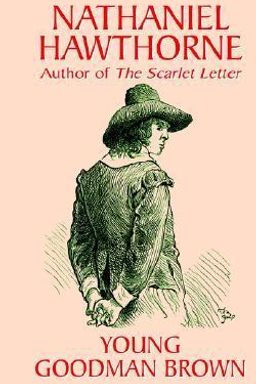
Young Goodman Brown cover

Young Goodman Brown

by Nathaniel Hawthorne

Nathaniel Hawthorne''s ''Young Goodman Brown'' is a gripping short story that delves into witchcraft, sin, and temptation, offering a scathing critique of early American society. Through the allegorical journey of Goodman Brown, Hawthorne exposes the hypocrisy and hidden evils within a seemingly pious community, challenging readers to reflect on human nature and morality.

The Fragile Nature of Faith and Human Morality

Have you ever wondered how well you really know the people around you—your family, friends, even your spiritual leaders? Nathaniel Hawthorne’s Young Goodman Brown poses this unsettling question at the heart of a story that asks whether faith can survive the discovery of universal hypocrisy. The tale follows a young Puritan named Goodman Brown who embarks on a nighttime journey into the dark woods of seventeenth-century Salem, only to find that evil pervades every corner of his world—including the hearts of those he believed most virtuous.

Hawthorne’s central argument is that human goodness is fragile and easily shattered by suspicion. Beneath the surface of piety and moral conviction, he suggests, lies a latent darkness—a capacity for sin that society and religion often fail to eradicate. The story’s genius lies in its ambiguity: was Brown’s encounter with the devil and the witch-meeting real, or just a dream? Hawthorne refuses to tell us. Either way, the psychological impact is the same: Goodman Brown’s faith in humanity dies forever.

Faith as Personal and Spiritual Anchor

The story opens on a seemingly harmless domestic scene—Brown kissing his wife, Faith, goodbye at sunset. Yet even this name, Faith, operates as powerful symbolism. Brown’s departure from her represents not just physical separation, but spiritual and moral departure. He leaves behind his innocence and step by step descends into temptation. As he journeys deeper into the forest, his surroundings grow darker, reflecting the moral confusion enveloping his mind. The forest, an age-old symbol in literature for the unknown and subconscious (as seen in Dante’s Inferno and even Robert Frost’s Birches), becomes a stage on which Goodman Brown’s beliefs are tested.

The Devil as Mirror of Humanity

When Brown meets a mysterious traveler—perhaps the devil himself—the encounter destabilizes his sense of moral certainty. The traveler resembles Brown physically, suggesting that evil is not foreign but deeply human; it shares our likeness. His serpentine staff evokes biblical imagery, recalling the serpent in Eden who introduced doubt and self-knowledge. As the traveler reminds Brown of his ancestors’ violent deeds—whipping Quaker women, burning Indian villages—Hawthorne reminds us that even the founders of Puritan virtue carried sin in their hearts. Through this, the author dismantles the myth of inherited righteousness. (Comparatively, Herman Melville in Billy Budd and Arthur Miller in The Crucible use similar historical backdrops to reveal moral corruption beneath religious zeal.)

Vision and Disillusionment

The deeper Brown ventures into the woods, the more he sees—whether in vision or dream—respected townsfolk performing acts that contradict their piety. The catechism teacher, Goody Cloyse, whom Brown once trusted for religious instruction, greets the devil familiarly. Even the town minister and deacon appear on their way to a blasphemous ceremony. When Brown believes he hears his wife’s voice among the damned and sees her pink ribbon fall from the sky, he becomes convinced that goodness itself has vanished from the world. “My Faith is gone!” he cries, collapsing both spiritually and emotionally.

At the devil’s gathering, Brown and Faith stand before a flaming altar, about to be baptized into sin. But Hawthorne leaves the climax suspended—Brown calls upon heaven, and suddenly the scene dissolves. Was the ritual real, or was it the fevered vision of a man’s internal struggle? That ambiguity is the soul of the story. Because whether or not evil truly triumphs, Brown believes it does—and that belief alone destroys him.

The Aftermath: From Faith to Despair

When Brown returns to Salem the next morning, he is forever changed. Every face looks corrupted; every act of religion seems like hypocrisy. He cannot listen to psalms or accept blessings. Most tragically, he cannot love his wife. His heart has become a desolate Puritan wilderness—a moral forest from which he never emerges. Hawthorne’s conclusion underscores the psychological realness of guilt and distrust, themes echoed in his later works like The Scarlet Letter and The Minister’s Black Veil. Once the seed of doubt is planted, moral certainty dies. In modern terms, Goodman Brown experiences what psychologists would call cognitive dissonance—the inability to reconcile ideals with perceived reality.

Why It Matters Today

Hawthorne’s 1835 allegory still resonates because we, too, live in a world where idealism clashes with moral complexity. Like Goodman Brown, we may strive to hold faith in humanity but falter when faced with corruption in institutions, leaders, or even ourselves. The story challenges you to ask: can you keep believing in goodness when you see its failure everywhere? Or does that very disappointment destroy the illusion of virtue? Hawthorne’s answer is bleak but truthful—faith must coexist with the knowledge of imperfection, or it cannot survive at all.


The Symbolism of the Journey into the Forest

At its surface, Young Goodman Brown’s walk into the forest is a simple errand, but symbolically it's an inward journey—a descent into the unconscious and into spiritual testing. The forest functions as Hawthorne’s metaphoric stage for moral uncertainty, representing both temptation and revelation. In Puritan culture, the wilderness stood for the chaotic realm outside divine order; to enter it meant facing inner corruption.

The Forest as Moral Wilderness

The landscape mirrors Brown’s internal transformation. At sunset, he crosses from light to dark—from reason to shadow. The narrow path he travels becomes a symbol of moral rigidity slipping into confusion. As trees close around him, every rustle seems to hide unseen eyes, hinting that evil might lurk everywhere. Hawthorne uses the forest not as a physical space but as an allegorical embodiment of doubt. (In Dante’s Divine Comedy, the lost ‘dark wood’ serves a similar function: a metaphor for spiritual uncertainty.)

Meeting the Double

The stranger waiting by the tree—dressed respectably, almost fatherly—is Brown’s mirror. His serpent staff that appears alive suggests deception itself has vitality. By walking beside him, Brown symbolically walks with his own shadow self. The traveler’s calm persuasion blurs moral boundaries: he implies that sin pervades everyone, even Brown's family line. When Brown recoils from his companion’s laughter, we see his faith beginning to fracture. The journey thus becomes less about travel and more about self-recognition—the moment when moral certainty meets moral reality.

Dream, Reality, and Perception

Hawthorne blurs the boundaries of waking and dreaming throughout the walk. Each encounter—Goody Cloyse’s revelation, the voices from the clouds—could be supernatural or psychological. This fluidity captures the human experience of moral conflict: when beliefs collapse, reality itself feels unstable. Brown's inability to distinguish evil's external presence from his imagination suggests that spiritual crisis originates within. You realize that the forest is not just outside him; it is inside him.

Emerging but Never Returning

Although Brown physically exits the forest, he never escapes it psychologically. Once faith is tested and fails, the moral wilderness persists within. His walk home mirrors his descent—each familiar face now distorted by suspicion. The journey completes a tragic circle: from innocence to knowledge, from unity to alienation. Hawthorne’s use of journey symbolism thus transforms a simple narrative into a moral allegory on human fallibility: the deeper we explore doubt, the harder it becomes to return to unquestioning belief.


Faith and the Loss of Innocence

Faith, Goodman Brown’s wife, functions as far more than a character; she is the embodiment of spiritual purity and trust. Her pink ribbons are perhaps the most enduring image in American literature—a fragile ornament representing innocence, hope, and moral simplicity. When Goodman Brown enters the forest, he effectively leaves his Faith behind in every sense of the word.

Faith as Symbol of Redemption

Throughout the story, Faith is portrayed as gentle, loving, and devout—an angelic figure contrasted with the corruption Goodman Brown later sees. Her plea for him to stay home foreshadows the coming moral fall. In rejecting her request, Brown rejects safety and divine grace. The pink ribbon that falls from the sky midway through the tale signifies the death of innocence. When he cries, “My Faith is gone,” it’s both literal and metaphoric—his wife may have succumbed to sin, and his belief in goodness dissolves entirely.

The Psychological Collapse

Once doubt is introduced, Brown’s psychology unravels. Faith’s potential corruption amplifies a universal fear: that the purest love may be tainted. Hawthorne uses this shock to illustrate the fragility of idealism. Brown’s mind projects universal guilt; even Faith’s joy on his return cannot heal his alienation. His distrust poisons not just his marriage but his view of all humanity. (In comparison, Tolstoy’s Kreutzer Sonata or Ibsen’s Ghosts explore similar disillusionment with purity and virtue.)

Loss of Faith as Moral Blindness

The tragedy is not simply that Brown learns sin exists, but that he loses the ability to see goodness. Hawthorne suggests that moral awareness without compassion leads only to despair. Brown becomes spiritually blind—he cannot discern grace from hypocrisy, so he condemns both. Faith, in contrast, continues to live and pray, embodying resilience. The story’s ending—Brown’s bleak, joyless burial—serves as moral warning against letting doubt eclipse empathy. For you as reader, this theme underscores the personal cost of cynicism: when belief dies, every relationship withers.


Hypocrisy and Collective Sin in Puritan Society

Throughout Young Goodman Brown, Hawthorne uses Puritan Salem as a microcosm of moral hypocrisy. The community prides itself on holiness, yet its representatives—minister, deacon, catechism teacher—appear at the devil’s ceremony. The implication is stark: moral systems founded on repression often hide the very sin they denounce.

The Salem Backdrop

Hawthorne’s choice of Salem, his own ancestral town, invokes real historical guilt. His forebears presided over witch trials, condemning innocents in the name of God. By setting his tale there, Hawthorne interrogates inherited sin—the idea that society condemns evil even while perpetuating it. The devil’s claim that he helped Brown’s grandfather and father in acts of cruelty brings history full circle: the pious lineage itself is corrupt.

The Ceremony of Sin

The midnight gathering dramatizes communal guilt. Here saints and sinners mingle unashamedly; the fiery altar becomes a grotesque parody of church worship. Hawthorne shows the collapse of categories—Puritan holiness and pagan wickedness merge into one distorted image of humanity. This moment, rich in allegory, reflects what modern psychology calls projection: people demonize others to avoid seeing their own flaws.

Moral Judgment and Alienation

When Goodman Brown witnesses the hypocrisy of his elders, he recoils so completely that he isolates himself from all human connection. Hawthorne uses this to critique the Puritan obsession with moral purity—it breeds paranoia instead of virtue. In this sense, the story predicts later American moral crises, from witch hunts to ideological purges. The collective sin of Salem becomes the seed of personal despair, showing how moral absolutism turns believers against their own community. For the reader, this is a cautionary mirror: judgment without humility leads inevitably to spiritual isolation.


Ambiguity and the Psychology of Evil

One of Hawthorne’s greatest achievements is his deliberate ambiguity—he never tells us if Goodman Brown’s experience was real or imagined. This uncertainty transforms the story into a psychological allegory: perhaps the devil is not a figure in the woods but a manifestation of Brown’s own moral anxiety.

Dream or Reality?

The transition from the devil’s ceremony to morning light feels dreamlike—the forest dissolves, the rock is cold, dew replaces fire. This suggests Brown’s ‘vision’ could be a nightmare of his conscience. Yet Hawthorne makes sure the dream feels real enough to change him. It doesn’t matter if it occurred physically; psychologically, its impact is irreversible. This technique blurs Gothic and moral realism—evil exists not just in deeds but in belief.

Fear of Inner Corruption

Brown’s horror lies not only in others’ sin but in his own identification with them. The devil’s resemblance to him and references to his ancestors hint that evil is familial, even innate. Hawthorne thus anticipates modern concepts of the unconscious: we reject in others what we fear in ourselves. The story’s ambiguity forces you to face this question—if you saw everyone’s flaws nakedly, how would you endure them? Brown cannot; hence his collapse.

The Moral of Uncertainty

Ambiguity makes truth subjective. Hawthorne’s reader, like Brown, must live with doubt—a hallmark of existential literature later echoed by writers like Kafka and Conrad. Evil becomes not an external force but a perception that changes reality. The line between spiritual insight and madness blurs. Ultimately, Hawthorne implies that awareness of sin, without corresponding faith or forgiveness, overwhelms the mind. To know evil without love is to live, like Goodman Brown, in perpetual night.


The Tragic Transformation of Goodman Brown

Goodman Brown’s journey begins as an act of curiosity and ends as a lifelong curse. Hawthorne’s narrative arc mirrors classical tragedy: the protagonist’s discovery destroys him. His descent into despair demonstrates the cost of uncompromising moral idealism.

From Innocence to Alienation

At the story’s start, Brown is a newlywed, joyful and devout, symbolizing childlike spiritual confidence. By the end, he has aged prematurely into cynicism. His inability to process disillusionment mirrors the downfall of tragic heroes—Oedipus discovering his guilt, Hamlet realizing universal corruption. Brown’s moral rigidity leaves him unequipped for ambiguity; once the illusion breaks, he cannot rebuild trust.

The Lonely Death

In the forest, Brown resists the final act of sin by invoking heaven—but the damage is done. Upon return, his distrust infects all social and familial bonds. His wife’s joyful greeting only deepens his bitterness. He cannot love or pray; his life becomes mechanical and joyless. The gravestone inscription—void of hope—marks the triumph of despair. Hawthorne’s closing image reflects not punishment for sin, but punishment for disbelief in redemption.

Moral Reflection

Hawthorne’s tragic vision warns that self-righteousness can be as destructive as sin itself. Brown’s fall comes not from wickedness but from his inability to coexist with imperfection. To live humanly, the story argues, one must accept duality—the coexistence of virtue and vice. Without it, faith becomes brittle, and guilt becomes absolute. This moral paradox turns Young Goodman Brown into an enduring study of human frailty and spiritual isolation.

Dig Deeper

Get personalized prompts to apply these lessons to your life and deepen your understanding.

Go Deeper

Get the Full Experience

Download Insight Books for AI-powered reflections, quizzes, and more.