
Idea 1
Believing Is Seeing: The Power of Inner Transformation
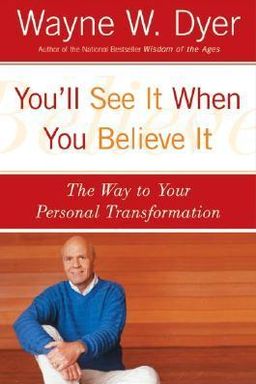
What if the entire world you experience is being created not from what you see, but from what you believe? Wayne Dyer’s You’ll See It When You Believe It begins with this profound reversal of the common phrase—we don’t see to believe, we believe to see. Dyer argues that every person’s life mirrors their inner thoughts and convictions: if you believe in scarcity, struggle, and limitation, that’s what your life delivers; if you believe in abundance, harmony, and divine possibility, the universe rearranges itself to confirm those beliefs.
The core claim of the book is that personal transformation happens when you identify yourself as a spiritual being having a human experience—not the other way around. You are not a body carrying a soul; you are a soul temporarily inhabiting a body. Once you live from this vantage point, your thoughts become creative forces, and life ceases to feel random or limited. “You’ll see it when you believe it,” Dyer explains, isn’t a slogan but a metaphysical law.
From the Physical to the Spiritual Perspective
Dyer opens with a concrete image: you can’t drink the word “water.” Concepts and words are only pointers; life’s truth must be experienced. In the same way, his book is not merely about changing vocabulary—it’s a manual for direct experience of personal transformation. The fundamental shift he calls for is moving from identifying with your physical form to recognizing the invisible intelligence that animates all form.
This invisible dimension, what he variously names “higher consciousness” or “life force,” directs every atom, heartbeat, and solar orbit. To tune in to it, you must stretch past conventional thinking—past the “I’ll believe it when I see it” attitude—and embrace the paradoxical realm where belief precedes vision. The paradox is crucial, because in a universe of dualities (light/dark, north/south, form/formless), awakening occurs by reconciling opposites rather than choosing sides.
Transformation Through Belief and Forgiveness
Dyer illustrates this transformation through his own life. The book’s emotional centerpiece is his 1974 visit to his estranged father’s grave. Having lived for decades filled with hatred for a man he never met, Dyer experiences an unexpected wave of forgiveness that permanently alters his consciousness. Standing by the grave, he whispers, “I send you love.” That moment of surrender leads to what he calls his awakening—a cascade of synchronicities, creative breakthroughs, and success, including the seamless writing and publication of Your Erroneous Zones. The lesson is clear: forgiveness dissolves resistance and restores the flow of divine energy through the self.
This act embodies one of Dyer’s recurring insights—that spiritual laws operate independently of belief, like the laws of digestion or gravity. You can’t stop them, only align with or resist them. When you forgive, you align yourself with the universe’s nonjudgmental intelligence. In Dyer’s words, “The universe does not forgive because it does not blame.” To embody this insight is to move from blame and scarcity to responsibility and abundance.
The Architecture of Transformation
The book unfolds like a staircase from ordinary consciousness to awakened living. Each principle builds upon the last:
- Transformation – Realizing you are divine energy beyond form
- Thought – Understanding how images and beliefs create life’s external reality
- Oneness – Letting go of separateness and feeling yourself part of the “one song” of existence
- Abundance – Shifting from scarcity consciousness to gratitude and expansion
- Detachment – Releasing the need to control or possess people and outcomes
- Synchronicity – Trusting the invisible intelligence that perfectly arranges events
- Forgiveness – Letting go of judgment so love can flow freely through you
Each of these chapters offers practical exercises—such as imagining standing behind your physical form, visualizing abundance, meditating on light, or practicing “observer consciousness”—to bridge the invisible and visible worlds. The outcome, he promises, is not perfection of your outer life but liberation of your inner one.
Why These Ideas Matter
Dyer’s argument matters because it replaces external striving with internal knowing. In a culture obsessed with appearances, possessions, and competition, his message flips the script: you already are what you seek. Abundance isn’t accumulated; it’s attuned. Happiness isn’t achieved; it’s allowed. Forgiveness isn’t an exception; it’s the natural state of a mind free from judgment. The book invites you to stop chasing transformation and instead surrender to it—to realize that, as Dyer writes, “You’ll see it when you believe it.”
In the pages that follow, Dyer maps out what such belief looks like in practice: living as a formless, flowing consciousness that cooperates with, rather than competes against, the perfection already built into the universe. It’s a radical invitation to inner freedom—a call to live from the inside out rather than the outside in.