
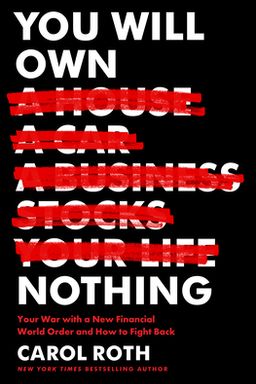
You Will Own Nothing cover

You Will Own Nothing

by Carol Roth

In ''You Will Own Nothing,'' Carol Roth delves into a potential future dominated by global elites, exploring the implications of digital currencies and social credit systems. Discover actionable strategies to secure your assets and autonomy, ensuring you remain in control of your destiny in an evolving world.

The War on Ownership and Financial Freedom

You are living through what Carol Roth calls World War F—a coordinated attack on ownership, privacy, and individual financial independence. This conflict doesn’t pit nations against one another but individuals against powerful networks of government, global institutions, and corporate interests that aim to centralize control. Roth argues that ownership—of assets, ideas, and property—is the foundation of both freedom and wealth. Without it, you cannot preserve autonomy or secure your future.

In this book, you learn how economic policy, technology, and ideology combine to erode ownership opportunities. Roth connects crises—pandemic-era interventions, social-credit scoring, ESG investing, and digital currencies—into a single roadmap for power consolidation. The fight isn’t about left versus right but citizens versus systems.

Three Forces of Control

Roth identifies three converging adversaries: governments (and their allied central banks), global elites (WEF, IMF, major financial institutions), and Big Tech. Each plays a distinct role. Governments set fiscal and monetary conditions that devalue currency and increase dependency. Elites use policy frameworks like ESG and global agreements to steer capital toward compliant actors. Big Tech enforces social conformity through data ownership, digital identity, and speech policing. Together, these forces shift you from an owner society to a renter society.

Ownership: The Source of True Wealth

Every major path to prosperity—real estate, business equity, stocks, patents, or intellectual property—requires ownership. The book highlights how elites have manipulated the housing market, education debt, and equity access to push you into permanent dependency. The provocative WEF slogan “You’ll own nothing and you’ll be happy” becomes, in Roth’s reasoning, a declaration of intent. The economic and technological architecture now being built ensures more renting, licensing, and subscription-based living, diminishing opportunities for ordinary wealth creation.

Crises as Tools of Transfer

The COVID-era policies exposed the playbook. Trillions in fiscal and monetary stimulus inflated asset prices, benefiting Wall Street and large tech firms while eroding purchasing power for savers and small business owners. As Roth notes, seven mega-tech companies gained around $3.4 trillion in market value in 2020 alone, while Main Street collapsed. These “emergency” measures accelerated the separation between those with access to capital markets and those who only hold cash or wages.

Technocracy Meets Financial Engineering

As technology and finance intertwine, power consolidates. When Big Tech firms function like shadow governments—setting communication boundaries, running digital payments, and defining identity standards—regulatory capture replaces democratic accountability. Roth emphasizes that “terms of service have become the new law,” a sign that ownership rights and civic freedoms are being rewritten through code and policy combined.

A Path Toward Resistance

Roth closes this opening message with both a warning and a strategy: you must rebuild your control over what you can own—whether that is physical assets, small businesses, data sovereignty, or financial literacy. The counterrevolution requires awareness of how debt cycles, digital infrastructure, and ideological capture work together. This book’s subsequent chapters uncover each weapon in this quiet war—debt, currency debasement, digital surveillance, ESG scoring, and more—then show you how to fight back by restoring ownership, privacy, and economic independence.


Debt and the Decline of Empires

Roth places the modern financial crisis within historical cycles of empire. Every great power—Dutch, British, American—has relied on debt and the privilege of a reserve currency to project influence. Over time, that privilege leads to overextension. The Dutch lost theirs to military competition; Britain’s pound gave way to the dollar through war and debt; now the dollar faces the same test.

From Gold to Fiat

At Bretton Woods in 1944, the U.S. made the dollar the world’s anchor by promising convertibility to gold. Economists like Robert Triffin warned that maintaining global liquidity required running deficits—the “Triffin Dilemma.” When President Nixon ended convertibility in 1971, the dollar became fiat, backed only by governmental trust. The subsequent “petrodollar” deal with Saudi Arabia kept the system afloat by ensuring that global oil trade remained dollar-based.

Sanctions and Dollar Weaponization

The U.S. decision in 2022 to freeze Russian central-bank reserves after its invasion of Ukraine marked a fracture point. If the world’s reserve asset can be frozen by political decree, global trust erodes. Roth points out this shift as a warning: the dollar’s dominance as a “neutral” store of value is fading, and rival systems—gold, commodities, or alternative currencies—will emerge as hedges.

Personal Consequences

For everyday citizens, these shifts manifest as inflation, higher borrowing costs, and declining living standards. As governments pile on unfunded liabilities, they lean on central banks to print more, diluting purchasing power. When faith collapses, monetary authorities often seek new tools—like Central Bank Digital Currencies—to reset control. Roth’s lesson is timeless: watch how empires treat debt, because citizens always end up paying the final bill.


The Shrinking Dollar

The erosion of money’s value is the thread that ties fiscal irresponsibility to personal hardship. Roth compares modern monetary debasement with ancient Rome’s denarius, which lost nearly all its silver content by the third century. The principle remains unchanged: governments devalue currency when spending exceeds production, stealing quietly from savers.

The Mechanics of Debasement

Money functions as a measuring device for value. When policymakers manipulate it, contracts and expectations break. The Federal Reserve’s post-2008 and pandemic-era actions—zero interest rates, trillions in quantitative easing—pumped liquidity into markets, distorted prices, and widened inequality. By 2022 the Fed’s balance sheet had reached almost $9 trillion, while real wages fell behind inflation that peaked above 9%.

Winners and Losers

Those closest to the money source—banks, large corporations, and connected financial players—benefited first and most. Meanwhile, savers, retirees, and wage earners lost purchasing power. Roth emphasizes the revolving door between Wall Street and Washington as proof that “policy capture” ensures the same architects of crisis profit from its remedies. Wealth becomes privilege institutionalized through insider networks.

Protecting Yourself

Roth’s practical message: recognize that a million-dollar balance sheet means little if the dollars buy less each year. True protection comes from owning assets that appreciate with inflation—land, productive businesses, and scarce commodities. She stresses diversification and understanding monetary cycles, because when currencies shrink, ownership of real assets is the only reliable defense.


Social Credit and Digital Control

What begins as social validation can evolve into full-blown surveillance. Roth traces how reputational scoring systems, inspired by China’s Social Credit System (SoCS), are seeding globally. In China, data from facial recognition, financial transactions, and online behaviors determines whether citizens can travel, get loans, or even access services. Protesters in Zhengzhou found their COVID health codes flipped red to block movement—an early form of algorithmic punishment.

From Likes to Locks

Public shaming, cancel culture, and corporate virtue signaling have normalized social evaluation outside legal processes. When digital identity projects (like ID2020) link identity, payments, and social data, reputation becomes currency. Roth warns that once payment and identity are unified, “non‑compliance becomes materially expensive.” The integration of government pressure and corporate enforcement—whether through content moderation or frozen crowdfunding accounts—duplicates SoCS outcomes under democratic veneers.

Global Migration of the Model

In the West, health passes, disinformation boards, and ESG ratings serve as friendly façades for similar mechanisms. Systems like New York’s Excelsior Pass Plus or payment blacklisting during Canada’s Freedom Convoy show how swiftly private and public powers can coordinate to restrict access. Social approval morphs into digital permission.

Guarding Your Autonomy

Roth’s message: resist normalization. Protect your privacy, diversify social and financial accounts, and build offline communities. Demand legal limits on corporate data use and prompt transparency whenever governments outsource censorship. Once society accepts social credit as normal, freedom becomes transactional.


CBDCs and Programmable Money

Among all financial innovations, Central Bank Digital Currencies (CBDCs) pose the most direct threat to property rights. Unlike decentralized cryptocurrencies, CBDCs are government‑issued, programmable, and traceable. Roth warns that a retail CBDC effectively eliminates your financial privacy and gives authorities power to control behavior through money design.

Programmability as Control

Each CBDC token can carry rules—restricted merchants, expiration dates, or bonuses for state‑approved behavior. China’s e‑CNY proves feasibility: digital yuan payments can include expiry mechanics or transaction tracing. If combined with digital identity systems, every purchase maps to a central ledger visible and alterable by authorities.

Erosion of Banking and Freedom

Retail CBDCs bypass banks, threatening their existence while leaving you directly accountable to the central bank’s app. The cybersecurity risk—one national ledger vulnerable to hacks—could dwarf any previous systemic threat. More alarming, policy changes could instantly freeze political dissidents’ accounts or enforce social mandates, weaponizing access to basic commerce.

What You Can Do

Roth argues that U.S. citizens must oppose retail CBDCs unless strong legal protections guarantee privacy and convertibility. Preserve cash usage, hold tangible stores of value like gold or real assets, and advocate legislatively for limits separating monetary policy from surveillance. Digital cash without freedom is not progress—it is programmable obedience.


ESG and Corporate Social Credit

Environmental, Social, and Governance (ESG) investing began as an ethical initiative but, Roth contends, has morphed into an ideological scoring system that redirects global capital. By 2020, ESG influenced over $40 trillion in assets. When asset managers like BlackRock, State Street, and Vanguard use fiduciary power to enforce sustainability standards, they effectively function as unelected regulators of the private economy.

A New Kind of Leverage

Larry Fink’s annual letters to CEOs demand climate and social alignment, threatening board votes for non‑compliance. These centralized voting blocs impose their own politics on companies, shifting decision-making from market signals to ideological compliance. Roth likens ESG to corporate social credit—firms are rewarded for conformity and punished for dissent.

The Real‑World Damage

She cites Sri Lanka’s 2022 collapse as a cautionary tale: world‑class ESG ratings didn’t prevent agricultural failure when fertilizer bans crippled production. Similarly, underinvestment in fossil fuels—driven by ESG mandates—helped trigger energy shortages and inflation in the West. Without balanced metrics, ESG becomes an expensive moral signal that distorts incentives and enriches intermediaries.

How to Respond

Demand transparency in ESG metrics, insist on fiduciary duties over politics, and support state‑level resistance to compulsory ESG adoption. As Roth notes, capital allocation should reward productivity, not political approval. ESG can be reformed—but only if investors reclaim their votes and challenge the myth that virtue can be quantified for profit.


Housing and the Erosion of Generational Wealth

Homeownership has long been the cornerstone of American wealth, yet institutional investors and regulatory costs now threaten to turn neighborhoods into rental portfolios. Roth reports that by late 2021, corporations purchased nearly 18% of single‑family homes sold—tens of thousands in a single quarter. Companies like Invitation Homes and Tricon Residential collect steady rents and appreciation that used to enrich families.

Why You’re Being Priced Out

After the 2008 crisis, cheap capital and quantitative easing allowed large funds to outbid individuals with cash offers. Regulatory fees, zoning restrictions, and under‑building (4–5 million missing units) inflated prices beyond wage growth. The result: a shift from an ownership economy to a renter economy, where millions lose access to the single largest wealth‑building asset.

How to Fight Back

Roth advises political and practical steps—support zoning reform to expand supply, oppose tax policies subsidizing institutional landlords, and explore co‑ownership or cooperative models to keep properties local. If you can buy, hold long term. If not, collaborate within communities to prevent entire neighborhoods from becoming corporate fiefdoms. Housing is ground zero in the battle to preserve upward mobility.


Education as Debt Trap

Higher education once promised mobility; now it delivers lifelong debt. With student loans totaling over $1.6 trillion, Roth shows how government-backed lending transformed universities into price‑insensitive monopolies. When private banks ceased underwriting risk in the 2010s, the federal government became both lender and collector, allowing colleges to raise tuition without accountability.

The Predatory Cycle

Easy money inflated costs while bankruptcy protections vanished. Universities expanded non‑instructional staff and built luxury amenities, all financed through taxpayer‑guaranteed loans. Endowments soared—Harvard alone received $179 million in federal grants in 2018. Students like Daniel Tapia, who found his balance growing despite years of payments, personify the trap: education marketed as empowerment but structured as servitude.

Reform and Personal Strategy

Roth demands accountability: reinstate underwriting linked to return on investment, restore bankruptcy rights, and make institutions share default risks. For individuals, she advises keeping debt within 3–5 years’ projected income and demanding transparency on program payoffs before borrowing. Education can still be transformative—if priced by value, not ideology.


The Great Wealth Transfer at Risk

Between now and 2045, an estimated $84 trillion will pass from older to younger generations. Roth calls this transfer the next major battlefield. Governments staring down trillions in unfunded liabilities—Social Security, Medicare, pensions—see private inheritance as a revenue reservoir. Policies like taxing unrealized capital gains or altering estate tax exemptions could amount to legalized confiscation.

Taxing What Isn’t Sold

Proposals to tax unrealized gains mean paying levies on paper value, forcing asset sales from family farms or small businesses that lack liquidity. Roth calls this the “confiscation of the unborn dollar”—a strike at property rights disguised as fairness. If enacted, such reforms would consolidate assets in fewer hands, undermining generational continuity.

Preserving Your Legacy

Plan early: use trusts, gift exemptions, and inter‑vivos transfers while current law allows. But beyond paperwork, push civic engagement to oppose wealth taxes and demand fiscal transparency. Governments must balance their books through responsibility, not by raiding inheritance. The “wealth heist” can only succeed if citizens fail to prepare.


Reclaiming Ownership and Agency

Roth closes with a call to action: freedom depends on what you own and defend. You can’t wait for reform—you must build resilience now. This means clearing bad debt, accumulating tangible assets, and investing in community institutions that protect speech, education, and property rights.

Financial and Legal Safeguards

Own productive assets—homes, small businesses, farmland, or gold. Learn legal structures like trusts to guard family wealth against future taxation. Use litigation and advocacy groups (like Pacific Legal Foundation) to challenge government overreach. Roth underscores precedents such as Knick v. Township that reaffirm property protection.

Community and Civic Defense

Local action matters: run for school boards, support zoning reform, or expose ESG mandates at the municipal level. Collective awareness prevents silent encroachment. As Roth writes, “Ownership is more than having things—it’s having a say.”

Your Role in World War F

World War F is not an event but an environment. You fight it through informed choice, diversified assets, digital restraint, and political engagement. Protect your property, your voice, and your community—and you reclaim the freedom that ownership guarantees.

Dig Deeper

Get personalized prompts to apply these lessons to your life and deepen your understanding.

Go Deeper

Get the Full Experience

Download Insight Books for AI-powered reflections, quizzes, and more.