
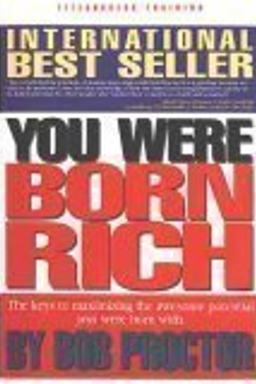
You Were Born Rich cover

You Were Born Rich

by Bob Proctor

Bob Proctor''s ''You Were Born Rich'' reveals the hidden potential within each individual to live abundantly. By transforming inner beliefs and aligning mindset with action, readers can manifest their desires and create the life they dream of. Discover practical strategies for personal and financial growth.

Awakening to Your Inner Wealth

What if everything you’ve ever wanted—money, purpose, freedom—was already within you, waiting to be recognized? In You Were Born Rich, Bob Proctor challenges the idea that wealth must be earned from outside circumstances. Instead, he argues that each person already possesses the mental and spiritual power to become rich in every sense of the word. Proctor’s central thesis is that abundance is not something you acquire; it’s something you awaken. The barrier isn’t lack of opportunity—it’s lack of awareness.

Drawing from the classic success philosophy of Napoleon Hill, Earl Nightingale, and Wallace Wattles, Proctor presents a guide not just to financial prosperity but to a rich state of consciousness. The book weaves together spiritual law, subconscious reprogramming, and practical money management to form a unified “science of success.” As Proctor writes, you are not reaching out for success; you are simply rearranging what already lies within.

The Mental Blueprint of Wealth

Proctor begins by redefining wealth as a mental and spiritual experience. Everyone, he insists, is born with an infinite potential for abundance. Just as a single acorn contains the blueprint of an oak tree, each person contains an inner pattern of wealth—the subconscious “image” of who we believe ourselves to be. The key is to align this internal image with the outer results we desire. Without that alignment, efforts and struggles only reproduce the same limited outcomes. (This echoes Napoleon Hill’s dictum: “Whatever the mind can conceive and believe, it can achieve.”)

Money as Servant, Not Master

In one of the book’s early chapters, “Me and Money,” Proctor dismantles the spiritual guilt many people feel about wealth. Money itself is neutral—neither moral nor immoral. The problem arises when people reverse the proper order: using people and loving money. “Love people and use money,” he urges, “not the other way around.” Money becomes a servant that circulates, multiplies, and empowers when handled correctly. When hoarded out of fear, it stagnates—like Mr. Chapman, the sad old man who died with $100,000 hidden in his house, having never enjoyed its value. Proctor’s point is timeless: prosperity flows; it must circulate.

Changing Your Internal Programming

The journey to abundance begins with changing your subconscious conditioning. Proctor teaches that most people live on auto-pilot patterns implanted by family, culture, and fear. These mental programs dictate earning potential, health, and even self-worth. The only way to change results in the external world is to alter the internal mental script. The book introduces methods of visualization and repetition—core techniques to replace old beliefs with new prosperity consciousness. By imagining yourself already in possession of wealth, your subconscious begins to attract the equivalent conditions and resources into your life.

Spiritual Laws That Govern Prosperity

Throughout the book, Proctor continually anchors his message in spiritual law—the “laws of vibration, attraction, and prosperity.” He explains that just as gravity is universal, so too are the metaphysical principles that connect thought, energy, and matter. When you align your vibration (thought and emotion) with abundance rather than limitation, you activate the Law of Attraction, drawing matching people and circumstances into your orbit. Likewise, when you release old possessions or stale habits, the Vacuum Law of Prosperity guarantees that new energy will rush to fill the void.

Why These Ideas Matter Now

Proctor’s message feels especially relevant in our age of anxiety and scarcity thinking. While modern economies often equate worth with net worth, Proctor flips the equation: prosperity is an inside job. Reading this book becomes less about “getting rich” and more about reawakening the innate creative power that already exists within you. Once you recognize this, financial success becomes only one expression of a deeper spiritual wholeness. In the chapters that follow, you’ll discover how to redefine your relationship with money, design precise goals, use the mind’s image-making faculty, surrender control, expect abundance, align with vibration and attraction, embrace risk and persistence, and finally, create space for new blessings through the Vacuum Law of Prosperity.


Redefining Money and Prosperity

In his opening chapter, “Me and Money,” Bob Proctor challenges the limiting beliefs that keep people poor—not from lack of work, but from misunderstanding the nature of money itself. He begins with the striking tale of eight of the world’s wealthiest financiers in 1923 who all ended in ruin, madness, or suicide. They understood how to earn money but not how to live richly. As Proctor explains, money has a spiritual nature. It mirrors the consciousness of its possessor—servant to some, master to others. The key is learning to relate to it correctly.

Money as Energy in Circulation

Money only has value when it moves. Proctor urges readers to see it like blood in the body: vital when flowing, lifeless when stopped. Through stories like the silver beer stein filled with coins he gives to children, he illustrates that currency must circulate. When hidden or hoarded—like Mr. Chapman’s hoarded fortune—it loses its purpose. Real prosperity means sharing, spending, and channeling money into life-enhancing uses. This concept reflects the principles of Wallace D. Wattles in The Science of Getting Rich, who likewise taught that wealth grows through creative rather than competitive exchange.

Developing a Prosperity Consciousness

Proctor introduces an exercise of visualization to shift our internal frequency about wealth. If you feel awkward talking about money, he says, imagine declaring to friends your intent to become rich—notice the discomfort. That unease reveals your subconscious conflicts around abundance. The remedy is repetition: see yourself already wealthy, relaxed around money, giving and receiving with ease. The subconscious cannot distinguish between the imagined and the real. Therefore, as you mentally experience wealth, you magnetize its physical form.

Fear, Faith, and Focus

“The thing I feared has come upon me,” Job said—and Proctor uses this to warn that fear repels the very prosperity you seek. Worrying about not having enough pushes the desired outcome away. Instead, faith and gratitude keep you aligned with attraction. He encourages trusting your own inner voice more than public opinion, reminding that opinions are the “cheapest commodities on earth.” The wealthy think independently and resist being hypnotized by collective scarcity.

Understanding vs. Memorization

Proctor distinguishes between memorizing motivational slogans and truly understanding principles. Abundance comes not from reading about wealth but from internalizing and applying new thoughts daily. He recommends studying with a companion—sharing thoughts multiplies understanding. The real change happens when you move from rote learning to deep comprehension. As he insists, “No amount of reading will bring success. It is understanding and application that make the difference.”

By the end of this chapter, money stands redefined: it is neither scarce nor sinful but a dynamic flow responding to your mental vibration. You are urged to “love people and use money,” honor circulation over accumulation, and trust that inner conviction will always outproduce outer conformity. This shift sets the foundation for every other idea in Proctor’s philosophy of inner prosperity.


Defining How Much Is Enough

In “How Much Is Enough?”, Proctor moves from philosophy to practicality. He insists that vague wishing—“I want lots of money”—is useless. The subconscious mind cannot act on generalities; it responds only to clear, defined images. The lesson begins with a simple but profound question: how much money do you actually want, and what will it serve? By writing specific targets and reasons, you give form to your desire.

Precision: The Language of the Subconscious

Proctor compares working with the subconscious to instructing a machine: if the input is vague, the output will be random. By calculating the precise lifestyle you want—house, vacation, donations, education—you convert fantasy into blueprint. Then, visualizing yourself already living that life strengthens the internal command. This echoes Earl Nightingale’s famous phrase: “People with goals succeed because they know where they’re going.”

The Babylonian Secret: Pay Yourself First

Drawing from ancient wisdom popularized in The Richest Man in Babylon, Proctor teaches the discipline of paying yourself first. Only 5% of people do it. He urges that at least 10% of all earnings go into a “Financial Independence Account” before paying any bills. This ritual, he claims, begins to rewire your sense of self-worth. You are no longer last in your own financial chain. Over time, this habit compounds into confidence and independence.

Debt, Discipline, and Freedom

For those burdened by debt, Proctor prescribes a systematic plan—setting aside 20% of income for a “Debt Clearance Account.” Rather than anxiety or avoidance, he proposes writing polite but firm letters to creditors explaining the repayment plan. This act of control restores dignity. Every small payment becomes a step toward financial sovereignty. He also reframes a mortgage as an investment rather than a liability, shifting the vibration of fear to gratitude.

Shifting from Deficit to Surplus Thinking

Finally, Proctor categorizes people into three financial states: deficit, break-even, and surplus. Most assume earning more solves money problems, but he notes that habits—not income—determine category. Deficit thinkers overspend regardless of earnings; surplus thinkers automatically save and invest. Discipline, not luck, moves you upward. He closes with an exercise: decide your figure, write it boldly, and visualize yourself living it now. This ritual turns financial imagination into structured creation. You can become wealthy, he insists, not by accident but by design.


The Power of Image-Making

Perhaps no idea defines Bob Proctor more than the concept of the “Image-Maker.” Drawing from Wallace Wattles and generations of metaphysical teachers, Proctor asserts that every result in your life stems from the mental pictures you hold in mind. You are an image-maker—whether consciously or unconsciously—and everything you experience is the physical reflection of those inner movies. Change the image, and you change your life.

Images as the Blueprint of Reality

Every invention, from the first chair to flight and telephones, began as an image. The Wright brothers saw themselves in flight before they ever left the ground. Edison saw a glowing bulb before his filament lit. Likewise, you must “dream your painting, and then paint your dream.” This is how Van Gogh said he worked. Imagination, not memory, is your creative faculty. Memory replays the past; imagination designs the future.

True Stories of Image Power

Proctor fills this chapter with real-life stories. John Kanary, a friend who dreamed of becoming a public speaker, exemplifies the principle. Though fearful and inexperienced, Kanary held an image of himself doing what Proctor did—speaking, teaching, inspiring. Through years of study and persistence, he turned the image into fact and became a respected speaker himself. Another example, insurance executive Paul Hutsey, transformed his district office from 175th to 11th place by visualizing it there first. Instead of being controlled by results, he controlled results through image.

Persistence: The Fuel of Creation

Proctor continually stresses that persistence is the razor’s edge separating dreamers from achievers. He quotes Napoleon Hill: “Persistence is to man what carbon is to steel.” The image attracts opportunities, but persistence keeps you aligned until they manifest. Fear, criticism, and delay are tests of faith. Those who persist convert invisible vision into tangible success.

Acting As If

Proctor advises readers to act like the person they want to become. “Before you can do something,” he quotes Goethe, “you first must be something.” Writing a statement that begins, “I am so happy and grateful now that…” and reading it daily imprints the subconscious. The act of seeing and feeling your goal as already here bridges the gap between desire and realization. In essence, life mirrors your dominant image: if you think rich, act rich, and feel rich, conditions must eventually align with that vibration. That is the creative process of life.


Let Go and Let God

Faith, Proctor teaches, is the invisible force that connects your image to manifestation. The principle “Let Go and Let God” means trusting that the universal intelligence will arrange the how once you have clearly defined the what. Many people, he observes, pray like beggars—wishing for divine intervention—rather than creators partnering with the infinite. True prayer is collaboration with the laws of the universe.

The Spiritual Science Behind Faith

Quoting Mormon scripture—“There is a law irrevocably decreed in heaven…”—Proctor explains that all blessings operate by law, not luck. The same law that governs flight governs prosperity. Understanding this removes superstition from spirituality. Faith is physical in its effects: a mental state that sets vibrational alignment. Clarence Smithison defines it simply: “Faith is the ability to see the invisible and believe the incredible.”

The David and Goliath Parallel

To dramatize faith, Proctor recounts David’s victory over Goliath. The giant relied on weapons; David relied on God. Likewise, you “slay” life’s Goliaths not through force but through inner conviction. Physical effort alone breaks down; faith converts vibration into form. “Letting go,” therefore, is not passivity—it is active trust, an emotional surrender to universal order. When you are aligned, the right people and circumstances move toward you inevitably.

Practical Prayer and Affirmation

Proctor translates spirituality into practice. Speak aloud to yourself affirming identity: “You are a child of God, made for success.” He instructs to declare confidence daily until inner doubt dissolves. Force, he warns, “negates.” Therefore, never try to make things happen through struggle; invite them by obedience to your vision. This chapter turns religious faith into a workable psychology of success—a system of letting spiritual law, not fear, govern outcomes. When you let go, you truly let God work through you.


Expect an Abundance

Expectation, says Proctor, is the bridge between belief and reality. Desire starts motion, but expectation sustains vibration. To expect is to emotionally assume receipt. In contrast, most people wish for prosperity but expect limitation—and life faithfully mirrors their ruling state. Expectation thus becomes a self-fulfilling prophecy, the magnet of circumstance.

Desire + Expectation = Attraction

Revisiting a story of a poor couple discovering electricity, Proctor illustrates that abundance has always been present like current in the wires—it merely awaits connection through awareness. Upgrading expectation is like switching from an 8-candle to a 60-candle bulb: the energy source is the same, the expression greater. When you expect more light, more flows through. A small consciousness cannot hold great wealth.

The Law of Gender and Gestation

All creation, Proctor notes, unfolds through time. Seeds, ideas, and pregnancies all require gestation. Impatience kills manifestation by uprooting the seed too soon. Therefore, once your image is planted, your role is to nurture faith and release anxiety. “As a man thinketh in his heart, so is he.” Repetition of prosperity thoughts replaces doubt, shifting your ruling vibration from scarcity to certainty.

The True Story of Pat and John

Proctor recounts how a couple, Pat and John, applied expectation to manifest their dream home before Christmas. By imagining themselves already living there and expecting provision, they attracted money, timing, and opportunity synchronistically. This isn’t fantasy thinking—it’s vibration aligning with form. Their story mirrors countless others Proctor cites, from inventors to families, proving that inner certainty materializes outer events.

Ultimately, expectation transforms life from random to deliberate. You become co-creator rather than spectator. Whether you seek a promotion, health, or love, you must first expect it “with your heart and soul.” Desire starts the motion; faith sustains it; expectation completes the circuit. What you deeply expect, you will inevitably express.


The Law of Vibration and Attraction

At the heart of Proctor’s philosophy lies the Law of Vibration—the idea that everything in the universe is in constant motion. Nothing rests. Your thoughts are vibrations, and since similar vibrations attract, your dominant mental state magnetizes equivalent external conditions. This is the deeper science behind the popular Law of Attraction.

Understanding Vibration

Drawing on science, Proctor references Dr. Wernher von Braun’s statement that the universe’s precision proves divine law. Every atom vibrates; every person emits frequency. Optimistic people emit high-frequency waves; pessimists radiate low ones. Like tuning forks, you attract minds and events vibrating at the same pitch. This explains why “misery loves company” and why gratitude multiplies good fortune.

Thoughts as Transmission

Your brain is a sending and receiving station of electromagnetic energy. When you focus on an idea, you increase its amplitude, broadcasting that vibration into the ether. Those waves seek resonance. Whatever matches returns as conditions—much like a radio receives only frequencies matching its dial. Thinking of wealth tunes you to opportunities; thinking of lack dials in problems.

Becoming a Mental Magnet

Proctor’s “mental magnet” analogy encapsulates conscious creation. If all energy already exists, your task is alignment, not accumulation. By raising your emotional vibration—through gratitude, love, and enthusiasm—you attract the higher forms of abundance already present in spirit. The “acorn analogy” dramatizes this: within each seed lies a pattern that draws nutrients necessary for its growth. Likewise, your image attracts matching people and resources, no pushing required.

Mastering vibration begins with self-awareness. Monitor how you feel: emotion is your frequency reading. When fear contracts, shift deliberately toward faith. “Everything you are seeking,” Proctor concludes, “is seeking you in return.” By choosing your vibration, you choose your world.


Courage and the Risk-Takers

To live richly, you must take risks. In “The Risk-Takers,” Proctor defines risk not as recklessness but as faith in action—the willingness to step from comfort into potential. The habit of excessive caution, he warns, is spiritual death. Those who avoid all risk still fail; they simply fail safely.

From Fear to Forward Motion

Like the child afraid to jump off the high diving board, adults hesitate to leap into business, creativity, or love for fear of falling. Yet confidence only arrives after the jump. Proctor quotes comedian Flip Wilson: “I fell down and got up for sixteen years.” Risk-takers fail forward—they convert every fall into flight. Success demands that same resilience you had as a child learning to walk.

Responsible Risk vs. Foolishness

Proctor clarifies that risk-taking is not irresponsibility. The professional diver trains; the foolish one dives without preparation. Calculated risk involves faith, preparation, and self-trust. He applies this to investments and entrepreneurship, contrasting impulsive gamblers with thoughtful builders who study, decide, and act despite fear. The goal is courage with awareness.

Leap Stories and Lessons

Proctor recounts stories of entrepreneurs like Bob and Pat McCrary, who left secure jobs to start their own business. Fear was real, but they acted anyway—and built success far surpassing their old stability. Across such stories, the pattern repeats: clarity + decision + persistence. Risk is the channel through which latent potential becomes visible. As Mary Martin sang in the musical South Pacific, “If you don’t have a dream… how are you going to make a dream come true?” Proctor’s answer: take the leap, and the net will appear.


The Razor’s Edge of Persistence

“You are only one idea away from turning your life around,” says Proctor. The “Razor’s Edge” principle asserts that the difference between success and mediocrity is often impossibly thin—one extra call, one more rehearsal, one additional effort when others quit. Winning and losing are separated not by talent but by one inch of persistence.

The Tiny Difference That Multiplies

Proctor illustrates with sports: the Olympic gold medalist in the 100-meter dash crosses the line one-tenth of a second before last place—yet receives 100% of the glory. The same applies in business, art, or relationships. The winner simply does one more thing—one more follow-up, one more study session, one more prayer. Like coach Vince Lombardi’s “second effort,” it’s that repeat thrust that breaks through resistance.

Real Examples of the Edge

Insurance salesman Heinz Daues doubled his record by deciding to maintain his October performance in November rather than relax. Decathlete Milt Campbell won Olympic gold in 1956 because he trained for four more years after settling for silver. These stories embody the philosophy: mastery is persistence beyond momentary success. The razor edge isn’t an extreme act; it’s consistent excellence sustained past comfort.

Personal Growth Through Practice

Proctor urges daily rehearsal like Dr. William DeVries practicing heart surgery mentally before performing it. One hour a day of focused improvement equals nine workweeks a year—enough to make anyone world-class. He reframes habit as the edge between drifting and compounding mastery. Persistence turns ordinary people into legends because faith becomes embodied through routine action. Keep going that one extra step, and the world opens in ways the quitter will never know.


The Vacuum Law of Prosperity

The book ends with one of its most practical spiritual laws: the Vacuum Law of Prosperity. Nature, Proctor explains, abhors a vacuum. To receive new good, you must first create space by releasing the old. Forget chasing accumulation; practice evacuation. This principle applies equally to closets, relationships, and mental habits.

The Story of Aunt Marg

Proctor’s Aunt Marg illustrates the law beautifully. Dissatisfied with her old drapes and furniture, she complained but never changed them. Proctor challenged her: if she truly disliked them, why keep them? Reluctantly, she gave them away—even before having replacements. Soon, new furnishings arrived effortlessly. By clearing what she no longer loved, she created a vacuum that prosperity rushed to fill. Her home, and her life, transformed.

Giving to Receive

Proctor insists this is not superstition but law. The universe cannot fill a space that’s already occupied—whether by clutter, resentment, or fear. He extends the principle to mental life: before new ideas can flourish, old limiting beliefs must be released. Doubt and guilt are “kinks in the hose” restricting divine flow. Removing these blockages allows life’s creative current to move freely again.

Practical Application

Start small: clear your closet of unworn clothes, give away items you dislike, and make way for better ones. Apply the same to goals—let go of past failures, outdated jobs, or toxic patterns. Never sell from scarcity; give freely and expect abundance to return through other channels. “You will never truly enjoy anything you must hold on to,” he writes. The law demands movement, not maintenance. In practicing release, you not only open space in your environment but in your consciousness itself—the final secret to living born rich.

Dig Deeper

Get personalized prompts to apply these lessons to your life and deepen your understanding.

Go Deeper

Get the Full Experience

Download Insight Books for AI-powered reflections, quizzes, and more.