
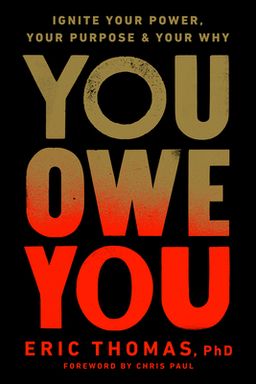
You Owe You cover

You Owe You

by Eric Thomas

Eric Thomas''s ''You Owe You'' challenges you to take responsibility for your life''s trajectory. By identifying your purpose and harnessing your unique talents, this book guides you to achieve unparalleled success and fulfillment in both personal and professional realms.

You Owe You: Awakening the CEO of Your Own Life

Have you ever felt like the world was happening to you—that your circumstances, other people’s expectations, or bad luck were holding you back from living fully? In You Owe You: Ignite Your Power, Your Purpose, and Your Why, motivational speaker Eric Thomas (known globally as ET, the hip-hop preacher) argues that only one person can change your life—you. His core message is radically simple: stop waiting for anyone else to rescue you, validate you, or define your success. You don’t owe the world; you owe yourself. And the moment you take full ownership of that truth, you become the CEO of your own life.

Thomas’s story is gripping and deeply human. Born in Chicago and raised in Detroit, he dropped out of high school, lived on the streets, and felt cheated by life and family. His turning point came when he realized he was not a victim—he had chosen that path. The transformation began when he decided to act as the architect of his own future. What followed was a journey from eating out of trash cans to earning a PhD in education, building a global speaking career, and mentoring professional athletes and corporate leaders.

The Central Claim: Radical Ownership

At the heart of Thomas’s philosophy is personal responsibility. He insists that victimhood is a mindset that steals your power. When you take ownership of your choices, emotions, and outcomes, you change from passive to active. You stop reacting to life and start designing it. The mindset shift—“It’s you versus you”—reframes success as the daily practice of beating your own excuses rather than competing with others.

The Structure of Transformation

Thomas’s roadmap is deliberately practical. He walks readers through ten stages of inner transformation—from discovering personal power to leading a purpose-driven life. Each chapter mirrors a milestone in his own journey. First, he guides you to take ownership, then to build community (“you are never alone”), and to identify your unique gift or superpower. Once you find and channel that power, he teaches you how to link it to your deeper motivation—your why—and to walk in your purpose where your talents meet service to others. From there, you learn to step into “miracle territory,” where preparation meets unexpected opportunity. Later chapters turn purpose into practical mastery—they cover knowledge, sacrifice, entrepreneurship, and self-reliance.

Why It Matters Now

Thomas writes for strivers who feel stuck in good but not great lives. He speaks directly to young people battling self-doubt, underdogs who grew up without privilege, and anyone ready for a change. His language is motivational, but his principles are adaptable far beyond self-help—echoing the classic ideas of thinkers like Viktor Frankl (Man’s Search for Meaning) and M. Scott Peck (The Road Less Traveled), both of whom he cites.

This book’s essence lies in transforming personal pain into power. It bridges the gap between inspiration and skill, showing you how to use your life story as fuel instead of baggage. By defining your why, mastering knowledge, and treating yourself as a business, you align effort with purpose. You stop searching outward and begin focusing inward.

Thomas declares, “Nobody owes you anything, but you owe you everything.” It’s both a warning and a liberation: success, happiness, and peace are DIY projects, built from the inside out.

By the end of You Owe You, you’ll have a blueprint for becoming fully, authentically yourself. You’ll see how to transform setbacks into lessons, align passion with purpose, and create a life that feels driven—not dragged. Thomas’s story proves that when you ignite your power, pursue your purpose, and define your why, you stop surviving and start living. You turn from victim to victor—and you own you.


It’s You Versus You: Becoming the CEO of Your Life

Eric Thomas begins with one brutal truth: nobody is responsible for your success but you. Your parents, teachers, employers, even the government owe you nothing. But you owe yourself everything. He illustrates this belief through his own transformation from angry, homeless teen to world-renowned speaker. The moment he took responsibility for his choices, his entire life changed.

From Victim to Victor

Thomas confesses that as a teenager he chose resentment over resilience. After discovering that his father wasn’t his biological dad, he felt betrayed and left home. For years he blamed others for his pain. He slept in abandoned buildings and dumpster-dived for food. The shift came only when he realized he was choosing his suffering. “Feelings are not facts,” he writes. “You can be angry—but be angry in a warm house, with clean clothes and food.” This awakening led him to get his GED, attend college, and eventually earn a doctorate.

Four Rules for Ownership

  • Own yourself. Hold yourself to the same standards you expect from others. Accountability means treating your life like a business and yourself as its CEO.
  • Own your decisions. Success isn’t about luck—it’s the result of conscious choices. Stop scrolling, get up early, apply for the job, or write the book.
  • Set a standard. Goals are dreams; standards are non-negotiables. Define what “success” means concretely—grades, savings, exercise habits—and stick to it.
  • No excuses. The mind never invents a goal it’s incapable of achieving. Missing a deadline isn’t destiny—it’s discipline.

These principles are echoed by thought leaders like Jocko Willink in Extreme Ownership and Stephen Covey in The 7 Habits of Highly Effective People. Thomas’s spin is rooted in toughness and empathy—he calls his method “grind management,” not time management.

Models of Overcoming

Thomas celebrates his mother, Vernessa Craig, as proof that anyone can rise above circumstances. Assaulted as a child, she became mute, but turned her silence into strength and built a career at the Argonne National Lab. Another mentor is Inky Johnson, a college athlete who lost use of his arm but refused victimhood, turning tragedy into motivational purpose. Both examples show ownership as a universal act of courage.

“When you shed the victim mentality and take ownership, you’re the boss,” Thomas writes. “You are the CEO of your life.”

The lesson? You can’t control everything that happens to you, but you can control how you respond. Every day you choose between victim and victor. When you take responsibility, you take power—and that’s how miracles begin.


Discover Your Superpower

Everyone has a superpower—a natural gift that energizes you, makes time disappear, and feels like flying. Thomas learned this at a Christian summer camp when he discovered his ability to connect and motivate people. The counselors noticed how he united diverse groups and helped homesick kids enjoy themselves. That sensitivity for people became the foundation of his career.

Unchanneled Gifts Become Chaos

Before you recognize your gift, it can cause harm. Thomas’s knack for communication made him class clown and troublemaker. His report cards read “insubordinate” year after year. Unfocused, he sought attention destructively. This is what he calls a “neglected superpower”—raw potential expressed without direction. The cure is awareness and discipline.

Finding and Honing Your Gift

Thomas explains that discovering your superpower requires three actions:

  • Tune out the external world. Stop listening to applause or criticism long enough to discern what excites you internally. Avoid confusing popularity for purpose.
  • Tune in to yourself. What activities make you lose track of time? What energizes you more the longer you do it? Follow that trail—it leads to power.
  • Fall in love with it. Obsession, not casual interest, makes mastery. You must study your craft like Beyoncé practices singing or Steph Curry drills his three-point shot.

He recounts performing his first sermon at Detroit Center Church, molding voice and timing with musical rhythm, drawing inspiration from pastors who infused preaching with urgency and art. That night, hearing people respond to his words, he realized he'd found his calling.

From Gift to Superpower

Finding your gift is only step one—channeling it elevates it to a superpower. Thomas compares it to discovering you can run fast but learning techniques to become an elite sprinter. He shares examples like rapper Tobe Nwigwe, who turned community mentoring into music ministry after guidance from Thomas’s team. Similarly, Inky Johnson transformed athletic loss into motivational speaking. Both fell in love with their gifts and trained them relentlessly.

“You’re the most powerful when you’re the most you,” Thomas insists. Mastering your gift is falling in love with yourself at your highest potential.

When your talent is disciplined by purpose, it stops being random and starts being transformational. Your life, career, and relationships align with that powerful clarity—and that’s how ordinary gifts become world-changing superpowers.


Find Your Why

Thomas says your “why” is the emotional engine that makes your superpower move. It’s the force that wakes you up when you’d rather sleep. Without a why, talent stalls. When you find one, motivation becomes unstoppable.

Love as Purpose

His own why began with love. Dede, his future wife, challenged him at age nineteen: “Do you love me enough to change your life?” That question ignited his transformation. He earned his GED, enrolled at Oakwood University, and committed to building a future with her. Later, his deeper why expanded to include his children, Jalin and Jayda, and his community. Each new layer strengthened his drive.

The Reason Behind the Reason

Your why, he explains, often hides beneath material goals. You might say you want money, status, or accomplishment—but why? The real reason could be freedom, love, legacy, or healing. Thomas calls this “the reason behind the reason.” (This inner mapping of motives aligns with Viktor Frankl’s idea in Man’s Search for Meaning that meaning, not pleasure, sustains life.)

Evolving Whys

A powerful lesson is that your why evolves. Thomas’s purpose widened—from surviving, to serving, to shepherding others. When his wife was diagnosed with multiple sclerosis, his why deepened again. Caring for her redefined success: it was no longer about achievements but sincerity and presence. Personal crises can refine our values into laser-like clarity.

Intrinsic Motivation vs. Extrinsic Reward

Thomas often coaches athletes whose early drive comes from external rewards—contracts, fame, or money. These fade quickly. “The worst thing that can happen to you,” he warns, “is to reach the league and not know why.” He urges readers to trade extrinsic fuel for intrinsic motivation—the desire to grow beyond the game, beyond the prize. Chris Paul, Devon Still, and Demario Davis exemplify this principle, turning their platforms into leadership and charity.

“When you want to succeed as bad as you want to breathe,” Thomas says, “you will be successful.” That simple truth captures the intensity of a true why—it’s life and breath combined.

Finding your why connects purpose to power. It transforms dreams from vague ideas into missions. Once you know what drives you at the soul level—and commit to it—your superpower gains direction, endurance, and joy. Every morning becomes an act of meaning.


Walk in Your Purpose

Purpose is the moment when your self-awareness meets service. After discovering your superpower and your why, you activate them by walking in purpose—using your gifts daily to make meaningful impact. Thomas defines purpose as “moving through the awareness of your gifts.” It means living intentionally, doing the work you were built for.

Purpose Requires Structure

Having purpose isn’t enough without systems. Thomas learned structure through Bell Tower Ministry at Oakwood University, which he founded with Irvin Daphnis and Melvyn Hayden III. Preaching three nights a week gave him discipline, direction, and audience awareness. “Power does not become purpose without a schedule and a plan,” he writes. Purpose needs deadlines, practice, and accountability—like any profession.

Expanding Awareness

Walking in purpose expands consciousness beyond self-interest. Thomas’s awakening began when he saw that his work could lift others—from his students at Oakwood’s GED program to athletes and CEOs globally. True purpose connects self-discovery to contribution. This progression mirrors Maslow’s “self-actualization”: once basic needs and goals are met, fulfillment comes from service and creativity.

Purpose Through Pain

Crises, too, deepen purpose. When Dede fell ill, Thomas realized genuine purpose requires sacrifice. Caring for her taught him that pouring himself fully into love and duty elevated his work’s meaning. Hardship, he says, is fertile ground for greatness—“crap makes things grow.” His grief transformed into fuel for teaching endurance and compassion worldwide.

Purpose isn’t found in comfort—it’s found in commitment. You can’t just believe; you have to build.

Walking in purpose means daily action aligned with vision. You live as a creator, not a consumer. When you use your gifts through structured effort, guided by compassion and clarity, you walk in your reason for being—and life itself begins to move with purpose.


Put Yourself in Miracle Territory

Thomas redefines miracles not as supernatural luck but as the predictable outcome of preparation meeting opportunity. “You can attract your own miracles,” he writes. Living in miracle territory means consistently using your gifts, positioning yourself where growth, connection, and chance intersect.

Creating Opportunity Through Effort

He recounts how volunteering and serving opened professional doors. For years he spoke for free—at schools, churches, and conferences—until someone from San Diego State invited him to major campus events. Each appearance led to another. Introductions snowballed until he was sharing stages with Dr. Na’im Akbar, whose book Visions for Black Men shaped his thinking. That meeting catalyzed invitations to Michigan State University, where his career skyrocketed. None of it was coincidence—his daily grind placed him where miracles could find him.

Miracles Are Intentional

Preparation generates possibility. Thomas urges you to show up and serve with excellence even when nobody’s watching. Every unpaid internship, volunteer class, or community meeting plants seeds in people’s minds about your passion. “Receiving miracles is not a passive act,” he explains. “It’s anything but.” Commitment magnetizes opportunity.

The Internet Legacy

His viral “Secret to Success” video—the speech where he says, “When you want to succeed as bad as you want to breathe”—came from this principle. He didn’t plan fame. He practiced excellence in small classrooms until someone recorded him. Years later, that clip went viral, remixed by NFL hopeful Giavanni Ruffin. Soon the world knew Eric Thomas. What looked miraculous was really persistent action meeting technology’s timing.

Prepare and Visualize

Thomas teaches athletes and entrepreneurs to visualize their miracles as if they are real—to mentally rehearse success. He recalls pretending to wear a graduation cap before earning his degree or sitting in the car he couldn’t yet afford. This mental conditioning prepared his soul to receive what his work built.

“Miracles happen when you’re being the most you,” Thomas insists. Authenticity is the gateway to divine timing.

If you want miracles, serve first, prepare relentlessly, and believe in your vision before anyone else does. You’ll find that success is less magic and more mastery—and miracles love showing up for people who are ready.


Knowledge Is the New Money

Thomas’s message about education shines: knowledge is currency. In the 1903 essay “The Talented Tenth,” W. E. B. Du Bois argued that educated individuals uplift entire communities. Thomas modernizes that idea for the twenty-first century—education isn’t about degrees; it’s about understanding and applying knowledge to build freedom, control, and impact.

Learning as Liberation

Growing up in Detroit, Thomas saw labor valued more than learning—working at Ford or Chrysler was the dream. But book knowledge changed his family’s trajectory. Education transformed his pain into insight. “When you have knowledge,” he says, “you have an ATM in your head.” It means independence and infinite returns if you keep learning.

Triple Threat: Education, Expression, Excellence

Thomas defines success as becoming a “triple threat.” You must not only acquire education but express your ideas clearly and perform them excellently. He cites Dr. King, Jackie Robinson, and Toni Morrison as examples—each mastered intellect, communication, and excellence. Education without expression leads to silence; expression without excellence leads to mediocrity.

Falling in Love with Learning

Education for Thomas is self-love. He fell in love with learning after reading Ben Carson’s Gifted Hands. The story of a poor, angry boy becoming a surgeon mirrored his own path. From there, Thomas devoured personal growth books—from Og Mandino to Zig Ziglar—and used their wisdom to upgrade his life. Like Malcolm X reading in prison, he turned curiosity into power.

Excellence Over Average

Knowledge also demands excellence. Thomas shows how Black students at Michigan State were statistically set up to fail because systems lacked support. He revolutionized advising by predicting dropouts and designing intervention that saved millions for the university. Excellence, he argues, is more profitable than excuses. Good is good, but good is not great. (This idea parallels Jim Collins’s Good to Great but framed through lived resilience.)

“Knowledge is the new money,” Thomas says, “so get you some.” Investing in your brain yields infinite compound interest.

His message turns education into empowerment: learn constantly, express boldly, and execute brilliantly. When you master learning for life, no one can bankrupt your potential.


You Are a Business

One of Thomas’s most powerful ideas is that you must treat your life like an enterprise. Whether you’re an athlete, teacher, artist, or parent, you are the CEO, the product, and the brand of you. “Anybody can be a businessperson when you start with what you have,” he insists.

Start with What You Have

When Thomas, CJ, and Karl formed his speaking company, they had no formal plan, office, or funding. They built contracts, logos, and websites by hand and sold books out of the trunk of his car. Their scrappy beginnings show entrepreneurship as mindset, not capital. Innovation starts with resourcefulness—duct-tape hustle before fancy systems.

Value Your Difference

Mentor Les Brown taught Thomas to embrace his uniqueness—and charge for it. Being Black, being raw, and sounding like hip-hop weren’t liabilities but assets. His authenticity became brand power. “You attract what you are,” Brown told him. Once Thomas owned his difference, corporations paid to hear what only he could say.

Knowing Your Worth

At first, Thomas let others set his speaking fees until business guru Bob Proctor stopped him cold: “I never said charge $20,000; I said no less than $20,000.” That advice reframed money as respect. Charging what you’re worth honors your effort and signals confidence. His rate eventually climbed to six figures, matching his impact.

Authenticity Over Assimilation

Corporate clients once asked him to wear a suit; he refused. His trademark hat and sneakers symbolize refusing conformity. “If I change that for money,” he told his partner, “what does that say about me?” Ironically, authenticity became his market niche—companies later requested the outfit as his official brand look.

Your gifts are your business. Every idea, story, and skill you have can create value. You don’t need permission—just purpose and clarity.

Thomas’s journey proves that entrepreneurship starts internally. When you see yourself as both product and producer, you stop working for others’ dreams and start building your own. You become the enterprise—and profit from authenticity, discipline, and faith.


You Owe You Everything

The final lesson of the book culminates in profound simplicity: nobody owes you anything, but you owe you everything. Thomas closes by turning self-help into self-honor. It’s not selfish to center yourself; it’s spiritual duty.

Knowing Yourself

Self-knowledge, he says, is the foundation of all achievement. Create a values list, a belief list, and non-negotiables that define who you are. His own list includes faith, family, health, and integrity. Personality tools like his Flight Assessment help uncover how you lead and learn. When you know your blueprint, outside influence can’t derail you.

Making You a Priority

Thomas warns against “survivor’s guilt”—the tendency to overgive when you succeed. He’s seen athletes lose fortunes trying to rescue everyone they left behind. The antidote is balance: take care of yourself first so you can sustainably help others. “If you can’t operate at your peak,” he says, “you can’t care for anyone else.” Self-care becomes self-preservation.

Pain as Growth

Change hurts. Thomas reminds us that evolution always does. Leaving jobs, cities, or comfortable habits may sting, but stagnation hurts more. “There’s no growth without pain,” he says. Every disruption—from losing a church to facing illness—is fertilizer for purpose. You can decide to let pain break you or build you.

Legacy, Not Just Success

Finally, Thomas reframes generational wealth as emotional, spiritual, and intellectual inheritance—not just money. Each generation must elevate the last. His family climbed from sharecroppers to factory workers to educators to creators. You owe it to yourself—and your lineage—to build a legacy that multiplies opportunity and wisdom.

“You don’t owe the world,” Thomas concludes. “You owe yourself to become the best version of you—for the world needs what only you can give.”

When you own you, prioritize growth, and live authentically, you create freedom that ripples outward. The book’s closing call is both personal and universal: stop asking for permission. Start living on purpose. The world doesn’t owe you greatness—but you owe yourself the chance to become great.

Dig Deeper

Get personalized prompts to apply these lessons to your life and deepen your understanding.

Go Deeper

Get the Full Experience

Download Insight Books for AI-powered reflections, quizzes, and more.