
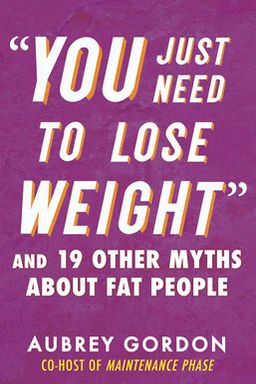
“You Just Need to Lose Weight” cover

“You Just Need to Lose Weight”

by Aubrey Gordon

In ''You Just Need to Lose Weight,'' Aubrey Gordon debunks societal myths about fat people, exposing biases and misconceptions about body weight. This insightful book empowers readers to challenge discrimination, support inclusivity, and rethink societal norms about size and health.

Debunking Anti-Fat Myths and Redefining Dignity

How often have you heard someone say, “You just need to lose weight”? And how often have you seen that phrase cast as both advice and judgment, as if fatness were a moral failing rather than a human variation? In You Just Need to Lose Weight, Aubrey Gordon—author and co-host of the podcast Maintenance Phase—argues that anti-fatness is not only pervasive but institutionalized, woven into our culture through myths that equate thinness with health, morality, and worth.

Gordon contends that fat people are not failed thin people; they are human beings deserving of dignity and respect. The book dismantles twenty common myths—from “being fat is a choice” to “fat acceptance glorifies obesity”—revealing how each perpetuates discrimination and inequality. But Gordon doesn’t just debunk facts; she humanizes the conversation, mixing deeply personal experiences, historical analysis, and social science to show why anti-fatness continues to thrive even amid growing awareness of body positivity.

The Core Argument: Anti-Fatness as Structural Oppression

At its heart, Gordon’s argument is both moral and political. Anti-fat bias is not a matter of personal prejudice—it’s an intricate system of oppression supported by medicine, media, education, and even well-intentioned social movements. As she explains, “just lose weight” thinking shifts the blame for discrimination away from institutions and onto individuals, allowing thin people and policymakers to avoid confronting the harm they perpetuate.

Through evidence and storytelling, Gordon highlights how these myths police every aspect of fat people’s lives—from family dynamics and health care to dating and employment. The result is a culture where fatness is treated as a form of deviance and thinness as virtue, echoing other systems of control rooted in racism, ableism, and patriarchy (similar to analyses in Sonya Renee Taylor’s The Body Is Not an Apology and Sabrina Strings’s Fearing the Black Body).

The Structure: Myth-Busting and Activism

The book is divided into four parts, each addressing a category of myths—moral, medical, cultural, and prescriptive. Gordon intersperses myth deconstruction with “Reflection Questions” and “Opportunities for Action,” encouraging readers to confront their biases and take practical steps toward harm reduction. This structure not only educates but also invites participation, transforming readers from passive observers into active allies.

She reminds readers that anti-fatness isn’t merely ignorance—it’s engineered. Medical frameworks like the body mass index (BMI) are shown to be relics of white, eugenicist science. Public health rhetoric around an “obesity epidemic” is revealed as fearmongering. Even progressive trends like body positivity often center thin, white, cisgender women, leaving out fat, Black, queer, and disabled people who originally built the movement.

Why These Ideas Matter

For Gordon, dismantling anti-fat myths is not about defending “lifestyle” choices—it’s about restoring humanity. She contrasts the cultural obsession with “wellness” against the lived realities of fat people denied health care, employment, and compassion. Her call to action is for readers to recognize anti-fatness as a systemic injustice that demands solidarity and accountability, not pity or correction.

“My life as a fat person,” Gordon writes, “doesn’t need to be argued or fixed; it needs to be defended.”

This statement underscores her vision: to dismantle the false hierarchy of bodies and invite more people—fat or thin—to stand up against anti-fat discrimination in all its forms.

What You’ll Learn

Throughout the summary, you’ll uncover the anatomy of anti-fat myths, the historical roots of the BMI and dieting culture, the false moral prism of “health,” and the politics of representation and desirability. You’ll see how Gordon reframes fatness as neither disease nor failure, but as an identity caught in the crossfire of institutional power. And most importantly, you’ll see how unlearning these myths can help you become a more empathetic, informed advocate—for yourself and others.

The book’s power lies in how it moves readers from understanding to action. By the end, Gordon leaves you with an urgent challenge: stop waiting for comfort, and start confronting anti-fatness wherever it hides. Because dismantling oppression starts not with pity but with belief—in the unconditional dignity of every body.


Myth 1: Being Fat is a Choice

Gordon begins her myth-busting journey with the most deeply entrenched belief: that fatness is a personal failure. “If fat people don’t like how they’re treated, they should just lose weight,” says the cultural refrain. But as Gordon reveals, this narrative functions as both moral policing and social absolution—it allows those in power to perpetuate discrimination while blaming fat people for their own oppression.

The Myth of Control

Our world tells us that bodies are bootstraps—that anyone can become thin with enough discipline. Gordon unpacks media stories, such as those glorifying model Rosie Mercado’s 240-pound weight loss, to show how these stories reinforce the illusion of control. Thinness is portrayed as proof of virtue, while fatness is framed as moral decay. Yet research contradicts this tidy equation: according to the National Institutes of Health, very fat women have less than a 1 percent chance of reaching a so-called “healthy” BMI in their lifetime.

Fatness, she explains, is shaped by complex factors—genetic, medical, environmental, and social—not simple arithmetic. Conditions like lipedema, polycystic ovary syndrome (PCOS), and diabetes medications directly affect body size regardless of effort. Still, cultural myths reduce these realities to personal failures, fostering anti-fat bias disguised as “concern for health.”

Media, Politics, and Dehumanization

Gordon examines how fatness is portrayed as faceless and shameful—news footage of headless torsos consuming fast food, policy programs declaring war on “obesity.” These visual tropes not only depersonalize fat people but correlate directly with increased bias. Studies show that exposure to demeaning media images increases personal dislike of fat people and even the desire for “social distance.”

“Fat people are reduced to our bodies,” Gordon writes, “our bodies are recast as burdens, and then we’re offered a thousand ways to make those burdens disappear.”

The Power of ‘Just’

Perhaps the most piercing insight in this chapter is the rhetorical violence of the word “just.” “Just lose weight” trivializes decades of struggle and erases the complexity of fat people’s lived experiences. Gordon illustrates the absurdity with her own calculations: for her 5’10” frame, losing 220 pounds at one to two pounds per week would take three years of flawless dieting—an impossible feat that underscores how casually society demands the unattainable from fat people.

Beyond Choice: Toward Compassion

By reframing fatness beyond the lens of choice, Gordon dismantles the moral binary separating “good” thin bodies from “bad” fat ones. She expands the discussion by comparing this choice-based logic to historical oppression—how labeling queerness or trans identity as a choice justified exclusion and violence. The takeaway is clear: whether fatness is chosen or not, no one deserves discrimination.

Ultimately, Gordon urges readers to abandon the myth that thinness equals worth. Advocacy begins when thin people stop expecting fat people to become “afters.” Respect shouldn’t be conditional on body size—it’s a right, not a reward.


Myth 2: Calories In, Calories Out

“Any fat person can become thin if they try hard enough.” It sounds scientific, almost irrefutable. But, as Gordon shows, it’s not science—it’s ideology. The idea that body size results solely from willpower and calorie arithmetic ignores decades of metabolic and psychological research and punishes fat people for failing to meet impossible biological expectations.

The Biology of Resistance

Gordon walks readers through how our bodies fight weight loss. Hormones like ghrelin (hunger) and leptin (satiety) shift dramatically after dieting, increasing appetite and decreasing energy use. “Our bodies,” she explains, “are wired to defend their highest sustained weight.” Even exercise, touted as a cure-all, barely affects weight—most long-term studies show less than five pounds lost after a year, a negligible change compared to expectations of transformation.

The Diet Mirage

The multi-billion-dollar diet industry thrives on false promises. Gordon cites a major review of fourteen popular diets—including Atkins, DASH, Mediterranean, and Weight Watchers—concluding that all produce modest weight loss that vanishes after twelve months. “You can’t pick the right diet if none of them work,” writes Robert Shmerling of Harvard Health, echoing Gordon’s point that dieting is a collective exercise in futility.

She also notes the physical risks: crash diets cause muscle loss, laxative teas lead to dehydration, and ketogenic regimens have been linked to increased mortality. Even when diets succeed short-term, long-term effects include weight regain, suppressed metabolism, and heightened risks of eating disorders.

Healthism and Moral Shame

Behind every “get healthy” slogan lurks an ideology Gordon calls healthism. The concept—popularized by sociologist Robert Crawford—treats health as moral performance. Fat people’s bodies become public property, policed by strangers “concerned” for their wellbeing. This is not health advocacy; it’s dominance. The same system that once enacted “ugly laws” against disabled people now compels fat people to shrink as a public duty.

Gordon’s message here is vital: concern for fat people’s health cannot coexist with contempt for our bodies. Health care must change not by shaming fat patients to lose weight but by respecting and equipping providers to deliver equitable care. Fatness doesn’t require cure—it requires compassion.


Myth 6: Obesity Kills Hundreds of Thousands

One of the most enduring public health claims is that “obesity kills 400,000 Americans every year.” This number, Gordon reveals, is more fantasy than fact—a statistical ghost haunting fat people’s reputations. Its origins lie in flawed research, political agendas, and the desperate pursuit of moral alarm.

The Birth of a Black Box

In 2004, a study published in JAMA by Ali Mokdad and colleagues declared an “obesity epidemic” responsible for hundreds of thousands of deaths. The media ran wild with headlines equating fatness with mortality. But researchers quickly noticed the calculation relied on decades-old data—some more than fifty years out of date—and assumed every death among fat people was “due to” fatness itself.

When Congress investigated, even the CDC admitted it had overstated the numbers. Revised estimates dropped from 400,000 deaths to less than 365,000—and later analyses by Katherine Flegal found that being “overweight” correlated with lower mortality than being “underweight.”

Science Meets Politics

Gordon shows how policy and profit converged here. Labeling fatness a disease allowed pharmaceutical companies to classify weight-loss drugs as “life-saving.” Medical institutions, relying on the BMI’s narrow definitions, treated correlation as causation. Researchers with industry ties (notably to weight-loss drug manufacturers) helped cement the narrative of fatness-as-fatality—a moral panic masquerading as epidemiology.

“It is absurd,” Gordon writes, “to claim all excess deaths of fat people are the result of being fat, just as it would be to say all swimmers die of drowning.”

The Lesson

Gordon urges us to see how data can be weaponized. Numbers that feel true are not always accurate; repetition does not make reality. When research fails to account for discrimination in health care, poverty, or structural inequities, its conclusions reflect bias, not biology. Anti-fatness, she reminds us, doesn’t just distort medicine—it kills curiosity, replacing inquiry with ideology.

Her call is simple but radical: stop counting fat people as casualties of their own bodies. Start counting how many are casualties of neglect, bias, and exclusion in the systems meant to help them.


Myth 7: The BMI Is Objective Science

To understand modern anti-fatness, Gordon argues, you must understand its favorite metric: the Body Mass Index. It’s treated as medical gospel, but its origins lie not in physiology or medicine—but in 19th-century social physics and eugenics.

The White Male Average

Developed by Belgian mathematician Adolphe Quetelet, the BMI began as a way to measure “the average man.” Quetelet wasn’t a doctor; he was a statistician seeking social laws. His “ideal” was based solely on white European men’s weights and heights—then exported worldwide as a universal measure of health. Later, figures like Francis Galton reinterpreted these averages to fuel eugenic theories about “racial fitness,” cementing whiteness and thinness as default ideals.

Medicine Adopts a Myth

By the mid-20th century, insurance companies used weight tables to assess risk—not health. When researcher Ancel Keys adapted Quetelet’s formula for individual use, he admitted it was only “50 percent accurate.” Yet the simplicity of BMI—a number easy to calculate and bureaucratically appealing—made it irresistible. The NIH and WHO adopted it wholesale, lowering thresholds again in the 1990s to classify millions more bodies as “overweight.” (Notably, the task force that recommended these changes was funded largely by weight-loss drug companies Abbott and Roche.)

Real Consequences

The BMI not only mismeasures individuals—it misguides policy. It overestimates fatness in Black people, underestimates risks for Asian people, and ignores sex-based and trans-specific differences altogether. Doctors still use it to deny care, refuse surgery, or dismiss symptoms, perpetuating bias under the guise of objectivity. Even calling fatness a “disease” now depends on BMI scores that fail to account for genetics, environment, or discrimination.

“Despite its fraught history,” Gordon says, “the BMI soldiers on—because it tells us what we want to hear: that health, whiteness, and thinness are the same thing.”

Her conclusion? The BMI isn’t science—it’s social control. Abandoning it won’t just make medicine more accurate; it will make it more just.


Myth 10: Accepting Fat People Glorifies Obesity

Few accusations sting fat activists more than “You’re glorifying obesity.” It’s a phrase wielded to silence joy. Gordon argues that this myth reveals less about fat people’s actions and more about thin people’s discomfort—anxiety over having to see bodies that defy prescribed norms.

Visibility as Rebellion

Gordon recounts examples like Lizzo’s Lakers game outfit and model Anna O’Brien’s Gillette campaign—moments that generated disproportionate outrage. None of these women told others to gain weight; they simply existed unapologetically in public. The reaction, Gordon argues, exposes our collective terror of fat visibility. To call a photo “glorification” is to redefine exposure as contagion.

Why It 'Feels Dangerous'

The claim that representation encourages fatness echoes racist and ableist histories of moral panic. It imagines fat joy as a threat to public health, as if smiles were epidemics. Thin critics often invoke “concern,” masking prejudice as virtue. “They aren’t judging others,” Gordon writes wryly. “They’re fighting the good fight.”

She turns the argument on its head: if representation equals glorification, then mainstream media glorifies thinness constantly—through countless diet ads, celebrity transformations, and “revenge body” stories. Fat people’s visibility isn’t an excess; it’s a correction.

Interrupting the Cycle

Gordon challenges readers to self-inquiry. What emotions do you feel when seeing a happy fat person? Discomfort? Fear? Curiosity? Those reactions expose the bias within, not evidence of fat people’s wrongdoing. Interrupting subtle moments—comments about “health,” jokes reducing someone’s size to morality—is activism in miniature.

“When fat people show up visible and joyful,” Gordon insists, “we aren’t glorifying obesity—we’re showing that shame was never medicine.”

Her point resonates: body acceptance is not propaganda but permission—permission to exist without begging for approval. If seeing fat people live freely feels threatening, the work lies not in policing them but in interrogating why it does.


Myth 20: Anti-Fatness Is the Last Acceptable Prejudice

“Anti-fatness is the last socially acceptable form of discrimination.” Gordon hears this phrase often—and while she agrees anti-fatness is rampant, she warns that framing it as the “last” erases other marginalized groups still fighting ongoing systemic violence.

False Finality

Declaring anti-fatness the “last” discrimination may feel radical but it implies oppression ended elsewhere. In reality, racism, ableism, transphobia, classism, and xenophobia are thriving alongside anti-fatness. Gordon names examples: racist policing, disabled people losing benefits when marrying, trans people denied surgeries due to BMI limits, and immigrants facing surveillance and raids—all socially “acceptable” because society tolerates silence.

Intersectionality and Erasure

Fatness intersects with other identities. Fat Black, Indigenous, and disabled people experience compounded discrimination. When thin advocates claim anti-fatness as the “last” prejudice, they center privileged fat bodies—usually white and cis—while sidelining those most harmed. Liberation for fat people, Gordon argues, must include dismantling racism, ableism, and classism, not claim supremacy in suffering.

Doing the Work

Privilege isn’t absolved by outrage. True allyship means practice: advocating for size protections in workplaces, amplifying fat activists of color, making spaces accessible, and interrogating complicity. “If oppression exists without unanimous resistance,” Gordon writes, “then it is accepted.” To call anti-fatness ‘the last’ is to stop looking for others—to stop growing.

“There is no last oppression,” Gordon concludes. “Oppression mutates. Meaning well is not a cure.”

Her closing message turns indignation into solidarity. Fighting anti-fat discrimination shouldn’t claim uniqueness—it should connect to broader justice movements. Because the point isn’t to win the hierarchy of harm—it’s to dismantle it.

Dig Deeper

Get personalized prompts to apply these lessons to your life and deepen your understanding.

Go Deeper

Get the Full Experience

Download Insight Books for AI-powered reflections, quizzes, and more.