
Idea 1
Gossip Is How Humans Make Sense Together
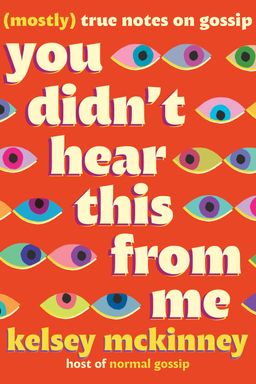
When was the last time a whispered aside or a late-night voice memo changed how you saw someone—or yourself? In "You Didn’t Hear This from Me," Kelsey McKinney argues that gossip isn’t a petty side-channel but one of humanity’s oldest, most powerful forms of meaning-making. She contends that gossip is not merely slander or idle talk; it is a social technology—how we teach norms, vet trust, warn one another, and play. And because it’s story first, it’s entangled with truth: not courtroom-fact truth, but the lived, shifting, “tell it slant” truth that lets you see the world, and your place in it, more clearly.
What counts as gossip—and why you already do it
McKinney starts by stretching the category: gossip is simply talk about someone not present. That definition covers an anxious prayer circle, two oncologists reviewing scans, a baseball rumor about Shohei Ohtani, and your mom’s text about a neighbor’s new boyfriend. We culturally conflate “gossip” with libel or cruelty, but most gossip is value-neutral information sharing (research suggests the bulk is neither malicious nor false). At its best, gossip is the everyday flow of social intelligence that helps humans cohere, a function anthropologists like Robin Dunbar have argued language evolved to supply.
The book reclaims gossip from centuries of gendered dismissal (think of “talebearers,” the “gossip’s bridle,” and the way “women’s talk” is trivialized). It also resists the pious instinct to regulate it out of existence—particularly evident in evangelical circles McKinney grew up in—showing how blanket prohibitions traditionally protect power rather than people.
Gossip, morality, and power
McKinney threads a provocative line: gossip operates as informal governance. Before cities and courts, reputation—and the conversations that formed it—organized society. Today, whisper networks can still be lifesaving, alerting you to a predatory coach (as in Mean Girls’ original Burn Book), a toxic boss, or a dating-app “West Elm Caleb.” But gossip is double-edged: the same channels can feed online pile-ons and panopticon-style surveillance where everyone becomes a Main Character to be judged. The key questions become: Who benefits? Who is protected? Who is harmed?
Truth, story, and the “slant”
This is a book about truth that refuses the illusion of certainty. Gossip, McKinney insists, lives at the seam where fact and interpretation meet—closer to oral tradition than deposition. She maps how urban legends (“the poop-in-a-bag first date,” ghostly handprints on a stalled car), political rumors (Hillary’s lamp, Obama “birtherism”), and celebrity narratives (Britney Spears) travel and mutate, revealing cultural anxieties more than verifiable events. Rather than demanding a singular, court-proof truth, McKinney invites you to ask: what is this story for? What values does it teach? What power does it shift?
What AI can’t fake about gossip
McKinney runs an experiment with ChatGPT: can it “gossip” the Epic of Gilgamesh? What comes back is tonally glib and technically tidy—and completely bloodless. AI, she suggests, lacks the situated point of view gossip requires. As Walter Benjamin argued about art’s “aura,” presence in time and space matters; so does perspective. Gossip needs a “who” and a “from where.” Without those, it’s regurgitation, not story.
Parasocial love, entitlement, and #FreeBritney
The book’s most urgent case study is Britney Spears. McKinney shows how entitlement gossip—fans believing they’re owed a celebrity’s inner life—fuels surveillance and exploitation. Yet the same fan networks later helped end Spears’s conservatorship. This is gossip’s paradox: it can wound and save, depending on whose agency it advances and whether listeners respect boundaries.
A field guide to sources, screens, and shows
You’ll walk through blind items and DeuxMoi DMs; Reddit’s AITA and the mechanics of rumor replication; and reality TV as gossip lab—where “receipts, proof, timeline, screenshots” (as Heather Gay thunders on Real Housewives of Salt Lake City) attempt to solidify social truth. You’ll see how Survivor’s idols and The Traitors’ deducing turn information into currency, and how the wrong Tattle can backfire.
Why this matters to your life
Once you see gossip as a moral technology, not a moral failure, your own practice can change. You can ask better questions (Where did this come from? Who is protected?). You can treat whisper networks as triage, not tribunals. And you can keep hold of what makes gossip uniquely human: play, wonder, and the slantwise pursuit of truths that dazzle gradually. McKinney’s point isn’t to make you gossip more, but to gossip better—with curiosity, skepticism, accountability, and joy.