
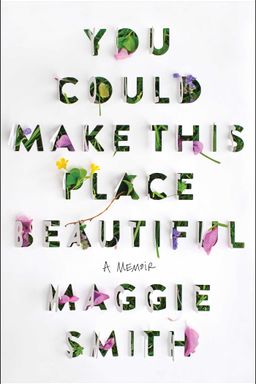
You Could Make This Place Beautiful cover

You Could Make This Place Beautiful

by Maggie Smith

The poet explores her love for her children and commitment to herself after the end of her marriage.

Make a Life You Can Bless

What do you do when the story you thought you were living disappears mid-sentence—when the script you’ve memorized is suddenly blank, and you’re still onstage? In You Could Make This Place Beautiful, Maggie Smith argues that you don’t wait for a new script; you write your way into a life you can bless. She contends that while a tell-all is impossible—no one holds the godlike omniscience to see everything—what you can offer is a tell-mine: a precise, humane account of your own seeing. And by honoring your partial knowledge, metabolizing grief, and insisting on daily acts of craft and care, you can make beauty amid rupture.

Across brief, lyric chapters—part memoir, part essayistic craft talk—Smith traces her marriage’s collapse from a handful of unforgettable emblems: a pinecone, a postcard, and neatly excised notebook pages. The book pairs these talismans with a set of working metaphors—the boat and its dark waters, the nesting dolls of former selves, ghosts in the house, scars on the body—to render private pain legible. It’s as much about rebuilding narrative as it is about divorce: mothering through upheaval, renegotiating labor and power, choosing work without apology, and learning the difference between forgiveness and peace.

What the book claims

Smith’s core claim is deceptively simple: you can’t control the plot, but you can choose the form. When life refuses arc and resolution, you can arrange the pieces—the Polaroids—so they speak to each other. The memoir’s very structure (short, echoing vignettes; the stage directions of “The Play;” meta notes on plot and foreshadowing) enacts this formal salvation. She also argues that betrayal is “neat”—it tempts you to stop asking the harder questions about labor, voice, and power that were splitting the hull before the pinecone ever hit the sideboard. The antidote isn’t exposure or revenge, but curiosity, boundaries, and craft.

Why this matters to you

If you’ve ever found yourself midlife and mid-mystery—marriage fraying, job changing, kids needing more than you feel you have—this book offers both language and method. Smith shows you how to hold two truths: the larger, public narratives (gendered labor, literary ambition, pandemic overwhelm) and the granular, household moments (bank lollipops after pulling half the savings; a child’s paper butterflies tucked in glove drawers). That doubleness invites you to treat your own life as material—not for spectacle, but for meaning-making. It’s the same move you find in Nora Ephron’s Heartburn (novelizing the wound), Rachel Cusk’s Aftermath (cold, essayistic witness), and Joan Didion’s The Year of Magical Thinking (grief as method). Smith sits among them, but with a poet’s ear and a mother’s fierce ethics: some moments, especially the children’s, are off-limits. “This moment isn’t for you,” she writes, drawing a line that’s also a craft lesson.

What you’ll learn here

First, you’ll see how a few ordinary objects—the pinecone, the postcard, the surgically removed notebook pages—can explode a life and, paradoxically, organize a book. Then you’ll trace the invisible contract of domestic labor: how a “creative partnership” curdled into a deal where his income set the terms and her work was put in air quotes, even by opposing counsel. You’ll walk through the viral moment of “Good Bones” (read on TV and by Meryl Streep), and how success destabilized a marriage already straining under inequities. You’ll step into Ohio—the “heart of the heart of it all”—as a character, wander Google’s street views to “update and unblur” memory, and watch a husband move states away to The Addressee while a mother steadies two kids through a pandemic.

Finally, you’ll practice the book’s signature disciplines: setting boundaries, choosing acceptance when forgiveness isn’t offered, and making an “offering cake” (torma) to the very ghosts that possess you—anger, rumination, the need for answers. You’ll witness small, muscular rituals—notes-to-self that became Keep Moving; roller skates and disco on a driveway; running intervals that earn laughter at the curb—until a second life appears: not a rebound plot, but a form that holds.

A line to carry

“I can’t distill what I’m not permitted to fully experience.” Smith refuses omniscience but refuses silence, too. Her permission slip to you: speak from where you stand; arrange what you can reach; and bless, as The Mountain Goats sing in a song inspired by her, “everything there is to bless.”


Tell-Mine, Not Tell-All

Smith opens with a rule: there is no tell-all, only a tell-mine. You don’t get access to “all”—not in marriage, not in memory, and certainly not in divorce. That admission isn’t a cop-out; it’s a craft stance and an ethical posture. Throughout the book, she protects her children’s stories and names, draws curtains around certain scenes, and leans into the white space—those stanza gaps where, as a poet, she invites you to feel the silence rather than fill it with spectacle.

Why partial truth is still true

In practice, “tell-mine” means Smith writes from the edges of what she can see. She’s clear about amnesia in pivotal moments—like the midnight confrontation after she found the postcard. You don’t get a screenplay of that scene because she doesn’t. Instead, she gives you the textures that memory truly keeps: the faded turquoise quilt, the sliver of streetlight through curtains, the seasick feeling of omniscience hovering just out of reach. Rather than guess motivations, she follows impacts: a counselor’s love seat soaked in tissues, bank lollipops after withdrawing the other half of the savings, a child’s line—“I have a mom who loves me and a dad who loves me, but I don’t have a family”—lodging like glass.

The ethics of omission

Smith repeatedly says, “This moment isn’t for you,” most often when kids are present. That boundary may frustrate voyeuristic expectations, but it models literary care. It’s a counterpoint to the confessional internet, and it echoes memoirists like Ocean Vuong and Jesmyn Ward who protect intimacies even as they witness. By turning away at key thresholds, Smith deepens what she does tell: the how of feeling, the where it lands in the body, the work it demands afterward.

Form as honesty

Short chapters, refrains (“How I picture it”), and stage directions (The Play) become her honesty engines. Life resists neat arcs, so she refuses them on the page, offering notes on plot that warn you not to map your heartbreak onto Freytag’s triangle. “Is this falling action?” she asks, almost wryly. The answer: form won’t force meaning, but it can frame it. (Compare to Jenny Offill’s Dept. of Speculation, which also uses fragments to honor a mind in crisis.)

What this gives you

When you’ve been burned by secrecy, it’s tempting to blast the whole story open. Smith shows another path: tell enough to metabolize, protect enough to remain whole, and experiment with form until the pieces “speak.” You can try this yourself: ditch pressure to narrate every scene; instead, assemble emblems (an object, a text, a doorway you couldn’t cross) and write what they changed. If you can’t remember the exact dialogue, write the weather, your pulse, the shape of the silence.

Key Idea

A memoir can be both fiercely protective and radically honest. The constraint isn’t a muzzle; it’s a meter. Like poetry, it shapes force into a form you can say—and survive.

(Context: Rachel Cusk’s Aftermath uses austerity and distance to keep strict custody of emotion; Smith’s tenderness and humor create a different—but equally disciplined—limit.)


The Pinecone, the Postcard, the Play

The memoir’s plot ignites with three props: a pinecone, a postcard to “The Addressee,” and a notebook with pages neatly excised. Those small items become a Rube Goldberg switch—once tripped, everything rolls. But Smith refuses to treat them as the whole story. She keeps returning to the question: What cracks already ran through the hull before the stowaway appeared?

The inciting incident and its shadows

One late night, she reaches into her husband’s messenger bag and finds a postcard about a pinecone from a walk he took with another woman, plus notebook pages narrating a scene at that woman’s home. The next night, those pages are surgically removed, “X-Acto-ed.” She throws away the pinecone, realizing the pinecone isn’t the problem. Rather than stage the confrontation as thriller, she edges around the consequences: marriage counseling sessions that focus not on betrayal but on Smith’s work travel; her husband’s coolness amid her weeping; and the way reality can be edited just like notebook pages—quietly, precisely, and out of sight.

Why betrayal is “neat”

Calling betrayal “neat,” Smith names its narrative trap: once there’s an explosion on one side of the street, no one looks at the other side. Infidelity can absolve you from asking what dynamics grew untenable—like gendered labor, unspoken deals, professional envy, and the pressure of public success. So she keeps chewing (she uses ruminant humor to name it): How did we split long before we split? Did we both slip away in the commotion?

Staging the life as “The Play”

To hold uncertainty, Smith invents a dramaturgical frame: The Wife, The Husband, The Finder, The Marriage Counselor, The Attorney. There’s no program, no director’s notes, and crucially—no script. The Finder learns onstage, improvising without lines, which is what post-shock life feels like. Some scenes are withheld (you won’t get the family talk with the kids), not as coyness but covenant. The device keeps you aware of performance: which role are you playing in your own home today—Partner, Parent, Staff, Ghost?

Why this reframing matters

When you’re drowning in a single story (“He cheated”), broadening the lens can be lifesaving. Smith insists on both/and: acknowledge the hard facts (the postcard; later, his move 462 miles away to live with The Addressee), and challenge the lazy causality that would make those facts the entire plot. That’s not to downplay harm—it’s to refuse cheap closure. The work isn’t to solve the mystery with a twist; it’s to live without the omniscient narrator she admits envying.

A practice to try

Give your rupture three objects. Name the play you’re in. Then ask: what was the “beforemath”? What did my body, calendar, and conversations reveal long before the inciting incident?

(Parallel texts: Heartburn uses comedy to metabolize betrayal; Smith uses lyric structure and stagecraft to honor ambiguity without turning away.)


Motherhood, Labor, and the Invisible Deal

Beneath the postcard sits an economy: who earns the money, who earns the thanks, and who earns the right to disappear to “work” without asking anyone to “cover.” Smith’s chapters on labor read like a ledger and a mirror. They’re personal (a spreadsheet of tasks, a lawyer air-quoting her “work”), and they’re structural (how power flows toward the higher earner and how women internalize it, too).

The unspoken agreement

Smith and her husband met in a college writing workshop—two artists, equals on paper. Years later, after law school and kids, the “deal” hardened: his job outside the home was treated as real by default; her writing life and travel were framed as disruptions requiring permission. Even Smith admits she sometimes treated his job as “more real,” because it paid the mortgage and insurance. That admission complicates simple villains and helps you see how inequity gets internalized.

The motherhood penalty, line by line

Her list of invisible labor (lunches, sunscreen, playdates, sick days, permission slips, “PJ and Stuffy Day” pajamas) becomes a feminist parable. She leaves corporate publishing to freelance—partly to write more, partly to mother on her terms. When “Good Bones” goes viral, requests for talks and readings surge. Instead of a shared recalibration, she gets a tightening of the leash: stop traveling, make the writing “smaller,” choose the marriage over your expansive life. The punchline arrives later: her book advance (Keep Moving) is what lets her refinance and keep the house. “My work was not the problem. My work was the solution.”

The contractor’s language

Look for how words do the policing. At AWP, a friend jokes about texting a signing line to her husband; Smith quips, “Please don’t—it’ll make everything worse.” In a deposition room, opposing counsel says when you were “working,” with air quotes. In counseling, the focus tilts to her laptop and trips, away from his secret notebooks. Language tries to make her small; language is how she refuses to shrink (compare Rebecca Solnit’s Whose Story Is This? on narrative power).

What you can do with this

Smith offers a pragmatic playbook:

  • Inventory the labor, as Eve Rodsky’s Fair Play suggests; see the machine’s hidden gears.
  • Name your deal. If it requires you to shrink your art or self indefinitely, it isn’t a partnership.
  • Defend your work with legal, financial, and linguistic boundaries (new email accounts, businesslike tone, stetting your tears in print when someone tries to redact them).

A sentence to remember

“If I respected you and your work, I wouldn’t begrudge you the time and space it takes to do it.” That’s the test she and a friend devise for future love—and for your next deal.


Art as Lifeline: Virality and Voice

If the home was a theater of scarcity, the page becomes Smith’s field of abundance. “Good Bones,” a poem drafted on a legal pad in a coffee shop, explodes online the same week as public griefs (Pulse, Jo Cox). It’s later read on CBS’s Madam Secretary and by Meryl Streep at Lincoln Center. The marriage doesn’t survive that seismic attention, but Smith’s life as an artist does—louder, wider, and fully hers.

The two-way shadow of success

Smith’s husband whispers in bed, “You’re famous,” with sadness in the tone. She shrinks her good news, cancels gigs to “save” the marriage, and still the chill intensifies. The irony: when the divorce comes, it’s her words that keep the lights on. This isn’t a triumphalist arc; it’s a lived evidence file that your art may be the very infrastructure your life needs—even when it disrupts others’ preferred version of you.

Turning notes-to-self into scaffolding

In the worst months, Smith writes daily notes on social media ending “Keep moving.” They’re pep talks and handrails. The practice becomes a book, and the book becomes a mortgage. The rhythm echoes Didion’s “magical thinking” but shifts from fixation to motion: you don’t control the wave; you do control the next step. Tool-wise, this is how you build when your brain is fog: small, repeatable rituals with a refrain.

Collaboration as witness

Her grief sparks other art: The Mountain Goats’ “Picture of My Dress,” Rhett Miller’s “The Scraps.” These cross-pollinations remind you that one person’s metabolized pain becomes another’s resonance. That’s not “at least you got a book out of it”; it’s a communal ecosystem of meaning (note Smith’s refusal of that minimization: the lemons weren’t worth it—but since they’re here, she’ll make something drinkable and name the cost).

Body-first craft

In parallel, Smith learns to live below the neck: yoga, running (insulting the robot coach out loud), roller-skating in a driveway with disco and neighbors. As postpartum depression returns with her son, she tries Lexapro; later she weans carefully and learns her heart palpitations are stress-triggered. The throughline: art saves, but bodies carry. To write a durable second life, you tend both page and pulse.

A working mantra

“My word’s the only thing I’ve ever needed.” (Cat Power in her earbuds, Lidia Yuknavitch in her pocket.) When the conference room fills with lawyers, she rubs rose quartz and holds to language. You can, too.


Grief’s Geography: Ohio, Ghosts, and Google

Place isn’t backdrop in this memoir; it’s a co-author. Smith lives in Bexley, “the heart of the heart of it all,” and Ohio keeps appearing—trees that make tunnels of light, a periwinkle house with too many windows to hide in, Schiller Park where she straps babies to her chest and teaches them seasons. When the marriage ends, the map still holds: the house remains, and so do its ghosts.

Updating and unblurring

In a Modern Love–turned–chapter, Smith looks at her house on Google Street View and sees an older version of their life—recycling bins at the curb, magnolia shade, her son’s tricycle on the porch. She clicks back through time and reads the images like rings on a tree. It’s a craft lesson: when memory blurs, consult the public archive. Then accept that the internet will lag behind your heart. “Street view is updated every one to three years,” the help page says. So is grief.

Ghosts you live with

Smith’s afterlife is literal: the last month under one roof, she becomes a ghost the husband won’t see; later, after he moves states away, she feels the house de-haunt, if only slightly. The ghost frame lets her hold intangibles you may know well: private jokes (“taco night!”), wedding songs (Lyle Lovett’s “Nobody Knows Me”), and the ache that there’s no “joint custody” for such things. You can inventory dishes and split equity, but who gets Paris? Who gets the Cliffs of Moher? Everyone and no one.

The pandemic as set and solvent

Then the world shuts: “We’ll Be Back” flashes on marquees while she turns a dining room into a second-grade classroom and a sunroom into a middle school. She skates with a friend in an alley to a disco playlist. Neighbors bring cake and pastries on the first Christmas she wakes without the kids. During lockdown, the scale of loss reframes the divorce without minimizing it—it’s both/and, not either/or.

A beekeeper walks into the yard

Smith tells two bee stories. Years earlier, a tornado of bees fills a backyard tree the same day a delivery driver—who happens to be a beekeeper—arrives and smokes them into safety. Later, at the new house where her ex now lives, fifty thousand bees are extracted from the walls. She texts a friend who calls it karma. The better reading is Smith’s: the universe keeps staging metaphors until you see your life in them. Sometimes the help arrives; sometimes the hive lives in the structure. Either way, you make a note. You keep moving.

Keep a place ledger

List where your big feelings live on the map—street corners, kitchens, parking lots with cappuccino crumbs. When the past flares, take a picture and write three sentences about what’s the same and what’s unblurred now.


Boundaries, Anger, and the Work of Forgiveness

Smith doesn’t peddle cheap absolution. She differentiates sharply between forgiveness (especially when no remorse is shown) and peace. Acceptance, not pardon, becomes the goal. Along the way, she honors anger—sometimes hurling a cup of water on the couch where her husband sleeps, sometimes stetting tears an ex tries to redline from her essay—while building boundaries thick enough to live behind.

Anger as information

“Where were his fucks?” she asks, after months of feeling like the only one who cares enough to fight. When a marriage counselor prompts her to apologize for the thrown water, she does—and notes the unsaid: “I wasn’t sorry for being angry.” Later, she learns a Buddhist practice—the torma, an offering cake for the ghost (don) that possesses you. “Thank you, pain, for being my teacher,” she writes, aspirationally. It’s not masochism; it’s agency. If hurt taught you to change, feed it and then remove its teeth.

Boundaries you can touch

Concrete steps stack: a new email account only checked on laptop; businesslike tone in messages; saying “Don’t call me Mag” when a too-intimate nickname arrives in the same email that announces an interstate move; refusing last-minute edits that would erase her labor and tears. She reframes coparenting with a therapist’s metaphor: she refuses to be a punching bag for someone training his strength. Relationship requires reciprocity; absent that, boundary is not meanness—it’s basic physics.

Acceptance over closure

Smith says outright: forgiveness is complicated; acceptance is possible. She can’t “eternal sunshine” the years, and she won’t regret her children—though she candidly admits she would never have chosen this path for them. That double vision (love without sanctifying the harm) grants you permission to stop waiting for the apology that’s not coming and invest in the life that is.

Making room for a second life

As boundaries hold, room appears—for new love (tended like a plant in quarantine), for the poem “Bride” in The New Yorker, and for calling herself “darling” in the mirror. She keeps the house—our house, she says of her kids and herself—and watches the neighborhood trees observe six feet like the world does. Eventually, she can say to her ex, from a lit corner of her stage: your absence made this life possible; thank you. Gratitude without naiveté is the sign the work is working.

A boundary script

“I want peace more than I want answers.” Use it to choose silence over bait, acceptance over ruminative loops, and the next small, beautiful act over the old fight.


Keep Moving: Building a Second, Timeless Life

Smith ends where life actually happens: not with a courtroom finale but with routines, playlists, and refrains—a second life roomy enough to hold joy without pretending the undertow is gone. “No feeling is final,” she quotes Rilke, and then she tests it in the field: birthdays split into two cakes; Ohio drives past a hundred shared landmarks; running routes that pass a plastic nativity where Joseph has tipped over and Mary and the baby manage on their own.

Rituals that knit

She and her kids build a family culture on music (Violet’s “Hey Mom” playlist, Rhett’s Beast Quest bedtime), hikes, quarantine roller-skate clubs in overalls with margaritas, and hidden valentines (paper hearts and butterflies they plant around the house for the weekend she’s alone). These are not consolation prizes; they’re scaffolding. When a neighbor arrives with cake on the first childless Christmas morning, she cries at the counter and eats with her hands—then laces up for a run. Movement plus sweetness: it’s a program.

The practice of blessing

Smith keeps blessing: the ocean that’s “still there,” the beagles and jays and cardinals, two pumpkins on a porch in the Street View where she’s newly on the deed alone. She blesses even the scraps (Rhett Miller’s song) and the future she’ll never have (a golden anniversary like her parents’). Then she reframes gold: forty-eight years with her parents, with her sisters, with her kids—those relationships will go the distance. That, too, is golden.

What you can copy tomorrow

Choose a refrain (“Keep moving,” “Small and holy”), write it daily for thirty days, and place one joyous, body-forward act in each day: a walk with a song you loved at seventeen, a recipe that makes a mess and laughter, a boundary you enforce and then reward with something good. If you can’t forgive, practice acceptance; if you can’t accept, practice distance; if you can’t move far, move one driveway’s length to the sound of CHIC’s “Le Freak.”

Closing note

“How will it end?” someone asks. Smith answers like a poet and a parent: it ends in the middle, only later. Meanwhile, you make this place—your place—beautiful enough to live in.

Dig Deeper

Get personalized prompts to apply these lessons to your life and deepen your understanding.

Go Deeper

Get the Full Experience

Download Insight Books for AI-powered reflections, quizzes, and more.