
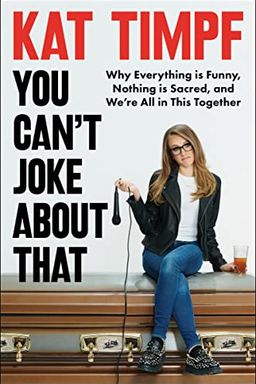
You Can't Joke About That cover

You Can't Joke About That

by Kat Timpf

The co-host of “Gutfeld!” and Fox News contributor gives her take on free speech and comedy.

Laugh at the Dark: Why Jokes Heal and Connect

When life gets brutal, do you clam up—or crack a joke? In You Can't Joke About That, Kat Timpf argues that the topics we’re told are off-limits—death, illness, trauma, politics, even identity—are precisely the ones we most need to joke about. Why? Because laughter is one of the only tools that reliably relieves pain, shrinks fear, and reminds you you’re not alone. Timpf contends that cultural taboos, safe-space rules, and the performative outrage economy are robbing people of comedy’s unique power to help us heal and connect—right when we need it most.

At its core, the book makes a simple but urgent claim: if we keep treating words as violence, intention as irrelevant, and mistakes as unforgivable, we’ll get less honesty, less healing—and a culture too afraid to say what’s true. Timpf doesn’t just say this; she shows it, painfully and hilariously, with stories of grief (losing her mom and grandma in quick succession), a near-death emergency surgery that left her living with an ostomy bag for five weeks, and the quiet humiliations of being broke and alone while trying to make it as a comic. Throughout, she keeps returning to one practice that made the unbearable manageable: turning it into jokes.

What this book covers

Timpf first maps how comedy’s unique superpower works. Research from Stanford and the Mayo Clinic backs her claim that humor physiologically relieves stress, reduces pain, and strengthens connection. She then dismantles three big cultural trends that strangle that power: (1) the idea that intent doesn’t matter—from Daniel Tosh’s off-the-cuff rape-heckler retort to her own on-air mistake about Jimmy Kimmel, she shows how erasing motive punishes attempts at humor like premeditated cruelty; (2) the instinct to erase or scrub past content—30 Rock, It’s Always Sunny in Philadelphia, and W/ Bob & David episodes pulled for blackface or "race-changing" sketches—rather than let us see, discuss, and learn from history; and (3) the push for safe spaces and trigger warnings in comedy and on campuses, which data suggests don’t help trauma survivors and often make things worse.

Along the way, she reframes the classic hot-button debates. On "words are violence," she shows how that logic justifies literal violence—citing reactions to the Will Smith–Chris Rock slap, Yale Law School shoutdowns, an attack on Dave Chappelle, and even the Charlie Hebdo massacre. On apology culture, she argues that saying sorry when you mean it is powerful, but ritualized apologies that serve mobs rather than the people hurt erode trust, cheapen contrition, and encourage self-censorship (compare Chris Harrison’s cascade of apologies with Sarah Silverman’s nuanced view: apologize when you’re sorry, not when you’re scared).

Why this matters for you

If you’ve ever paused before speaking—at work, at a dinner table, or online—wondering if an honest remark will cost you, this book explains why you feel that way and how to push back without being a jerk. Timpf is clear: defending comedy isn’t a partisan hobby; it’s a civic habit. You need a culture that lets you try, fail, and try again—the same way comics do. That means protecting attempts at humor from being treated like hate crimes, preserving ugly parts of the past so we can learn, and resisting the algorithmic outrage machine that turns one clumsy sentence into a career death sentence.

You’ll see how joking through the darkest stuff—like Timpf’s emergency ileostomy she nicknames "Beth" (and the hospital’s all-caps instruction: "DO NOT ATTEMPT TO PENETRATE STOMA!")—transforms isolation into camaraderie. You’ll also see why letting people laugh at death and illness is not disrespect; it’s medicine. Her mother laughed with nurses in her final days; Timpf laughs about missing her mom by posting, "Mom’s dead, gonna do some laundry" on Mother’s Day to puncture solemnity’s suffocation. Those moments don’t trivialize loss; they free people to breathe around it.

How the summary is organized

First, we’ll unpack why intention matters and how confusing failed jokes with malice wrecks trust. Then we’ll explore why you should never erase problematic art but contextualize it. Next, we’ll look at using humor to cope, joking through illness and death, and the gender/power thorns Timpf has faced in comedy. We’ll then tackle the "words are violence" shift and the psychology of safe spaces and triggers. We’ll examine apology mechanics, free speech as a cultural—not just constitutional—value, and the Twitter outrage machine that turns performative morality into a sport.

Core thesis

Comedy is a human technology for pain: it makes heavy things lighter and lonely people less alone. Policing it for perfection punishes the very attempts that produce healing.

By the end, you’ll have a playbook to defend humor in your life, use it to metabolize tough experiences, and help build a culture where people can take risks, apologize sincerely if they blow it, and keep talking—and laughing—together. (For context, the book sits alongside Jonathan Haidt and Greg Lukianoff’s The Coddling of the American Mind on safetyism, and Jon Stewart/Jordan Peterson’s "comedians as canaries" framing.)


Intention Absolutely Matters

Timpf begins where most pile-ons end: with the question, "What did they mean to do?" She argues that in comedy, motive is the moral backbone. A failed joke in pursuit of laughter is categorically different from a statement meant to wound. Collapsing that difference makes honest conversation impossible and scares people into silence.

Why motive changes the meaning

Take Joan Rivers’s Holocaust joke about Heidi Klum: "The last time a German looked this hot was when they were pushing Jews into the ovens." The Anti-Defamation League blasted it. Rivers—who lost family in Auschwitz—insisted she jokes about the Holocaust to keep its horror present. Here, the target is amnesia, not victims. Intention illuminates that difference.

Consider Daniel Tosh at the Laugh Factory. A heckler yelled, "Rape jokes are never funny!" and he snapped back, "Wouldn’t it be funny if that girl got raped by five guys right now?" Timpf doesn’t defend the line—it didn’t make her laugh—but reminds you it was an off-the-cuff response to a heckler in a room built for risk. You can hate the joke and still see the folly in treating a spontaneous, dumb attempt at shock as equivalent to endorsing rape.

When intention is erased

Timpf’s most searing example is her own. On Gutfeld, she quipped that medicating a feral cat is harder than giving medicine to kids—seconds before Greg Gutfeld reminded her Jimmy Kimmel’s son had a serious heart condition. She apologized in the next segment, shaking and near tears. Yet an out-of-context clip went viral, and Kimmel’s sister tweeted, "F— OFF AND DIE." Her intent was relatable pet-owner humor; the mob heard targeted cruelty. The lesson: when motive is ignored, penalties become detached from facts and proportion.

The cost of "intent doesn’t matter"

Consider New York Times reporter Donald McNeil Jr. He quoted the n-word while asking students a factual question about a classmate’s use of it—after which 150 Times staffers wrote that his intent was "irrelevant." He was pushed out. Or the Jeopardy! contestant who flashed three fingers to mark three wins; 450 former contestants accused him of white supremacist messaging "intentionally or unintentionally." If we treat accidental offense like planned malice, we dilute language and destroy second chances. (Psychologist Paul Bloom argues in the Wall Street Journal that intention is central to moral judgment; our law distinguishes manslaughter from murder for a reason.)

Risk, failure, and how comedy actually works

Jokes can’t be debugged in a lab. Comics learn by trying, bombing, revising. Declaring that only successful edgy jokes are allowed—"push boundaries, but only if it’s funny"—is nonsense. You only know if something works by risking that it won’t. A culture that punishes misses like malice ensures fewer attempts and blander speech. You pay that cost even if you’re not a comic—you become less likely to raise your hand with a half-formed idea or an awkward question.

Practical takeaway

When you feel offended, ask: Was the intent laughter or harm? If it’s the former, respond like you would to a missed shot, not a mugging—explain why it missed, don’t call for exile.

This isn’t a free pass. If a "joke" keeps punching the same people with the same stereotypes, pattern matters. But for good-faith attempts, weigh intent heavily. It’s a small act of charity that keeps the door open to connection—and keeps you from becoming the person you fear on your worst day.


Don’t Erase—Contextualize

When uncomfortable art resurfaces, the instinct today is to delete. Timpf argues that erasure—pulling episodes, memory-holing sketches—doesn’t protect anyone; it blocks learning. Keep the work, frame it, and talk about it. That’s how you get wiser audiences and better creators.

Case studies in deletion

In 2020, Hulu pulled five episodes of It’s Always Sunny in Philadelphia featuring blackface, brownface, and yellowface—material designed to satirize the characters’ hack racism. In one, even the glue-sniffing janitor Charlie says, "This is so racist," underscoring the anti-racist target. NBCUniversal yanked four 30 Rock episodes for "race-changing makeup." Tina Fey apologized and said intent is not a free pass—yet the satire’s aim was clearly to lampoon tropes, not endorse them.

Netflix removed a W/ Bob & David sketch where a white character in blackface can’t get police attention until he puts it on—then he’s tased, exposing bias. Co-creator David Cross argued the episode had "three or four layers" and made a positive statement about a Black cop, but the platform purged the whole episode. Even How I Met Your Mother was misremembered: a writer lamented Jason Segel’s "yellowface"—except the bit imagined other characters as kung fu masters and used accents and robes, not makeup, to parody genre clichés. But with the episode gone, debates rely on foggy memories and screenshots, not the work itself.

Why keeping the record matters

Art is evidence. It shows what people laughed at, ignored, or challenged at a given time. If you erase the past, you erase the path of progress—and deny future viewers the chance to critique with precision. Archivists warn that removals risk accidental, permanent loss. More importantly, deletion replaces discussion with denial. It’s the cultural equivalent of pretending you "didn’t date that guy after the reunion"—the truth still exists, you’ve just made it harder to learn from.

A better approach

  • Add context cards: Explain historical tropes, creator intent, and contemporary critiques.
  • Encourage post-views: Link to essays or after-shows that unpack tensions. (Think of what Turner Classic Movies does before older films.)
  • Keep a canon of discomfort: Make controversial episodes available in a clearly labeled, educational collection.

When your view changes

Timpf is candid about change. After her mother died, she once joked onstage that people’s long Facebook posts about their dead pets felt trivial to her grief. Years later, as her cat Cheens battles kidney disease and a heart condition, she would never tell that joke again. But she doesn’t want it erased. It illuminates where she was—and helps her consider how her future pet-grief post might land for the "old her." That’s growth via record, not deletion.

Principle

We don’t become better by hiding the artifacts of when we were worse. We become better by confronting them together.

Erasure feels compassionate in the moment; it’s often corporate risk management in disguise. Discussion is harder—but it’s the only route to wisdom.


Humor Beats Toxic Positivity

"Just be grateful" is lovely advice when you’re not in pieces. Timpf argues that the pressure to always be positive—about your body, your life, even a pandemic—often backfires. What works better? Not taking yourself so seriously and mining your insecurities for jokes that give you and others oxygen.

Why forced gratitude fails

During lockdown, memes scolded: "Our ancestors stormed Normandy; you just have to sit on the couch." As Timpf quips, pioneers didn’t notice their spouses’ annoying whistling because they were debating whether to eat a dead child to survive the journey. Minimizing someone’s present pain with someone else’s worse pain doesn’t relieve stress; it adds shame.

Body positivity gives another example. Despite decades of "love every inch" messaging, a Glamour survey found 97% of women report daily negative body thoughts; only about a quarter of men and women say they’re "extremely satisfied" with their looks (Body Image, 2016). Telling yourself to adore your cellulite can feel like gaslighting yourself.

Self-deprecation as a relief valve

Timpf’s antidote is shameless self-roasting. She jokes on TV that she looks like a young Macaulay Culkin wearing a wig; that her bra size is "Double Mastectomy"; that people "skip second and go straight for third" because of how flat-chested she is. Does this make the insecurity vanish? No. But it replaces spiraling rumination with shared laughter and a hit of oxytocin.

Research backs her up. A University of Granada study links self-defeating humor to higher happiness and sociability. Another study in Leadership & Organization Development Journal found leaders who use self-deprecating humor are seen as more trustworthy and capable than those who use other humor—or none—despite being rated equally funny. You’re not weak for admitting a soft spot; you’re strong for disarming it.

Name your demons (ridiculously)

In quarantine, Timpf fell into a cycle: procrastinate, panic, then pick at her skin. Her husband dubbed it "dickin’ and pickin’." Juvenile? Sure. Weirdly effective? Also yes. Giving the behavior an absurd name turned a shame spiral into a shared joke—and the joke made it smaller.

Try this

The next time you catch an insecurity flaring, describe it in a way that makes you laugh. Text a friend the ugliest morning selfie with a caption that punctures the shame. Laughter won’t fix the problem; it will shrink its power.

None of this is an argument against gratitude. It’s a plea to stop shaming people for not achieving Instagram-level serenity and to offer a concrete alternative: humor. You can be grateful and miserable, put together and a mess, grieving and laughing. In fact, pairing them is how you keep moving.


Joking Through Illness and Death

Few things feel more "off-limits" than disease and dying. Timpf insists they’re ground zero for comedy’s healing power. If you’re living through it—or loving someone who is—levity doesn’t dishonor the seriousness; it gives you and them space to breathe.

The ostomy saga (a case study)

In late 2020, Timpf was doubled over in pain. A CT revealed a perforated bowel; she needed an emergency ileostomy. She emerged with her small intestine pulled through her abdomen into a bag—her "shitbag"—that leaked repeatedly. Nurses insisted there wasn’t enough surface area on her body to prevent blowouts. She tried to keep working on TV. Anxiety attacks surged; she couldn’t bear telling friends why she was cancelling plans.

She coped by naming the bag "Beth" and joking that every time she had sex, it was the world’s worst threesome. Her favorite absurd moment: emptying the bag in a Pennsylvania rest stop while the most euphoric version of "Walking in a Winter Wonderland" blasted, making her laugh hysterically at the dissonance. She printed an all-caps hospital instruction sheet—"DO NOT ATTEMPT TO PENETRATE STOMA!"—and joked: the only reason for that warning is that enough men needed to be told.

What patients actually want

People fear saying the wrong thing to the sick, so they say nothing—or they sugarcoat. Timpf shows how lonely that makes patients feel. Her mom, dying of cardiac amyloidosis, rolled her eyes at forced optimism: "Everyone else is treating me like I’m either a kid or a retarded person." A small study of 340 terminally ill patients found 93% ranked keeping a sense of humor as "very important," as important as the absence of pain. A systematic review of humor in palliative care found positive effects across patients, relatives, and caregivers. Humor doesn’t cure disease; it restores personhood.

Death talk, un-sanitized

Hollywood taught Timpf to expect an ambiently lit farewell speech with soft piano. Reality looked like fluorescent lights, beeping monitors, and ice chips. After her mother died, social media’s Hallmark condolences suffocated. On Mother’s Day she posted, "Mom’s dead, gonna do some laundry." Some scolded, "That’s not funny." It was for her—and for others in the same trench. Jokes like that don’t belittle grief; they torch the taboo that walls mourners off from the living.

Guideline

If you love a sick person, stop trying to get the words "right." Treat them like themselves. Laugh with them. Let them lead. The wrong tone isn’t honesty; it’s avoidance.

Bottom line: the darker the room, the more valuable the light. If you can joke, you can breathe. And if you can breathe, you can endure.


Words Aren’t Violence

After the Will Smith–Chris Rock slap, polls showed a shocking share of Americans thought Smith wasn’t wrong—or that Rock was "more wrong." Timpf says this moment revealed a broader cultural slide: declaring that "words are violence." It sounds empathetic; it legitimizes literal aggression and kills dialogue.

Why the equation breaks

Emotions researchers like Lisa Feldman Barrett argue that hurtful words can cause stress, and prolonged stress causes physical harm—so speech can be violence. Haidt and Lukianoff counter in The Atlantic: even if A can cause B and B causes C, it doesn’t follow that A is C. If giving lots of homework causes stress, and stress harms health, homework isn’t a felony assault.

The USA Today Health & Wellness framing after the slap treated Rock’s "GI Jane" joke as "linguistic violence" and "bullying." Timpf—who’s had alopecia herself—empathizes with Jada’s pain and still rejects the leap. Rock was a comic hired to target celebrities in the room; intent and context matter. If words are violence, hitting back becomes "self-defense." That logic scales from the Oscars to mobs.

From shoutdowns to stabbings

At Yale Law, a panel on working across differences was shut down by protesters threatening, "I’ll fight you, b—." Police had to escort speakers out. A few weeks after the Oscars, a man rushed Dave Chappelle onstage with a knife; he later said he found Chappelle’s jokes "triggering" as a bisexual man. In 2015, terrorists murdered 17 people at Charlie Hebdo because satire "violated" sacred limits. The stakes differ; the rationale rhymes: offended words justify violent response.

The better frame

Speech can hurt. Callous or targeted harassment deserves condemnation; patterns matter. But labeling speech "violence" collapses the category we reserve for fists, knives, and guns. Keep the line bright. Respond to words with more words—critique, counterspeech, humor—not force. This standard protects the powerless most, historically and now.

Practice

When a joke stings, say why. Ask questions. Leave if you need to. Don’t endorse the idea that your pain deputizes your punch.

Comedians are society’s risk-takers. If they must fear a slap—or worse—whenever someone feels "violated" by words, the rest of us will soon fear it too. And the space for truth will keep shrinking.


Safe Spaces, Triggers, and Real Safety

Timpf doesn’t deny trauma; she questions whether our current "safety" tools work. The evidence says trigger warnings don’t help survivors and can harm them. Safe-space comedy turns shows into minefields where an offended person’s veto trumps everyone else’s freedom—including survivors who use humor to heal.

Trigger warnings: the data

Harvard psychologists Payton Jones, Richard McNally, and Benjamin Bellet ran multiple studies. Trigger warnings didn’t reduce distress among trauma survivors—nor among participants with probable PTSD—even when the material matched their trauma. Worse, warnings reinforced the idea that trauma is central to identity. That’s the opposite of recovery.

Comedy under contract

A University of London student club required comics to sign a "Behavioural Agreement Form" banning racism, sexism, ableism, and more—unless discussed "respectfully and non-abusively." Comedian Konstantin Kisin declined, calling the form itself a joke. In the U.S., bookers told Vice they’d pull a mic—and pay—if a comic violated safe-space rules, even forbidding a woman joking about her own sexual assault experience. The irony is thick: the survivor’s healing is subordinated to bystanders’ discomfort.

There is no universal "safe space"

One Harvard student’s safe space featured massage circles and journaling—until a white poet used the n-word in a poem. Her takeaway: even curated spaces fail. Timpf’s point: safety defined as "nothing can offend me" is impossible. People’s histories vary, context collapses, and the line slides with the moment. A better aim is resilience: give people practice hearing hard things without breaking.

When "safety" hides abuse

Timpf spotlights Canadian comic Chanty Marostica, a darling of safe-space rhetoric who later faced public accusations of predatory behavior from multiple women in the scene (Marostica issued a buzzword-heavy apology and faded). Predators thrive where social capital attaches to public moralizing; calling others unsafe becomes a shield. Real safety comes from norms of honesty, due process, and shared context—not performative purity.

Upgrade your safety model

Trade "protect me from discomfort" for "help me build capacity." Expect surprise in comedy. If something crosses your line, leave, critique, or book different comics—don’t require pre-approval of every syllable.

The healthiest rooms aren’t padded; they’re honest. Let comics try. Let audiences react. Let everyone get better at being with what’s real.


Apologize When You Mean It

Apologies can repair trust—or become meaningless rituals that feed mobs and stifle speech. Timpf threads a middle path: say sorry when you’re actually sorry, to the people actually affected, without self-exoneration theatre. But don’t apologize for the crime of attempting humor.

When apologies work

Sarah Silverman’s standard: "I apologize when I’m sorry. I don’t apologize when I’m not." She disavows a 2007 blackface sketch and says she’s "horrified"—not to appease the Internet, but because she changed. She also warns that without a path to redemption, you push people into corners where only their defenders will have them. (Behavioral research: apologies can yield huge intrapersonal and interpersonal benefits when sincere and specific.)

When they don’t

The Chris Harrison saga shows how apology cascades can’t outrun a feeding frenzy. He sought grace for a Bachelor contestant’s antebellum party photos, apologized, then apologized again on GMA, and still lost his job. Donald Trump told Joe Rogan never to apologize; research Timpf cites notes refusals can feel empowering because apologizing cedes power to recipients. But refusing to apologize out of fear of looking weak is just mob-driven self-censorship in another costume.

Comedy-specific guidance

  • If your joke accidentally hit a nerve (like Timpf’s Kimmel moment), say so quickly and directly; own the harm without pretending your intent was malice.
  • Don’t deliver the non-apology: "I’m sorry you were offended." That’s an insult wrapped as contrition (Randy Pausch: "A bad apology is worse than no apology").
  • Avoid grovel loops designed for bystanders. Apologize to the person harmed and then shut up and do better.

Also: protect your right not to speak

Timpf ends with a PSA: with police, exercise your right to remain silent (ACLU basics: ask if you’re free to go; decline consent to searches; request a lawyer). It’s a fitting coda to an apology chapter: know when speaking helps—and when silence protects.

Rule of thumb

Apologize to heal relationships, not to satisfy algorithms. Say fewer, truer words—and keep creating.

Ultimately, real apology culture requires real forgiveness. Without that, everyone talks more and trusts less.


Free Speech Is a Cultural Habit

You know the First Amendment protects you from the government. Timpf argues you also need a culture that protects risk-taking from social punishment. That means defending speech across teams, resisting government creep into "misinformation" policing, and treating comedians as canaries whose freedom signals our own.

Not just a legal shield

Former Rep. Justin Amash notes: the First Amendment and free speech aren’t the same circle. You can have no government censorship and still have a culture so punitive that people self-censor. Timpf has defended speech she loathes (e.g., Kathy Griffin’s fake-severed Trump head photo) on principle: it was gross, not criminal. The principle protects you when your own joke stumbles.

Beware government arbiters of truth

Hillary Clinton urged regulating Facebook speech; the Biden White House flagged "misinformation" for platforms; a "Disinformation Governance Board" launched with a leader (Nina Jankowicz) who’d spread falsehoods about Hunter Biden’s laptop and praised Christopher Steele. Even if you trust the current team, power persists: the next administration can wield the same tools. (Note the Wuhan lab leak: once branded a conspiracy, now a plausible hypothesis.)

Comedians as canaries

Jordan Peterson and Jon Stewart both argue that authoritarian drift reveals itself by how it treats comics. Norm Macdonald’s late-career "apology tour" over clumsy quotes about #MeToo victims (and an ill-phrased "Down syndrome" line he immediately regretted) contrasts starkly with his 2000 View appearance joking that Bill Clinton was a "murderer"—which the hosts handled with pushback and laughter, not banishment. The room has changed. If comics can’t try, the culture can’t breathe.

Politics needs comedy

Satire increases attention and recall (Journal of Communication) and empowers citizens to question power (Review of Communication). Ukraine’s official Twitter used jokes about Russia’s invasion to puncture propaganda (Britain did similar radio satire in WWII). Comedy makes big lies smaller and big people human-sized.

Daily practice

Defend speech when it’s not your team’s. Resist calls for bans on "hate speech"—there’s no stable definition, and historically, marginalized groups rely most on speech protections.

A free-speech culture lets people change their minds out loud. Without it, you get brittle public scripts—and private resentment that never learns.


The Outrage Machine (Twitter 101)

Twitter turns moral judgment into a scoreboard. A tiny slice of users produces most tweets; a handful of angry quote-tweets becomes a headline: "People Are Mad." Timpf dissects how this dynamic punishes context, rewards clout-chasing, and turns one clumsy sentence into a life sentence.

How performative morality works

Jonathan Haidt and Tobias Rose-Stockwell call it "moral grandstanding"—public virtue to raise your status. NYU research shows tweets with moral-emotional words are more likely to be shared; Pew found posts with "indignant disagreement" get double the engagement. That’s why bland nuance dies and "Wow" quote-tweets thrive.

Collateral damage

Washington Post reporter David Weigel retweeted a dumb joke (“Every girl is bi… polar or sexual”), un-retweeted, apologized, and still got a month’s suspension after a colleague amplified the offense. The colleague herself then spent days tweeting about it—proof she wasn’t trying to resolve harm but to keep the story hot. Roseanne Barr’s racist tweet about Valerie Jarrett cost her a smash reboot (and her character was killed off by opioid overdose). Trevor Noah’s old edgy tweets resurfaced when he got the Daily Show gig; Gilbert Gottfried lost the Aflac duck for joking about a tsunami; teen athletes saw years-old slurs dug up on their biggest day (Heisman winner Kyler Murray, No. 7 NFL pick Josh Allen, All-Star pitcher Josh Hader).

Intent and proportion go missing

Ilya Shapiro’s clumsy "lesser black woman" tweet (arguing Sri Srinivasan was the most qualified for the Supreme Court) prompted a wave of viral condemnations; even after reinstatement, he resigned from Georgetown Law amid a cloud. Meanwhile, when the New York Times hired Sarah Jeong and her old "cruel to old white men" tweets surfaced, some conservatives demanded symmetry: "fire her like Kevin Williamson." Timpf urges a higher bar: defend Jeong’s place and Williamson’s; stop letting Twitter decide who can work.

Musk, moderation, and satire

Elon Musk’s bid for Twitter started after the Babylon Bee was suspended for a cheap Rachel Levine "Man of the Year" joke. After taking over, he suspended Kathy Griffin for impersonating him—technically within policy but awkward for a "comedy is now legal" banner. The lesson is bigger than Musk: even well-meaning moderation will be political, and satire often sets the tripwires.

Your move

Before you dunk, ask: Am I adding context—or currency? Before you call for firing, ask: Am I okay with this standard landing on my past self?

Twitter is not real life—only about one in five Americans use it, and the top 25% of users create 97% of tweets. Don’t let its incentives become your ethics.

Dig Deeper

Get personalized prompts to apply these lessons to your life and deepen your understanding.

Go Deeper

Get the Full Experience

Download Insight Books for AI-powered reflections, quizzes, and more.