
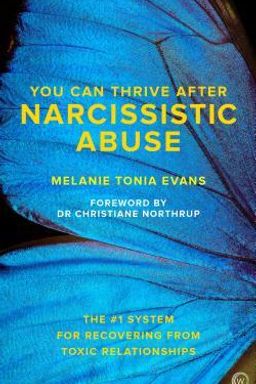
You Can Thrive After Narcissistic Abuse cover

You Can Thrive After Narcissistic Abuse

by Melanie Tonia Evans

You Can Thrive After Narcissistic Abuse offers a groundbreaking system to help survivors understand and recover from toxic relationships. Through compelling stories and practical steps, it guides readers to release past traumas, confront negative beliefs, and cultivate self-love to thrive in healthy, fulfilling relationships.

Thriving Beyond Narcissistic Abuse

What if the most painful relationship of your life could become the turning point for your greatest transformation? In You Can Thrive After Narcissistic Abuse, Melanie Tonia Evans argues that escaping the torment of toxic relationships isn’t just about surviving—it’s about transcending. She contends that recovery from narcissistic abuse must reach beyond intellectual understanding or traditional therapy; it requires an inner energetic and spiritual revolution that heals trauma at its root.

Evans, who endured the devastation of marriage to a malignant narcissist, offers what she calls the Thriver Model—a system that shifts victims from perpetual pain to peace, from survival to thriving. Through her own near-breakdown and renewal, she discovered Quanta Freedom Healing, a subconscious energy method that releases trauma from the body. Her core message: the key to recovery isn’t understanding the narcissist—it’s healing yourself on the deepest level.

The New Paradigm: From Surviving to Thriving

Most traditional recovery keeps victims in survival mode: learning about narcissism, setting boundaries, and managing triggers. Evans proposes something radical—total liberation. Her method helps you reclaim your soul, self-worth, and joy. The book insists that every collapse caused by narcissistic abuse is a divine invitation: a breakdown that holds the seed of breakthrough.

Evans draws parallels with trauma work by Bessel van der Kolk (The Body Keeps the Score) and Bruce Lipton’s research on epigenetics. Both show that trauma lives in the body and even the genes. Cognitive approaches can’t reach the root because trauma embeds below conscious awareness. As Evans puts it, “You can’t think yourself out of trauma; you must feel it out.”

The Thriver Journey: Ten Steps to Inner Freedom

Evans structures her system as ten sequential healing steps. These move from relieving immediate pain, to forgiving yourself and life, to releasing guilt, fear, and injustice, and ultimately, reclaiming inner spiritual power. Each step includes guided visualizations and journaling to reach the subconscious where beliefs of unworthiness and powerlessness reside. By purging this emotional debris, you make space for what Evans calls “Life Force”—the creative energy of authenticity and love.

She insists that even those with severe PTSD, anxiety, or despair can rise again if they dedicate themselves. The transformation, she says, means becoming a “source to yourself,” no longer depending on the narcissist or anyone else for love, approval, security, or survival.

A Revolution in Healing

Traditional talk therapy helps some survivors manage symptoms, but Evans charges that it fails to remove trauma’s energetic imprint. Quanta Freedom Healing—rooted in the body’s wisdom and quantum physics—is designed to reach the unconscious neural wiring. She explains it as communicating with the body’s intelligence, gently releasing traumatic energy, and replacing it with peace. Many of her clients, she claims, experienced relief within weeks after years of stagnation.

While Evans integrates spiritual language (Source, Life Force, God), she emphasizes that you don’t need a specific belief—just connection to something greater than fear. This aligns with holistic healers like Louise Hay and Joe Dispenza, who also teach that energy follows intention, and that consciousness can reprogram biology.

Why This Matters

Narcissistic abuse is an overlooked epidemic, affecting families, workplaces, and societies. Victims lose their health, wealth, and sense of self. Evans reframes this not as a curse, but as a collective wake-up call to heal human relationships. Her book empowers readers to shift from victimhood to victory, modeling generational change for children and communities. “When we heal,” she writes, “we heal the world.”

This first key idea lays the foundation for all others. The following sections explore how narcissism develops, why empaths attract abusers, and how Evans’ ten-step Thriver system systematically releases pain, replaces it with power, and rebuilds a new identity based on self-love, authenticity, and spiritual awakening.


Understanding Narcissistic Abuse

Evans defines narcissistic abuse not as normal conflict or ego clashes, but as “soul rape”—a form of psychological possession that erodes your identity. The narcissist’s behavior, she explains, stems from a collapsed inner self that survives by siphoning energy—attention, approval, money, and emotion—from others. The result: a cycle of idealization, devaluation, and discard that leaves victims traumatized and confused.

Narcissism as a Generational and Epigenetic Disease

Drawing from neuroscience and epigenetics, Evans cites research by Rachel Yehuda and Michael Meaney suggesting trauma can be inherited across generations. In her view, narcissism is not just a personality disorder but an energetic disease of disconnection—passed down when children don’t receive unconditional love or boundaries. Without a stable “inner identity,” they create a false self—a mask of superiority that hides a core of shame and emptiness.

She writes, “In a narcissistic world, image replaces essence.” This critique echoes Erich Fromm’s The Sane Society and mirrors modern culture’s obsession with external validation. The narcissist is simply the extreme manifestation of a collective wound.

Five Core Signs of Narcissism

Evans identifies consistent red flags: emotional insecurity, entitlement, circular arguments, pathological lying, and blame-shifting. Her vivid examples make these traits tangible: a jealous partner demanding proof of loyalty, a boss rewriting history, or a friend twisting blame until you doubt your sanity. These behaviors, she notes, are not occasional lapses—they define the narcissist’s survival method.

Understanding these signs isn’t about labeling others; it helps you disconnect from the trap of trying to win their approval. “You can’t argue with a narcissist any more than you can teach a wolf to be vegan,” she quips—reminding readers that the path forward is detachment, not education.

The Energetic Cost of Engagement

Evans stresses that continual exposure to narcissistic abuse triggers chronic stress responses—adrenal fatigue, PTSD, insomnia—and even cellular changes. Borrowing concepts from Dr. Bruce Lipton’s The Biology of Belief, she argues the body literally records trauma as chemical addiction. Victims become hooked on the emotional highs and lows, like gamblers unable to leave the table. Awareness alone isn’t enough; liberation requires breaking the body-level addiction through somatic healing.

Ultimately, Evans reframes narcissistic abuse as a spiritual crisis. It calls you back to self-partnership, to stop seeking completion externally. By comprehending what narcissism truly is—an energy of void—you learn that your healing lies not in fixing them, but in reclaiming your own light.


Why We Attract Narcissists

One of Evans’ boldest claims is that we unconsciously attract narcissists as opportunities for growth. This is not victim-blaming—it’s empowerment. She invites you to see that relationships mirror your unhealed wounds. Until you become a full source of love, approval, security, and survival to yourself, you’ll keep drawing people who reflect where those energies are missing.

Nine Traits of Susceptibility

Based on thousands of coaching cases, Evans lists nine common susceptibilities among empathic people: fear of rejection (CRAP—criticism, rejection, abandonment, punishment), overreliance on approval, guilt-driven caretaking, workaholism, difficulty setting boundaries, self-criticism, and the need to fix others. These reflect a conditional self-worth often programmed during childhood.

For example, her client Anne grew up with a demanding father and invisible mother, learning to earn love through service. In adulthood, she kept repeating that dance with narcissistic bosses and partners. Healing, Evans insists, requires finding the inner child behind those patterns and teaching her that she no longer has to trade her soul for connection.

From Victim to Thriver

Evans reframes attraction as an invitation to evolve: “The person who ripped you apart is the messenger who shows where you’re still apart from yourself.” Instead of asking “Why me?” she encourages asking “What’s in me that needs healing?” This echoes spiritual teachers like Pema Chödrön and Eckhart Tolle, who also describe pain as the portal to awakening. Through this lens, every betrayal becomes a classroom for self-evolution.

When you release self-abandonment and become emotionally sovereign, the energetic resonance with narcissists ends. You don’t repel them with anger—you simply disinterest them. “They can’t feed on light,” Evans writes. The once magnetic dynamic dissolves because you no longer vibrate at that frequency of lack.

A Spiritual Contract for Growth

Evans likens this transformation to alchemy: turning emotional lead into gold. The narcissist, while destructive, catalyzes your awakening to unconditional self-love. Once healed, you no longer fear future predators. Instead, you thank your experience for birthing a wiser, freer self. “The gift,” she concludes, “is becoming the person who no longer needs to ask for love—you are love.”


The Thriver Model of Healing

Evans’ Thriver Model is the heart of her system—a framework that guides survivors from emotional fragmentation to empowerment. Unlike traditional recovery, which often maintains a victim identity, the Thriver Model teaches self-partnership and energetic release. It rests on what she calls the Quantum Law: so within, so without. External reality mirrors internal vibration.

Three Stages of the Thriver Path

  • Survivor: You’ve escaped the narcissist but still carry trauma, fear, and stories about injustice.
  • Builder: You begin releasing wounds, reclaiming boundaries, and seeing your patterns.
  • Thriver: You’ve transmuted pain into power, radiating peace and attracting healthy people automatically.

Evans insists this is not mere self-help theory; it’s a step-by-step inner technology. Using her Quanta Freedom Healing modules, she instructs you to feel a painful emotion, locate it in the body, release its energetic density through visualization, and fill the empty space with divine light. Each release reprograms the subconscious, replacing fear and shame with inner calm.

The Ten Steps to Healing

Her ten structured steps make the abstract process tangible: 1) Release immediate pain and loss, 2) Release the illusion of the narcissist as your source, 3) Forgive yourself and life, 4) Heal injustice and betrayal, 5) Let go of the fight for justice, 6) Stop taking responsibility for the narcissist, 7) Connect to spiritual empowerment, 8) Heal the fear of what they may do next, 9) Release the energetic tie, and 10) Realize your liberation and truth. Each phase dissolves a deeper layer of dependency, enabling the birth of your authentic self.

The Somatic Science of Transformation

Evans links her method to the neuroscience of memory and emotion, referencing Dr. Joe Dispenza’s research that new thoughts rewire neural pathways. When trauma is released somatically, new synapses form to support joy and peace. “We aren’t broken,” she reminds readers, “we’re simply full.” Empty the old energy, and wholeness emerges naturally.

Ultimately the Thriver journey is not about revenge or even forgiveness—it’s about energetic reclamation. As she tells her students, “When you stop fighting darkness and become light itself, darkness dissolves by default.”


Breaking the Trauma Bond

Why is it so hard to leave a narcissist, even when you know the relationship is destroying you? Evans explains this paradox through the lens of biology. Trauma bonds are chemical addictions linking you to the abuser. Every abuse–reward cycle floods your body with stress hormones and neuropeptides that mimic narcotic highs. When you try to end contact, you literally go into withdrawal.

The Peptide Addiction Loop

Drawing from Dr. Candace Pert’s discovery that emotions produce cellular addiction, Evans shows how victims chase painful emotional hits. Your body “craves what it knows.” If you grew up around criticism or chaos, calm feels unsafe. That’s why you may obsess over the narcissist’s next text while ignoring self-care. Healing, then, means breaking the physiological loop by giving the body new emotional nutrition—peace, safety, joy.

Evans compares recovery to detoxing from a drug. Going No Contact is the equivalent of rehab. Modified Contact, if children are involved, requires emotional quarantine—gray rock behavior that starves the narcissist of drama. Meanwhile, self-partnering fills the void left by the drug of trauma.

No Contact as Sacred Boundary

Evans warns that breaking No Contact is like “an alcoholic taking another drink.” Every text reopens energetic wounds and rehooks the addiction. Her mantra—“less thinking, more shifting”—means when obsessions arise, you turn inward and release the feeling instead of analyzing it. Over time, craving fades. The narcissist loses psychic hold because your body no longer vibrates at their frequency.

Client stories throughout the book—women like Margaret or Kevin, men like Roger—show that once trauma bonds dissolve, even legal intimidation loses power. Narcissists sense the lack of emotional supply and retreat. The ultimate revenge, Evans smiles, “is a life that no longer remembers their name.”


Spiritual Empowerment and Higher Consciousness

After the body heals, the spirit awakens. In the later chapters, Evans guides readers to connect with what she calls the Life Force—a universal intelligence that partners with you once trauma is cleared. Healing then becomes a co-creative process where intuition replaces fear, and you experience synchronicities guiding you toward purpose.

Becoming Source to Yourself

Evans asserts that true freedom arises when you no longer rely on others as your emotional source. This doesn’t mean isolation; it means generating love and security from your own connection to Life. As her client Jess discovered, dependency on relationships for validation faded once she embodied self-love. She stopped attracting controlling partners and began cultivating genuine friendships. “When you stop chasing, you magnetize,” Evans writes.

Quantum Creation and Wholeness

Citing Joe Dispenza’s concept that “emotions create future realities,” she teaches readers to inhabit gratitude and self-worth before external success appears. The Thriver doesn’t wait for life to change—they become the frequency of change. This shift, Evans claims, yields not only peace but prosperity: clients report improved health, relationships, and finances once they embody inner wholeness.

From Fear to Faith

A major milestone of thriving is surrender—trusting that Life, not the narcissist or circumstances, governs outcomes. When fear arises, Evans instructs you to meet it with the four powerful truths: “Everything happens for me, not to me. Breakdown births breakthrough. My healing heals others. Life supports me when I align with it.” This perspective reframes trauma as sacred initiation, transforming survival into purpose.

By reconnecting to Source, you reclaim the power to create consciously rather than reactively. Evans calls this the quantum leap from victimhood to divinity—a state where peace becomes your default, not your goal.


Healing Future Generations

Evans’ work extends beyond individual recovery; it’s about ending the transgenerational cycle of abuse. She devotes the final part of her book to families and collective healing, showing how one person’s inner work can transform entire lineages. Her message: when you heal yourself, you heal your children—and even your ancestors—through energetic resonance.

Parenting as Energy Leadership

Evans urges parents to model emotional authenticity, not perfection. When children witness you cry, heal, and rise, they learn resilience and self-regulation. Hiding pain teaches shame; facing it models courage. Her own story with her son Zac—who spiraled into addiction during her abuse years—illustrates this. Once she healed herself, Zac recovered and eventually joined her company’s leadership. Their bond embodies her principle: “Heal yourself first; they will follow.”

The Collective Thriver Shift

Evans proposes that humanity stands at a crossroads between domination and collaboration. Narcissism represents the dying paradigm of power-over; thriving symbolizes the next era of co-creative consciousness. As more individuals self-partner and release trauma, societies shift toward empathy, equality, and sustainability. Healing, she says, is the most radical activism there is.

From Breaking to Building

The Thriver Mission, now practiced globally, represents a new model for collective evolution. Victims move from forums of complaint to communities of creation. Evans describes parents using NARP with their children by proxy, seeing miraculous improvements in behavior and health. She calls it “ripple healing”: every trauma cleaned up in one body uplifts humanity’s energetic field. “We are all cells of one body,” she reminds us, “and when one cell heals, the whole organism improves.”

Her closing invitation is both intimate and cosmic: dare to become the generation that ends abuse. Heal the trauma, embody light, and show your children that love—real, resilient love—is the new normal.

Dig Deeper

Get personalized prompts to apply these lessons to your life and deepen your understanding.

Go Deeper

Get the Full Experience

Download Insight Books for AI-powered reflections, quizzes, and more.