
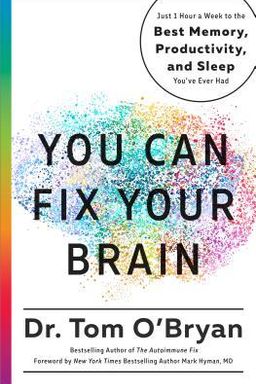
You Can Fix Your Brain cover

You Can Fix Your Brain

by Tom O'Bryan

You Can Fix Your Brain provides a comprehensive guide to enhancing cognitive function. By addressing inflammation, diet, and environmental factors, Dr. Tom O''Bryan empowers readers with strategies to reduce brain fog, boost memory, and achieve mental clarity.

Healing the Brain by Healing the Body

How can you protect your brain from degeneration, anxiety, or fog long before symptoms appear? In The Autoimmune Fix and its expanded works, Dr. Tom O’Bryan argues that the brain is not a separate organ to be medicated—it’s part of an interconnected ecosystem involving the gut, immune system, environment, and structural health. The central argument is simple but profound: if you want a healthy brain, you must look upstream and heal the systems that feed and protect it.

Dr. O’Bryan expands the definition of autoimmunity beyond disease diagnosis. Autoimmunity, he explains, is a spectrum of excessive immune activity that can remain invisible for years. Your immune system, trying to defend you, can sometimes make misfires—especially through molecular mimicry—attacking tissues that resemble foreign invaders. This becomes catastrophic when the target tissue is your brain.

Autoimmunity as a Process, Not a Disease

You have multiple immune systems—the gut, liver, circulating white cells, and brain’s glial network—and each interacts continuously. When chronic triggers like food peptides (e.g., gluten fragments), toxins, infections, or trauma keep activating immunity, antibodies persist long after the trigger is gone. That long persistence quietly degrades tissue, which explains why symptoms of autoimmunity often show up years later as Alzheimer’s, anxiety, or learning disorders. (In O’Bryan’s clinic data, those with elevated wheat antibodies frequently had brain antibodies, showing the bridge between food and neurological injury.)

The Upstream Triggers: Gut, Barrier, and Toxins

You start with the gut—the center of 70% of your immune power. When the intestinal lining becomes permeable, large molecules leak through (“leaky gut”), triggering antibodies that can later cross-react in the brain (“leaky brain,” or B4). Physical trauma, gluten, mold, heavy metals, or pollution can all damage the blood-brain barrier. Once that happens, glial cells release a “bazooka response,” creating inflammation that gradually kills neurons.

Toxins multiply the threat. O’Bryan uses the metaphor of a body-burden glass: every exposure—BPA, phthalates, lead in bone, or mold spores—fills it. When it overflows, the immune system becomes reactive, attacking self-tissue. He shows how neo-epitopes (new immune targets formed when chemicals bind proteins) convert harmless molecules into autoimmune triggers. His practical advice includes avoiding plastics, filtering air and water, and testing for heavy metals or mycotoxins to locate hidden exposures.

Biomarkers and Predictive Autoimmunity

What’s revolutionary here is the concept of predictive autoimmunity. If you identify antibodies to brain or barrier proteins early—S100B, NSE, TG6, MBP—you can intervene before the damage becomes irreversible. Dr. O’Bryan calls these antibodies “messengers from the future.” Panels like Vibrant’s Neural Zoomer or Cyrex Arrays 10–12 quantify immune activity against dozens of brain-related antigens, giving you a roadmap for prevention. (Note: in functional medicine, this anticipatory focus mirrors Dale Bredesen’s multi-target Alzheimer’s protocol—a convergence of systems biology and clinical practice.)

Structure, Movement, and Mind as Co‑Therapies

A structural dysfunction (a misaligned spine, disk impingement, or chronic forward-head posture) reduces blood flow and increases inflammation—a surprising but crucial driver of brain decline. Through patient stories like Anna and Larry, O’Bryan demonstrates how correcting physical structure restored cognition and organ function. Exercise and posture become not fitness trends but neurologic therapies: daily 30-minute aerobic sessions sustain oxygen flow, reduce endotoxin buildup, and promote neurogenesis.

Mind-set completes the triad. How you think modulates stress hormones and gene expression. Breathing, meditation, gratitude, and intentionality aren’t side notes—they reshape neurochemistry and create the hormonal environment where new habits can form. “Progress, not perfection,” he writes, is the mantra that turns change into a sustainable practice.

The Pyramid of Health and Base-Hit Living

Dr. O’Bryan’s Pyramid of Health integrates four dimensions—Structure, Biochemistry, Mind‑set, and Electromagnetics—derived from George Goodheart’s “Triangle of Health.” If one side collapses (a misaligned spine, poor diet, chronic stress, EMF overload), the system tilts and the brain suffers. His philosophy of “base hits” encourages incremental wins: walking daily, removing gluten, turning off Wi‑Fi at night, choosing clean food and air, and committing one hour weekly to self‑care. These small consistent acts compound into resilience.

The Core Promise

When you understand the interconnected web—gut permeability, toxin load, immune cross‑reactivity, and structural flow—you get a roadmap to regenerate the brain decades before irreversible damage. Dr. O’Bryan’s central promise is hopeful: your brain can heal if you track biomarkers, clear exposures, align your structure, nourish your gut, control inflammation, and cultivate a kind, intentional mind. The future of brain health lies not in pharmaceuticals but in how you live each day.


Autoimmunity and Molecular Mimicry

Dr. O’Bryan teaches that autoimmunity is not a malfunction—it’s an overperformance. Your immune system’s soldiers (IgA, IgG, IgE, IgM, IgD) protect you constantly, but when they misidentify “friend” as “foe,” the result is collateral inflammation and tissue loss. The misfire that connects food to disease is molecular mimicry: a foreign peptide resembles your tissue sequence and tricks antibodies into attacking you.

How Molecular Mimicry Works

Suppose you eat a wheat peptide, alpha‑gliadin, with the amino sequence A‑A‑B‑C‑D. Your immune system produces antibodies to A‑A‑B‑C‑D. If a cerebellar protein shares that sequence, the antibodies cross‑react, attacking brain tissue. That’s how gluten can trigger cerebellar ataxia or cognitive decline. O’Bryan’s clinic data revealed over a quarter of patients with wheat antibodies also had antibodies to cerebellum and myelin basic protein—a tangible link between diet and neuroautoimmunity.

From Normal Clearance to Pathologic Attack

Autoantibodies normally clear aged cells; but when continual antigenic stress (food fragments, chemicals, infections) amplifies the process, you begin losing cells faster than you regenerate. This movement along the autoimmune spectrum—from subtle dysfunction to disease—is measurable. With targeted functional testing (Cyrex Arrays or Neural Zoomer), you can locate immune provocation early and change the trajectory.

Key insight

Inflammation is your immune system’s survival mode. To heal, you must stop adding fuel—remove the triggers before your antibodies make lasting scars.

Case Lessons and Prevention

Leona’s scleroderma and brain fog reveal generational toxin transmission; Kelly’s adolescent psychosis reversed with wheat removal; and Dale Bredesen’s Alzheimer’s protocol illustrates multi-trigger intervention. These examples prove that identifying the root cause—food, toxin, infection, trauma—lets you exit the autoimmune spiral. Predictive autoimmunity isn’t fear‑based; it’s empowerment through early measurement and intelligent prevention.


Gut and the Second Brain

Your gut is not just a digestive tube—it’s your second brain. This 25‑foot system holds most of your immune defenses and directly influences mood, cognition, and behavior. When this “cheesecloth” lining tears, inflammation begins, and so does neurological decline. Dr. O’Bryan and others (like Michael Gershon) highlight how gut permeability and dysbiosis are root causes of nearly every chronic brain condition.

Microbiome and Brain Communication

Your microbiome, five pounds of microbes, sends nine messages up to the brain for every one down. When balanced, it regulates serotonin (90% made in the gut), cortisol, and immune signals. When dysbiotic (too many Firmicutes, too few Bacteroidetes), it produces inflammatory cytokines and toxins that widen intestinal gaps. The resulting LPS leakage activates systemic autoimmunity and can initiate blood‑brain barrier breakdown (B4).

Food Peptides and Neurological Impact

Some peptides behave like opiates. Gluten yields alpha‑gliadin fragments that alter GABA metabolism; dairy yields casomorphins that act on brain receptors. A child like Kelly recovered from psychosis in one week after gluten removal—proof that food can act like a drug. Once inflammatory peptides are identified and removed, immune tone normalizes, and mood stabilizes.

Repairing the Gut

Begin with a one‑week food log to identify the Big Three offenders (wheat, dairy, sugar). Add fermented foods and cruciferous vegetables to rebuild flora. Support gut cells with colostrum, vitamin D, glutamine, and omega‑3s. Use digestive enzymes (like E3 Advanced Plus) that completely break food proteins before they reach immune sentries. Every meal can be either therapy or toxin—you choose which side of inflammation you stand on.

Core insight

A leaky gut equals a leaky brain. Rebuild your intestinal barrier and microbiome, and you build the foundation for cognitive renewal.


Toxins, Barriers, and Hypoperfusion

Your brain’s safety net—the blood‑brain barrier—is as fine as silk and fiercely defended by glial cells. Yet B4, the breach of that barrier, is common. It lets large molecules and toxins in, causing inflammation and hypoperfusion (starved blood flow). Dr. O’Bryan identifies concussion, gluten, mold, pollutants, and AGEs as frequent culprits. Even minor, repeated trauma (like soccer headers) can make the barrier porous, explaining high CTE rates among athletes.

Diagnosing a Leaky Brain

When proteins like S100B and NSE appear in blood, they signal BBB damage. Testing antibodies to these markers can reveal early neuroinflammation years before MRI findings. O’Bryan recommends routine panels (Neural Zoomer, Cyrex Arrays) to catch this “silent leak.” If hypoperfusion occurs—oxygen and glucose drop—neurons starve. Celiac patients often display hypoperfusion in 4 of 12 regions, reversible by a wheat‑free diet within a year.

Environmental and Internal Burdens

The body burden metaphor—a glass slowly filling with chemicals—is powerful. BPA acts as estrogen, heavy metals reside in bone for decades, and mold toxins infiltrate air and food. When storage exceeds clearance, inflammatory cascades erupt. Patients like Sabina (autoimmune myofasciitis from tattoo ink) and Steve (mold‑triggered brain fog) exemplify how identifying exposures leads to recovery.

Practical Action

  • Filter water and air, avoid plastics, minimize charred foods.
  • Support detox with crucifers, methyl donors (B12, folate), and glutathione boosters (NAC, selenium).
  • Measure exposure—heavy‑metal challenges and mycotoxin panels help quantify burden.

Healing starts by turning off the spigot: remediation first, then detox. Once load decreases, the immune system quiets, bloodflow restores, and the brain begins its slow repair.


Structure, Movement, and the Spine‑Brain Link

Structure anchors every other pillar of health. Your spine and posture directly influence blood‑brain flow, nerve conduction, and inflammatory tone. Misalignments compress foramina (“sliding doors”) through which nerves exit, narrowing their passage until organs and cognition falter. Anna’s 25‑year pelvic dysfunction resolved only after spinal correction; Larry’s word retrieval improved when cervical posture was fixed.

Aerobic and Structural Therapy

Movement is medicine. O’Bryan prescribes 30 minutes of aerobic exercise six days weekly in your calculated heart range (180 − age ± 5). Keep a pulse monitor alarm to stay consistent. This steady practice enhances oxygen delivery, clears toxins, and stimulates neurogenesis—even for ApoE4 carriers. Structural therapies like chiropractic, cranial-sacral, or Rolfing augment these effects by restoring mechanical symmetry.

Posture Habits

  • Perform pillow yoga before sleep—a towel under neck, pillow under knees.
  • Adjust car seats to 90 degrees, not reclined, to prevent forward‑head strain.
  • Track micro‑changes (rearview mirror test) to monitor spinal compression.

Key principle

Structural integrity preserves neurologic integrity. Correct posture and movement before searching for chemical solutions.

Combine daily movement with hydration (½ oz per pound body weight). These baseline practices—simple yet profound—protect the spine, stabilize nerves, and create sustained brain vitality.


Mind, EMFs, and the Invisible Dimensions

The final two sides of O’Bryan’s Pyramid—Mind‑set and Electromagnetics—describe invisible forces shaping health. Your thoughts regulate hormones; electromagnetic fields shape cell redox balance. Together they explain why lifestyle change must include both psychological and environmental awareness.

Mind‑Set and Belief Physiology

Placebo science reveals measurable changes: belief activates brain regions that modulate pain and optimism. O’Bryan illustrates how reframing (“You have dysfunction, not disease”) transforms cortisol patterns. Hourly gratitude breaths, meditation, and deliberate intention realign stress hormones. Intentionality affects digestion and immune responses—gratitude while eating produces better metabolic outcomes than resentment.

Electromagnetic Pollution

EMFs from phones, routers, and wiring add oxidative stress. Hardell’s studies show increased glioma risk with close, long‑term mobile use. Children absorb more radiation due to thinner skulls. Distance reduces exposure exponentially: one inch cuts absorption by 66%. O’Bryan’s advice—use wired headsets, keep phones off body, turn off Wi‑Fi at night—is low‑cost and protective.

Practical Mental and Environmental Care

  • Meditate 10–20 minutes daily; track gratitude.
  • Turn off routers, relocate electronics from bedside.
  • Maintain mental hygiene: journaling or breathwork neutralizes stress triggers.

O’Bryan’s message threads through all layers: invisible choices matter. A calmer mind and reduced EMF load create the biochemical peace in which real physical healing becomes possible.


Behavior Change and the Base‑Hit Strategy

Dr. O’Bryan ends the book with how to apply all this science. Transformation happens through “base hits” — small, measurable actions that stack over time. Using the DiClemente‑Prochaska model, he guides you from pre‑contemplation to maintenance. You begin where you are and move gradually toward mastery.

Stages and Weekly Wins

Weeks 1–12 include progressive steps: core exercises, breathwork, three‑week gluten/dairy/sugar elimination, EMF mitigations, tracking biomarkers, and acknowledging victories. Each week builds competence and confidence. The mantra “Progress, not perfection” makes relapse part of learning, not failure.

Tools and Feedback

  • Use objective metrics—step counts, pulse monitors, follow‑up antibody panels—to measure improvement.
  • Celebrate small wins—new energy, stable mood, better sleep.
  • Work with accountability partners or practitioners for sustained change.

Guiding principle

Base hits win the ball game. One hour a week, consistently, can outmatch a lifetime of shortcuts and quick fixes.

Behavior change is the bridge from knowledge to transformation. Through structure, nutrition, detox, mind‑set, and tracking, you build health as a compound investment. This closing framework reminds you: healing is cumulative, compassionate, and entirely possible.

Dig Deeper

Get personalized prompts to apply these lessons to your life and deepen your understanding.

Go Deeper

Get the Full Experience

Download Insight Books for AI-powered reflections, quizzes, and more.