
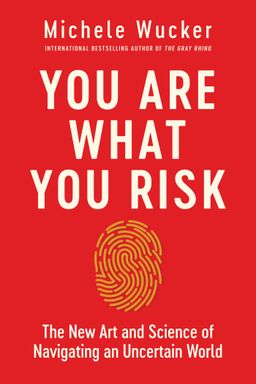
You Are What You Risk cover

You Are What You Risk

by Michele Wucker

Discover how your relationship with risk uniquely defines your life. ''You Are What You Risk'' explores the art and science of navigating uncertainty, guiding you to embrace opportunities and make informed decisions that shape your future.

Understanding Your Relationship with Risk

Every person, organization, and society carries a distinct pattern of how they recognize, respond to, and manage uncertainty. In Michele Wucker’s work on risk, she argues that learning to understand this pattern—your risk fingerprint—is essential for making better choices in every part of life. Risk is not simply about danger or gambling; it is about how you relate to change, opportunity, and responsibility. The book connects self-awareness, psychology, culture, and global policy to show how you can turn fear into informed action.

Wucker’s central claim is that risk is deeply personal and social. Your reactions arise from layered influences—your personality traits, life experiences, cultural environment, and the institutional “ecosystem” that supports or exposes you. She builds an integrated language that moves from the micro (brain chemistry, emotions, habits) to the macro (economic systems, generational patterns, and global cooperation).

Risk as Identity

Your risk fingerprint mirrors your identity. It reflects how you notice threats, how much anxiety or curiosity they provoke, and how far you’ll go to act. Wucker connects this to personality science—especially the Big Five traits and Geoff Trickey’s Risk Type Compass—and shows how our fingerprints differ by domain. One person may take entrepreneurial risks but avoid health risks; another may face physical danger calmly yet fear financial instability. These contrasts are not inconsistent—they stem from experience and emotional context.

The Role of Emotion and Physiology

Risk decisions aren’t just cognitive. Your body detects uncertainty before your rational mind. Hormones like adrenaline and cortisol shape fear and focus, while dopamine and serotonin influence reward and curiosity. Trader-turned-biologist John Coates found market fluctuations mirrored hormonal levels more accurately than traders’ conscious judgments—a reminder that self-monitoring matters. Wucker draws practical lessons: use breathing, sleep, and biofeedback to calibrate stress and avoid impulsive mistakes. Emotional calibration doesn’t mean removing feelings—it means reading body signals as part of decision intelligence.

Perception and Probability

Quantitative risk models can deceive you. Philosophers like Pascal, Bernoulli, Knight, and Keynes showed that uncertainty operates on two levels: measurable risk (probabilities you can calculate) and true uncertainty (events you cannot predict). Wucker warns against the “Knightian fallacy”—trying to quantify everything. When numbers mislead, resilience and redundancy matter more than precision. You must learn to distinguish subjective risk (how risky something feels) from objective risk (its actual statistical likelihood) and notice the biases—availability, dread, voluntariness—that distort perception.

Framing: Gray Rhinos and Black Swans

Wucker’s signature metaphor, the gray rhino, describes visible, probable, high-impact risks that societies often ignore until it’s too late. Unlike black swans—rare surprises popularized by Nassim Taleb—gray rhinos are predictable and require timely action, not excuses. The metaphor has real-world policy power: China’s 2017 financial reform explicitly labeled looming threats as gray rhinos, prompting immediate market discipline. Personally, labeling a risk—a failing marriage, chronic health issue, or debt spiral—as a gray rhino helps mobilize action instead of paralysis.

Demographics, Culture, and Ecosystems

Risk behavior isn’t determined by personality alone. Age, income, history, and social safety nets define what risks are feasible. Poor households often avoid productive risks because failure is fatal (“risk capacity,” not just “risk preference”). National cultures reflect historical imprints: Germany’s regulatory caution, Singapore’s trust in state intervention, or New Zealand’s empathetic crisis leadership under Jacinda Ardern each express collective fingerprints. Corporate cultures, too, define how much dissent or experimentation employees can tolerate. When ecosystems distribute downside fairly—through insurance, social policy, or shared norms—they unleash creative risk-taking.

Developing Risk Literacy

The COVID-19 pandemic revealed what happens when risk perception and efficacy information diverge. People misjudged infection and mortality probabilities, and those errors mapped onto emotional responses and political identities. Wucker argues that risk literacy—the ability to interpret probabilities, evidence, and behavioral impact—is a collective asset. Leaders must pair emotional appeal with actionable guidance (“We’re a team of five million,” Ardern told New Zealanders) so citizens feel agency rather than helplessness. The same logic applies to mental health: emotional risks deserve equal literacy and preventive focus.

Action and Reinvention

Most importantly, you can reshape your personal risk relationship. Change happens through motivation, necessity, or realization—as shown in Coss Marte’s journey from incarceration to entrepreneurship or Jennifer Barc’s coaching model. Building a diversified risk portfolio—skills, savings, networks, and mentors—creates a “risk umbrella” that supports growth while guarding against collapse. Peer communities like coworking spaces (Nicole Vasquez, Mike LaRosa) extend that safety net through trust and collaboration. The final message: risk is not the enemy of stability; unmanaged fear is. Mapping your fingerprint and ecosystem makes you capable of taking meaningful, responsible risks that expand your life and collective resilience.


Your Risk Fingerprint

Your risk fingerprint is the unique pattern that defines how you notice and respond to uncertainty. Wucker breaks this down into three layers—personality, experience, and ecosystem—and shows how they interact to create a recognizable decision style across domains. Once you know your fingerprint, you can choose risks deliberately instead of reacting blindly.

Layer 1: Personality

The Big Five personality traits form the base of risk identity, but their influence depends on context. Extroverts may take social risks easily but avoid financial exposure. Tools like Geoff Trickey’s Risk Type Compass offer granularity beyond generic “risk-aversion” labels, placing you on spectra such as calm vs anxious or impulsive vs deliberate. Organizations use these profiles to build balanced teams—pairing visionaries with executors—to turn personality differences into strength.

Layer 2: Experience

Life experience shapes your comfort zones. Wucker recalls her grandmother “Bobonne,” who hoarded food after wartime scarcity but avoided surgery despite medical danger. Each experience leaves domain-specific scars: high caution in one area, boldness in another. Your personal history conditions risk sensitivity—and recognizing these domains helps prevent overgeneralizing fear or overconfidence.

Layer 3: Ecosystem

Your environment—culture, institutions, and policy—defines what choices are feasible. A strong social safety net expands risk capacity; fragile institutions compress it. Families, laws, and workplace cultures all shape risk tolerance. Megan and Marty Bhatia’s world-traveling family built portable skills and financial buffers to turn apparent danger into calculated adventure—an example of ecosystem design offsetting perceived risk.

Core applications

Map your fingerprint to explain why you fear some uncertainties but not others. Use this awareness to design safety nets, negotiate team roles, and practice risk habits that reshape behavior over time.

Wucker’s point is empowering: your fingerprint isn’t destiny. Through awareness, you can preserve what serves you and change what limits you. Risk becomes not a static label but a dynamic skill you can refine with practice.


How Emotion and Perception Distort Risk

You don’t perceive risk neutrally; you filter it through emotion, control, and fairness. Psychologist Paul Slovic’s model identifies factors like voluntariness, controllability, immediacy, novelty, dread, and equity as key drivers of subjective risk. Wucker explains how these emotions—sometimes protective, sometimes misleading—shape your everyday decisions.

Voluntariness and Control

You tolerate voluntary risks up to a thousand times more than imposed ones. Chauncey Starr’s research explains why you feel comfortable skydiving but resent environmental hazards. ER nurse Matthew Tweardy-Torres faced involuntary COVID exposure, managing it through procedural control—proof that perceived agency changes emotional response.

Availability and Surprise

New or vivid risks hijack attention. Media amplifies rare events, skewing judgment. Ben “Lucky” Schlappig’s comfort flying the 737 Max contrasted with his family’s fear—their response shaped by shock and unfamiliarity, not data. Knowledge tempers panic by translating novelty into understanding.

Fairness and Moral Emotion

When a risk feels unjust, you inflate its danger. Barbara Sarnecka’s study of moral outrage over Danish parenting norms showed how resentment magnifies perceived risk. Emotional fairness, not probability, drives many responses—from outrage at corporate misbehavior to anxiety about unequal exposure.

Using Emotional Insight

Wucker suggests pausing to name emotional drivers before deciding: Is this risk voluntary? controllable? new? dreadful? Facing these questions detaches bias from decision. Calibration comes from comparison—asking “risky compared to what?”—and collecting multiple viewpoints to normalize judgment.

Emotion isn’t an error; it is information. When you align emotional cues with rational analysis, you gain balanced intuition—the ability to recognize real threats without falling for false ones.


Framing Risks You Can Act On

Language determines whether you freeze or act. Wucker’s concept of the gray rhino reframes big, visible risks as solvable problems. When you name a danger clearly, you trigger accountability and urgency. This framing contrasts with black swans—unpredictable shocks that demand resilience, not prevention.

In policy, China’s leaders used the gray rhino metaphor to spotlight looming financial bubbles; hearing the term motivated concrete reform. In personal life, readers applied it to neglected relationships, ignored health issues, and unsustainable finances. Labeling the obvious forces honesty and action.

Practical Classification

Wucker recommends sorting threats into categories: gray rhinos (obvious and plausible), black swans (unforeseeable), or hybrids. For gray rhinos, set deadlines and responsibility lines. For black swans, build redundancy and psychological resilience. Mixed cases require both: planning for the likely and cushioning against the rare.

Accountability by Framing

Framing creates emotional engagement. A “rhino charging” is impossible to ignore. The metaphor democratically empowers: anyone can spot gray rhinos in their community—climate change, debt, burnout—and take preventive steps. Language transforms procrastination into agency.

Actionable takeaway

Use framing deliberately: name a risk, own its visibility, and pair fear with specific actions. When you treat a problem as foreseeable, you unlock political will and personal motivation to confront it.

Ultimately, framing isn’t semantics—it is strategy. The words you choose dictate whether risks stay invisible excuses or become manageable projects.


Culture, Fairness, and Who Bears the Downside

Every society decides who bears the cost of failure. Wucker argues that this moral dimension—who carries the downside—is central to designing fair and resilient systems. When risk is pushed onto the vulnerable, creativity collapses. When it’s shared equitably, innovation thrives.

National and Corporate Fingerprints

Nations express their collective risk culture through institutions and history. Germany’s engineering conservatism reflects trauma-driven predictability; Singapore’s state-backed trust enables decisive reform; New Zealand’s pandemic success under Jacinda Ardern shows empathy as risk governance. Corporations mirror similar choices: shareholder primacy versus stakeholder purpose. The 2019 Business Roundtable statement—and firms like Ellevest or Patagonia—signal a shift toward ethical risk distribution.

Ethical and Structural Implications

Marina Krakovsky distinguishes admirable risk bearers—those who absorb uncertainty for others, like publishers or community lenders—from predatory ones who shift danger unfairly. Designing who bears risk affects productivity and justice alike. Social insurance, health care, and safety nets expand risk capacity; predatory lending and underinsurance destroy it.

Implications for Leaders and Citizens

Wucker challenges leaders to ask “Who pays if this fails?” Contracts, bonuses, and policies should align incentives with fairness. Investors and citizens should demand accountability and transparency. Systems fairer in downside distribution produce stronger collective risk appetite—unlocking creative entrepreneurship without exploitation.

Fair risk distribution isn’t idealism; it’s efficiency. Societies that treat risk responsibility as shared moral logic end up more dynamic, trustworthy, and adaptive.


Risk at Work and Organizational Culture

Organizations are risk machines: they amplify, absorb, and transmit uncertainty through culture. Wucker explores how leadership styles, team composition, and incentives shape whether a company learns, innovates, or collapses under pressure. Risk empathy—understanding the fingerprints of your colleagues—is key to sustainable performance.

Balancing Personalities

Barb Morgan-Browning and Marc Hertz’s company thrived by turning clashing risk styles into complementary strengths. Cautious and bold partners need clear conflict protocols, not avoidance. Diversity of fingerprints prevents groupthink and builds creative tension—an advantage if it’s channeled constructively.

Psychological Safety

Amy Edmondson’s research anchors the idea: when people feel safe to speak up, they share bad news faster and innovate more responsibly. Tools like role rotation and “devil’s advocate” assignments structure disagreements. Without safety, employees hide gray rhinos and magnify surprises.

Leadership Risk

Charismatic but unchecked leaders—Uber’s Travis Kalanick or WeWork’s Adam Neumann—illustrate how personal recklessness becomes organizational crisis. Boards must define risk appetite, reward ethics, and monitor culture metrics. Principia’s research finds that belief in company purpose reduces unethical “pro-organizational misconduct.” Embedding integrity into targets and pay structures transforms risk-taking from reckless to principled.

Organizations with risk empathy balance discipline and curiosity. They reward learning from failure, protect dissenters, and turn individual fingerprints into collective resilience.


Global Risk and Shared Agency

Global risks—climate, pandemics, systemic crises—call for coordination across scales. Wucker connects personal agency with global problem-solving, arguing that local actions aggregate into systemic resilience. You act individually, but your choices contribute to collective outcomes.

From Risk Society to Participation

Drawing on Ulrich Beck’s “risk society” and Sang-jin Han’s “joongmin” idea, Wucker explains that modern risks are human-made, demanding global but participatory solutions. After the Sewol ferry disaster, Korean civic engagement illustrated rational reform by connecting citizens and institutions. That kind of engaged citizenship—bottom-up responsibility paired with institutional response—is central to solving complex risks.

Mood and Agency

Peter Atwater’s framework shows how collective mood shifts affect global cooperation. Fear narrows focus to “me-here-now,” while confidence expands to “us-everywhere-forever.” Communicating success stories restores trust and makes large-scale cooperation feasible.

Designing Global Tools

Arunabha Ghosh’s proposal for a Global Risk Pooling Fund and Climate Risk Atlas uses insurance logic to share downside internationally. Risk pooling reduces costs and encourages transparent participation—if governance prevents freeloading. Youth activism, led by Greta Thunberg and Haven Coleman, demonstrates how collective action redefines agency: fear transformed into movement creates institutional response.

The lesson: start locally, act visibly, and link your choices to systemic outcomes. When individuals believe their actions scale, global risk becomes manageable rather than paralyzing.

Dig Deeper

Get personalized prompts to apply these lessons to your life and deepen your understanding.

Go Deeper

Get the Full Experience

Download Insight Books for AI-powered reflections, quizzes, and more.