
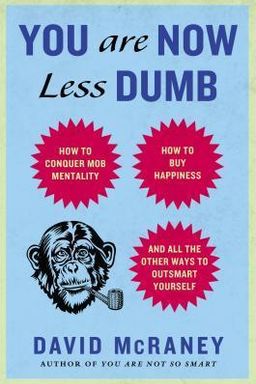
You are Now Less Dumb cover

You are Now Less Dumb

by David McRaney

In ''You Are Now Less Dumb,'' David McRaney unravels the intricate ways our brains deceive us, highlighting cognitive biases and misconceptions that shape our daily decisions. Through engaging studies and examples, McRaney offers strategies to uncover hidden truths and navigate the mental traps that often lead us astray.

Why You Are Less Dumb: Understanding Self-Delusion

Have you ever wondered why your decisions sometimes make no sense even though you feel perfectly rational? In You Are Now Less Dumb, David McRaney tackles this question head-on, arguing that while humans possess immense capacity for logic and reason, they are rarely rational in practice. The book builds on his earlier work (You Are Not So Smart) and unpacks the comforting yet dangerous idea that believing you’re logical often blinds you to the elaborate network of delusions, biases, and self-deception that define your daily life.

McRaney contends that your brain is hardwired not for truth, but for coherence and survival. You construct stories to make sense of the chaos around you—even when those stories are false. From the myths of willpower to the emotional quirks of group behavior, the book reveals how seemingly reasonable people fall prey to predictable self-delusion. Yet McRaney isn’t cynical: he argues that understanding your irrationality can help you outsmart it and, in doing so, become “less dumb.”

How We Lie to Ourselves

McRaney opens with an ancient philosophical fallacy—naïve realism, or the belief that we see the world exactly as it is. He dismantles the illusion with psychological experiments and stories, showing that perception is not a passive camera but an active construction; what you see and remember is altered by what you expect and what your brain wants to feel true. This realization forms the cornerstone of the book: you do not perceive reality—you construct an internal story about it.

Why It Matters

You are surrounded by modern tools—smartphones, databases, and algorithms—but none of them compensates for the cognitive bugs embedded in your thinking. As McRaney points out, humanity invented science precisely because our natural reasoning is so faulty. Left to our instincts, we fall for the common belief fallacy (“everyone believes it, so it must be true”), construct emotional but wrong narratives, and justify poor choices through cognitive dissonance. Understanding these mental traps is not just academic; it’s crucial for making sound personal, political, and moral decisions.

The Map of Irrationality

Across seventeen chapters, McRaney explores how the mind deceives itself through classic cognitive biases and social phenomena. You’ll meet the Benjamin Franklin Effect (you like people you’ve helped, not those who help you); the Backfire Effect (fact-checking can deepen false beliefs); Ego Depletion (willpower is finite and exhausts like fuel); and The Illusion of Asymmetric Insight (you think you understand others better than they understand you). Each chapter uses vivid anecdotes—from psychological experiments to cultural examples—to illuminate how emotion, identity, and culture distort reason.

A Rational Approach to Irrationality

McRaney aligns his narrative with thinkers like Daniel Kahneman (Thinking, Fast and Slow) and Dan Ariely (Predictably Irrational): we are predictably flawed, not hopelessly stupid. He offers practical strategies borrowed from behavioral psychology—pause before forming conclusions, question your emotional certainties, and recognize that intuition is often just bias in disguise. By examining your mental shortcuts, from superstition to social conformity, you begin to see that being “less dumb” isn’t about being smarter than others—it’s about being humbler, slower, and more curious when reasoning about yourself.

From Ignorance to Insight

What makes the book unique is its tone. McRaney writes with humor and warmth, treating irrationality not as a failure but as an unavoidable part of being human. His goal isn’t to make you cynical but to train you to spot when your brain is lying to you—so you can laugh, adjust, and learn. He reminds readers that “being less dumb” doesn’t mean eradicating self-delusion, only becoming wise enough to anticipate it. The lesson? You cannot be perfectly rational—but you can learn to reason around your irrationality.

In the end, You Are Now Less Dumb is not a manual for perfection but a realistic framework for understanding what makes us humanly flawed. In a world dominated by confident ignorance—from politics to punditry—McRaney’s message is both humbling and empowering: awareness of your own limits is the first step toward genuine wisdom.


Ego Depletion: The Biology of Willpower

Ever wonder why resisting temptation feels harder after a long day? McRaney’s chapter on ego depletion dives into one of psychology’s most fascinating (and controversial) discoveries: willpower is not infinite—it’s more like a rechargeable battery that drains as you use it. The idea stems from Roy Baumeister’s 1990s lab studies showing that self-control in one area can weaken self-control in another. McRaney uses vivid experiments involving cookies, radishes, and college students to illustrate that every decision, act of restraint, and emotional suppression burns mental fuel.

Testing Willpower in the Lab

Baumeister’s famous “cookie and radish” experiment set the stage. Hungry students were placed in a room with freshly baked cookies and a bowl of radishes. Some could eat cookies; others were forced to eat radishes. Later, all had to solve impossible puzzles. Those who resisted cookies gave up faster than cookie-eaters—they had spent their mental energy holding back desire. McRaney explains that every act of self-control drains an inner resource, often linked to blood glucose. Judges make harsher rulings before lunch, sugar restores patience, and every conscious choice burns through biochemical energy.

Social Rejection and Self-Control

Expanding on Baumeister’s later work, McRaney shows how emotional factors like ostracism also erode self-regulation. In one study, rejected students at a fake party doubled their cookie intake compared to accepted peers. When social connection breaks down, your mental system says, “Why bother regulating myself if no one cares?” He ties this to deeper human instincts—social exclusion is psychologically painful because belonging requires effort, and rejection makes restraint feel pointless.

Fuel or Psychological Process?

McRaney contrasts two competing models. The resource model claims the brain literally runs low on glucose; the process model argues the brain becomes “frugal,” conserving effort unless new motivation or reward appears. In either case, the lesson is practical: if your mental energy feels dry, rest and reward can replenish it. Avoid big decisions on an empty stomach or after emotional strain. (Similar advice appears in Kahneman’s Thinking, Fast and Slow, which warns against “decision fatigue.”)

How to Outsmart Depletion

You can’t escape ego depletion entirely, but you can manage it. McRaney suggests planning difficult choices for when your mental reserves are fresh, eating well, sleeping enough, and recognizing that self-control relies on physiological and social context. Don’t demand constant restraint from yourself; instead, recognize that your willpower is a biological resource intertwined with emotions, motivation, and even blood sugar. Being less dumb means treating your self-control like fuel—use it wisely and refuel regularly.

Key Lesson:

Willpower isn’t just a matter of discipline—it’s a finite blend of biology, mindset, and motivation. Treat it as something you spend, not something you achieve.


The Backfire Effect: Facts That Strengthen False Beliefs

You might think facts change minds—but McRaney reveals that facts can make beliefs stronger. The backfire effect occurs when people confronted with evidence against their cherished views double down instead of updating their opinions. Based on studies by Brendan Nyhan and Jason Reifler (2006) and later research by Kelly Garrett and Brian Weeks, McRaney shows that attempts to correct misinformation—about weapons of mass destruction, vaccines, or climate change—often make believers more certain they were right all along.

Why Corrections Fuel Conviction

When new data contradict core beliefs, the brain goes into defense mode. McRaney cites neuroscientist Kevin Dunbar: instead of engaging learning areas, disconfirming evidence activates regions associated with effortful thinking and suppression. Your brain literally fights to protect its worldview. That’s why conspiracy theories persist both on the right and the left—and why smart, educated individuals often become better at rationalizing misinformation rather than rejecting it.

Emotional Investment in Belief

Every belief you hold ties into identity and emotion. When someone corrects you, it’s not just an intellectual challenge—it feels like a personal attack. McRaney likens this to cognitive dissonance in action: when reality threatens your internal narrative, you twist reality instead of yourself. That’s why online debates rarely end with “You’re right, I’ve changed my mind.” Instead, both sides leave more entrenched than before.

Why Simplicity Wins

As John Cook and Stephan Lewandowsky note in The Debunking Handbook, complex corrections rarely overcome intuitive misconceptions. A simple myth is cognitively easier than a long scientific explanation. McRaney echoes this—your mind prefers smooth, emotionally coherent narratives to messy, data-heavy truth. The harder an idea is to process, the less likely it feels true. That’s why denial, not skepticism, spreads most easily online.

Escaping the Mental Trap

McRaney argues that overcoming the backfire effect requires empathy, not confrontation. People embrace facts only when they feel emotionally safe enough to do so. Instead of attacking a belief, focus on understanding its psychological roots. Ask questions, tell stories, and approach challenges with humility. As Dunbar’s research shows, long-term learning (such as physics students correcting naive models of motion) reveals that truth takes repetition and patience. You don’t debunk—you slowly update.

Key Lesson:

When facts threaten identity, people cling harder to false beliefs. If you want to change minds, nurture curiosity instead of challenging pride.


Pluralistic Ignorance: The Silent Majority Illusion

McRaney’s chapter on pluralistic ignorance reveals how groups can misread themselves as deeply divided even when most agree. The phenomenon occurs when individuals privately disagree with a perceived norm but believe everyone else supports it—so they stay silent. His examples span college drinking studies, social conformity, and political oppression, showing how false consensus can freeze social progress for decades.

How Misperception Spreads

Deborah Prentice and Dale Miller’s Princeton alcohol studies found that students uncomfortable with binge drinking assumed “everyone else loved it.” In truth, most felt the same hesitation. Their silence created a false norm—the illusion that heavy drinking was universally embraced. This pattern echoes broader cultural myths: people accept moral or political standards not out of conviction, but fear of standing out.

Silence Sustains Lies

McRaney connects this to historical cases, like Hubert O’Gorman’s research on American segregation attitudes. In the 1960s, most white citizens privately supported desegregation but falsely believed others opposed it. That illusion prolonged injustice and policy stagnation for years. Individuals assumed they were moral minorities when they were, in fact, the majority.

Breaking the Spell

Pluralistic ignorance thrives on fear of embarrassment and punishment. People conform publicly to avoid ridicule. McRaney quotes psychologist Tim O’Brien’s insight from The Things They Carried: soldiers killed and died “because they were embarrassed not to.” The cure, he explains, is simple but rarely practiced—open discussion. Speaking honestly reveals how many people secretly share your views, shattering the illusion of difference.

From Shame to Solidarity

McRaney praises comedians, social media communities, and support groups for their capacity to puncture pluralistic ignorance. Admitting discomfort or dissent publicly transforms hidden agreement into visible consensus. The Internet, paradoxically, helps people find their “tribe,” making pluralistic ignorance easier to identify and escape.

Key Lesson:

Most people privately agree with you on far more than you think. Speak up—the crowd’s silence is often mutual misunderstanding, not true disagreement.


The Illusion of Asymmetric Insight: Why You Think You Know Others

You probably think you understand your friends better than they understand you. McRaney’s exploration of the illusion of asymmetric insight reveals how this self-serving bias divides communities, politics, and relationships. Drawing from experiments by Emily Pronin and Lee Ross, McRaney shows that we all believe we see deeper into others’ minds than they can see into ours—and by extension, that our worldview is clearer and more rational.

The Robbers Cave Experiment

McRaney recounts Muzafer Sherif’s classic Robbers Cave study, where two groups of boys at summer camp—Rattlers and Eagles—descended into hostility after discovering each other’s existence. Each tribe quickly formed norms and rituals, then demonized the other. The moral: humans instinctively form groups, then assume outsiders are simpler, less nuanced, and less moral than themselves.

How the Bias Works

Pronin’s studies found that participants described their friends’ personalities using observable actions (“Tom is most like himself when joking”) but described their own using internal feelings (“I’m most like myself when I feel proud”). You assume depth within, superficiality without. The same dynamic scales to politics: liberals think conservatives are closed-minded; conservatives think liberals are naive. Each side assumes it understands the opposition better than the opposition understands itself.

From Individual to Collective Blindness

McRaney argues this illusion reinforces tribalism. Once you join a group—political party, fandom, or profession—you see your in-group as diverse and outsiders as monolithic. The result is polarization and contempt. Shared problems (Sherif’s boys fixing a water pipe together) are the only force that dissolves this illusion, reminding us that humans cooperate when goals align.

Seeing Yourself Objectively

To counter asymmetric insight, McRaney encourages humility. The more convinced you are that your perspective is objective, the more irrational you become. Real understanding comes from curiosity and shared vulnerability. Instead of assuming ignorance in others, recognize that you’re equally deluded by emotion and bias.

Key Lesson:

Everyone thinks they have deeper insight into others than others have into them. True empathy begins by admitting you’re wrong about what others know.


The Sunk Cost Fallacy: Why You Stay Stuck

Why do you finish bad movies or stay in miserable jobs? In The Sunk Cost Fallacy, McRaney explains that humans protect investments—not because it’s rational, but because loss hurts more than gain feels good. Drawing on Daniel Kahneman and Amos Tversky’s research, he shows how your brain’s aversion to waste traps you in cycles of commitment long after payoff disappears.

Loss Hurts Twice as Much

The core principle is simple: psychologically, losses loom larger than gains. Kahneman found people refuse 50/50 bets unless potential rewards double potential losses. McRaney expands this to everyday life—you attend boring concerts because tickets cost money, finish terrible dinners because you “paid for it,” and stay in toxic relationships because you’ve “invested years.” In each case, sunk costs bias your decisions toward past investment, not future benefit.

FarmVille and Psychological Traps

McRaney brilliantly uses the Facebook game FarmVille to illustrate the concept. Players tend virtual farms, planting crops that die if not harvested. The game exploits sunk costs—each player invests time and effort, then keeps playing to avoid losing progress. FarmVille’s addictive cycle mirrors real-world behavior: you keep feeding commitments to validate prior choices, not because current returns justify them.

From Risk to Reflection

Humans, McRaney writes, evolved to avoid loss because waste once meant death. But in modern contexts—finance, relationships, careers—the instinct backfires. Logic dictates abandoning doomed investments, yet emotion demands continuity. Being “less dumb” means asking: “Would I choose this path again if starting fresh?” If not, the only rational move is to stop—even if quitting feels painful.

Key Lesson:

You cling to past investments to avoid admitting loss. Wisdom means choosing future benefits over sunk emotional or financial costs.


The Overjustification Effect: When Rewards Kill Passion

Why does getting paid to do what you love sometimes make you stop loving it? McRaney explores the overjustification effect, the psychological phenomenon where external rewards undermine intrinsic motivation. Rooted in classic experiments by Mark Lepper and Richard Nisbett (1973), he shows that when you’re rewarded for an activity you already enjoy, you reinterpret your own joy as obligation, not passion.

Children and Drawing

In a preschool study, children who naturally loved drawing were divided into groups: one promised a certificate, one given a surprise certificate, and one given no reward. Two weeks later, only the promised group lost interest in art. Those children rewrote their story: “I draw to get certificates,” not “I draw because it’s fun.” McRaney uses this to explain why extrinsic incentives can corrupt inner drive.

Beyond Money

He connects this to B.F. Skinner’s behaviorism, which viewed humans as programmable machines responding to stimulus and reward. But McRaney, echoing Daniel Pink’s Drive, argues for deeper motives—mastery, autonomy, purpose. Paying people for creativity or altruism often turns genuine joy into transactional effort. The mind becomes cynical: “I must be doing it for the reward.”

Competence vs. Compliance

Not all rewards are toxic. Experiments by David Rosenfield showed that acknowledgment of competence—paying people for excellence—preserves passion, while paying for mere task completion destroys it. The implication is vital for workplaces and education: recognition fuels mastery; bribery kills curiosity.

Doing It for Love

McRaney advises reframing motivation around purpose rather than payment. You should pursue work that remains meaningful even when rewards vanish. When you find joy in the act itself—drawing, writing, mentoring—you stay intrinsically motivated. External rewards should affirm skill, not replace passion.

Key Lesson:

Rewards can transform play into work. Preserve curiosity by celebrating competence—not compliance—so passion remains its own payoff.


Self-Enhancement Bias: The Comfort of Delusion

Do you secretly believe you’re smarter and kinder than average? McRaney’s chapter on self-enhancement bias exposes the psychological illusions that keep you sane—optimism, superiority, and control. Building on Shelley Taylor and Jonathon Brown’s research, he shows that self-deception isn’t weakness but survival. Without positive illusions, humans sink into despair.

The Neuroscience of Positivity

Studies reveal that people who see themselves realistically tend to be mildly depressed (“depressive realism”). The rest of us inflate our abilities to persevere. You believe you’re more moral, attractive, and capable than others because such delusions protect motivation. Evolution favored overconfidence—it fuels ambition, creativity, and risk-taking.

From Individual to Culture

McRaney traces how self-enhancement inflates across generations. Jean Twenge’s research connects modern narcissism to social media and overpraise. The same optimism that built civilizations can also breed hubris—political misjudgments, reckless policies, and inflated self-worth. But repression isn’t the solution; awareness is. Confidence is essential, but unchecked certainty becomes delusion.

Balancing Truth and Sanity

To be less dumb, McRaney suggests accepting your illusions instead of denying them. Recognize your tendency to self-enhance—and use it as fuel for growth. Confidence drives action; humility drives correction. Together, they create realistic optimism—the golden mean between naive arrogance and self-defeating realism.

Key Lesson:

You need self-delusion to survive—but unchecked superiority blinds you to reality. Aim for self-awareness, not self-criticism.

Dig Deeper

Get personalized prompts to apply these lessons to your life and deepen your understanding.

Go Deeper

Get the Full Experience

Download Insight Books for AI-powered reflections, quizzes, and more.