
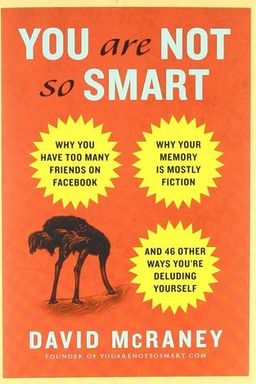
You Are Not So Smart cover

You Are Not So Smart

by David McRaney

Explore the fascinating world of self-delusion in ''You Are Not So Smart.'' David McRaney delves into psychological research to reveal how our minds deceive us daily, affecting our actions, beliefs, and perceptions. This insightful book helps readers recognize and understand these mental tricks, offering a path to greater self-awareness and clarity.

You Are Not So Smart: How Everyday Thinking Deceives You

Have you ever been certain you were right—only to realize later that you were completely wrong? In You Are Not So Smart, David McRaney upends the comforting notion that you are a rational, consistent, and objective creature. He argues that your mind is full of invisible biases, shortcuts, and flawed assumptions that shape everything you believe, remember, and do. You don’t make decisions based solely on logic; instead, you constantly rewrite reality so you can feel good about yourself.

The book draws from decades of cognitive science to show that the human brain is a master confabulator—a storyteller spinning narratives to maintain an illusion of control and coherence. McRaney blends sharp humor with insights from psychology, using real experiments to demonstrate just how easily your mind can trick itself. His central message is bold yet liberating: recognizing your delusions isn’t humiliating—it’s empowering, because only then can you start thinking more clearly.

The Mind: A Storytelling Machine

McRaney begins by explaining that your mind creates meaning from chaos through constant storytelling. You take dangerous shortcuts to keep your self-image intact, telling yourself comforting lies about why you chose what you chose or why you believe what you believe. In reality, much of your decision-making is unconscious. Phenomena like priming—when simple cues influence your behavior without your awareness—reveal that even your smallest actions are often triggered by subliminal suggestions.

For instance, participants exposed to words associated with old age (“wrinkled,” “Florida,” “gray”) unconsciously walked slower afterward. This subtle manipulation shows that you are constantly interpreting and reacting to the world from a script your brain writes, not from logical reasoning. McRaney reminds you that you are always of “two minds” — one emotional and automatic, the other rational and deliberate — but it’s the emotional brain that usually wins.

Why Self-Deception Is Essential

One of McRaney’s most paradoxical insights is that some delusion is not only inevitable but necessary. Your mind needs certain illusions—about your competence, your control, your morality—to function without paralyzing anxiety. Without these built‑in distortions, you might freeze up or despair at your limitations. He calls this our “psychological immune system.” Yet this same mechanism blinds you from recognizing mistakes, makes you overconfident, and traps you in toxic mental patterns like procrastination and confirmation bias.

For example, you convince yourself that your opinions are well-researched (confirmation bias), that your failures were caused by bad luck instead of your own errors (self-serving bias), and that other people notice your flaws far more than they actually do (the spotlight effect). Your self‑image depends on these inaccuracies, because questioning them feels threatening. As McRaney jokes: “Feeling good about yourself is mostly self‑delusion. But it’s useful self‑delusion.”

Patterns, Illusions, and Cognitive Shortcuts

At the heart of the book lies the idea that your brain hunts for patterns—even when none exist. This pattern-seeking nature once kept humans alive in dangerous environments, helping them recognize predators, poisons, or allies. But in the modern world it gives rise to apophenia (seeing connections where there are none), conspiracy theories, superstition, and pseudoscience. Because the brain craves coherence, it constructs stories that feel true even when they’re demonstrably false.

To keep up with the overwhelming number of decisions you face daily, your mind uses heuristics—mental shortcuts that allow speedy judgments but often lead to irrational conclusions. The availability heuristic, for instance, makes you overestimate how common dramatic events are because the media keeps them vivid in your mind. If you see one shark attack on the news, you assume the ocean teems with man‑eaters. Your statistics are emotional, not numerical.

Illusions of Memory and Control

McRaney also dismantles your faith in memory. Every act of remembering reconstructs a story rather than replaying an objective record. Experiments by Elizabeth Loftus show that a single misleading word like “smashed” instead of “bumped” can make witnesses “remember” nonexistent broken glass. Your memories are flexible—constantly rewritten to fit new information or your current emotional state. This means that your autobiography is a movie “based on true events,” not a documentary.

Just as your memory deceives you, so does your sense of control. You believe you can predict outcomes and steer life through willpower, but random chance and complexity often rule. The more competent or powerful you feel, the greater your illusion of control—which explains why gamblers press harder on dice or CEOs overestimate their influence on markets. As McRaney wryly notes, “The future is a billion rolls of the dice, and you think you can load them.”

From Illusion to Insight

Ultimately, You Are Not So Smart isn’t a book designed to shame you—it’s an invitation to humility. McRaney argues that true wisdom begins when you accept that your brain is a kludge, an ancient machine adapted for survival rather than truth. By learning how biases like groupthink, conformity, and the just‑world fallacy operate, you can counteract them with curiosity and skepticism. Awareness doesn’t abolish delusion, but it gives you distance from it. And that distance, McRaney suggests, might be the closest thing to smart we can ever get.


The Mind’s Hidden Architect: Priming and Automaticity

David McRaney introduces priming as a powerful demonstration of how unconscious cues shape your choices. You believe you make decisions with full awareness, but experiments show otherwise. Everyday sights, smells, and words quietly influence how you act just moments later. Your unconscious is constantly tugging on the steering wheel, guiding you toward behaviors that fit hidden associations.

How Priming Works

Priming occurs when exposure to one stimulus affects your response to a subsequent one without conscious awareness. In one of John Bargh’s classic experiments at NYU, participants unscrambled sentences containing words associated with the elderly—like “Florida” and “wrinkled.” Afterward, they unconsciously walked slower down the hallway than those primed with neutral words. They weren’t pretending to be old; their brains automatically connected those cues with slow movement.

Similarly, in another study, people who sat near briefcases before playing an economic game behaved more competitively than those near backpacks. The props triggered notions of business negotiation and self-interest. Even scent has power: when a room smelled faintly of cleaning products, participants tidied up more afterward. These subtle triggers reveal that much of your “will” is a patchwork of invisible nudges.

Why It Matters

Priming reveals that your brain is not a camera recording reality; it’s a storyteller piecing together cues from context. Advertisers exploit this constantly—using color, background music, and words to plant emotions before a product even appears. When you see recycled imagery of wealth or family warmth in ads, you’re being primed to associate happiness with consumption. Recognizing these manipulations helps you resist them, but the effect often bypasses reasoning altogether. It hits deep within your adaptive unconscious—the fast, emotional system psychologist Daniel Kahneman (in Thinking, Fast and Slow) calls System 1.

Regaining Awareness

McRaney notes that priming cannot be consciously “turned off,” but you can reduce vulnerability by shifting from autopilot to mindful attention. For instance, following a shopping list, eliminating distractions, or slowing decisions to ask “Why do I feel this way right now?” can re-engage your analytical brain. The takeaway: as you move through stores, meetings, and relationships, remember that you are constantly being cued—and the smartest defense is noticing you’re inside a script written by your environment.


The Stories You Tell Yourself: Confabulation and Introspection

You believe you know why you act and feel the way you do, but McRaney reveals this belief as an elegant illusion. When memories and motivations are missing, your brain fills the gaps with plausible fictions. This is confabulation—the automatic process of inventing explanations for behaviors whose true causes lie hidden from awareness.

Why You’re a Natural Storyteller

Split-brain studies are McRaney’s most striking evidence. When researchers severed the corpus callosum to treat epilepsy, patients’ hemispheres could no longer communicate. In one experiment, one half of the brain saw the word “walk” and made the person get up. When asked why, the speaking hemisphere—unaware of the cue—replied, “I’m going to get a drink.” The brain fabricated a logical answer to maintain consistency. You do this every day, albeit less dramatically, weaving stories to explain choices you never consciously made.

The Introspection Illusion

McRaney builds on psychologist Timothy Wilson’s research showing that introspection often distorts rather than clarifies insight. In one study, students asked to explain why they chose a poster ended up picking motivational kitten posters—and despising them later—while those who simply chose without analysis remained happy with their decisions. Overanalyzing feelings forces the rational brain to invent reasons that sound convincing but misrepresent true, intuitive preferences.

Even your memories are “based on a true story.” Each recollection is reconstructed, edited by current emotions and beliefs. Like an unreliable film narrator, your brain constantly revises what happened to suit who you think you are now. This makes your identity more fluid than you realize—but also more stable than it deserves.

Living with Uncertainty

Understanding confabulation is freeing. Accepting that you often invent after-the-fact explanations encourages humility and flexibility. When you catch yourself saying “I did that because…” pause and consider that you might be crafting a narrative, not recalling a fact. (Psychologist Daniel Dennett calls this stance “heterophenomenology”—listening to your own mind as if it were someone else’s story.) Embracing this uncertainty makes you less defensive, more curious, and ultimately closer to truth.


The Comfort of Illusion: Biases that Protect the Ego

You like to think of yourself as fair-minded, but much of that fairness is an illusion your brain spins to shelter your self-esteem. McRaney surveys several ego-protecting biases to show how deeply self‑deception permeates your thinking—from the self‑serving bias that credits your successes to skill and failures to bad luck, to the just‑world fallacy that insists people deserve whatever happens to them.

Self‑Serving Bias and Illusory Superiority

Research reveals that nearly everyone believes they are smarter, more moral, and kinder than average. In workplace studies, 90% rate themselves as above‑average performers—an impossible statistic. This illusion of superiority fuels confidence but blinds you to errors. The bias extends into relationships, driving the belief that you're more ethical than your peers or a better driver than others on the road. McRaney quips, “You think you’re more honest than average, which just proves you’re not.”

The Just‑World Fallacy

When you hear about victims of misfortune, you instinctively assume they did something to deserve it. This cognitive comfort blanket—the idea that the world is fair—protects you from randomness and vulnerability. Melvin Lerner’s experiments in the 1960s showed that people watching someone suffer shocks began to devalue the victim, calling her careless or naïve, just to preserve belief in a fair universe. McRaney warns that this delusion breeds moral laziness by obscuring systemic injustice: “You’d rather believe karma works than face chaos.”

Why We Need Self‑Deception

Though these biases distort judgment, McRaney suggests they may have evolved for psychological survival. A fragile ego collapses under the weight of constant self‑critique; illusions keep you moving forward. The challenge, he argues, is balance—maintaining enough self‑confidence to act but enough self‑awareness to doubt. Admitting that your brain edits reality doesn’t make you weak; it makes you human.


The Social Mirror: Conformity, Groupthink, and the Bystander Effect

You imagine yourself as an independent thinker, but in truth, much of your behavior is scripted by social pressure. McRaney shows how your brain’s desire for belonging overrides reason, producing conformity, groupthink, and moral paralysis in crowds.

When the Group Thinks for You

The experiments of Solomon Asch are iconic: participants asked to compare line lengths conformed to obviously wrong answers when everyone else in the room did. Seventy‑five percent betrayed their own perception at least once. Similarly, Stanley Milgram’s “shock experiments” revealed how ordinary people torture others when instructed by authority figures in lab coats. McRaney connects these findings to everyday obedience—how you follow norms at work, online, or in politics because dissent risks alienation.

The Paralysis of Crowds

The bystander effect, coined after notorious cases like Kitty Genovese, describes how individuals in groups ignore emergencies, assuming someone else will act. When smoke filled a room in one experiment, people sat still because others did. The illusion of transparency—believing your inner fear shows on your face—worsened the freeze. You mirror others’ calm, masking mutual panic. McRaney’s advice: never wait for the crowd; if something looks wrong, be the one to move first.

Collective Delusion

From boardrooms to governments, groupthink thrives wherever harmony matters more than truth. The Bay of Pigs invasion, McRaney notes, unfolded because smart people silenced objections to preserve unity. The lesson echoes psychologist Irving Janis’s warning: every group needs an appointed skeptic—an “asshole,” as McRaney puts it—to keep the hive honest. Seeing yourself as a free agent isn’t enough; freedom requires deliberate dissent.


The Fragile Perception of Reality: Attention and Expectation

You believe you perceive the world like a video camera, but your attention works more like a flashlight—narrow, selective, and easily misdirected. McRaney uses the now‑famous Invisible Gorilla experiment by Simons and Chabris to reveal just how much you miss when focused on other tasks.

Inattentional and Change Blindness

When participants counted basketball passes, half failed to notice a person in a gorilla suit stroll through the scene. This blindness extends to change detection: in real interactions, when experimenters swapped places mid‑conversation behind a passing door, two‑thirds of subjects never noticed. Your brain edits perception, storing only the essentials to keep life manageable. Expecting continuous awareness is an illusion of memory and ego.

Expectations Sculpt Experience

In one study, wine lovers rated cheap wine as exquisite when told it was expensive; brain scans even showed increased pleasure signals. Similarly, the so‑called “Pepsi Challenge” proved buyers often prefer branding over taste. McRaney argues that your beliefs prime sensory processing—meaning you literally see and taste what you expect. The impact isn’t confined to products; it shapes your politics, relationships, and judgments of others.

The Cost of Overconfidence

Attention blindness and expectation bias make eyewitness testimony unreliable and everyday perception fallible. Yet you retain faith in your infallible senses. Awareness of this fragility encourages intellectual humility—an antidote to self‑righteous certainty. As McRaney concludes, “Your eyes are liars, and your memory is their accomplice.”


Learned Helplessness and the Illusion of Control

McRaney reminds you that in some situations, freedom is psychological, not physical. Learned helplessness—coined by Martin Seligman after experiments with dogs—shows how repeated failure convinces you that effort doesn’t matter. Once you believe outcomes are uncontrollable, you surrender even when escape is possible.

How Helplessness Takes Hold

Seligman placed dogs in harnesses where electric shocks were inescapable. Later, when given a chance to jump to safety, they didn’t even try. Humans behave similarly: victims of abuse, unemployment, or chronic bureaucracy internalize futility until they stop seeking alternatives. McRaney extends this insight to modern apathy—citizens who don’t vote “because it won’t change anything” exemplify societal helplessness.

The Flip Side: The Illusion of Control

While helplessness paralyzes, the illusion of control intoxicates. You believe you can influence random events—throwing dice harder to roll high, or thinking positive thoughts to sway outcomes. Experiments by Ellen Langer showed that participants who merely chose their own lottery numbers valued the tickets far more than randomly assigned ones. Both extremes—believing you have no control or infinite control—detach you from reality.

Regaining Agency

Recognizing limits is the beginning of empowerment. McRaney argues that true control lies in small, deliberate actions—rearranging a room, setting manageable goals, refusing passive surrender. The smallest choices rebuild psychological ownership. His blunt encouragement: “You’re smarter than rats and dogs. Don’t give in yet.”


Becoming Wiser: Awareness Without Arrogance

As McRaney concludes, intelligence isn’t about being right—it’s about understanding how often you’re wrong. Wisdom grows from metacognition: the ability to think about your thinking. When you notice your biases, you may still experience them, but you can counterbalance their influence.

Humility as a Cognitive Tool

The Dunning–Kruger effect encapsulates the danger of ignorance married to confidence. The least skilled overestimate their ability because they lack the knowledge to recognize mistakes. Conversely, true experts know how much they don’t know. With humor, McRaney notes this paradox keeps the world both functioning and unbearable—“The stupid are cocksure, and the intelligent full of doubt.” The antidote is skepticism toward your own certainty.

From “Not So Smart” to Self‑Aware

McRaney doesn’t offer an easy fix to human folly. Instead, he provides a map. Knowing you are prone to conformity, memory distortion, and illusion of control allows humility in conversation, empathy in disagreement, and caution in judgment. The point is not to eliminate bias—it’s to notice when it’s in the driver’s seat. Awareness transforms delusion from a prison into a mirror.

“You can’t be smart all the time,” McRaney writes, “but you can always be curious.” By trading certainty for inquiry, you escape the biggest self‑deception of all—the belief that intelligence alone makes you wise.

Dig Deeper

Get personalized prompts to apply these lessons to your life and deepen your understanding.

Go Deeper

Get the Full Experience

Download Insight Books for AI-powered reflections, quizzes, and more.