
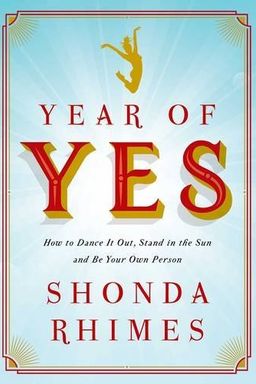
Year of Yes cover

Year of Yes

by Shonda Rhimes

Year of Yes by Shonda Rhimes is an inspiring account of how saying yes transformed her life. From overcoming personal challenges to embracing new opportunities, Rhimes shares her journey of growth, empowerment, and self-love, offering readers a compelling guide to living a fuller life.

The Transformative Power of Saying Yes

When was the last time you said “no” out of fear—and what might have happened if you’d said “yes” instead? In Year of Yes, Shonda Rhimes invites you into the astonishing, hilarious, and deeply human story of how learning to say yes changed her life completely. She contends that by committing to yes—especially to the things that terrify us—we unlock creativity, courage, joy, and self-respect. It’s not about blind positivity; it’s about choosing engagement over avoidance, and presence over fear.

Rhimes, the powerhouse creator behind Grey’s Anatomy, Scandal, and How to Get Away with Murder, begins this journey as a self-described introvert and workaholic who hides behind her success and says no to nearly everything that requires vulnerability: speaking, parties, interviews, spontaneity. But after her sister murmurs, “You never say yes to anything,” Rhimes feels something explode inside her—a challenge she can’t ignore. That comment becomes a spark that ignites the most radical year of her life.

From Fear to Freedom

The book opens with Rhimes’s confession that she is both “old” and a “professional liar.” As a storyteller, she has lived in fiction, spinning characters and plots instead of living her own story. But when confronted with her sister’s words, Rhimes must stop hiding behind narrative and start writing the story of her real life. She takes the terrifying leap of saying yes for an entire year—to interviews, public appearances, playtime with her kids, self-care, speaking truth, and even surrender. Each yes reveals something about fear, responsibility, womanhood, and success.

Through vivid, comic depictions of her experiences—like panicking before appearing on Jimmy Kimmel Live or freezing up before an Oprah interview—Rhimes exposes what it means to be a public figure who still feels invisible. Saying yes forces her to confront that contradiction. It’s an experiment not in bravery alone, but in authenticity: yes to being seen, yes to discomfort, yes to truth, yes to living.

Why Yes Matters

For Rhimes, saying yes is about dismantling fear—she calls it the act of “laying track for an oncoming train,” a metaphor she learned from television production. The train will come regardless, so one must keep laying track or risk derailment. Yes becomes her version of track-laying for life: staying in motion, producing courage instead of excuses. Fear, she writes, tricks us into stagnation. Saying yes restores movement.

This matters beyond television or fame. Rhimes shows how each no we utter to life diminishes us—a form of slow self-erasure. Her story reflects what psychologist Carol Dweck calls the “growth mindset”: understanding that you must step outside your comfort zone to evolve. Rhimes’s transformation is not an overnight miracle but a series of lived experiments. One yes leads to another, each peeling back an old fear and exposing a new truth.

An Invitation to Revolution

Throughout the book, Rhimes argues that saying yes is a personal revolution—a declaration that you will participate fully in your own life. That revolution touches everything: work, parenting, relationships, body image, and identity. Her decision to say yes to public speaking turns into the celebrated Dartmouth commencement address that changes how she views success. Her choice to say yes to play rekindles joy with her children. Even saying yes to saying “no”—learning when to refuse exploitation—becomes part of her liberation.

This narrative resonates because Rhimes isn’t preaching perfection. She’s funny, blunt, and vulnerable, showing the awkwardness of growth: from sweat-soaked panic backstage to the empowerment of admitting “I don’t want to get married.” Her voice blends wit and wisdom, echoing memoirists like Brené Brown (Daring Greatly) and Elizabeth Gilbert (Big Magic), but tethered to the daily grind of motherhood and media. She proves that saying yes is not naïve—it’s revolutionary self-leadership.

The Journey Ahead

In the sections to follow, you’ll see how Rhimes’s year unfolds through twelve deep lessons: conquering fear of exposure, confronting stage fright, speaking truth publicly, surrendering the mommy wars, discovering the joy of play, transforming her health, embracing body acceptance, joining women’s solidarity, accepting praise, learning boundaries, finding real friendship, defining love, and ultimately stepping into her own light. Each key idea is a stage of transformation—a practical map for anyone ready to choose life over fear.

By the time Rhimes ends her year, she no longer fears saying yes. Because yes, she learns, is the sun. It’s courage, creativity, and self-love made visible. Saying yes, she realizes, does not guarantee success—but it guarantees aliveness. And that, she insists, is more than enough.


Yes to Fear and Vulnerability

Shonda Rhimes begins her transformation by facing the fears that paralyzed her life. Before her sister’s challenge, she hid behind the safety of saying no—no to interviews, red carpets, public speaking, and any opportunity that might expose her to scrutiny. Inside her pantry of fiction, she preferred to write about fearless heroines like Meredith Grey and Olivia Pope rather than embody one.

Confronting the Habit of No

When her sister Delorse mutters, “You never say yes to anything,” during Thanksgiving dinner, the words hit Rhimes like a grenade. She realizes that behind her glamorous career, she’s miserably comfortable. The grenade explodes weeks later when she attends the Kennedy Center Honors—and recognizes that if she’d been asked whether she wanted to sit with the Obamas, she would have said no. That revelation terrifies her. She’s a creative powerhouse yet crippled by fear of exposure.

For an introvert who equates self-revelation with “standing on a restaurant table and lifting your skirt,” saying yes means rebellion. Her decision to accept every scary opportunity for one year becomes an act of deliberate vulnerability. It’s not performative courage—it’s radical curiosity: what happens if I live differently?

The Power of Transparency

Rhimes discovers that transparency dismantles fear. Her first major test is public speaking—the Dartmouth commencement address. Instead of giving a bland, polished speech, she rewrites it overnight to become painfully honest. Onstage, she breaks her cycle of pretending by confessing her fear of public exposure and by telling graduates unfiltered truths: “Dreams are lovely, but they’re just dreams. It’s hard work that makes things happen.”

That moment—a shy, sweating television mogul admitting her terror—becomes liberating. By saying yes to vulnerability, she redefines strength not as perfection but as openness. (In Daring Greatly, Brené Brown echoes this idea: vulnerability is not weakness; it’s courage in raw form.)

Fear as a Creative Teacher

Rhimes names fear her new collaborator. She likens writing television to “laying track for a speeding train”—production keeps coming whether you’re ready or not. Similarly, life keeps coming. Saying yes to fear, she learns, means laying track faster and better. She stops waiting for fear to pass and starts creating through it. The thrill of surviving a Jimmy Kimmel Live appearance without collapsing becomes a metaphor: when terrified but committed, she discovers what she calls “the hum”—that electric rhythm when exertion transforms into exultation.

For you, Rhimes’s journey offers a practical reframing: fear is not a stop sign—it’s the hum’s ignition. Every yes, even small ones, rewrites how you see yourself. When you say yes to vulnerability, you say yes to becoming.


Yes to Telling the Whole Truth

Truth-telling becomes one of Rhimes’s most powerful yeses. After years of “Athlete Talk”—her habit of safe, PR-approved soundbites—she decides to speak honestly, even when uncomfortable. This shift begins with rewriting her Dartmouth commencement speech. She scraps a glossy version and writes a raw, funny, messy one about reality, race, failure, and the illusion of “having it all.”

Owning Reality Over Fantasy

Rhimes argues that most people dream instead of do. “Dreams are lovely, but they’re just dreams,” she tells graduates. “It’s hard work that makes things happen.” By juxtaposing her struggle with stage fright against the myth of effortless success, she dismantles celebrity and reveals her humanity. She admits that “whenever you see me succeeding at one area of my life, I’m failing in another.” That confession becomes a battle cry for realism.

This honesty also redefines the myth of the “superwoman.” As a single mother of three, running multiple television shows, Rhimes refuses the narrative of balance. She exposes the impossible juggling act behind “doing it all” and reshapes it into compassion: if you’re succeeding somewhere, you’re failing somewhere else—and that’s okay.

Breaking the Silence

Her storytelling about motherhood reveals the invisible shame women carry about accepting help. In a standout chapter, she shatters the taboo around nannies and childcare, praising her own “Jenny McCarthy”—a brilliant caregiver who helps raise her children and keeps her sane. Rhimes’s frankness becomes political: she insists that women stop judging each other and end the “mommy wars.” Being a mother isn’t a job, she argues; it’s an identity. What matters is love and respect, not Pinterest-perfect cupcakes.

Her refusal to fake balance is a feminist rebuke to the culture that rewards women for martyrdom. (Compare this to Anne-Marie Slaughter’s Unfinished Business and its argument that true equality requires changing work structures, not women.) Rhimes’s honesty doesn’t just heal her guilt—it invites others to lay down theirs.

Truth as Connection

When Rhimes speaks candidly—onstage, in interviews, and to herself—she discovers connection. Her most authentic speech moments unite audiences because they hear their own hidden fears mirrored. Truth becomes empathy’s door. By saying yes to speaking her full truth instead of polishing it, Rhimes experiences what she calls “the exhale”—that moment when fear dissolves because you’ve stopped pretending.

Ultimately, saying yes to the truth is saying yes to being known. And being known, Rhimes realizes, is the opposite of being alone.


Yes to Play and Joy

One evening, Rhimes’s daughter Emerson asks, “Mama, wanna play?” She’s dressed in a ball gown, rushing toward the door. But time freezes, and Rhimes sees her child’s hopeful eyes. In that instant, she realizes she has missed too many tiny invitations to joy. She kicks off her heels, drops to the floor, and says, “Yes.” That moment marks a new law in her life: whenever her kids ask to play, the answer is always yes.

Rediscovering Innocence

As an introverted workaholic, play once felt frivolous. But Rhimes learns that play is not indulgence—it’s oxygen. By joining in silly games, reading Everyone Poops, or dancing like a fool in couture, she reconnects to something she’d buried: innocence. Playing revives creativity and heals the burnout that work alone can’t. It brings her back to what psychiatrist Stuart Brown calls “the brain’s purest form of learning.”

Fifteen-Minute Miracles

Rhimes discovers that joy doesn’t require hours—it thrives in minutes. Her daughters’ attention spans rarely exceed fifteen minutes, so she can always fit play in. This insight liberates her from guilt: joy isn’t a luxury, it’s available in small doses. She schedules work-free weekends and sets boundaries—no emails after 7 p.m.—and finds her imagination replenished.

Play becomes the antidote to perfectionism. When she creates time for laughter and silliness, her writing improves. “Wanna play?” becomes shorthand not just for spending time with family, but for choosing life over anxiety. (In The Artist’s Way, Julia Cameron makes the same argument—that creative recovery begins with playful curiosity.)

Joy as Fuel for Work

Rather than compete with her ambition, play amplifies it. Rhimes compares the balance between work and joy to laying track for her production train: the more she plays, the more smoothly the train runs. Joy and discipline coexist. She starts treating her creative energy like an athlete—nurturing herself physically, emotionally, and mentally. Watching her daughters dance in Frozen capes reminds her that she, too, deserves unstructured happiness.

By saying yes to play, Rhimes learns to say yes to love, spontaneity, and humanity. Her law—always answer “yes”—becomes a simple, enduring mantra that transforms exhaustion into wonder.


Yes to Health and Body Acceptance

At the beginning of her Year of Yes, Rhimes describes herself bluntly: “I am fat.” She’s exhausted, uncomfortable, and terrified of her reflection. Then comes what she calls The Airplane Seat Belt Incident of 2014: sitting in first class, unable to buckle her seatbelt. That humiliation becomes the last straw. Instead of sinking further into numbness, she asks a vital question—how do I yes this one?

The Realization of Fatness as Numbness

Rhimes’s revelation is radical. She realizes she hasn’t been failing at health—she’s been succeeding at numbness. Food became her protective layer, her armor against fear, disappointment, and visibility. Every indulgence felt like “spackling over the cracks.” Saying yes to change means saying no to being anesthetized. Once she sees food as magic that deadens instead of nourishes, she cannot unsee it.

She resolves to fight for her life. Literally. Her doctor confirms hypertension and sleep apnea. She recognizes that being dead inside is not safe but dangerous. Saying yes to health is terrifying—it threatens her comfort—but it’s her only path back to freedom.

Hard Work, Not Magic

The battle involves no quick fixes. Rhimes rejects diets, cleanses, and clichés like “Nothing tastes as good as thin feels.” She sees losing weight as what it is: work. She starts small—hydration, doctor visits, Pilates. She tells herself she’ll never enjoy it and embraces that. Lowering expectations makes discipline tolerable. By detaching joy from the process, she laughs through it instead of giving up.

Within a year, she loses over 100 pounds—not through fad diets, but through consistent care. More importantly, she stops treating her body as a “container for her brain.” Feeling strong, she gallops through her hallway with her child on her back and bursts into tears from pride. That moment—a gallop, not a number—becomes the true measure of victory.

Being Seen Instead of Hiding

Losing weight changes more than appearance—it changes her relationship with visibility. Rhimes admits she once used her body to hide. Fame had made her hyper-visible while her self-esteem made her invisible. Now slimmer and stronger, she learns it’s okay to want to be seen. She begins to enjoy fashion, color, and presence. “For the first time,” she writes, “I’m comfortable being looked at.”

This is not vanity—it’s reclamation. The yes to health becomes a yes to embodiment. Feeling vibrant, she stops apologizing for existing in her own skin. Betsy Beers’s teasing reminder that “you can train yourself to love salads” becomes both joke and prophecy. Health, Rhimes discovers, is self-love made physical.


Yes to Success and Badassery

In the later chapters, Rhimes turns her attention to confidence. She notices that women—including herself—can’t handle being celebrated. At an Elle dinner honoring powerful women in TV, every woman deflects praise. They duck heads, wave hands, laugh nervously. Rhimes does the same, until she realizes how absurd it is: “What is wrong with us?!”

Learning to Accept Compliments

To fix this, she invents the “thank you, smile, shut up” rule. When someone compliments her work, she says thank you, smiles, and stops talking. No excuses, no humility spiral. She practices this awkwardly—sometimes hilariously—but soon it becomes natural. Accepting compliments becomes a gateway to owning her power and rewriting her relationship to success.

Embracing Badassery

Rhimes coins her own word: badassery. She defines it as “the practice of knowing one’s accomplishments and gifts, accepting them, and celebrating them.” Like Wonder Woman, she says, real badassery means swagger without apology. It’s self-love turned outward—confidence that lifts rather than diminishes others. When Shonda starts to swagger, her assistants notice she glows. Her friends call it visible transformation.

Rhimes contrasts this with men’s casual ownership of success: “No man ever worries people will think he thinks he’s better than they are.” For women, social conditioning demands shrinking. Her Year of Yes teaches her to stop making herself smaller. (Compare this to Lean In by Sheryl Sandberg, which also urges women to claim space, but Rhimes’s approach adds humor and radical joy.)

Redefining Pride

Through speeches like “On Ceilings Made of Glass,” Rhimes rejects the idea that she alone shattered barriers in Hollywood. She insists her success rests on generations of women who cracked the glass before her. Pride, for her, isn’t isolation—it’s gratitude. Badassery is collective bravery. By claiming space, she invites others to do the same.

As she dons a cheeky T-shirt reading “Bill Clinton Loves Anything I Do,” Rhimes celebrates swagger not as arrogance but as truth. “Don’t call me lucky,” she declares. “Call me a badass.” Saying yes to confidence, she discovers, is its own kind of freedom—the joy of finally seeing and loving yourself without apology.


Yes to Boundaries and Difficult Conversations

Rhimes’s later yes is paradoxical: learning to say no. After gaining confidence, she realizes that real freedom lies in boundaries. Having said yes to everything external, she must also say yes to protecting her time and self-respect. She learns this through painful encounters with friends who ask for money, validation, or endless emotional labor.

The Courage of No

Rhimes’s mantra becomes “No is a complete sentence.” She scripts herself three versions—“I’m unable to do that,” “That doesn’t work for me,” and simply, “No.” When a friend named Laura demands a huge loan, Rhimes says no, trembling. The resulting confrontation liberates her. “The worst thing that could happen is happening,” she reflects, “and I’m glad. Now I know.” Saying no exposes true character—it reveals who values you for yourself instead of what you can give.

This moment initiates her superpower: she can have difficult conversations. Instead of deflecting conflict, she now faces it directly. When someone speaks passive-aggressively, she asks, “What did you mean by that?” The question, calm and clear, diffuses drama and demands honesty. Difficult conversations, she learns, are freedom’s price.

Choosing People Wisely

The Year of Yes inevitably exposes toxicity. Rhimes realizes that some of her friendships were imaginary—characters she’d created to fill emptiness. When she finally sees friends like “Pam” and “Ken” as they are, she grieves but feels cleansed. Real friends, like Zola, Gordon, and Scott, cheer her on, challenge her honesty, and “shove her forward” when she hides. The pruning of false people becomes essential to her happiness.

Boundaries transform love itself. She stops being a doormat and starts being a gladiator for herself—the same courage she writes for her characters. Saying yes to truth includes saying yes to “enough.” (In The Gifts of Imperfection, Brené Brown similarly calls boundaries “compassion in practice.”)

No as Self-Respect

Ultimately, Rhimes reframes no from fear to power. Every refusal, she says, is a yes to self-worth. When she refuses exploitation or bitterness, she gains peace. “I can say it,” she tells herself, “or I can eat it.” Choosing to say it keeps her alive, healthy, and real. Saying yes to difficult conversations becomes her final armor of authenticity.


Yes to Redefining Love and Happiness

In one of the book’s most intimate chapters, Rhimes confronts society’s ultimate expectation: marriage. Everyone assumes that success plus motherhood plus fame equals a fairy-tale ending. But when she’s engaged to a wonderful man, she realizes she doesn’t want marriage at all. She wants freedom, authenticity, and creativity. Saying yes to herself means saying no to convention.

Rejecting the Fairy Tale

Despite loving weddings—the gowns, the parties, the vows—Rhimes recognizes that her joy in rituals doesn’t translate to a desire for marriage. Her happiness lies in motherhood and work, not in romantic dependency. “Marriage is the wrong train,” she admits. She’s been laying tracks for a ghost train, building a story instead of a life. When she finally confesses her truth—“I don’t want to get married”—she feels euphorically free.

Others are shocked, but Rhimes revels in liberation. Her sister Delorse asks, “You’re happy because you said yes to not getting married?” and Rhimes laughs: no, I’m happy because I said yes to not pretending. Rejecting the fairy tale becomes a radical feminist act—choosing authenticity over performance.

Redefining What’s Enough

Rhimes challenges the cultural obsession with “having it all.” She already has a full, rich life—three children, fulfilling work, and love. Marriage doesn’t complete her; it confines her. Happiness, she argues, isn’t one-size-fits-all. “My happy ending isn’t your happy ending,” she writes. “Happiness comes from living as you need to, as you want to.”

This insight dismantles external approval and perfectionism. She doesn’t need validation through romance, weight, or awards. Instead, her fulfillment comes from self-definition. Being unmarried is not lack—it’s autonomy. (Compare her message to Glennon Doyle’s Untamed, which also preaches radical self-authority.)

Choosing the Self as Love

Ultimately, Rhimes’s yes to happiness is a yes to self-love. Her epilogue, “Yes to Beautiful,” crystallizes this: standing under bright lights for a magazine cover, she finally feels at peace in her body, career, and life. She sees herself—smiling, radiant—and whispers, “I am beautiful.” That’s the culmination of every yes. Happiness, she realizes, is not a destination or man or trophy. It’s the act of being alive and loving who you are right now.

Dig Deeper

Get personalized prompts to apply these lessons to your life and deepen your understanding.

Go Deeper

Get the Full Experience

Download Insight Books for AI-powered reflections, quizzes, and more.