
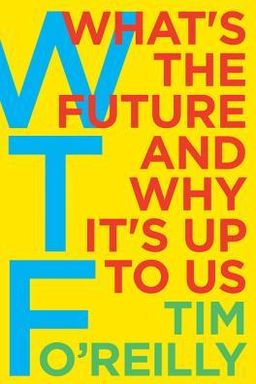
WTF cover

WTF

by Tim O’Reilly

In ''WTF: What’s the Future and Why It’s Up to Us,'' Tim O''Reilly explores the transformative potential of digital technologies. By understanding platforms and algorithms, he argues, we can use them to elevate society, improve business models, and redefine governance. This book offers a roadmap for navigating the digital age responsibly and innovatively.

Choosing the Future We Build

Tim O’Reilly’s WTF: What’s the Future and Why It’s Up to Us is both diagnosis and manifesto. He argues that technology’s shocks—the moments that make you say “WTF???”—represent both wonder and warning. You live amid machine learning, on-demand platforms, and algorithmic governance that feel magical yet destabilizing. The book’s central claim is that the future is not preordained by technological forces or markets; it is a matter of human choice, encoded in design decisions, incentive systems, and policies.

To act wisely, you must see technology not as destiny but as opportunity wrapped in responsibility. Every tool, platform, or algorithm carries embedded choices that decide who benefits, who loses, and how capability is distributed. O’Reilly invites you to become an active participant in mapmaking—to chart how emerging technologies shift power and habit, and to shape outcomes toward fairness and shared prosperity.

From astonishment to stewardship

The “WTF” moment when technology first astonishes—think of Google Maps, the iPhone, or AI assistants—is the starting signal for social transformation. A true unicorn, O’Reilly says, is not defined by valuation but by impact. Linux, Airbnb, and Uber didn’t just make money; they restructured industries and created ecosystems of new jobs. Yet the same mechanisms that create wonder can also produce concentration of wealth and labor exploitation when guided by narrow fitness functions like profit or engagement.

Every “unicorn” therefore carries two sides: democratized capability or extractive consolidation. The difference depends on human judgment—how you design algorithms, regulate platforms, and measure success. The book’s recurring ethical question: Does this technology extend human potential, or replace and diminish it?

Seeing tomorrow through better maps

To navigate disruption, you need new maps. O’Reilly calls himself a mapmaker—someone who condenses complexity into visualizable patterns that reveal direction. The old map of the tech world focused on desktop software and ownership; the new map focuses on data flows, platforms, and networked intelligence. “Vector thinking” replaces prediction with momentum analysis: identify where speed and scale are accelerating (AI, data, connectivity), and then imagine plausible futures given that trajectory.

History’s rhymes help: open protocols enabled early Internet revolutions; now open data and AI ethics shape the next ones. If you listen for echoes—from IBM’s monopoly to Google’s algorithmic dominance—you learn how unchecked power can repeat patterns unless governance evolves. A good map helps you act before trends harden into monopolies or cultural distortions.

Hybrid intelligence and human agency

O’Reilly’s most provocative idea is the emergence of hybrid intelligence—a global brain combining humans, machines, and networks. Your clicks train algorithms; your reviews shape recommendations; your data flows feed self-learning systems. You are not outside this machine—you are part of its collective mind. The challenge is to ensure this hybrid system amplifies human flourishing rather than reducing you to a cog in opaque systems. Transparency, inspectable algorithms, and deliberate design of fitness functions (purpose-driven objectives) become civic imperatives.

Whether in social feeds, financial markets, or self-driving cars, algorithms optimize for coded goals. If those goals reward engagement or short-term profit, outcomes can distort truth and equity. Redesigning fitness functions—to favor accuracy, consensus, or human well-being—requires courage and higher-level engineering: you must decide what to measure and what success should mean.

Rewriting rules for a humane economy

Technology follows incentives. When shareholder value is treated as the sole purpose, the “market” becomes a rogue algorithm optimizing for financial extraction rather than societal value. O’Reilly’s analysis of buybacks, high-frequency trading, and financialization parallels his broader thesis: systems do what they are coded to do, and we have coded ours to reward short-term gains. You can rewrite those rules—through tax reform, capital gains windows, or business models that prioritize real economy value and worker welfare over speculation.

Platforms like Airbnb, Etsy, and Kickstarter demonstrate that technology can redistribute wealth when designed to grow their ecosystems rather than just their valuations. Governments, too, can act like platform designers: expose services via APIs, use outcome-focused regulation, and treat citizens as co-developers of policy through open-data collaboration.

Repairing and building Day One institutions

In his closing call, O’Reilly blends Jeff Bezos’s “Day One” mindset with civic foresight. You should construct systems—companies, governments, movements—that stay curious, responsive, and purpose-focused. Scenario planning becomes the practical toolkit: think in futures, test robustness, and commit to solving meaningful problems like climate adaptation, healthcare, and education. Each is a sandbox for aligning technology’s fitness functions with human progress.

Essential takeaway

You are not a spectator in the algorithmic age; you are a participant shaping its code. Building the future means choosing which fitness functions—profit, power, or human capability—will guide the hybrid intelligence we have unleashed. Tim O’Reilly’s message is pragmatic and optimistic: if you design with purpose, you can make WTF stand for wonder, not fear.


Mapping and Vector Thinking

O’Reilly’s method for anticipating change is mapmaking—drawing conceptual diagrams that reveal direction instead of prediction. You can’t see the future directly, he says, but you can infer its paths by understanding present vectors: trends with speed and magnitude. Think of Moore’s Law (exponential improvement), the rise of data-driven services, or the steady integration of AI into everyday tools.

Building better maps

Old maps blind you by framing the world through outdated assumptions. The desktop-software map made critics miss the rise of the web-as-platform. O’Reilly illustrates this with open source: instead of seeing Linux, Perl, and Apache as ideological projects, he traced how they combined to enable e-commerce and Google-scale search. Each piece became part of a new landscape. A good map merges technology, economics, and human systems.

Vectors as analytical tools

A vector contains magnitude (speed of change) and direction (where it’s heading). You identify what is accelerating—connectivity, cloud computing, machine learning—and then extrapolate who benefits and who may lose. This helps you distinguish noise from signal. O’Reilly’s conferences (Web 2.0, Gov 2.0, Next:Economy) were public exercises in vector thinking—gatherings to sense the next phase of digital evolution.

(Note: Vector thinking echoes Peter Schwartz’s scenario planning and Stewart Brand’s “pace layers”: look at deep trends and adapt before they overwhelm you.)

Keeping maps real

Korzybski’s dictum—“the map is not the territory”—anchors the warning. Don’t worship your models; test them against observation. Feynman’s anecdote of students memorizing formulas without comprehension dramatizes this. You avoid analytical blindness by constant validation—watch anomalies, track emergent niches, and revise your mental map quickly. Vector thinking trains you to spot early signals and steer accordingly.

Applied takeaway

Observe acceleration, compare patterns, and draw your own map. It will never predict perfectly—but it will prepare you to act wisely as vectors converge.


Platforms and Collective Intelligence

Platforms are the defining architecture of modern enterprise. O’Reilly calls them “software above the level of a single device,” meaning distributed systems that merge code, data, and human participation into service ecosystems. Amazon, Google, Uber, and Airbnb succeed not because of proprietary software alone but because they orchestrate global networks of contributors.

Harnessing human inputs

The web makes collective intelligence practical. Google ranks pages by link structure and user behavior; Amazon refines recommendations via purchases and reviews; Wikipedia democratizes knowledge through volunteered editing. Each system becomes smarter as people use it—learning loops replace command-and-control hierarchies. The “data as Intel Inside” metaphor captures this: data is the strategic asset; the more labeled examples you have, the more valuable your service becomes.

Designing healthy platforms

Jeff Bezos’s internal memo insisting on service interfaces across all Amazon teams turned organization into architecture. Teams exposed APIs, became autonomous, and could later externalize those capabilities as AWS. O’Reilly uses this to illustrate that structural openness breeds agility. Interface-based organizations decentralize innovation—teams promise results and own outcomes, echoing Mark Burgess’s “promise theory.”

You build sustainable platforms by designing incentives that align participants’ success with yours. Open data ecosystems (Google Maps, Taobao sellers) and shared metrics (YouTube’s ad revenue split) demonstrate this alignment. When platforms measure and disclose ecosystem impact, they legitimize trust and measure prosperity beyond valuation.

Strategic question

Ask: Does my platform grow the ecosystem or extract from it? The answer decides if your innovation builds shared prosperity or another monopoly.


The Market and Its Misaligned Fitness Function

One of O’Reilly’s most urgent warnings is that markets have become algorithmic machines optimizing for the wrong objective. When shareholder value became the overriding fitness function, finance and corporate strategy turned extractive. The market, he writes, acts like a runaway system: fast, automated, and indifferent to human welfare.

Financialization as machine behavior

High-frequency trading, derivatives, and buybacks automate decision loops. Algorithms race to capture microseconds of advantage and trillions of dollars of speculative gain. Meanwhile, corporations spend more on buybacks than on R&D or wage growth. These are not accidents—they are logical results of encoded incentives. Milton Friedman’s shareholder doctrine and Jensen-Meckling’s reward alignment created systems where short-term profits outweigh long-term stability.

Choosing a new code

Markets do what we program them to do. To reverse extraction, you must rewrite the code: favor long-term capital gains windows, limit buybacks, introduce transaction or carbon taxes, and tie executive rewards to multi-year investment and workforce outcomes. O’Reilly borrows ideas from Larry Fink’s letters to CEOs, Thomas Piketty’s research, and Mariana Mazzucato’s innovation-economy proposals to show real levers for repair.

Economy as a design problem

The system yields what its fitness function defines. Change the fitness function, and you change reality. Instead of optimizing for speculative value, design for human capability and productive renewal. Indie-funded businesses, cooperatives, and benefit corporations exemplify alternative rulesets that encode different incentives—profit as sustainability, not extraction.

Core insight

The market is not a force of nature. It is a complex machine we built. If we recode its objectives, it can again serve rather than consume human progress.


Algorithms and Civic Outcomes

Algorithms are invisible policymakers. They decide what you see, which jobs you’re offered, what prices you pay, and which voices dominate discourse. O’Reilly teaches you to look at their underlying fitness functions—the goals they optimize—and judge the consequences. Optimize for clicks, you get clickbait; for engagement, you get polarization; for accuracy or consensus, you build civic trust.

Fitness functions steer culture

Algorithmic culture reflects the metrics that matter. Facebook’s News Feed trained society to reward emotional engagement; YouTube’s recommendation loops amplified extremism; ad auctions turned truth into collateral damage. Transparency and feedback mechanisms are essential. The Taiwanese pol.is experiment proves an alternative: it replaced viral metrics with consensus mapping, surfacing shared viewpoints among thousands and improving public policy.

Outcomes over rules

O’Reilly’s regulatory vision shifts from prescriptive rules to outcome-based feedback systems—similar to how central banks use telemetry to adjust monetary policy. Algorithms that measure real-time safety, congestion, or fairness can make governance scalable to digital speed. The same automation that powers private platforms can be repurposed for transparency and public accountability.

Fake news and gig-economy issues demonstrate the urgency. Misinformation spreads faster than truth; labor classifications lag behind digital realities. Portable benefits, open data requirements, and civic algorithm audits are practical next steps. You insist that platforms be accountable not just for compliance but for measurable social results.

Practical takeaway

Inspect the objective function, not just the technology. You can’t fix outcomes until you fix what systems are optimized to achieve.


Learning and Augmentation

Automation’s real question is not “Will machines take our jobs?” but “How do we design work that amplifies human capability?” O’Reilly argues that progress comes from augmentation—embedding knowledge into tools and systems so that humans do more, better, and at higher skill levels.

Design for capability, not replacement

When you integrate algorithms and people well, you create richer jobs. Apple Store staff using digital devices to serve customers or drone-delivery teams at Zipline combining logistics systems with local human expertise are examples. These roles embody human-machine partnership, not substitution. AI, when used to extend expert reach, transforms potential work into new craft.

Lifelong learning as infrastructure

James Bessen’s historical insight, which O’Reilly echoes, is that productivity gains from new technology appear only when skills diffuse. That diffusion requires deliberate investment in learning—community colleges, retraining programs, maker spaces, and micro-certification platforms that map evolving skill demands. Upwork’s skills-matching and Google’s internal reskilling demonstrate scalable education ecosystems inside markets.

Policy and leadership choices

Governments and employers must design institutional platforms for augmentation. That means redirecting tax policy from rewarding capital gains to rewarding skill investment, and funding research and public infrastructure that expand capability. Organizations should replace rigid hierarchies with service-based teams that measure promises, as Amazon’s model shows. You train systems to learn from their people, not discard them.

Central lesson

Wealth and meaning grow where humans and machines cooperate to add value. Treat learning as core infrastructure, and every innovation becomes a multiplier of human potential.


Scenario Planning and Day One Strategy

As the book closes, O’Reilly gives you tools to act under uncertainty. Scenario planning—developed by the Global Business Network and futurists like Schwartz—helps you prepare for multiple possible futures instead of betting on one forecast. Combined with Bezos’s “Day One” philosophy, it becomes an operational ethic: stay adaptive, purpose-driven, and awake.

Thinking in scenarios

Map critical uncertainties and design strategies that work across outcomes. Climate response exemplifies this mindset: even skeptics of extreme warming should prepare via renewable investments and efficiency because those strategies have asymmetric upside (jobs, stability, industrial renewal). The same logic applies to social policy—UBI pilots, carbon-tax reforms, or innovation funds that promote resilience regardless of political swings.

Building Day One institutions

Bezos defines Day One as constant customer focus, rapid iteration, and aversion to complacency. O’Reilly extends it to civic and corporate design: build organizations and laws that keep human values central and feedback loops active. Whether in startups, governments, or nonprofits, Day One structures fight stagnation by measuring outcomes and renewing purpose continually.

Work that matters

Choose projects that address real needs: Zipline’s medical drones, DeepMind’s health diagnostics, or public-data ecosystems improving governance. These examples prove that ambitious technology aimed at social good can outperform narrow profit-maximization. Purpose became not soft virtue but strategic advantage.

Final message

The future belongs to those who make choices that keep systems alive, adaptive, and humane. Plan across scenarios, act with a Day One mindset, and you’ll turn uncertainty into agency.

Dig Deeper

Get personalized prompts to apply these lessons to your life and deepen your understanding.

Go Deeper

Get the Full Experience

Download Insight Books for AI-powered reflections, quizzes, and more.