
Idea 1
Writing That Works: The Power of Clear, Purposeful Communication
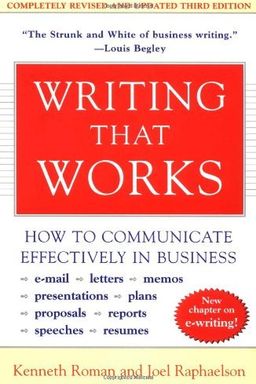
Have you ever read an email or report so confusing that you weren’t sure what the writer wanted from you? Kenneth Roman and Joel Raphaelson begin Writing That Works with a simple but powerful observation: too many business communications waste time. Executives, they note, constantly complain about unclear, long-winded messages that fail to communicate purpose or action. The book’s central argument is that good writing isn’t about showing off intelligence—it’s about achieving results. Whether you’re writing a short email or a major report, your goal is not “clarity for clarity’s sake,” but to move people—to make them understand, agree, and act.
Roman and Raphaelson write from decades of experience at Ogilvy & Mather, one of the world’s most influential advertising agencies. Advertising, they remind us, is simply business communication in its purest, most results-driven form. From this experience, they distilled principles that apply not only to copywriters but to any professional who writes memos, plans, proposals, presentations, or speeches. In their view, writing that works means writing that gets people to do something—approve an idea, buy a product, hire you, or grant funding.
Why Writing Matters More Than Ever
Although the first edition of this book was typed on a typewriter, the third edition was emailed to an editor. This evolution illustrates a larger truth: tools change, but the need for clear, precise communication does not. In a world of e-mail and instant messages, writing has become the defining measure of professionalism. The authors cite a CEO who lamented that many communications crossing his desk were “meaningless” and failed to specify actions. They stress that your writing is your public identity; often, people know you only through your words. Every memo, email, and report either reinforces or undermines how others perceive your competence and clarity of thought.
As the authors put it, effective writing is the ultimate time saver. In today’s crowded inboxes, short, purposeful writing isn’t just appreciated—it’s essential. People who can articulate ideas succinctly will always rise faster, simply because they make life easier for others. As business thinker Peter Drucker once observed (and the authors quote approvingly), the difference between busy executives and effective ones lies in how they use the few truly productive hours of the day. Clear writing is one of the best uses of that time.
From Clarity to Action
The authors’ guiding principle is simple: clarity isn’t the goal—action is. To communicate effectively, you must: (1) know what you want your readers to do, (2) decide what essential information they need to take that action, and (3) organize your writing to drive them there quickly. This emphasis on action echoes the viewpoint of modern management thinkers like Jeffrey Pfeffer and Robert Sutton, who criticize “smart talk”—language that sounds impressive but leads nowhere. Roman and Raphaelson agree: if your memo doesn’t lead to a decision or a change, it has failed.
The authors point to concrete examples from government and business. The U.S. Securities and Exchange Commission, for instance, introduced “plain English” initiatives after discovering that simplified writing improved compliance, trust, and savings. The Veterans Benefits Administration even saved half a million dollars annually by writing clearer letters. The pattern is consistent: clarity gets results, not because it’s more elegant but because it removes friction between writer and reader. The best writing simply meets readers where they are, and leads them step by step toward understanding and action.
Writing in the Age of E-Mail
Roman and Raphaelson were early observers of the email revolution. E-mail, they argue, democratizes writing—it gives everyone, from interns to CEOs, direct access to keyboards. That makes the ability to write well not just desirable but strategic. People no longer have secretaries to “fix” their prose, and recipients of sloppy email still judge the writer. As Playboy CEO Christie Hefner quipped, “It’s very annoying when people think grammar doesn’t matter just because it’s e-mail.” A good sentence structure signals a good mind.
But email also tempts us to be hasty. The danger is what the authors call “streams of unconsciousness”—quick, rambling messages that confuse more than they clarify. Effective communicators pause to structure their thoughts, even in email. The authors’ advice is timeless: compose yourself before you compose your message. Good writing demands reflection before reaction, especially when the “Send” button makes instant publication effortless.
The Discipline of Simplicity
Throughout the book, Roman and Raphaelson return to one theme: simplicity is the mark of mastery. This doesn’t mean dumbing down ideas; it means stripping them to their essence. Churchill’s “The news from France is bad” is far more powerful than “The situation in regard to France is very serious.” The same principle guides everything from one-page memos to major speeches. The authors encourage writers to prefer short words, short sentences, and short paragraphs. As The Wall Street Journal demonstrates daily, brevity is readability. Applicants who write clearly rise; those who require rewriting stall.
The message resonates with other classic guides such as William Zinsser’s On Writing Well and Strunk & White’s The Elements of Style: writing is thinking. If your writing is muddy, it’s because your ideas are muddy. The cure isn’t grammar lessons but sharper thought. Structure forces clarity; rewriting brings discipline. Every clear memo or plan, in the authors’ view, is evidence of a mind that knows where it’s going.
A Blueprint for All Business Writing
The rest of the book builds on this foundation, guiding you through every form of business communication: effective sentences and paragraphs (“Don’t Mumble”), memos, letters, emails, presentations, reports, proposals, and even résumés. Each form has its own rhythm and etiquette, but the principles stay constant: be specific, be concise, and aim for action. Later chapters even explore writing for computers, coping with political correctness, and editing yourself—proof that writing is never truly finished, only improved.
Ultimately, Writing That Works is more than a manual—it’s a philosophy of communication. Its lesson is both humbling and empowering: anyone can write well, not with natural talent but with purpose, thought, and revision. Whether you’re pitching an idea, applying for a job, or proposing a plan, the quality of your writing will shape the quality of your results. As Roman and Raphaelson remind us again and again, writing that works doesn’t just inform—it performs.