
Idea 1
Writing That Moves Busy Readers to Act
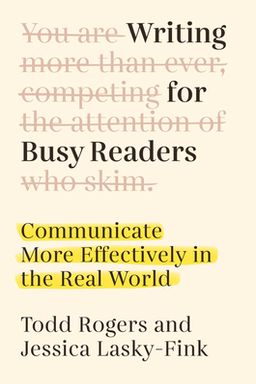
When was the last time you opened an email, scanned three sentences, and thought, “I’ll read this later”—only to never return to it? Most of us live in a constant swirl of messages demanding our time. In Writing for Busy Readers, behavioral scientists Todd Rogers and Jessica Lasky-Fink tackle this modern reality head-on, showing that effective writing isn’t just about eloquence—it’s about science. They argue that writing should be measured not by beauty or complexity, but by how well it’s understood and acted upon by people with limited time, attention, and cognitive bandwidth.
The authors contend that most writing fails because we don’t write for the reality of today’s readers. Everyone is overloaded—checking email while commuting, responding to Slack during meetings, glancing at texts between errands. Rogers and Lasky-Fink ask a provocative question: What if the success of your writing depended not on what you say, but on how easy it is for someone else to grasp? Through decades of social science research, dozens of experiments, and hundreds of real-world trials—from schools and hospitals to political campaigns—they uncover systematic ways to craft writing that sticks, persuades, and performs.
The Shift from the Writer’s Mind to the Reader’s Mind
According to Rogers and Lasky-Fink, most of us make a dangerous assumption: we imagine our readers have endless patience. But they don’t—and science proves it. Readers decide in fractions of a second whether to read something, when to read it, how deeply to read it, and whether to respond. The book’s first section, “Engaging the Reader,” explores how our brains process messages under time pressure, revealing how attention filters, selective focus, and multitasking distort what people notice. Understanding those constraints, they say, is the first step toward compassion and clarity in writing.
The Six Principles of Effective Writing
The authors then distill a wealth of behavioral and cognitive research into six field-tested principles that any writer can apply:
- Less Is More – Cut words, ideas, and requests to boost clarity and engagement.
- Make Reading Easy – Simplify language and structure to lower cognitive load.
- Design for Easy Navigation – Organize text visually; treat it like a map that readers can scan.
- Use Enough Formatting but No More – Highlight wisely; avoid visual clutter that confuses.
- Tell Readers Why They Should Care – Make messages personal and relevant to their goals.
- Make Responding Easy – Reduce friction so acting feels effortless and immediate.
Each principle comes alive through real-world examples—a political fundraiser that tripled donations with shorter emails, a school district that improved parental response by 6% through simpler wording, or a government agency that redesigned a form and instantly reduced missed court dates by thousands. The book’s message is simple but radical: effective writing is not subjective art—it’s an evidence-based practice grounded in how minds work.
Why This Matters
Rogers and Lasky-Fink write with both urgency and warmth. They note that “ineffective writing taxes readers’ time,” placing the burden on those already stretched thin—especially non-native speakers, overworked employees, and those with limited literacy. Clarity, they argue, isn’t mere efficiency; it’s an act of kindness and equity. Accessible writing gives all readers equal footing. The book thus bridges psychology, ethics, and communication science to reshape how we view our written words—as everyday tools for influence and inclusion.
In the end, Writing for Busy Readers is less about what makes writing good and more about what makes it work. You’ll learn to think like a reader, design like a mapmaker, and write like a behavioral scientist. Whether you send two emails a day or two hundred, these principles promise not just to improve your communication—but to change the way you think about attention, empathy, and effectiveness in a crowded world.