
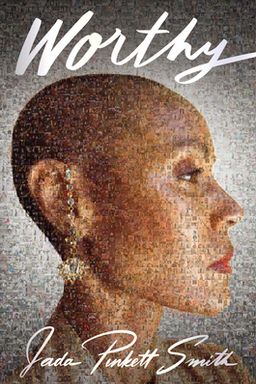
Worthy cover

Worthy

by Jada Pinkett Smith

The actress and talk-show host describes personal and professional difficulties she encountered and her journey to finding self-love.

Worthy as Cultivation in Chaos

How do you keep your center when life keeps moving the ground beneath you? In Worthy, Jada Pinkett Smith argues that worth is not a trophy you win, but a living practice you cultivate—first in the small, ordinary rituals of care, and then in the fires of trauma, fame, love, and public scrutiny. She contends that you can grow a self that holds under pressure, but to do so, you must understand where your roots formed, how ruptures shaped your instincts, and which practices turn survival into wholeness.

This book knits together a life arc: a grandmother’s garden becomes moral syllabus; parental addiction creates an orphaned vigilance; the “University of the B-more Streets” teaches hustle and hazard; mentors open doors to art; chosen family—especially Tupac—provides anchor and agony; intimate partnerships test your urge to be saved; breakdowns turn into breakthroughs through therapy, music, plant medicine, and spiritual practice; and public truth-telling (Red Table Talk) becomes both medicine and minefield. The result is a blueprint for making worth an active verb—something you maintain with boundaries, grief-work, craft, courage, and community.

Roots: The Garden and the Syllabus of Dignity

Marion—Jada’s grandmother—plants more than roses. She plants standards: a white-glove test on floorboards, composting apple peels into soil, reading lists, boycotts of Nestlé, and trips to the Ethical Society. Those ordinary acts say “you matter” long before the world does. You learn patience, responsibility, and curiosity—the first scaffolding of worth. (Note: This echoes Clarissa Pinkola Estés’s notion that ritual and myth root the wild feminine in integrity.)

Ruptures: Addiction, Hypervigilance, and the Early Hustle

Then the ground cracks. Robsol’s brilliance and brutality, Adrienne’s heroin struggle, and the “orphan while your parents live” feeling force early independence—Pepsi on cereal, hiding from police, gauging predators in a synagogue parking lot at nine. Those skills harden into a street-savvy self-protector. They help later; they also cost you ease and trust. (Parenthetical note: Attachment theory explains the anxiety or avoidance that can follow inconsistent caregiving; Jada shows how race, neighborhood, and economics intensify that pattern.)

Alternative Schooling: Streets and Stages

The Baltimore streets become another university—Cherry Hill window shops, BP’s .22 for protection, Chet’s logistics (vacuum-sealed bricks in detergent boxes, money in speakers). Respect is currency, visibility is risk. Simultaneously, the Baltimore School for the Arts and mentors like Donald Hicken reveal another path: disciplined craft, auditions you don’t want to take, and the guts to pivot after Juilliard’s no to UNC’s yes.

Chosen Family and Grief

Tupac enters as creative kin and political teacher (Assata Shakur, Angela Davis). Their sibling bond tests loyalty when he’s shot, imprisoned, and later murdered. Add Eazy-E’s death and Maxine’s suicide, and you see how unmourned grief turns into rage, depression, and numbness. Francis Weller’s line—“When our grief cannot be spoken, it falls into the shadow”—names what happens when you keep moving instead of mourning.

Love Without Rescue

With Will, Jada confronts the “savior cycle” Bell Hooks warns about: expecting a partner to heal your wounds. The Jamaica pool-jump stunt works momentarily but sustains dysfunction. Blended family work with Sheree and Trey shows another way—cooperation centered on the child. Meanwhile, career rooms ask her to “swallow the key” and trade identity for “Mrs. Smith” leverage; she resists, even telling Harvey Weinstein no when he wants Will attached to her project.

Descent and Return

A panic attack on Melrose and suicidal planning at Mulholland reveal how even success can hide despair. Lyte flies in; Debbie Allen connects her to Dr. Sally Grieg; Prozac steadies the floor so therapy can work. Music—Wicked Wisdom—lets the “wild banshee” scream on Ozzfest stages despite death threats. Ayahuasca in Ojai surfaces the darkest voices (“Kill yourself”), then bathes her in a luminous Divine embrace and the guidance of a panther. Sustained practices—Thich Nhat Hanh’s teachings, Bhakti study with Radhanath Swami and Jay Shetty—turn vision into change.

Public Medicine, Public Fire

Red Table Talk begins at a kitchen table (with Gammy and Willow) and grows into a forum where vulnerability heals and also attracts backlash. The “entanglement” episode and the 2022 Oscars “holy slap” show how public candor without careful framing can be weaponized. Jada’s lesson: own your truth, but prepare for the storm—strategy, mentors, and private processing are non-negotiable.

By the end, you’re left with a practice: cultivate roots, name ruptures, grieve honestly, choose integrity over leverage, refuse rescue fantasies, build boundaries, and keep a daily surrender to something larger. Worth is not a label; it’s a life you tend—like Marion’s roses—through seasons of heat, frost, and bloom.


Roots And Ruptures

Jada’s earliest formation happens in two classrooms at once: Marion’s backyard garden and the unstable house of addiction. You watch how those forces braid into a durable but wary self—part cultivated rose, part street-hardened vine. The practical question for you: which early rituals built your dignity, and which wounds taught you to survive at any cost?

The Garden as Moral Syllabus

Marion’s home is a curriculum. You scrub floorboards that squeak under a white-glove test. You compost apple peels into dark, fertile soil. You read Roll of Thunder, Hear My Cry and sit at the Ethical Society learning that multiple faiths can coexist. Marion’s rules—no spanking, no tickling, no hide-and-seek—come with history: slavery’s legacy of punishment, tickling as torture. Boundaries become lessons in dignity, not dictates for obedience.

Exposure feeds curiosity. Hasidic neighbors, souvenirs from India and Africa, summer reading programs—each says “the world is bigger than your block.” The key metaphor—“Everything grew if given enough sun, fertilizer, and the right amount of water”—lodges as an operating principle: nurture yields transformation.

Addiction’s House: Orphaned While They Live

Then there is Robsol: brilliant, charismatic, capable of violent harm, and honest enough to say, “I’m a drug addict and a criminal.” Adrienne is the fierce, ambitious mother whose heroin dependence steals consistency. Together, they create emotional scarcity. Jada learns to cook from nothing (Pepsi on cereal), hide when police knock, and spot predatory energy in a parking lot at nine. Hypervigilance becomes normal.

Those skills read like maturity to outsiders—toughness, hustle, masculine bravado—but they are survival crafts. Jada works jobs, sells records, and later steps into drug sales in Cherry Hill as calculus against dependence on a man. Resilience rises, but so does the cost: intimacy becomes dangerous, trust a luxury.

Two Truths You Can Use

First, ordinary care is not ordinary to a child; it’s identity-shaping. If you mentor or parent, embed values inside rituals—the way Marion embeds ethics in chores, books, and rules with historical context. (Note: Compare to Montessori’s emphasis on practical life work shaping agency.)

Second, don’t romanticize resilience. If you grew up like Jada, list the survival skills you’re proud of—and the hidden debts they carry (hypervigilance, isolation). Recovery begins where you can name both.

From Roots to Rupture to Resource

The paradox is generative: the garden’s care teaches patience and self-worth; addiction’s chaos builds alertness and independence. Together, they equip Jada to navigate high-risk spaces later—the streets of Baltimore, the politics of Hollywood, and the volatility of public life—without fully losing her center. Your task is similar: identify which root nourishes you and which rupture still calls for tending.

Key Idea

“Worth” begins in ordinary, repeated care—and it can survive extraordinary ruptures when you honor both the rituals that formed you and the grief they could not prevent.


Street School, Stage School

Jada earns a double degree: one from the “University of the B-more Streets,” the other from conservatory training at the Baltimore School for the Arts and UNC School of the Arts. Each campus teaches mastery; each one can also wreck you if you misunderstand its ethics. You learn to ask where you’re getting your validation and what it costs.

Street Curriculum: Hustle, Discretion, Visibility Risk

In Cherry Hill, Jada sets up a first-floor window spot. BP gives her a .22 for protection. Chet teaches logistics—UPS stealth, vacuum-sealed bricks in detergent boxes, money in speakers—and the value of legit cover jobs. The social math is constant: reputation is currency (sneakers at Druid Hill Park, dance battles at Painters Mill), but attention raises risk (robberies, rival targeting, police scrutiny). The Cherry Hill stickup—terror so intense she pees her pants—crystallizes the margin for error.

Why choose this path? Agency. If systems ignore you—teachers labeling you disruptive, schools that don’t protect you—the streets offer an alternative scoreboard. Money seems like safety, autonomy, and dignity. (Comparative note: This mirrors entrepreneurship patterns in deindustrialized zones where legitimate lanes shrink.)

Stage Curriculum: Craft, Mentorship, Pivots

At BSA, Donald Hicken insists she audition for UNC even after Juilliard says no. Rejection becomes a pivot, not a verdict. Hollywood demands new calculations: turn down The Fresh Prince when film is the priority; accept Debbie Allen’s creation of Lena James on A Different World when TV becomes a vehicle for growth; heed Keenen Ivory Wayans’s ethical counsel to refuse perjury for a friend; choose Nancy Rainford’s passionate representation over prestige.

The career principle is consistent: integrity over short-term heat. Jada refuses to lever Will’s brand when Harvey Weinstein wants his name attached to her film. That “no” preserves her key—agency and creative identity—even when the industry rewards the opposite.

What You Can Extract

  • Design dual education: let the streets teach improvisation and people-reading; let conservatory or craft training refine discipline and range.
  • Track the price of visibility: perform when it opens doors; go low-profile when it paints targets.
  • Pick mentors who stretch you and guard your ethics; their “nos” and re-routes (Hicken, Allen, Wayans) save years.

When you blend both schools—hustle’s agility and craft’s rigor—you get anti-fragility: you can step into chaos without abandoning your standards. That’s the engine behind Jada’s early ascent.

Key Idea

The right mix of improvisation and discipline turns survival instinct into sustainable excellence.


Chosen Family, Chosen Grief

Tupac isn’t a subplot in Jada’s life; he’s a mirror, megaphone, and moral test. Their bond shows how chosen family can raise your ceiling and break your heart—and how failing to grieve can flatten your spirit for years. If you love fiercely, you must also learn to mourn well.

Kinship Without Romance

They meet at Baltimore School for the Arts. The romantic test-kiss fails spectacularly; what remains is a sibling ferocity—debates about sexism in liberation movements, exchanges of rhymes and artistic push. Pac calls her “Square” with affection. He opens a canon—Assata Shakur, Angela Davis, Eldridge Cleaver—that extends the history Marion already planted.

Loyalty Under Fire

When Pac is shot at Quad Studios and later imprisoned, Jada mobilizes: court visits, Rikers trips, care for Afeni. He proposes marriage from prison—a plea for stability and protection. She draws a boundary: unconditional care without surrendering her body or autonomy. This is loyalty as practice, not romantic myth—standing with someone while preserving self.

Losses That Don’t Land

Then the deaths come. Eazy-E’s sudden AIDS diagnosis and death at 31. Maxine’s escalation and suicide in Toronto. Pac’s murder and the surreal moment of being handed his ashes. Jada keeps moving, swallowing rage, losing love for hip-hop’s violent currents. Francis Weller’s line frames the consequence: grief unspoken goes to shadow and returns as depression, anger, and numbness.

How You Mourn On Purpose

  • Name the loss: denial dissolves when you say, “He died and I wasn’t there,” or “I never got goodbye.”
  • Make ritual: a letter, a playlist, an altar in your heart; commemorate the date so your body doesn’t carry it alone.
  • Tell the story: to trusted people or publicly when ready (RTT later becomes one such container).

Grief is both personal and communal. Pac’s death wasn’t hers alone; it scarred hip-hop and Black America. Remember that public losses multiply grief: you mourn the person and the cultural betrayal of dreams deferred.

Key Idea

Chosen family gives life its fiercest love—and demands that you practice fierce mourning when it ends.


Love Without Rescue

Romance tests your definition of worth. Jada maps how the “savior cycle”—yearning for a partner to fix old wounds—undermines intimacy and autonomy. Parallel to that, step-parenting and celebrity marriage pressure you to “swallow the key” of your identity. Her answer is a trilogy: self-responsibility, child-centered collaboration, and creative boundaries.

The Savior Loop and the Jamaica Lesson

Early with Will, Jada craves a prince to end chaos. When insecurity spikes over his contact with Sheree’s family in Jamaica, she gets drunk, scales a trellis, and cannonballs into a pool to win him back. The spectacle “works,” but it’s the wrong fuel—attention instead of accountability. Bell Hooks calls out that fairy-tale script; Jada learns to ask, “What needs am I outsourcing to him that I must meet myself?”

Blended Family as Daily Practice

With Trey, the pivot is simple and hard: put the child first. Jada invites Sheree to lunch, opens with respect, and apologizes when she oversteps (like the candy-store sugar fiasco). The language shifts—“bonus son” replaces hierarchy—and small rituals (holidays, shared celebrations) knit a real unit. De-escalate in public, repair in private; collaborate instead of compete.

Swallowing the Key—and Spitting It Back Up

Fame tempts you to trade autonomy for leverage. Offers arrive with strings: “Attach Will as EP and doors open.” Jada refuses when Harvey Weinstein pushes that bargain. She names the slow erosion—everything becoming “the Smiths’”—as a handmade gilded cage. Reclaiming the key means inventorying what you gave away (credit, money, decision-making), drawing new lines (no defaulting to the other’s brand), and practicing “no,” even when it costs.

None of this is anti-partnership. In fact, Jada and Will decide on no prenup as a moral stance to build together. The point is consent: you choose teamwork without erasing yourself. You can love someone fully only if you don’t outsource your worth to their approval or power.

Your Application

  • Write two lists: needs you expect a partner to meet; needs you can meet yourself. Reassign at least one today.
  • If you’re in a blended family, script a first-principles conversation: “Child first; collaborate; repair quickly.”
  • Identify one “key” you swallowed (credit, time, voice). Take a small, concrete action to reclaim it this month.

Key Idea

Love thrives when two whole people choose each other—without rescue fantasies and without erasing either self.


Descent, Medicine, And Voice

Jada’s midlife chapter is a descent into the underworld and a climb back with new medicine. A panic collapse on Melrose, plans for an “accidental” death off Mulholland, and years of numbed rage give way to therapy, medication, a primal creative rebirth in metal, intensive plant medicine, and a new public ministry at Red Table Talk. The arc shows how you move from surviving to serving.

Collapse and First Help

She pulls over on Melrose, gasping, sobbing, then later scouts cliffs to end it. Lyte gets on a plane. Debbie Allen arranges Dr. Sally Grieg, who prescribes Prozac to lift the floor so therapy can work. Jada wrestles with stigma and side effects (blunted libido) but accepts a short-term pharmacological bridge. The lesson: medication is a tool, not a verdict; the point is safety and space for deeper work.

The Wild Banshee: Wicked Wisdom

Music becomes catharsis. With Pocket Honore and Cameron Graves, Wicked Wisdom evolves into a nu-metal force. A Viper Room audition wins Sharon Osbourne’s invite to Ozzfest. The backlash is vicious—online threats, sneers in cornfields—but craft and presence win crowds. In one rural shack, color and class melt by the final note. Like Tina Turner’s rock pivot, Jada crosses a cultural line—reclaiming the howl she once muted. She tours with her kids, insulating joy from the Hollywood bubble.

Aya: Shadow Work and Surrender

In Ojai, ayahuasca drags up the darkest voices—“Kill yourself”—until she begs for mercy. On the fourth night, an iridescent light floods her with Divine love; a panther guide returns as focused power. The Medicine Woman’s tenderness—“You did well”—anchors integration. Jada doesn’t stop there: she seeks Thich Nhat Hanh’s presence in Vietnam and studies Bhakti with Jay Shetty and Radhanath Swami. Visions become routines: meditation, fasting, scripture, and community.

Public Vulnerability, Public Fire

Red Table Talk starts small—with Gammy and Willow—and becomes a cultural confessional. The “entanglement” episode, shot hastily with Will, shows the hazard of unframed revelation; narratives collide, and the internet judges. The 2022 Oscars “holy slap” explodes that scrutiny worldwide. Jada chooses to stand publicly with Will; support and fury follow. Her counsel: before you put your pain on a platform, assemble a strategy, a truth circle, and private processing. Vulnerability is a medicine—dose carefully.

Your Practices

  • Crisis map: list three people you call on your worst day; add a professional resource now.
  • Creative outlet: pick one “banshee” practice that lets your body speak (singing, drumming, martial arts).
  • Spiritual integration: a daily 10-minute surrender ritual—breath, mantra, or gratitude—to stabilize insights.

Key Idea

Breakdown can become breakthrough when you combine safe help, embodied creativity, courageous shadow work, and disciplined integration.

Dig Deeper

Get personalized prompts to apply these lessons to your life and deepen your understanding.

Go Deeper

Get the Full Experience

Download Insight Books for AI-powered reflections, quizzes, and more.