
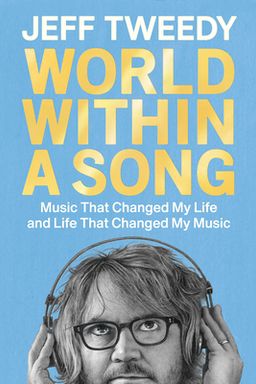
World Within A Song cover

World Within A Song

by Jeff Tweedy

The founder of the rock band Wilco explores 50 songs that made an impression on him.

Songs Are Worlds You Live Inside

When has a song ever felt more like a place than a piece of music—somewhere you’ve actually been, with weather, light, and people you know? In World Within a Song, Jeff Tweedy argues that songs don’t just soundtrack your life; they absorb it, reshape it, and hand it back as a home you can always reenter. He contends that each listener carries a private, unrepeatable universe inside even the most public song. Your “A Day in the Life” or “Dock of the Bay” is not his, and that’s the miracle. What matters isn’t canon building but experience building—the way tunes store your memories, teach you how to be human, and connect your inner life to a world of others who are also listening.

Tweedy’s core claim is radical in its humility: other people’s songs made him. As a kid in Belleville, Illinois, as a bandmate in Uncle Tupelo and Wilco, and as a father, partner, and friend, he learned that songs are the most portable technology we have for meaning, memory, and empathy. He writes not a ranking, but a map of how listening shaped his art and life—why a Deep Purple riff (“Smoke on the Water”) can be your first passport stamp, how Patti Smith’s opening line (“Jesus died for somebody’s sins but not mine”) can sound like a conversion, and why a field recording of a banjo (“Satan, Your Kingdom Must Come Down”) can feel like moral courage.

What You’ll Find in This Book

First, Tweedy shows you how songs embed and retrieve memories—what he calls Rememories—brief, dreamlike flash-narratives that punctuate the chapters. You’ll see a neighbor tricked by ham radio patter (“Schadenfreude Buffet”), a Cub Scout Pinewood Derby meltdown, a CBGB bathroom you can’t unsee, and a glass-blown heart gifted backstage that becomes his nightly talisman. The lesson: songs don’t simply remind you of life events; they become the frame that develops them in your mind.

How Listening Becomes Making

Second, you’ll watch a working songwriter discover his vocation by listening. DIY scenes (SST Records, the Minutemen’s “Our band could be your life”), a feral Replacements set (“God Damn Job”), and a mysterious crate of his brother’s records (Aphrodite’s Child, Kraftwerk) turn listening into apprenticeship. The Beatles Anthology demos then demolish the myth of perfection: even the Beatles sounded human on the way to extraordinary. (Brian Eno and David Byrne make a similar point in How Music Works: process isn’t a detour—it’s the road.)

Taste, Bias, and the Body

Third, Tweedy argues for body-first listening and taste-humility. He confesses to hating ABBA’s “Dancing Queen” until it knocked him out in a grocery store aisle decades later, and to fearing 10cc’s “I’m Not in Love” as a kid before hearing its alien beauty as an adult. He pleads: trust goose bumps over posture, and if you dislike something, try again in ten years. (Compare to Oliver Burkeman’s advice on re-meeting art as you change.)

Authenticity, Risk, and the Edge

Fourth, Tweedy explores how artists court real danger to make real work—Suicide’s “Frankie Teardrop,” Patti Smith’s “Gloria,” Lou Reed’s welcoming menace—while also pointing to older wells of authenticity in folk collectors like John Cohen and the Lomaxes. Street musicians in New York teach him invulnerability; the city shows him you can dress how you want and sing in public. Yet he also skewers the performance of authenticity (industry pecking orders, a chilly encounter with Timothy B. Schmit’s bass rig) without bitterness.

Songs as Empathy Machines

Fifth, you’ll see songs teach empathy without a lecture. Arthur Russell’s “Close My Eyes” slips a closeted Iowa teenager’s first person into your mouth, and suddenly your heart knows what your brain doesn’t. Rosalía’s “Bizcochito” proves you can “sing two languages at once”—the literal words, and a second, emotional language that anyone can feel. And Mavis Staples turns The Band’s “The Weight” into a masterclass in joy as moral force.

Why It Matters

Tweedy isn’t trying to convince you to love his songs; he’s trying to help you notice what your songs are already doing to you. If you create, he’s giving you permission to build with borrowed light and imperfect takes. If you just love music, he’s showing you how to let songs console you, enlarge you, and make you braver. As he writes of the Staple Singers and the song he later wrote with Mavis—“You Are Not Alone”—music’s deepest claim is not coolness, but companionship. Your job is to listen fully enough to hear the hand on your shoulder.

Key Idea

“Loving one thing completely becomes a love for all things.” That’s Tweedy’s quiet thesis. Start with the song-sized, and the world-sized opens.


Memory Works in Song-Sized Scenes

Tweedy invites you to think in “song-sized” thoughts—compact, melodic packets that hold far more than chronology. He calls the short, cinematic interludes scattered through the book “Rememories,” and they function like outtakes cued by a needle drop: a pinewood derby scandal, a ghosted Houston club, the CBGB toilet you can’t unsee. The form is the message. Memory doesn’t spool out as a sober transcript; it drops as choruses, riffs, and bridges.

Songs That Became Memory Keys

Your first musical dent probably wasn’t tasteful. For Tweedy, it’s the four-note gravity of “Smoke on the Water”—the “Seven Nation Army” of its day—learned at seven or eight on a guitar’s bottom string. That tiny victory wasn’t elegant, but it was a key: “I can do this.” Similarly, Leo Sayer’s “Long Tall Glasses” becomes the smell and sound of his father bellowing “I CAN DANCE!” after Pabst Extra Lights, night after night—annoying then, tender now. A dubious pop bauble transmutes into uncut joy: a father seen and forgiven through a chorus.

Gifts also trigger new maps. After a gruesome bike accident that would strand him in bed (and push him toward the guitar), a not-very-close friend shows up with Wings Greatest. “Mull of Kintyre,” a bagpiped love letter to a Scottish home, isn’t just McCartney; it’s the first moment Tweedy feels deeply seen by someone who barely knew “music was my thing.” A cheap compilation becomes proof of friendship, and a lifetime cue to notice the people in front of you.

Home Movies Inside Songs

Some songs lock to a person so tightly that pressing play becomes visiting. “Somewhere Over the Rainbow” is Judy Garland, sure. But it’s also Tweedy’s mother, TV-lit at 2 a.m., mouthing along through cigarette smoke, “as soft as a child.” The song is now a portal to the look on her face—arguably the truer artifact than any studio take. Years later, in Montana, a stranger gifts Tweedy a crimson, hand-blown glass heart, hours after he learns of his brother’s failing heart. That heart sits on his amp every night, and Blondie’s “Heart of Glass” becomes a braid: his mother’s red-glass collection, his brother’s prognosis, the stranger’s recovery story, his own tears. A pop title becomes a reliquary.

Rememories as a Practice

Tweedy’s Rememories aren’t just literary. They model a way you can hold your own story: short, sung, and vivid. A prank with a ham radio voice turns a feuding neighbor into family-bonding (“Schadenfreude Buffet”). A failed treehouse camp reveals grown-up cons and a child’s resilience. A crowd-surfed encore (“Will You Love Me Tomorrow”) makes private insecurity public—and cared for. These are mnemonic devices disguised as melodies. Instead of interrogating your past for meaning, you can hum it back into shape.

Try This

Pick one song that won’t leave you alone. Write the 200-word scene it summons. Don’t explain it. Score it. Who’s there? What color is the light? What line in the song pinches you even now?

(Context: In The Power of Meaning, Emily Esfahani Smith argues that story and belonging are meaning pillars. Tweedy shows how songs entwine both—your story becomes singable, and you belong to everyone else who’s been inside that song.)


Listening As Apprenticeship

Tweedy learned to make songs by living inside other people’s. You can, too. His education wasn’t a conservatory; it was a hand-me-down crate (Amon Düül II, Aphrodite’s Child’s apocalyptic 666), a mail-order SST collection (Minutemen, Hüsker Dü, Meat Puppets), and the shock of live bands who seemed to detonate the room just by showing up (The Replacements flattening the floor with “God Damn Job”). The pattern: listen hard, imitate joyfully, and keep anything that still feels like you.

DIY: From Scenes to Selfhood

The SST logo was once a quality stamp so reliable that Tweedy and his friends bought unknown bands on faith. That trust made him bolder. He discovered Slovenly’s vulnerable, “aspirational art” on Riposte precisely when his scene’s buying habits were being gamed by supply—a lesson in curating your own canon. (“Listen like a label you run for yourself.”) Then the Minutemen’s “History Lesson—Part II” arrives not just as a song but as a life strategy: “Our band could be your life.” Translation: start a band, be honest with your friends, get in the van. You’ve already won when you get to keep doing it. (Compare to Ian MacKaye’s Dischord ethos; success is continuity.)

The Moment That Changes Everything

Before X took the stage in St. Louis, the Replacements stumbled out. Paul Westerberg fell face-first off the stage and kept singing “I NEED A GODDAMN JOB!” from the floor. It wasn’t theater; it was freedom embodied. Tweedy writes, “It had been invented inside me that day.” You likely have a version of this—one night when a body in a room showed you what your life could be. Honor it. Let it set your bar for honesty.

Perfection Is a Myth (Even for the Beatles)

The Beatles Anthology cracked open the cathedral. “Strawberry Fields” begins as an ordinary acoustic song. “Helter Skelter” lumbers as a tepid blues before it scorches. The revelation isn’t that they were sloppy; it’s that they were gloriously iterative. If the Beatles needed dead ends, so do you. Record your demos, let yourself sound bad “on the way,” and keep chasing the take that sounds like it invented itself as you heard it. (Austin Kleon’s Steal Like an Artist makes the same permission explicit: copy, then morph.)

Gatekeeping and Grace

Scenes can wound. At the Blue Note, Tweedy’s young band is given two live channels and told not to touch Timothy B. Schmit’s pristine bass setup. It stings for decades. But he resists calcifying into bitterness; he uses the story to ask where he’s failed to extend grace to those below him on a bill. Apprenticeship includes learning what not to become.

Practice Notes

• Make your own “SST list”—five labels, DJs, or curators you trust—then buy unseen. • Keep a “Minutemen metric”: if a step won’t help you keep doing it, don’t take it. • Archive your false starts; future-you will hear the path.


Let Your Body Judge First

You overthink music because you want to be right; your body wants to be moved. Tweedy urges you to privilege goose bumps over arguments. His Exhibit A is Aphrodite’s Child’s cult track “Loud, Loud, Loud”—a doomy spoken-word march from a Greek prog concept album based on Revelation. Is it silly? Yes. Does he get chills every time? Also yes. Life’s too short, he says, “to let your critical thinking get in the way of being moved.”

Taste Evolves—If You Let It

He once performed masculinity-by-proxy by disdaining disco and pop. Then ABBA’s “Dancing Queen” ambushed him in a grocery aisle and he realized he’d denied himself “undeniable joy” because of fear and bigotry he’d inhaled as a kid. His rule now: if you hate a song, schedule a re-listen in ten years. He also grew from fearing 10cc’s “I’m Not in Love”—especially the coma-like middle section—into admiring its alien architecture and black-humored lyric (“It hides a nasty stain that’s lying there”). Your nervous system changes; let your library change with it.

Separate Song from Scene (and Critics)

Rock writing can help you discover bands—and also make you outsource your ears. Tweedy thanks critics, then ribs the star-rating economy that reduces a thousand words to “it’s okay.” When The Knack’s “My Sharona” hit, critical derision about contrivance and gross lyrics didn’t matter to a kid floored by the middle’s gasping, hard-rocking release. He prefers listener sovereignty: any song can be your companion for a minute or a lifetime. (Carl Wilson’s Let’s Talk About Love makes a parallel case using Celine Dion—taste is personal, social, and revisable.)

It’s Also Fine to Dislike Things

In a wry detour, Tweedy confesses he can’t stand “I Will Always Love You,” no matter who sings it. He preempts the outrage cycle by saying: it’s okay if something isn’t for you; not all art has to love you back. He’s less generous to “Wanted Dead or Alive”—but even the rant underlines his broader ethic: the point isn’t universal judgment; it’s honesty about your ears right now.

The Perils of Shared Jokes

Finally, he begs you: stop yelling “Free Bird.” The proto-meme severed a song from itself and turned it into a vibe-killer. Better to actually play “Free Bird” and marvel at the guitar crossfire than to recycle a gag that once was subversive and now is stale. Songs deserve fresh air.

Re-Listening Ritual

Make a “Why I Was Wrong” playlist. Add three songs you once scorned. Write one sentence about what you missed. Your future self will thank you.


Authenticity, Risk, And The Edge

What feels “real” in music often lives where risk, context, and conviction intersect. Tweedy tracks this line from the downtown menace of Suicide and Patti Smith to the quiet gravity of field recordings and the radical welcome of the Velvet Underground. Authenticity isn’t a costume; it’s a cost you’re willing to pay to tell the truth, whether that truth is a banshee scream, a forked folk hymn, or a pop song sung like it’s your whole life.

When the Room Tilts

“Gloria” opens Patti Smith’s Horses with blasphemy-as-baptism: “Jesus died for somebody’s sins but not mine.” For a teen Jeff dodging religious conformity, it felt dangerous and saving. Then there’s Suicide’s “Frankie Teardrop,” which he calls the outer limit of recorded torment—so intense he warns parents not to play it on a dark road for their kids. Beside those, Springsteen’s Nebraska, however brilliant, can sound “actorly”—not fake, but safer.

Older Than Punk, Truer Than Pose

John Cohen’s High Atmosphere tapes—Frank Proffitt murmuring “Satan, your kingdom must come down”—deliver a different kind of spine-true. Tweedy, a nonbeliever, sings it anyway, because the song’s arc (pray, sing, shout) mirrors a universal struggle against the world’s bullshit. Folk collectors (Cohen, the Lomaxes) taught him that authenticity can be voices recorded in kitchens by people who may not know a record is being made—but the point isn’t fetish; it’s transmission.

Risk, Reframed

Authentic risk isn’t always darker, louder, or cooler. Sometimes it’s the banjo player from a notorious local band (White Pride—satire that got out of hand) standing up at a carpeted squat and playing a joyous bluegrass “Ramblin’ Man.” In a stroke, Tweedy realizes punk’s gatekeeping is a lie; razing the past won’t free you more than repurposing it with love. Similarly, the Velvet Underground looks like darkness from a distance, but up close, their true revolution is invitation: “misfits, step into the light—together.”

The City’s Protective Cloak

In New York, street musicians teach another authenticity: invulnerability. You play with your case open and your hat on your head because the city busy-ness makes room for difference. Tweedy tries on a beret—empowered in Manhattan, humiliated back home—and learns that context is a coward’s best friend. Part of risk is where you stand when you sing.

A Working Test

Ask of any performance: What would it cost me to mean it like that? If the answer is “something real,” you’re near the edge where songs change people.


Empathy, Companionship, And Shared Joy

Tweedy’s deepest claim is that songs are the most democratic empathy machines we have. They console your loneliness and smuggle you into someone else’s. He shows you both doors: how a song becomes your companion in a tough room, and how a different song tricks your ego into singing “I” on behalf of a life not your own.

From Consolation to Courage

Otis Redding’s “(Sittin’ On) The Dock of the Bay” is Tweedy’s paradigm of world-building: “Here are the waves. Listen.” It makes space, quiets the overthinker, and carries you somewhere softer. He and Mavis Staples later write “You Are Not Alone” from that same place—imagining a single person, alone in a room, feeling a hand on their shoulder. Meanwhile, “I’m Beginning to See the Light” becomes a bedtime song to his sons, proof that romantic lyrics can carry parental awe without apology.

Songs That Tie You Back Together

Michelle Shocked’s “Anchorage” makes Tweedy cry almost on contact. He doesn’t fully know why—until a post-show reunion with his first best friend, the tomboy down the block he’d been shamed away from. Her hug and whispered blessing (“I’m so proud of you, my dear, dear courageous friend”) complete a circuit the song had been lighting for years. Some songs are letters you’ve been waiting to receive.

First-Person Empathy

Arthur Russell’s “Close My Eyes” puts a closeted Iowa teen’s longing into your mouth. Because it’s written in the first person, your brain hears you say “I,” and a backdoor to empathy opens. You don’t have to pledge to understand; you just sing—and part of you does. Rosalía’s “Bizcochito” doubles this trick: her voice carries a literal language and an emotional micro-language that reads across borders. You feel the stance (defiance, play, power) even if your Spanish is high-school thin.

Communal Joy Is Serious Business

The Last Waltz performance of “The Weight” with the Staple Singers shows Tweedy what joy looks like when it’s moral and muscular. At home, his Seeburg jukebox always starts the party with “I’ll Take You There.” These aren’t just good times; they’re secular liturgy—a reliable way to remember you belong. (See also: Dacher Keltner’s work on “awe” as prosocial glue.)

A Small Litany

Keep a dock song (for quiet). Keep a letter song (for repair). Keep a you-are-not-alone song (for midnight). Keep a party song (for the kitchen). Rotate as you change.


Sound Itself Tells the Story

Lyrics matter. But Tweedy keeps pointing to something even more elemental: sound as narrative. Randy Newman’s “In Germany Before the War” never says what happens to the “little girl”; the orchestration, chord-voicing, and uneasy major-over-minor harmony leave “no doubt.” John Cage’s 4'33" flips the frame: silence isn’t empty; it’s the hum of the room and your own heartbeat becoming the composition. And a Scottish hotel alarm, once surrendered to, becomes a cathedral of overtones, polyrhythms, and unexpected tears.

Build Worlds, Don’t Just Sing in Them

“Dock of the Bay” is Tweedy’s gold standard because it sounds like it wrote itself. The whistled refrain isn’t a gimmick; it says, “Thinking can’t fix much; listen to the waves awhile.” The Rolling Stones’ “Connection” is his ideal of terse world-building—a song so in his DNA he’s tried to rewrite it for forty years. Meanwhile, Souled American’s “Before Tonight” stretches time like friends ambling to a bar—entraining you to feel tempo as conversation, not a click track. Arrangement is meaning.

Surrender as Technique

When a 2 a.m. fire alarm wouldn’t stop, Tweedy stopped fighting it. He “listened with intention,” and the punishing tone revealed harmonics, counter-melodies, even a “mirror adding a shimmering, clear top note.” The emotion he’d once missed in conceptual music arrived—because he included his own soul in the signal chain. That becomes a broader instruction: if a sound won’t leave you alone, give in. There’s a story hiding in its overtones.

Process Notes and Pitfalls

Not every sound-world is sacred. “Happy Birthday,” for instance, loads Tweedy with performance anxiety—family expecting him to dazzle when all he wants is cake. Elsewhere, industry absurdities (a bomb threat clears a label office; a two-channel opening slot with a grand piano immovable at center stage) remind you that the world around the song can distort the listening. Your task, if you make things, is to keep returning to sound as the compass, especially when the room’s politics get loud.

Craft Checklist

• Does your arrangement “tell the listener where to look” when words can’t? • Could one less instrument make the story clearer? • Where can a whistle, breath, or room tone say more than a lyric?

Dig Deeper

Get personalized prompts to apply these lessons to your life and deepen your understanding.

Go Deeper

Get the Full Experience

Download Insight Books for AI-powered reflections, quizzes, and more.