
Idea 1
How to Stop Feeling Like an Outsider and Succeed Anyway
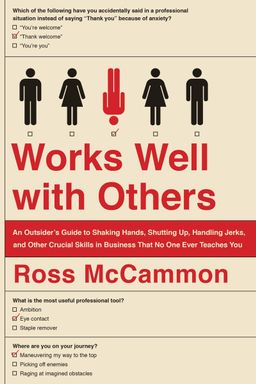
Have you ever walked into a meeting, party, or new job and felt like everyone else had the rules—and you didn’t? In Works Well with Others, Ross McCammon turns that awkward, insecure feeling into the foundation of confidence itself. Drawing from his unlikely journey from a small in-flight magazine in Texas to becoming an editor at Esquire in New York, McCammon argues that professional success isn’t about being perfect, connected, or even particularly polished—it’s about learning to act human in strange environments, and to use your anxiety and outsider perspective as fuel rather than a flaw.
At its heart, McCammon’s book is a survival manual for impostors—people who think they were let into the building by mistake. He reveals that everyone, from new interns to pop stars, is at least a little bit nervous and weird. Success, he argues, comes not from faking confidence but from developing comfort with discomfort, and learning how to play the small social games that make big opportunities possible. He calls these moments—the handshake, the first-day introduction, the awkward work lunch—the “microtransactions” of professional life. Master them, and you’ll seem confident even when you aren’t.
From Chicken Sandwiches to Esquire
McCammon opens his story sitting in a parking lot outside Dallas, eating a Chick-fil-A sandwich and feeling a dull dissatisfaction with his work editing Spirit, Southwest Airlines’ magazine. Minutes later, he receives a call from a New York recruiter inviting him to interview at Esquire. The conversation captures the book’s main thread—opportunity never feels like opportunity when you’re terrified of blowing it. Convinced that the call is a scam, he still agrees to the interview, and soon finds himself in Manhattan, worrying that he’s not wearing the right jacket and that everyone will find out he doesn’t belong.
This experience becomes the prototype for nearly every chapter: McCammon places himself in uncomfortable, often ridiculous scenarios (shaking hands with Kanye West backstage, surviving fancy lunches with executives, buying his first acceptable pair of shoes) and extracts from each a principle for how to function when you feel like a fraud. Each failure or faux pas—like introducing himself to a coworker in the men’s room—becomes a lesson in human behavior and humility.
The Power of Small Things
Unlike typical self-help books promising life hacks or business frameworks, Works Well with Others focuses entirely on little social rituals—how you shake hands, order lunch, email, smile, and talk about clothes. McCammon treats these as vital signals of how you see yourself and others. Small talk, for example, isn’t meaningless—it’s civilization in miniature. Knowing how to exchange pleasantries shows empathy, curiosity, and confidence, and it sets the tone for more consequential conversations later. Similarly, a good handshake (firm but brief, with eye contact and enthusiasm) establishes respect faster than any résumé.
His point isn’t that outward performance replaces substance, but that behavior precedes belief. Dressing well, he argues, actually makes you feel more capable (“enclothed cognition,” as researchers call it). Smiling lifts your mood by activating brain circuitry linked to joy. Taking small confident actions makes confidence follow, not the other way around. As with Amy Cuddy’s research on body language or Brené Brown’s writings on vulnerability, McCammon shows that how we carry ourselves changes how we experience ourselves.
The Art of Awkwardness
Perhaps the most reassuring theme of the book is that awkwardness isn’t a liability—it’s a resource. Anxiety indicates that you care. Feeling like an outsider can sharpen your awareness and empathy. In the workplace, the people who quietly wonder whether they belong often overprepare, notice details others miss, and take nothing for granted. Self-doubt, McCammon says, gives you an advantage if you use it for motivation instead of paralysis.
He develops this into a broader professional philosophy: confidence and humility are not opposites but partners. To work well with others, you must project both—enough certainty to inspire trust, and enough insecurity to stay teachable. When he eventually learns this, McCammon stops worrying about “fitting in” at Esquire and realizes that everyone there, even the most accomplished editors, are improvising too. That’s the paradox of professional life: no one ever really knows what they’re doing, but those who accept that fact do it best.
Why It Matters
In a world obsessed with hustle culture and performative confidence, McCammon offers something subtler and more humane. His message is that success isn’t about erasing insecurity—it’s about managing it with grace. You don’t “fake it till you make it”; you learn it as you make it. By reframing discomfort as progress, embarrassment as data, and awkwardness as humanity, you unlock the real secret to working well with others: being a little kinder—to them and to yourself.
The rest of the book builds out this philosophy through short, funny, and often profound essays on professional etiquette, communication, style, and mindset. From the rules of lunch to the art of profanity, McCammon provides a playbook not for perfection but for presence. If you’ve ever second-guessed your handshake, your outfit, your small talk, or your whole career, this book—and this summary—will help you do all of it better, without being someone you’re not.