
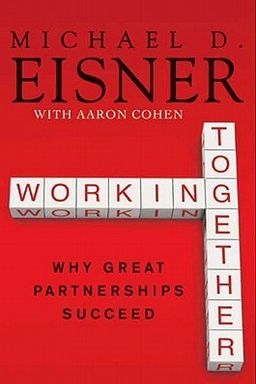
Working Together cover

Working Together

by Michael D Eisner with Aaron Cohen

Working Together showcases the power of partnerships in business through engaging stories of renowned duos, from Eisner and Wells to Gates and Munger. Discover how trust, humility, and shared goals lead to extraordinary success, providing invaluable insights for anyone looking to strengthen their professional and personal collaborations.

The Power of Partnership: Why Working Together Works

Have you ever wondered why some collaborations feel effortless and wildly productive, while others collapse under ego and mistrust? In Working Together: Why Great Partnerships Succeed, Michael Eisner—former CEO of Disney—argues that true success in business and life often hinges on partnership. Drawing from his own decade-long collaboration with Frank Wells at Disney and a series of case studies across industries, Eisner contends that partnerships built on trust, integrity, humility, and shared purpose amplify creativity and yield more than the sum of their parts.

Eisner’s central claim is simple yet profound: one person alone can be brilliant, but two deeply aligned minds can be unstoppable. He illustrates this truth through stories of remarkable duos—from Warren Buffett and Charlie Munger to Bill and Melinda Gates, from Ron Howard and Brian Grazer to Valentino and Giancarlo Giammetti. Whether running Hollywood studios, global philanthropic empires, or neighborhood restaurants, these pairs share a common DNA: mutual respect, complementary strengths, and unwavering honesty.

The Core Argument: Why 1 + 1 = 3

At the heart of Eisner’s philosophy is an equation Frank Wells helped him discover: 1 + 1 = 3. In other words, when two people collaborate with trust and aligned vision, their combined potential exceeds what either could achieve alone. Eisner’s experience leading Disney with Wells from 1984 to 1994—transforming it into a global entertainment powerhouse worth $80 billion—embodied this principle. Wells was the steady, ethical counterbalance to Eisner’s creative energy—a relationship that mirrored other legendary pairings throughout the book.

But Eisner doesn’t glorify partnership lightly. He’s clear: successful collaborations require humility, emotional intelligence, and constant communication. In fact, he warns that partnerships underpinned by ego or envy often self-destruct. True partners acknowledge their differences and use them to complement, not compete. As he shows through Sewell Avery’s downfall at Montgomery Ward or the implosion of Studio 54’s empire, unchecked ego can ruin even the most visionary enterprises.

Partnerships as the Antidote to Modern Business Cynicism

Eisner situates his exploration in the aftermath of early 21st-century corporate scandals—Enron, Bernie Madoff, and the 2008 financial crash. These events, he asserts, weren’t just about greed—they reflected a breakdown of trust and collaboration. Partnerships grounded in ethics and transparency, he argues, can serve as the immune system of capitalism, re-centering business on integrity rather than exploitation. “Morality pays,” he insists, echoing Buffett’s long-held belief that character is the ultimate competitive advantage.

For Eisner, partnership is more than a business arrangement—it’s a moral stance. It creates accountability, tempers reckless ambition, and encourages empathy. In a world obsessed with individualism and celebrity CEOs, Working Together is a case for interdependence as a path to happiness as much as to success. As Eisner puts it, partnerships aren’t just productive—they make people happier, because joy shared is joy magnified.

A Tour of Ten Transformative Partnerships

Across ten vivid stories, Eisner examines partnerships that redefined industries. We meet Warren Buffett and Charlie Munger, the longtime investing duo whose friendship turned Berkshire Hathaway into a $700 billion empire through intellect and restraint. We sit with Bill and Melinda Gates as they redefine philanthropy, blending analytical brilliance with human compassion to tackle global health issues. We enter Hollywood through the eyes of Brian Grazer and Ron Howard, whose creative synergy at Imagine Entertainment has yielded blockbusters from A Beautiful Mind to 24. In fashion, Valentino Garavani and Giancarlo Giammetti embody enduring devotion that blurred the lines between business, art, and love. And in business, Bernie Marcus and Arthur Blank show how friendship built The Home Depot—and how ethics built an empire.

Each story, while distinct, echoes the same refrain: ego kills, trust builds. Successful partnerships require not only complementary skills but complementary temperaments. The visionary needs the pragmatist (like Eisner and Wells), the idealist needs the realist (like Buffett and Munger), and sometimes, the dreamer needs a grounding partner who sees the unseen risks (like Joe Torre’s bench coach Don Zimmer during the Yankees’ championship runs).

Why This Matters for You

Eisner closes with an insight both personal and universal: happiness is not achieved by dominance, but by connection. “Working together,” he writes, “is far better than working alone.” This message extends beyond boardrooms. Whether you’re in a startup, marriage, classroom, or creative duo, partnership is the crucible in which empathy, honesty, and excellence are forged. It’s through collaboration that you refine your weaknesses, expand your perspective, and sustain your joy. Eisner’s book is not just a love letter to his late friend Frank Wells—it’s a call to rediscover what business and life are really about: trust, integrity, and the simple, transformative power of we.


Frank Wells and Michael Eisner: Disney’s Trust Formula

When Michael Eisner took the helm of Disney in 1984, the once-beloved studio was floundering. What transformed it wasn’t just his creative genius but his partnership with Frank Wells—a soft-spoken former Warner Bros. executive and adventurer who had literally climbed six of the world’s seven summits. Together, they built one of the most productive partnerships in corporate history. Eisner called it the moment he learned the equation “1 + 1 = 3.”

Complementary Strengths in Action

Eisner and Wells’s dynamic mirrored many classic leadership duos: Walt Disney and Roy Disney, or Apple’s Steve Jobs and Tim Cook. Eisner brought vision and creative volatility—the “wild CEO,” bursting with ideas like expanding Disney theme parks, reviving animation, and launching live-action hits such as Who Framed Roger Rabbit. Wells offered steadiness, diplomacy, and humility. He managed the company’s vast operations, fielded crises discreetly, and made sure Eisner’s ideas were financially grounded. Instead of competing for dominance, they divided power: Wells as President and COO; Eisner as Chairman and CEO.

This balance—between imagination and judgment—was their cornerstone. Wells was “Caesar’s wife” in ethics, insisting on financial transparency so strict that he and Eisner wrote an annual personal check to the company to avoid conflicts of interest. Eisner’s endless curiosity and transparency matched Wells’s calm. Together, they created Disney’s “synergy engine,” ensuring every film, show, park, and product amplified each other—a model still defining Disney’s corporate strategy today.

Ethics and Synergy

Frank Wells wasn’t just a businessman—he was Disney’s conscience. When a deal didn’t “smell right,” Wells would reject it outright, proving that morality and success weren’t opposites but allies. (Eisner called this “the smell test.”) He handled thorny issues—from the backlash to Disneyland Paris to internal personnel disputes—with grace. Wells embodied what Warren Buffett would call an indispensable quality: integrity. As Buffett said of his own partner Charlie Munger, “If people don’t have integrity, don’t hire them—because you can’t change that trait later.” Eisner learned this lesson firsthand from Wells.

Their partnership also modeled how companies could operate across departments with unity rather than competition. Wells became Eisner’s “VP of mishegoss”—a Yiddish term for managing Disney’s blend of creative chaos. When divisions clashed over intercompany charges or revenue splits, Wells made fair, final decisions, ensuring the “help the other fellow” ethos Eisner cherished became part of Disney’s DNA. This internal alliance between creative and corporate sides became Disney’s secret sauce in the 1980s and early ’90s.

A Partnership Defined by Love and Loss

Then, tragedy struck. On Easter Sunday 1994, Wells died in a helicopter crash during a ski expedition. Eisner’s eulogy revealed deep friendship beyond business—he quoted the fortune Wells kept in his wallet for thirty years: “Humility is the final achievement.” Without his partner, Eisner stumbled politically and struggled to replicate the same harmony with successors. He later admitted that no relationship ever matched the trust he had with Wells. Their decade together became his north star—and the genesis for this book.

Frank Wells taught Michael Eisner—and us—a simple truth: partnership isn’t about equal power; it’s about equal purpose. Wells’s steady integrity magnified Eisner’s creativity, proving that when trust and talent intertwine, the results can transform not just a company, but an entire generation’s imagination.


Buffett and Munger: Wisdom, Wit, and Integrity

Warren Buffett and Charlie Munger are the gold standard of enduring partnership. Over fifty years, they built Berkshire Hathaway into a global empire by relying not on technology or trends, but on clear thinking, humor, and shared ethics. When Buffett says, “With Charlie, it’s been nothing but a good time,” he means it literally—their collaboration is proof that joy and profits can coexist.

Thinking Partners, Not Yes-Men

Unlike many business pairs, Buffett and Munger rarely even share an office. They live in different cities—Omaha and Los Angeles—but spend hours reading, thinking, and talking. Their style is mental collaboration, not micromanagement. Buffett devours company reports; Munger reads philosophy, science, and history. When they finally talk, Munger’s bluntness—often summarized by his famous Dr. No quip—meets Buffett’s optimism. “Charlie,” Buffett jokes, “you’ll say ‘no’ to anything until it’s proven worth your time.”

Their complementary strengths reflect Benjamin Franklin’s approach to shared wisdom: “We must all hang together, or surely we shall hang separately.” Buffett is the communicator and dealmaker; Munger is the philosopher-attorney who taught him to buy great businesses, not just cheap stocks. Together they expanded Berkshire’s empire from textile mills into insurance, railroads, and consumer brands like GEICO and Dairy Queen. Their secret wasn’t speed, but discipline. When tempted by hype, Munger’s realism reined in Buffett’s enthusiasm—saving them billions when others got burned by market fads.

Ethics Over Ego

Both men credit their success to integrity, not intelligence. As Buffett likes to teach students, if you could invest 10 percent of your life’s earnings in one classmate, “Who would you choose?” The answer—the kind, trustworthy peer—says everything about success. Munger and Buffett live that advice daily. They never “keep score” against each other or compete for credit. Buffett once told Eisner, “It works because I like the spotlight—and Charlie doesn’t.”

This absence of envy is their superpower. When Buffett’s stock choices shine, Munger cheers; when Munger’s insights change the company’s direction, Buffett credits him publicly. They view honesty as a strategy—“Morality pays,” as Eisner echoes—because ethical consistency attracts loyal shareholders and trusted executives. (Notably, during Enron and Madoff’s collapse, Berkshire’s reputation only grew stronger.)

The Joy of Shared Learning

What makes their partnership rare is that it’s built on intellectual joy. Buffett calls Munger “a book with legs,” while Munger says Buffett is “a learning machine.” They spend most of their lives reading, not reacting—a lesson to any entrepreneur addicted to noise. Their friendship shows that partnership can be both profitable and personal: a lifelong dialogue between equals who sharpen each other’s minds and values. In an age obsessed with disruption, Buffett and Munger remind you that curiosity and ethics, not algorithms, still compound best over time.


Bill and Melinda Gates: Equality in Action

The Gates Foundation, the world’s largest private philanthropic organization, is not just a monument to wealth—it’s a testament to partnership. Bill and Melinda Gates’s collaboration reshaped global health and education by applying the same precision and logic that built Microsoft. But unlike many business partnerships, theirs is grounded in marriage—a daily balancing act of intellect, empathy, and shared mission.

From Tech Titan to Global Citizen

Bill Gates began his career as the ultimate lone coder. His early partnerships—with Paul Allen and Steve Ballmer—were defined by dominance and competition. It wasn’t until he married Melinda French, a Microsoft manager with equal intellect and emotional intelligence, that he discovered what true equality in partnership means. Together they built a foundation that applies Silicon Valley’s analytical rigor to solve humanity’s hardest problems—malaria, education inequality, and poverty.

Equal Voices, Complementary Gifts

Melinda often walks into high-level meetings to skeptical stares—until, three minutes later, her insight wins the room. Those meetings symbolize a subtle revolution in leadership: gender equality through competence. As she put it, “When they start to hear me talk, they realize—this is a partnership.” Bill calls their relationship “the most equal partnership I’ve ever had.” Melinda brings empathy, intuition, and collaborative strategy; Bill contributes data-driven reasoning and relentless problem-solving. Respect replaces hierarchy.

Their decision-making style models radical transparency. They debate fiercely—about everything from vaccine funding to leadership hires—but always through a shared lens: what helps humanity most? Guided by Warren Buffett’s advice (“Hire someone who brings out the best in both of you”), they selected CEO Jeff Raikes precisely because he honored both their strengths.

Global Impact through Shared Purpose

The Gates’ lessons extend beyond philanthropy. Their partnership reveals that equality in vision multiplies impact. You may not be building vaccines, but in any collaboration—personal or professional—true partnership demands humility and shared accountability. As Melinda says, “When I’m out, the decision will be made as if I were there.” Their unity shows that when people align intellect with compassion, they don’t just change companies—they can change the world.


Ron Howard and Brian Grazer: Creative Symmetry

When film executive Brian Grazer first cold-called actor Ron Howard in the late 1970s, he didn’t just find a director—he found his creative soulmate. Their company, Imagine Entertainment, became one of Hollywood’s most consistent storytelling powerhouses, producing A Beautiful Mind, 24, and Arrested Development. Their secret? Perfectly balanced differences and a radical 50–50 partnership.

When Opposites Complement

Grazer, the hyperactive, spiky-haired producer, radiates Hollywood’s fast-talking energy; Howard, the calm ex–child star, exudes Midwestern humility. Yet beneath their surface contrasts lies identical moral code—both value honesty, fairness, and excellence. As Howard says, “We view the world differently, but we arrive at the same conclusions.” Grazer handles deal-making, energy, and talent negotiations, while Howard translates that kinetic chaos into cinematic depth.

Their relationship survived ego’s test early. After Splash made them stars, Grazer felt overshadowed by Howard’s fame. They briefly parted ways but soon realized independence was emptier than collaboration. When they reunited to start Imagine, they pledged absolute equality: every project, every dollar split 50–50. That single structural decision removed envy, enabling decades of creative trust. It’s a practice Eisner praises as “the financial foundation for emotional stability.”

Trust and Transparency

Grazer sells; Howard refines. Yet key to their longevity is conversation. They speak daily, critique each other’s work privately, and resolve creative disagreements with empathy. Their structure inside Imagine—Grazer as producer, Howard as director—reflects Disney-style synergy: everything supports everything else. As Eisner notes, even when one leads, the other always contributes the moral compass.

Their story embodies a universal creative truth: great collaborations thrive on contrast without conflict. Whether in film, business, or art, the spark between different minds—guided by respect, not rivalry—can produce stories that outlast both partners.


Valentino and Giammetti: Love as Leadership

Fashion titan Valentino Garavani and his lifelong partner, Giancarlo Giammetti, built a global luxury brand through devotion that blurred the lines between love and leadership. As captured in the documentary Valentino: The Last Emperor, their half-century collaboration shows how personal affection can be the ultimate business glue. “This isn’t a story about money or fashion or power,” Giammetti says. “It’s a story about love.”

Two Roles, One Vision

Valentino, the creative genius obsessed with perfection, lived for art. Giammetti, the strategist, built the empire behind the scenes—handling licensing, merchandising, and public relations. Their dynamic mirrors Walt and Roy Disney or Lennon and McCartney: one dreamer, one doer. But unlike many duos, they also shared a romantic past. When their love evolved into friendship, they preserved their emotional bond as professional trust. That intimacy fueled loyalty that money couldn’t buy.

Giammetti once said he never felt shadowed because Valentino’s glory “was mine.” He preferred power to fame—a humility rare in fashion. His marketing vision turned Valentino’s couture into a global brand through licensing deals in perfumes, handbags, and even bathroom decor (in 1980s Japan). They became “The Last Emperors” of bespoke elegance, proof that love and business can coexist when ego gives way to shared devotion.

The Mirror and the Candle

Eisner cites Edith Wharton’s insight: “There are two ways of spreading light: to be the candle or the mirror that reflects it.” Valentino was the candle; Giancarlo, the mirror. Their success defied stereotypes of co-founders needing equal spotlight. When a documentary unveiled their private squabbles, they feared ridicule—but audiences saw vulnerability and love. Fame had hidden their humanity; honesty made them immortal.

Their relationship demonstrates a radical lesson: in any partnership, affection and admiration—not envy—are the real currency. Whether lovers or leaders, the best partners root for your brilliance even when it outshines theirs.


Marcus and Blank: Building an Ethical Empire

In 1978, Bernie Marcus and Arthur Blank were fired from their comfortable executive jobs. Over coffee in a California diner, they scribbled the blueprint for what became The Home Depot—an empire built on discount retailing and, more importantly, mutual trust. Marcus was the visionary merchant; Blank, the disciplined financial mind. Together, they turned vision into viability through relentless ethics and shared humility.

Shared Origins, Shared Respect

Both Jewish sons of working-class families from the East Coast, they bonded over similar values—hard work, gratitude, and fairness. Marcus had flair and bluntness; Blank brought precision. Their chemistry resembled the yin-yang balance Eisner describes elsewhere: emotion meets intellect. Early on, Marcus’s mentor, investor Ken Langone, told him success required one rule: “It’s not about you, it’s about the business.” Marcus lived by it—and so did Arthur.

Their home-improvement stores revolutionized the industry with three principles: low prices, expert service, and massive selection. But their true innovation was cultural. They practiced “inverted leadership,” placing store employees at the top of the organizational pyramid and themselves at the bottom. CEOs made the money, but associates had the power. As Marcus said, “There’s only one boss—the customer.”

Ethics as Strategy

Their partnership proved that kindness scales. They even trained corporate lawyers by making them unload trucks, ensuring empathy with workers. Stores engaged in acts of “tzedakah” (charity), fixing customers’ roofs for free. Ethics weren’t PR—they were policy. This culture inspired fierce loyalty and high morale, cementing Home Depot’s orange-apron identity as a family, not a franchise.

Decades later, when both founders retired, internal politics tested their legacy, but their principles endured. As Marcus summed up, “It was never about ego—it was always about the business.” Their story reminds every entrepreneur that integrity is not just moral—it’s magnetic. It pulls people and profits in equal measure.


The Lessons of Partnership: Trust, Ethics, and Joy

After exploring ten distinct duos, Eisner ends Working Together with a universal conclusion: the most successful partnerships all thrive on three shared pillars—trust, ethics, and mutual joy. Whether in marriage, business, or art, those who collaborate with humility and integrity achieve not just success, but sustained happiness.

Trust and Transparency

Every great pairing Eisner profiles—from Buffett and Munger to Grazer and Howard—operated with radical honesty. They told each other the truth, no matter how painful, confident that criticism came from respect, not rivalry. Eisner contrasts this with partnerships destroyed by secrecy—like his later misfires at Disney—where people withheld information and trust evaporated. Transparency, he insists, is what makes disagreement productive instead of destructive.

Ethics as the Backbone

As economies crumbled under corporate greed, Eisner’s examples show that ethical partnerships outlast even recessions. Frank Wells’s “smell test,” Buffett’s insistence on integrity over IQ, and Marcus’s servant-leadership model all demonstrate that honesty isn’t optional—it’s oxygen. Partnership naturally enforces accountability: one person watching, correcting, and encouraging the other to stay aligned with principle.

The Pursuit of Happiness

Eisner closes with a broader insight: success may create wealth, but partnership creates happiness. Drawing on a Harvard study of 250 men over 70 years, he notes that what made people happiest wasn’t fame or money, but “sustained relationships over time.” From Meckstroth and Rodwell, the world champion bridge duo, to his own marriage, Eisner argues that shared purpose turns work into joy. In his words, “Working together is much better than working alone.”

The takeaway is timeless: you can’t do your life’s best work in isolation. Partnership isn’t a risk—it’s an accelerant for fulfillment. It’s where competence meets character, and where success finally feels like something worth celebrating together.

Dig Deeper

Get personalized prompts to apply these lessons to your life and deepen your understanding.

Go Deeper

Get the Full Experience

Download Insight Books for AI-powered reflections, quizzes, and more.