
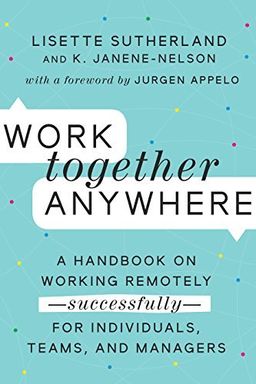
Work Together Anywhere cover

Work Together Anywhere

by Lisette Sutherland and Kirsten Janene-Nelson

Work Together Anywhere is an essential guide for individuals and managers navigating the shift to remote work. It explores the benefits, skills, and technologies required for successful remote collaboration, offering practical strategies to enhance productivity and foster employee loyalty in a flexible work environment.

The Rise and Architecture of Remote Work

Why are individuals and organizations everywhere embracing remote work? The book paints a comprehensive picture: remote work is not a fad, but a structural shift driven by technology, economics, and human priorities. It connects the rise of telework to both individual desire for flexibility and managerial pursuit of agility and global talent.

You learn that the motivations for remote work are remarkably consistent across levels—workers seek autonomy, balance, and meaningful productivity, while employers seek scalability, cost savings, and resilience. Together, these forces create a new paradigm where results matter more than presence, and workplaces are defined by agreements, tools, and trust rather than physical boundaries.

Drivers Behind the Shift

Evidence from FlexJobs, Global Workplace Analytics, and Nicholas Bloom’s well-known Ctrip experiment (Harvard Business Review) show why workers choose remote work: flexibility, commuting avoidance, better focus, family balance, and expanded opportunity. For many, remote work is necessity rather than mere preference—parents, caregivers, rural residents, or retirees depend on it to remain productive while managing life’s constraints. Bloom found Ctrip telecommuters increased productivity by 13.5%, drawing a sharp contrast to office environments riddled with interruptions.

The Employer Perspective

Companies increasingly see remote work as strategic, not optional. Surveys show flexibility directly correlates with retention: 62% of workers leave or consider leaving for lack of it. Organizations like Formstack and PayTrace adopted remote-first models when they could not find local talent. Doing so unlocked competitiveness and cut real estate costs (Global Workplace Analytics estimates $10,000/year savings per employee). Firms now hire internationally, scale up or down efficiently, and structure resilience against disruptions—weather, transit, or global crises.

From Hours to Outcomes

A key philosophical shift underpins remote success: the Results-Only Work Environment (ROWE) by Cali Ressler and Jody Thompson. It replaces attendance metrics with deliverables. Remote practitioners like 10up Inc. and Automattic prove that visibility via shared boards or documentation builds accountability while protecting autonomy. Success depends not on monitoring software but on clarity of commitments, milestones, and measurable results. (Note: this echoes Peter Drucker’s timeless lesson—“what gets measured gets managed.”)

Preparation and Practice

Remote work requires readiness: reliable tech, structured routines, and mindset. Your setup—fast internet, good lighting, quiet workspace—signals professionalism. Early chapters encourage you to experiment incrementally: iterate workspace design, prepare business foundations (contracts, taxes, insurance), and cultivate routines that sustain health and productivity. Tools are amplifiers of intent, not saviors; your habits shape success more than your software.

Beyond Tools—A Cultural Transformation

The book argues this movement is cultural: organizations redefine work from location-based to trust-based. Managers evolve from supervisors to coaches; teams rely on visibility, documented agreements, and social rituals. Remote-first systems demand clarity—because ambiguity multiplies across distance. Communication, team agreements, social time, well-being, and conflict management become explicit disciplines rather than organic patterns.

The Big Idea

Ultimately, remote work is portrayed not as escape from offices but as a pragmatic reimagining of work itself. The future rewards those who master transparency, results, and empathy. The book teaches that successful remote teams are built, not found—through intentional systems of trust, clarity, and care. If you harness technology with human discipline, remote work becomes a lever for better focus, happier lives, and stronger organizations.


Understanding Remote Motivations

People choose remote work because it aligns with their deepest life priorities—flexibility, caregiving, and meaningful productivity. Part I compiles research from FlexJobs and Global Workplace Analytics: 72% of respondents rank work-life balance as top priority, and 84% of parents place flexibility above salary. Remote work reduces commuting, broadens options, and enables participation for diverse demographics—from rural professionals to retirees seeking supplemental income.

The Productivity Dimension

Evidence points toward measurable productivity gains. Bloom’s Ctrip experiment found telecommuters completed 13.5% more calls and used fewer sick days. Remote environments eliminate “the interruption factory” of typical offices. Workers cherish calm conditions and fewer distractions, correlating with greater focus and satisfaction.

The Opportunity Dimension

Beyond lifestyle, remote work expands access. Platforms like Upwork and Freelancer generate billions annually and democratize earning potential. Freelancing reflects autonomy in its purest form—choosing projects, hours, and clients. Payoneer’s survey found over half of freelancers are under thirty globally, yet in the U.S., most remote professionals are experienced experts over forty-five. The mix breaks stereotypes: remote work isn’t digital nomadism but inclusion across generations.

Key Insight

Remote work succeeds because it serves both necessity and aspiration—a bridge between economic survival and personal fulfillment.

Understanding motivations helps you design roles, set expectations, and offer flexibility thoughtfully. For individuals, mapping motives clarifies whether remote work fits your strengths and context. For managers, it illuminates why flexibility attracts high performers and why denying it risks losing talent.


From Presence to Performance

The cultural heart of remote work is the Results-Only Work Environment (ROWE) created by Cali Ressler and Jody Thompson. It represents a shift from measuring time and attendance to measuring results. You move from “hours managed” to “outcomes delivered.” This principle underlies successful distributed teams like Automattic, 10up, and Buffer.

Reframing Productivity

Traditional offices conflate presence with output. Remote work exposes the flaw: it forces clarity in objectives and measurable deliverables. Managers must define success concretely—deliverables, deadlines, and quality metrics. Workers must communicate progress transparently. Productivity becomes about fulfillment of commitments rather than office visibility.

Tools That Enable Visibility

You make progress visible through shared dashboards and documentation: Trello, Asana, Jira, or GitHub. Daily stand-ups and Kanban boards transform invisible labor into public progress. This curbs managerial anxiety and strengthens accountability. (In Agile practice, visibility is the antidote to micromanagement—this book builds upon that principle.)

Handling Fear and Trust

Managers often fear remote workers will slack off; research and real examples show the opposite. Remote professionals often work longer, take fewer breaks, and experience fewer sick days. The solution isn’t surveillance software but structured reporting and regular check-ins tied to deliverables. Transparency and trust go hand in hand.

Lesson

Measure outcomes, not activity. Replace supervision with alignment and visibility, and you’ll get both freedom and accountability.

ROWE is not laissez-faire—it’s disciplined results-driven practice. Success requires granular planning, communication, and trust-building through transparency. When done well, you transform “remote risk” into measurable performance advantage.


Setting Up for Success

Before you request flexibility or build a virtual team, you must prepare your tools, environment, and habits. The book outlines a practical checklist—tech infrastructure, workspace design, business basics, and daily rituals.

Technology and Space

Your foundation is reliable connectivity and equipment. Remote veterans like AgileBill Krebs emphasize sound and lighting quality (“how’s my sound?” should be habitual). Good headsets, webcams, and backup internet matter. Visual environments shape perception—Nick Timmons shows how proper lighting improves engagement on video calls. Where you work also matters: experiment with setups, as Jesse Fewell did—from attic to backyard office—until focus and comfort align.

Business Fundamentals

Freelancers or contractors need solid infrastructure—contracts, deposits, invoicing, insurance, and tax planning. Protect yourself with clear written agreements (especially on platforms like Upwork). Adriana Vela advises portable preparedness: travel kits, labeled cords, and backup batteries. For mobile professionals, organize tasks around connectivity availability.

Habits and Routine

Routines define productivity. Establish workday signals—get dressed for work, plan tomorrow tonight, and schedule breaks. Ben Linders and Andrea Zabala remind you that discipline is freedom: treat home as a professional environment. Combine rituals with movement and ergonomics to sustain well-being. Use Pomodoro or Personal Kanban (Jim Benson) to limit multitasking and visualize workload.

Practical Insight

Small preparation reduces major missteps. A professional setup and boundaried routine make your remote life sustainable.

Success is about readiness: technical, psychological, and structural. Once you master the basics, remote work shifts from adaptation to advantage—in efficiency, health, and clarity of focus.


Leading with Trust and Alignment

Remote work only thrives under effective leadership—built on trust, clarity, and alignment. Leaders become architects of predictability rather than enforcers of presence. The book shows this through examples from Chargify, Sococo, and Happy Melly.

Clarity and Leadership

Chargify’s CEO Lance Walley notes: “A great team, aligned around the same goals, does great work.” Remote leaders provide clear priorities and decision rules. They define focus through OKRs or value lenses and ensure visibility in tasks. Sococo managers replicate the “hallway effect” through virtual offices—restoring accessibility and presence.

Tools and Rituals for Alignment

The book categorizes solutions for replaced office benefits: video for high bandwidth, shared boards for transparency, and virtual platforms for social accessibility. Rituals—stand-ups, retrospectives, shout-outs—substitute serendipity and bonding. Companies like Happy Melly codify Slack etiquette, response windows, and social rituals like “Kitten Talk.”

Trust Mechanisms

Luis Suarez advises leaders to “give trust first.” Transparency systems support that: shared Kanban boards, open documentation, and peer recognition (Merit Money or Bonusly). When achievements become visible and celebrated, suspicion fades. Remote-first organizations combine empathy and systems to make trust scalable.

Leadership Rule

"If one person is remote, everyone works as if remote." Equal access and visibility protect cohesion.

Leading remotely means designing clarity, consistency, and compassion. You replace physical supervision with transparent systems and emotional intelligence—making your dispersed team cohesive by design.


Building Systems That Hold Teams Together

Remote teams need explicit systems—agreements, etiquette, and rituals—to stay cohesive. The book introduces the Team Agreement as the binding document that turns ambiguity into alignment.

The Team Agreement Framework

Phil Montero’s ICC Workflow (Information, Communication, Collaboration) structures agreements into practical buckets: who accesses what, which channels for which purposes, and how collaboration occurs. Happy Melly’s and Sococo’s examples show variations: some teams choose core hours; others opt for free flexibility plus documented protocol for sync time requests. These frameworks address timezone overlap, response-time expectations, and feedback protocols.

Tool and Etiquette Discipline

Tools must have jobs. Slack handles immediate queries, Asana covers multi-input tasks, Zoom handles meetings. Happy Melly’s Slack etiquette—rules on @mentions, threading, and conflict handling—illustrate operational clarity. Rapid escalation to video or voice prevents misunderstandings (Mark Kilby’s and Tom Howlett’s shared rule: “move to voice when emotion rises”).

Social and Reflexive Practices

Social time and recognition bind teams emotionally. Rituals like virtual trivia at FlexJobs or Kitten Talk at Happy Melly make people human before colleagues. Peer recognition systems (Merit Money, Bonusly) reward mutual reliability. Retrospectives and Feedback Wraps (Jurgen Appelo) repair rifts constructively. Together, these turn fragmentation into community.

Bottom Line

Codify the rules, rituals, and roles. Agreements and etiquette transform distance into shared rhythm.

Your team’s strength lies not in spontaneous rapport but designed predictability. Agreements, rituals, and respect create remote culture that scales and endures.

Dig Deeper

Get personalized prompts to apply these lessons to your life and deepen your understanding.

Go Deeper

Get the Full Experience

Download Insight Books for AI-powered reflections, quizzes, and more.