
Idea 1
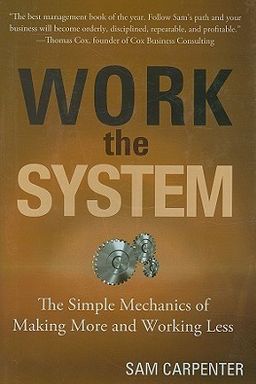
Work the System: Seeing Life as a Machine
What if your chaotic business or life problems were not random at all—but the outcome of systems quietly doing what they were designed to do? In Work the System, Sam Carpenter argues that every outcome—good or bad—is the result of a system producing it with mechanical precision. When you stop reacting to fires and instead redesign the systems producing those fires, everything stabilizes. Carpenter calls this awareness the Systems Mindset: a distinct shift from emotional firefighting to engineering thinking.
Carpenter’s revelation emerged during personal and business crisis. His company, Centratel, was near collapse—employees quitting, bills late, sleep gone—when one night he mentally zoomed out above his business and suddenly saw every operation as a network of interlocking systems executing linear sequences: 1→2→3→4. That instant of clarity transformed his role from exhausted manager to designer of machines. From there, the book teaches you how to adopt this mindset and apply it to every area of work and life.
You and the Systems Mindset
The Systems Mindset is not a tool—it’s a permanent shift in perception. You learn to see recurring events as systematic chains of cause and effect. Each failing outcome becomes an engineering puzzle, not a moral failure. Like Deming or Covey’s process thinkers, Carpenter insists that reality is mechanical and largely knowable: fix the underlying mechanism, and you fix the symptom automatically.
You will sense you’ve “got it” when your mind detaches slightly from daily chaos and you begin treating every recurring activity—payroll, scheduling, family chores—as improvable, documentable systems. Problems stop feeling personal. You diagnose sequences, patch weak links, and preserve energy for design instead of drama.
The Core Workflow: Isolate, Fix, Document
Once you can see the machine, you start fixing it. Carpenter outlines a three-step loop you’ll repeat forever: Isolate a troublesome subsystem, Fix its weak points, and Document the new procedure. The documentation turns an informal, error-prone act into a reliable mechanical one. For example, Centratel’s broken bill-paying system consumed hours of Sam’s week. He invested fifteen hours once to automate payments and document the process; it eliminated months of future labor and stress.
The same applies to people issues. When Sam saw phone agents wasting time on the Internet, he didn’t issue vague warnings. He built a monitoring system, tested it, wrote down expectations, and added it to the employee handbook. Recurring problem: gone.
Building the Documentation Spine
Systems thrive on written clarity, so the book’s second pillar is the Three Controlling Documents—a simple hierarchy that stabilizes operations. Your Strategic Objective declares what the enterprise is and where it’s going. General Operating Principles are the decision rules (your constitution). And the Working Procedures are the laws—specific, step-by-step guides for recurring tasks. These written artifacts externalize your intent, allowing others to follow the plan accurately without your constant supervision.
Centratel’s library grew to more than 800 procedures, written primarily by frontline staff who actually performed the work. That bottom-up authorship built ownership and improved compliance. Each document becomes an evolving but concrete authority: follow it precisely; if a better method surfaces, edit the document immediately and republish. The result is a living, self-correcting machine.
Leadership as Engineering
Once you think mechanically, your identity changes. You stop being the overworked hero and become a project engineer—someone who designs systems and oversees implementation. Carpenter adopted this stance after years of exhaustion. He delegated day-to-day activity, spent time only improving procedures, and taught successors to do the same. (Stephen Covey summarized this distinction clearly: “Management works in the system; leadership works on the system.”)
Eventually, Sam reduced his involvement at Centratel to about one hour per month, yet profits and quality rose. The key, he insists, is that every fire is evidence of a broken system—not proof that you’re indispensable.
The Broader Life Application
Carpenter extends this philosophy to personal life. Just as a company needs a strategic objective, so do you. He wrote his own Personal Strategic Objective and Operating Principles and treated health, sleep, diet, and relationships as subsystems to be engineered: track sleep, correct deficiencies with blood tests, and implement short maintenance rituals. The same isolate–fix–document pattern heals burnout as effectively as it repairs businesses.
A Philosophy of Serenity and Control
Ultimately, Work the System is both an engineering manual and a philosophical reboot. Carpenter’s claim is radical in its simplicity: life and business are not chaos; they are predictable systems waiting for conscious design. If you step above the noise, see the moving parts, fix them consciously, and document the new paths, you’ll build a machine that runs without constant intervention. The reward is profound—more freedom, more profit, and peace of mind rooted not in luck but in structure.