
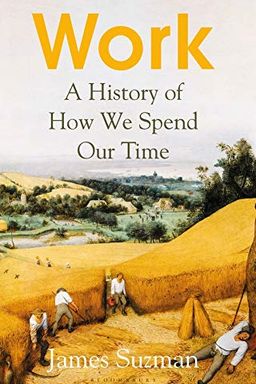
Work cover

Work

by James Suzman

Explore the sweeping history of human work from ancient times to the modern era in ''Work'' by James Suzman. This book delves into the profound impact of work on human evolution, societal structures, and the looming challenges posed by technology and inequality.

Work, Energy, and the Human Story

Why do you work? Is labor a solution to scarcity, an expression of meaning, or a thermodynamic inevitability? In Work: A History of How We Spend Our Time, anthropologist James Suzman reconstructs the human story of work—from the first controlled fire to the algorithmic age—to show that what you call 'work' is not a universal constant, but a cultural, energetic, and ecological phenomenon. Work, he argues, sits at the intersection of physics, biology, culture, and imagination: it’s how humans convert energy into purpose, order, and identity.

Suzman challenges you to question the idea—taught since classical economics—that scarcity is the eternal human condition. Rather than assuming endless wants and limited means, he asks whether humans learned to see the world through that lens only after agriculture and industrial capitalism made scarcity central. To answer, he draws from anthropology, evolutionary biology, thermodynamics, and economics to reveal how energy, ecology, and meaning have always coevolved.

From Physics to Biology: The Energy Foundation of Work

Work begins as a physical concept. In the 1820s, Gaspard-Gustave de Coriolis defined work in physics as the energy transferred when a force moves an object—a measure equally applicable to engines and humans. Ludwig Boltzmann and Erwin Schrödinger later showed that life itself is a work process: organisms capture energy from their environment to maintain order against entropy. Every act of metabolism is a negotiation with chaos. Through this lens, human labor is one chapter in a 3.8-billion-year story of energy capture and transformation.

Suzman traces how life changed whenever new energy sources were unlocked: photosynthesis generating oxygen; fire making calories accessible; farming harnessing sunlight through crops; fossil fuels multiplying human reach. Each step reshaped how societies worked and how people imagined meaning. That long thermodynamic arc ties the weaver bird to the weaver in a medieval guild, and both to you.

Scarcity, Providence, and the Many Economies of Work

Turning to anthropology, Suzman contrasts modern economic models—which treat scarcity as constant—with foraging peoples like the Ju/'hoansi of the Kalahari or the BaMbuti of the Congo. These societies often lived with minimal material wants, confident in the environment’s ability to provide. Fieldwork by Richard Lee showed that Ju/'hoansi adults secured sufficient food with only about 17 hours of weekly effort; the rest of their energy went into storytelling, art, and social care. For them, the environment was 'provident,' not hostile, and cultural norms like demand sharing ensured resources circulated freely.

This extended sense of trust meant foragers saw leisure not as idleness but as normal. In contrast, when societies embraced agriculture and later industry, scarcity became institutionalized. Work changed from a means of collective sufficiency to a moral imperative—to labor continually, accumulate, and plan ahead, equating time with money.

The Evolution of Purpose

Suzman examines purpose by looking at nature’s builders: weaver birds, termites, and apes. Masked weavers spend lavish energy building and destroying nests, not from necessity but to learn, signal, and attract mates. Termite mounds operate like superorganisms—structures that regulate temperature and oxygen for millions. Purposeful-seeming behavior, he shows, evolves wherever surplus energy and complex social systems exist. Humans extend that biological drive into culture: you use surplus time to build, create, and make meaning beyond material need.

From Firelight to Factories: Culture and Energy Merged

Mastering fire was humanity’s first great energy revolution. Cooking multiplied available calories, shrank digestive demands, and freed energy for brain growth. Around hearths, early humans gained leisure—the birth of conversation, teaching, and art. Each new energy leap—agriculture, cities, steam—generated new ways to organize labor and social life. Göbekli Tepe’s monumental stone circles (built before domestication) and ancient cities like Uruk show how surplus energy sustains specialized work, record-keeping, and hierarchy.

By the Industrial Revolution, those energy flows were mechanized. Steam engines and factory systems transformed work into regimented time, alienating labor from craft and meaning. Frederick Taylor’s 'scientific management' and Henry Ford’s assembly lines maximized efficiency but also redefined human value in terms of productivity—the opposite of the Ju/'hoansi ideal. Today’s automation and 'bullshit jobs' debates, Suzman argues, echo the same historical tension: when machines promise abundance, cultures still cling to scarcity and moralize work.

The Book’s Challenge

Suzman’s thesis ultimately circles back to you. Work is not simply an economic transaction; it is how energy, matter, and meaning flow through human life. The challenge is to recognize that scarcity is a choice shaped by culture, not by physics. Recognizing work’s deeper history—from cells metabolizing sugar to servers humming in data centers—can free you to imagine new arrangements of labor, purpose, and leisure that align with both ecology and human fulfillment. As he insists, your future depends on how you choose to spend energy—with what purpose, and in what kind of world.


Scarcity, Culture, and the Forager’s Lesson

Suzman begins by overturning the alleged universality of scarcity. Economists like Adam Smith and John Maynard Keynes built their theories on the idea that humans always want more than they can have. That motive justified markets, production, and moral discipline. But if you lived among immediate-return foragers, you might never feel that gnawing deficiency: they did not work to accumulate, but to sustain.

The Provident Environment

The Ju/'hoansi of southern Africa, the Hadzabe of Tanzania, and the BaMbuti of the Congo all illustrate what Suzman calls the 'provident worldview': belief in an environment that supplies what’s needed when it’s needed. Anthropologist Colin Turnbull recorded the BaMbuti calling the forest 'father and mother'; to store food would imply mistrust in its generosity. The result is a culture oriented around sharing, humility, and play.

Demand Sharing and Mockery

Demand sharing functions as both social glue and anti-hierarchy. If anyone can ask for food or tools and refusal is taboo, wealth cannot accumulate. When a Ju/'hoan hunter brings a large kill, others deflate his ego by mocking it—'thin, stringy meat'—to prevent dominance. These norms make equality a cultural achievement, not a natural state. They show that scarcity-driven competition is not inevitable; it’s a response that societies choose or reinforce.

Leisure as Cultural Wealth

When you look at how little foragers work, Suzman reminds you of a striking reversal: the societies richest in free time are often those poorest in possessions. They illustrate that abundance can come from satisfaction rather than accumulation. That is why anthropologist Marshall Sahlins called them 'the original affluent society.' In this light, many modern problems—overwork, burnout, ecological depletion—begin with forgetting the lesson that the natural state of work is not constant toil, but sustainable sufficiency.


Fire, Food, and the First Leisure

Fire did more than warm caves—it transformed the logic of labor. Archaeological evidence from Wonderwerk Cave (South Africa, c. one million years ago) and Qesem Cave (Israel, c. 400,000 years ago) shows habitual fire use far earlier than once assumed. Cooking unlocked new energy efficiencies: foods became easier to digest, yielding more calories and freeing time that once went into chewing and searching for raw nutrition.

Cooking as an Evolutionary Strategy

According to Richard Wrangham’s cooking hypothesis, fire enabled smaller guts and larger brains by raising the net caloric yield of food. Suzman connects that biological change to social innovation: fire centralized communities, kept predators at bay, and created spaces for storytelling. From those circles of warmth arose shared narrative and education—the ancestors of modern culture and the arts of conversation.

Leisure and New Social Roles

Freed energy also created leisure, which in turn created non-subsistence roles. Around hearths, people could teach, care for children, and share information, giving rise to dependency and support networks—conditions that later allowed specialized storytellers, healers, and artisans to emerge. Fire was thus not only the first labor-saving device but also the first enabler of cultural overproduction—people working for meaning, not just calories.

For Suzman, this energy surplus is central: every major human transformation can be plotted as an increase in usable energy that allows more complex forms of social organization. Fire marked the moment when energy abundance first met imagination—when work could become creative.


From Farming to Cities: The Work of Civilization

The birth of agriculture 10,000 years ago marked humanity’s decisive shift from 'provident' trust to 'productive' striving. As people learned to cultivate crops and domesticate animals, they multiplied energy capture from the sun—but also invented new forms of scarcity. Suzman calls this the great paradox: farming increased total food but deepened inequality, overwork, and disease.

The Malthusian Trap

Agriculture enabled population explosions—from four million people at the dawn of cultivation to hundreds of millions by early modernity. But as Thomas Malthus warned, productivity gains were repeatedly erased by faster population growth. Farmers mined soil fertility, worked longer hours, and bore more children to manage risk, creating a self-reinforcing scarcity loop. Each innovation—plow, irrigation, granary—bound people more tightly to the land and the clock.

Time and Moral Order

Farming restructured time itself. Immediate-return life gave way to calendars and deferred gratification: plow now, reap later. The idea that 'time is money'—crystallized centuries later by Benjamin Franklin—emerged from this shift. Suzman highlights early accounting tablets from Uruk (c. 5,000 years ago) showing workers paid in grain and beer. Labor became measurable, recordable, and moralized. Diligence replaced spontaneity as virtue, and idleness became sin.

Cities and Specialization

When surpluses stabilized, they fed the first cities—Uruk, Kish, and later Rome. With them came scribes, bureaucrats, artisans, and priests whose work was symbolic or administrative rather than subsistence-based. Writing emerged from clay tallies recording grain owed to temples, making bureaucracy humanity’s earliest white-collar industry. Suzman observes that professions and urban guilds created belonging and pride—but also fixed inequalities, as elites extracted surplus labor from others.

Civilization, in his retelling, is not progress but reorganization: the slow transfer of energy surpluses into patterns of social stratification and temporal discipline. The cost of permanence was the loss of flexibility.


Machines, Discipline, and the Age of Industry

When steam and factory systems arrived in the eighteenth century, they compressed centuries of agricultural labor into factory walls. Thomas Savery’s and James Watt’s engines turned fossil fuel into mechanical motion, launching the industrial feedback loop that defines modernity. Work no longer tracked seasons but the clock. The rhythms of machines replaced ecological rhythms.

The Factory Regime

Factories stripped work of artisanal autonomy. Richard Arkwright’s mills demanded long, regulated hours under supervision; by 1800, child labor filled half the textile workforce in Britain. Social critics from Karl Marx to Mary Shelley saw in this system both triumph and horror: efficiency paired with alienation. Shelley’s Frankenstein became a parable about technologies creating monsters they could not control.

Taylorism, Fordism, and the Culture of Efficiency

Frederick Winslow Taylor timed tasks to the second, turning workers into extensions of the machine. Henry Ford then applied Taylor’s principles to the assembly line, reducing Model T production from twelve hours to ninety-three minutes. The bargain: dehumanizing repetition in exchange for steady wages and affordable goods. The eight-hour day, collective bargaining, and paid holidays arose as social corrections to these new physical and psychological demands.

Émile Durkheim diagnosed the deeper ache as 'anomie'—a disorder of infinite aspiration born when shared norms collapse. Modernity made work a source of both identity and isolation. The industrial age taught you to equate labor with virtue, even when machines could already do more work than you ever could.


The Service Economy and the Automation Dilemma

By the late twentieth century, industrial labor gave way to service and knowledge work. Productivity kept rising, but meaning often fell. Suzman, drawing on thinkers like David Graeber and Colin Clark, shows how modern economies produce both abundance and emptiness: countless jobs exist mainly to maintain appearances of activity, hierarchy, or control.

The Proliferation of 'Bullshit Jobs'

Graeber’s critique names roles that even their holders believe unnecessary—layers of bureaucracy born of Parkinson’s Law ('work expands to fill the time available'). Administrative overgrowth in universities and corporations exemplifies the problem: more spreadsheets, fewer teachers; more metrics, less learning. Gallup surveys show that about 85% of workers globally are disengaged at work. Economic growth no longer guarantees meaningful labor.

Automation, Inequality, and Limits

Meanwhile, automation promises liberation but risks new hierarchies. Studies by Carl Frey and Michael Osborne estimate nearly half of modern jobs could be automated. Algorithms now write, diagnose, and debate. Yet the wealth generated by machines mostly accrues to asset owners, not displaced workers. This 'Great Decoupling'—productivity without wage growth—exacerbates inequality while straining ecological systems already reaching their limits.

Toward Sustainable Purpose

Dennis Meadows and the Club of Rome warned in 1972 that perpetual economic growth is incompatible with finite planetary resources. Suzman echoes that warning: automation could create abundance, but without cultural revision it will reproduce scarcity—this time of meaning and ecological stability. To move forward, societies must decouple dignity from employment and redefine work around sustainable purpose, care, and creativity rather than sheer production.

Dig Deeper

Get personalized prompts to apply these lessons to your life and deepen your understanding.

Go Deeper

Get the Full Experience

Download Insight Books for AI-powered reflections, quizzes, and more.