
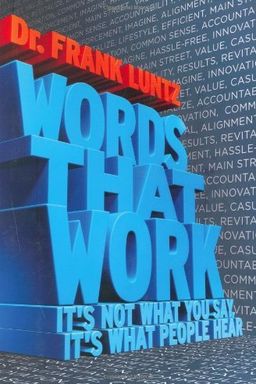
Words That Work cover

Words That Work

by Dr Frank Luntz

Words That Work by Dr. Frank Luntz delves into the art of communication, revealing how word choice impacts perception and influence. By understanding your audience and employing clear, imaginative language, you can master the skills needed to succeed in any conversation, from business to personal interactions.

The Power of Words That Work

How can words change what people believe and do? In Words That Work, political strategist Frank Luntz argues that language is not just communication—it’s persuasion. He reveals how small choices of words, tone, and structure can transform public opinion, drive campaigns, and shape personal and professional outcomes. The book contends that what matters most isn’t what you say but what people hear. To make your language effective, you must treat words as tools calibrated for audiences, emotions, and contexts—not as decorations for cleverness.

Across politics, business, and daily life, Luntz shows that language with clarity, brevity, credibility, and emotional resonance wins trust and changes behavior. His research—spanning focus groups, polls, and instant-response dial sessions—proves that effective communication is measurable, testable, and improvable. Through hundreds of examples, from “death tax” to “Contract with America,” he reveals how framing, naming, and timing decide what sticks in public memory.

Language as a Living Tool

Luntz begins with his core principle: language is a tool to achieve understanding, not a trophy to show intelligence. The best communicators aren’t grammarians—they’re translators. They make the abstract visceral and the complex personal. “It’s not what you say, it’s what people hear” drives the entire philosophy. This makes empathy central: to persuade, you must first inhabit the listener’s perspective. Luntz grounds this idea in neuroscience and marketing research—attention and retention come from ease, rhythm, and visualization more than logic or data density.

Emotion and Aspirations Over Facts

Facts rarely persuade by themselves. What moves people are the feelings those facts evoke. The language that lasts taps universal aspirations—hope, safety, fairness, belonging—while staying rooted in personal experience. Martin Luther King Jr.’s “I have a dream” works because it creates a picture of life as it could be; Nike’s “Just do it” succeeds because it invites personal action. Luntz’s research shows that audiences remember visuals and verbs—phrases that paint movement and possibility—far more than lists of statistics.

Research and Testing: Finding What Works

Behind every successful message, Luntz insists, is rigorous testing. Polls identify what people think, but dials and focus groups show why. Watching perception graphs spike and dip gives communicators real-time data about emotional resonance. This method reveals how subtle linguistic shifts transform response: “drilling for oil” feels dirty, but “exploring for energy” sounds adventurous and clean. This insight—that words carry emotional imagery—underpins the whole book. He calls this iterative process “language discovery.” Words that work are not invented by consultants; they’re drawn out from the mental models audiences already hold.

Framing and Context: Setting the Stage for Meaning

No word exists in isolation. Context—the surrounding story, timing, and frame—shapes interpretation. The same policy can succeed or fail depending on what you call it. Luntz uses the example of “welfare” versus “assistance to the poor”; the latter implies compassion, the former dependency. Reframing is not manipulation but clarification—helping audiences see issues through the values they already hold. Strategic framers, he says, define debates before they’re fought. Whoever names the issue first often wins it.

The Book’s Structure and Promise

Across the book, you move from principle to practice: ten operational rules of effective language; case studies in framing (“death tax,” “Contract with America”); emotional mapping of audiences through characters like Jennifer Smith; and tactical exercises for daily persuasion—from writing memos to apologizing well. Each part builds the case that words, properly chosen and tested, can unite ideas with emotion and ethics with clarity. Whether you’re a leader, teacher, or marketer, the formula is the same: choose simplicity, test for resonance, and align meaning with trust.

Core Insight

Language controls perception; perception controls behavior. If you want to lead, shape the story people tell themselves about your idea.

By the end, you see that Luntz’s message is both strategic and moral: truth must be delivered in words that people can hear. The right language doesn’t distort reality—it translates it into terms of shared meaning. In that way, words that work don’t just win arguments; they connect hearts and minds long enough for change to begin.


The Ten Rules of Effective Language

Luntz distills decades of political and commercial communication into ten rules—simplicity, brevity, credibility, consistency, novelty, sound and texture, aspiration, visualization, questioning, and context. These serve as a checklist for building language that informs, excites, and endures.

Simplicity and Brevity

Use short words in short sentences. People rarely admire what they can’t understand. Language that forces comprehension fails before it persuades. Reagan’s one-line “Are you better off today than you were four years ago?” exemplifies compact clarity; Nike’s “Just do it” distills action and ethos into three words. Cut to essence: one test for every sentence—can it fit on a bumper sticker?

Credibility and Consistency

Words must match reality. The quickest way to destroy credibility is overpromise and underdeliver, as “New Coke” proved. Repetition builds believability: Avis’s “We try harder” didn’t explain—it reinforced a pattern. Credibility accumulates not from novelty but from consistency over time.

Sound, Texture, and Novelty

A phrase must feel good in the mouth to last in the mind. Alliteration, rhythm, and musical simplicity (“Plop, plop, fizz, fizz”) increase recall. Novelty—something the audience didn’t know—captures attention. That’s why Apple’s “Think Different” thrives despite grammatical rebellion. Rules exist to be broken when rhythm serves resonance.

Aspiration, Visualization, and Questioning

Paint a better future. Language that focuses only on fear or anger motivates briefly; aspiration sustains momentum. Invite audiences to imagine (“Imagine your child’s first day at a safer school”). Questions, meanwhile, turn listeners into participants. Reagan’s recurring “Are you better off?” engages the audience’s reasoning more than an assertion ever could.

Context and Relevance

No phrase lives alone. Every message must come with the “why before the therefore.” “Don’t leave home without it” only worked because AmEx first established travel anxiety. Without shared context, even brilliant slogans fall flat. Luntz’s rule: imagine what the listener will hear, not what you intend to say.

Checklist for Impact

Before you speak or write, ask: Is it simple, short, true, repeatable, fresh, rhythmic, inspiring, visual, engaging, and contextual? If so, you’re close to words that work.


Framing and Context

Even the most eloquent words fail without the right frame. Luntz argues that framing—the lens through which audiences interpret a message—decides meaning before facts do. “Assistance to the poor” and “welfare” denote the same policy but activate opposite emotions. The first connotes compassion; the second dependency. Frames don’t reflect debates—they create them.

Defining the Debate

Control of vocabulary equals control of perception. “Death tax” turned a technical issue into a moral grievance; “exploring for energy” made industrial activity sound noble instead of extractive. Luntz’s research shows how changing a single word shifts majorities by double digits. The core rule: define issues around values and outcomes, not bureaucratic processes. “Retirement security” beats “Social Security reform” because it centers on safety and futurity, not policy tinkering.

Order, Sequence, and Setting

In focus groups, voters who saw Ross Perot’s biography before his policy video liked him; reversed order, they did not. Presentation sequence primes interpretation. Thus storytelling must teach first, then persuade. Establish emotional rapport before logic—context makes conclusions credible.

Audience and Emotional Context

Different listeners hear differently. Women and family-centered voters prefer narrative and authenticity over statistics. Messages framed around “for the children” consistently outperformed fiscal language. The takeaway: adapt context to the values and stresses of your audience.

Framing Rule

The label often wins the argument before it begins. Define your issue through values and emotional relevance, and your facts will follow naturally.


Testing, Tuning, and Research

Luntz rejects intuition as a communication strategy. Words that work are discovered, not invented. You learn which phrases connect only by testing real reactions. Polls reveal the landscape of opinion; focus groups reveal motivations beneath it. Yet his signature innovation is the “dial session” that tracks emotion second by second as participants listen. The data expose which words make hearts rise or drop.

Limits of Surveys

Telephone polling can show what people say, not always what they feel. Rising nonresponse and question order distort results. In-person methods add texture: tone, body language, laughter, and silence reveal emotional truth. Focus groups, small and diverse, help surface metaphors ordinary people use to explain policy—these metaphors become the building blocks of persuasive framing.

Dial Sessions and Discovery

Holding a physical dial that tracks reactions from 0 to 100 captures authenticity unseen in loud debates. Quiet participants reveal steady data; spikes show trigger words. When four senators delivered identical speeches, the same words sparked identical dial movements—proof that language, not personality, drives perception. This made testing a scientific loop: phrase, test, refine, retest.

Deployment and Discipline

Testing doesn’t end at insight; you must apply it discipline-style. Once you find resonant language, repeat it consistently across every channel. The Republicans’ “Contract with America” succeeded because its terms were tested, signed, and repeated in identical wording nationwide. Consistency transformed message into movement.

Lesson

If you want to make your message real, measure emotion before logic. Then deliver the same resonant words until they become familiar truth.


Crafting a Credible Promise

One of Luntz’s signature examples of applied language engineering is the 1994 Contract with America. It reframed policy wish lists as a binding promise between citizens and government. The genius lay not in policy but in structure: a name implying enforceability, precise timing, and visual design that created accountability.

Naming that Creates Trust

“Contract” outperformed “plan” or “platform” because it carried legal gravitas—a sense that the public, not politicians, were the contracting party. Dropping “Republican” from the title widened its appeal. The addition of an enforcement clause (“If we break this contract, throw us out”) added psychological sincerity. These word choices made political promises feel personal and verifiable.

Structure and Timing

The Contract organized deliverables by immediacy: Day One reforms, 100-day goals, and ten clear legislative items. This “rule of ten” resonates culturally and cognitively—ten feels complete but digestible. Order created accountability. Every item could be checked off publicly, transforming abstract reform into measurable progress.

Visual Reinforcement

Luntz ensured the Contract appeared in TV Guide as a cutout checklist for homes, using visual anchors to extend life beyond news cycles. The result was a language object—people could touch, share, and display it. Every critique that reprinted it multiplied reach. The lesson extends beyond politics: if your promise can be held, it can be believed.

Core Principle

Frame your commitment as a contract, not a claim. Make outcomes and timelines visible so trust has structure.


Emotional Drivers and Audiences

To find words that work, you must know the people who will hear them. Luntz builds archetypes—like “Jennifer Smith,” a middle-American working mother balancing bills and children—to humanize audience segments. For her, relevance, brevity, and realism outrank ideology. Likewise, understanding exurban voters—family-oriented, fiscally conservative, service-seeking—helps shape messages around stability and predictability. Knowing who listens shapes how they perceive risk, trust, and aspiration.

Principles and Core Values

Behind all demographics lie shared emotional triggers: principle, opportunity, community, common sense, convenience, and value. These pillars cross politics and purchase decisions. People want government and brands to deliver results that feel moral and practical. Policy talk framed as opportunity (“a chance for your family”) or common sense (“let’s fix what everyone sees is broken”) resonates far more than abstract fairness or efficiency.

Localism and Familiarity

Americans trust what feels local. “Main Street” beats “Wall Street,” “family values” evokes character more than religion, and “no surprises” promises service reliability. The most effective messages tie large concepts to daily experiences—your commute, your bills, your kids’ education. Speak where people live, not where you stand.

Practical Lesson

Start with human realities before abstract ideals. When words echo daily experience, they bridge policy and trust.


Persuasion in Daily Life

For Luntz, effective language isn’t just for politicians—it’s for you. He closes his book with everyday persuasion lessons showing that empathy and visualization drive cooperation as powerfully as they drive polls. Whether apologizing, writing a letter, or negotiating a raise, tone and clarity matter more than argumentation.

Empathy in Action

A genuine apology pairs words with deeds: a note plus a small gesture (flowers, a call) conveys humility. “I’m sorry” must sound and feel sincere. The same formula—emotional acknowledgment plus concrete act—builds credibility in every personal exchange.

Visualization and Future Focus

When asking for a raise or cooperation, pivot toward the future—“Imagine if” reframes conflict as partnership. Visualization turns logic into shared possibility. It applies everywhere from sales pitches to parenting: people prefer to imagine improvement over replaying blame.

Structure for Clarity

A letter that gets read opens with a clear ask, ends with a personal postscript, and uses short paragraphs. The same rhythm of simple sentences, vivid verbs, and empathy holds in conversation. The micro-rules never change: be brief, be human, be vivid.

Final Thought

Every word is a choice. Choose them with care and consistency, and your daily interactions will have the same persuasive power as great campaigns—because at their core, both are acts of empathy translated into language.

Dig Deeper

Get personalized prompts to apply these lessons to your life and deepen your understanding.

Go Deeper

Get the Full Experience

Download Insight Books for AI-powered reflections, quizzes, and more.