
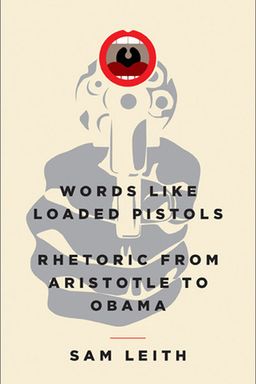
Words Like Loaded Pistols cover

Words Like Loaded Pistols

by Sam Leith

Explore the fascinating world of rhetoric with ''Words Like Loaded Pistols.'' From Aristotle to modern-day speeches, this book deciphers the art of persuasion. Learn to craft compelling arguments, recognize hidden motives, and communicate with impact.

The Art of Persuasion as Human Power

What makes some people so convincing? Why do certain speeches, from Lincoln’s at Gettysburg to Obama’s in Chicago, move us deeply while others drift past unheard? In Words Like Loaded Pistols, Sam Leith contends that rhetoric—often dismissed as manipulative or shallow—is actually the foundation of civilization. He argues that the art of persuasion, practiced consciously since Aristotle, underlies everything from law and politics to business presentations and tweets. If you use words to change minds, you are already a rhetorician.

Leith’s project is both historical and practical: to recover rhetoric’s rich legacy from Aristotle to Obama and show how it still drives our daily discourse. Across its five canonical parts—invention, arrangement, style, memory, and delivery—the book demonstrates how speeches and arguments are made memorable and moving. It links classical theory to modern practice, weaving examples from Greek orators, Roman courts, medieval preachers, twentieth-century dictators, and contemporary politicians. The result is a field guide for anyone who wants to understand how language carries power.

Rhetoric as Essential, Not Extraneous

Leith begins by confronting rhetoric’s bad reputation. In modern English, “rhetoric” has become almost an insult, shorthand for empty, deceitful talk. Yet for most of Western history, it was central to education and civic life—the art of using reason and imagination to move others toward truth or action. Aristotle defined rhetoric as “the ability, in any given case, to see the available means of persuasion.” That makes it a discipline as much about listening and empathy as about performance. Understanding rhetoric, Leith argues, isn’t about learning to manipulate others but about seeing clearly how persuasion works on you as well as by you.

The ancient Greeks invented rhetoric alongside democracy. In the Athenian assembly and law courts, every citizen was expected to argue his case. Figures like Corax and Gorgias discovered that persuasion had rules—the power of rhythm, analogy, contrast, and structure—and that these could be taught. Plato feared rhetoric’s potential for abuse, equating it with flattery and sophistry, but his student Aristotle gave it legitimacy by framing it as an analytic and ethical art. Rhetoric became the companion of philosophy: dealing not with eternal truths, but with uncertainty—the realm where human life is lived.

From Classical Roots to Contemporary Speech

Following Aristotle’s lead, Leith traces rhetoric through Roman civilization, Christian preaching, the Renaissance, and modern political life. Cicero, Rome’s most dazzling orator, built the intellectual spine of rhetorical education: the five canons—discovering what to say, organizing it persuasively, expressing it beautifully, remembering it, and performing it with timing and flair. Quintilian codified the idea that a good orator must also be a good man: eloquence and virtue should reinforce each other. In the Middle Ages, rhetoric served clerics and lawyers; in the Renaissance, it shaped the prose of Erasmus, Sidney, and Shakespeare; in the Enlightenment, it informed the speeches of revolutionaries. By the twentieth century, it powered Churchill’s wartime fire and Hitler’s terrifying charisma—equal proof of rhetoric’s double edge.

Leith’s modern heroes are not philosophers but practitioners: Lincoln, whose simplicity masked deep structure; Martin Luther King Jr., whose biblical cadences baptized civil rights in sacred imagery; Barack Obama, who fused Lincoln’s restraint with King’s rhythm; and professional speechwriters, the “unknown rhetoricians” who craft messages that govern nations. Yet even as political rhetoric has waned in public esteem, its techniques have migrated into new media. Social networks, advertisements, and viral videos replicate ancient appeals—ethos (character), pathos (emotion), and logos (reason)—in meme form.

Why It Matters Now

You might think rhetoric is an antique curiosity, but Leith insists it is indispensable to a world flooded with persuasion. Every clickbait headline, tweet thread, or political ad employs ancient strategies under new disguises. The better you grasp them, the freer you are from manipulation. Rhetoric gives you tools to analyze power: how language binds communities, provokes war, sells products, or sparks revolutions. It teaches the balance between reason and feeling—between argument’s skeleton (logos) and its blood and heartbeat (pathos and ethos).

At its core, the book rehumanizes persuasion. As Leith concludes, rhetoric “gathers in the folds of its robe everything that makes us human.” Through it, we learn not just how to speak effectively but how to listen critically, think flexibly, and act ethically. Persuasion, he suggests, is how civilization itself holds together. The words we use are indeed like loaded pistols—dangerous when misfired, but indispensable tools when aimed with purpose and care.


The Five Canons of Rhetoric

Rhetoric, for Cicero and his successors, was a complete system—almost a technology of communication. Leith walks readers through its five canons, showing how invention, arrangement, style, memory, and delivery remain the blueprint for any speech or persuasive text today, from campaign rallies to TED Talks.

Invention: Finding What to Say

Invention is discovery—the search for arguments, examples, and emotional appeals that will persuade a given audience. Aristotle defined it as finding the available means of persuasion. Leith revisits the trio of appeals: ethos (credibility), logos (reasoning), and pathos (emotion). Great orators blend all three: Churchill appealed to duty and courage; Nixon to moral indignation (sometimes too well); Obama to shared hope. The canon reminds you to consider: What motivates your listener to change their mind?

Arrangement: Giving Thought Shape

Once arguments are found, they need structure. Classical speeches followed six parts—introduction, narration, division, proof, refutation, and peroration. Leith shows how these map surprisingly well to modern tasks: a political candidate’s stump speech, a viral op-ed, even an email pitch. Good arrangement balances reason and narrative momentum. Lincoln’s “Gettysburg Address” runs on a skeleton of arrangement so perfect it seems effortless: opening (“Four score and seven years ago”), statement of conflict, moral proof, and final exhortation.

Style: Dressing Thought in Words

Style gives persuasion its melody. Cicero, Quintilian, and later Shakespeare all emphasized decorum—fitting tone to audience and context. Leith brings this to life with Comic and tragic contrasts: Gussie Fink-Nottle’s drunken school speech in Wodehouse flops because it violates decorum. Churchill, Lincoln, and King succeed because their diction, rhythm, and imagery match their message and moment. Style also embodies figures of speech—metaphor, antithesis, and tricolon (“I came, I saw, I conquered”)—the DNA of memorable language.

Memory and Delivery: Making Words Live

Before teleprompters, orators memorized vast texts using “memory palaces”—imaginary structures filled with vivid mental images. Leith relishes these early hacks of cognition, from Simonides remembering banquet guests to St. Augustine calling memory the palace of the soul. But beyond mnemonics, “memory” meant having internalized your argument so fully that you could adapt it in real time—a skill equally vital in interviews or debates today. Finally comes delivery: voice, posture, gesture, and control of presence. Demosthenes ranked it first, second, and third in importance. Modern parallels include tone in writing, pacing in podcasts, even emoji in texts. Rhetoric succeeds only when its performance fits its content.


The Three Branches of Oratory

Aristotle classified all persuasive speech into three temporal branches: deliberative (about future action), judicial (about past events), and epideictic (about present values). Leith devotes a chapter to each, illustrating them through political history, media, and even comedy. Understanding which branch you are in clarifies what kind of persuasion you must use.

Deliberative: Persuading to Action

This is the rhetoric of politics—the art of deciding what should be done. Demosthenes used it to rally Athens against Philip of Macedon; modern leaders employ it in campaign speeches or advertising slogans. Deliberative rhetoric revolves around the future: should we wage war, sign this treaty, buy this product? It balances moral virtue and practical advantage. Leith compares Demosthenes’ call for civic duty to Simon Jenkins’s op-ed urging Britain to cede the Falklands—a modern example of arguing honor versus interest.

Judicial: Persuading about the Past

Judicial rhetoric dominates law and blame. Cicero’s courtroom battles define the genre: defending Sextus Roscius from a parricide charge by accusing his accusers. The aim is to establish facts, credible motives, and justice. Leith explores its evolution through modern examples—from courtroom dramas like A Few Good Men to Sarah Palin’s self-justifying response to the Tucson shootings. This branch, he notes, often shapes public morality: politicians now try their cases before cameras rather than juries.

Epideictic: Praising and Blaming Now

Often overlooked, epideictic rhetoric includes eulogies, wedding toasts, and viral posts of outrage or praise. Leith shows how Isocrates and Gorgias turned rhetoric into aesthetics—making virtue visible through delight. Great instances include Mark Antony’s funeral speech in Julius Caesar, Al Smith’s takedown of William Randolph Hearst, or even Eric Cartman’s expletive-filled “song of blame.” Praise and blame form the moral grammar of public life; understanding them means grasping how emotions shape identity and community.


The Champions of Rhetoric

To make rhetoric vivid, Leith structures much of his book around portraits of its great practitioners—heroes and villains who wielded words like weapons or wings. Each embodies a different rhetorical temperament: Satan the seductive rebel; Cicero the forensic gladiator; Lincoln the plainspoken moralist; Churchill and Hitler the dueling voices of the twentieth century; King the preacher-prophet; Obama the modern hybrid; and the anonymous speechwriters behind them all.

Satan and Cicero: Early Models of Persuasion

Leith opens his gallery with Satan—the ultimate orator of rebellion, whose eloquence in Milton’s Paradise Lost dramatizes rhetoric’s dangerous charm. From “Better to reign in Hell” to his manipulative tenderness toward Eve, Satan embodies rhetoric’s capacity to justify even damnation. Cicero, conversely, represents its civic grace: his courtroom invective and political speeches fused intellect and showmanship, turning argument into empire. His dictum that an orator must “move, delight, and teach” remains rhetoric’s north star.

Lincoln, Churchill, and Hitler: The Twentieth Century’s Voices

Lincoln’s “Gettysburg Address” is Leith’s exemplar of brevity as moral architecture—a speech only 272 words long that redefined America’s moral purpose. Churchill, meticulous and theatrical, used rhythm and tone to turn prose into battle drums (“We shall fight on the beaches”). Hitler, his dark twin, used the same instruments—pause, crescendo, repetition—to hypnotize crowds, showing that rhetoric amplifies character rather than creates it. Words can protect liberty or destroy it; the difference lies in the speaker’s ethos.

King, Obama, and the Speechwriter’s Legacy

Martin Luther King Jr.’s “I Have a Dream” epitomizes the rhetorical symphony—biblical cadence, repetition, and emotional precision transforming theology into social justice. Obama, blending Lincoln’s restraint with King’s rhythm, reconnects rhetoric to hope and citizenship in a skeptical era. Behind both, Leith salutes the invisible professionals like Ronald Millar, Peggy Noonan, and Jon Favreau who shape political destiny through craft. Rhetoric, he reminds us, is collaborative performance—the choreography of minds and words across time.


Ethos, Pathos, and Logos in Action

All persuasion, Aristotle argued, rests on three pillars: ethos (who you are), pathos (how you make others feel), and logos (what reasoning you use). Leith translates these ancient concepts into modern insight, showing how every advertisement, campaign, and conversation blends them in instinctive ways.

Ethos: Credibility and Character

Ethos answers the question, “Why should I trust you?” From Antony’s appeal to “Friends, Romans, countrymen” to Colonel Tim Collins’s eve-of-Iraq speech, ethos depends on identification. We believe those who seem like us or like our best selves. Politicians, from Thatcher as the thrifty housewife to Obama as the everyman dreamer, cultivate ethos through story. Yet if overplayed, it curdles into hypocrisy—as Sarah Palin’s self-defensive speeches reveal.

Pathos: Emotion as Evidence

Pathos stirs action through feeling. Leith traces its mechanics from Aristotle to modern advertisement: pitying charity appeals, fear-driven policies, or shared laughter. The best pathos builds solidarity, not manipulation. Think of Lincoln’s compassion or King’s righteous joy—emotion aligned with moral argument rather than replacing it. Rhetoric fails when emotion overwhelms truth, as Hitler’s ecstatic assemblies demonstrated.

Logos: The Shape of Reason

Logos stitches arguments into coherence. It uses enthymemes—arguments with hidden premises—to make audiences supply conclusions themselves. “Ask not what your country can do for you…” is logic framed as inspiration. Leith warns that logic in persuasion is rarely pure mathematics—it’s plausible storytelling. Recognizing your own enthymemes, he suggests, is intellectual self-defense in an age of spin.


Style, Memory, and Delivery—The Human Craft

In its later sections, Words Like Loaded Pistols becomes almost a handbook for communicators, showing how expression, recall, and performance still make or break persuasion.

The Power of Style

Style conveys attitude. Leith revives the classical triad—grand, middle, plain—illustrating each with living examples. The grand style soars (Shakespeare’s Henry V); the middle balances elegance and clarity (Cromwell’s proclamations); the plain sharpens truth (Orwell’s essays). Decorum—matching language to context—is its governing virtue. Misjudge tone, and persuasion collapses. Rhetoric, at its best, is precision empathy: hearing how your words will sound in someone else’s ear.

Mnemonics and Mental Architecture

Leith relishes the lost art of memory. From Simonides’ mythic banquet to Cicero’s “method of loci,” speakers once built mental palaces, placing ideas as imaginary objects in rooms. Modern neuroscience, he notes, confirms how space scaffolds thought. Even in the digital age, internalizing your material—knowing it so well you can improvise—makes your voice authentic. Writer Tony Judt, paralyzed by disease, composed essays through mental architecture, demonstrating memory’s creative soul.

Delivery: Presence and Persuasion

Finally, Leith turns to delivery, the threshold between words and action. Voice and body turn theory into impact: Demosthenes called delivery the first, second, and third element of rhetoric. Today, tone, pacing, and gesture translate into vocal warmth, camera posture, or textual rhythm. The timeless rule: believe what you say. Authenticity is the new eloquence. As Leith quips through Quintilian, the ideal orator is still “a good person speaking well.”

Dig Deeper

Get personalized prompts to apply these lessons to your life and deepen your understanding.

Go Deeper

Get the Full Experience

Download Insight Books for AI-powered reflections, quizzes, and more.