
Idea 1
Delight as the Hidden Engine of Progress
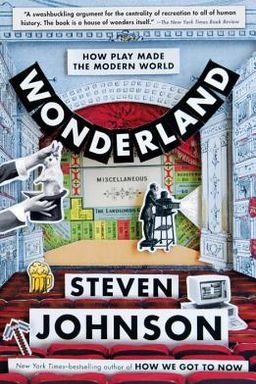
Why do civilizations advance? You're often told that necessity drives invention—that people innovate to solve urgent problems. Yet as Steven Johnson and others demonstrate, play, curiosity, and aesthetic pleasure have been equally transformative. The search for delight has repeatedly reconfigured markets, science, and even the architecture of thought. Whether it’s a pinned cylinder on a self-playing organ or a shimmer of calico in a London shopfront, pleasure often lights the first fuse of progress.
Play as a catalyst
The book’s central current—sometimes called the “hummingbird effect”—shows how play breeds technology. Leisure devices like the Banu Musa brothers’ 9th-century self-playing organ contained ideas later essential to computation: separation between mechanism and control, repetition, and programmability. The same paradox appears centuries later when Jacques de Vaucanson’s musical automata inspire his attempt to automate weaving, culminating in the Jacquard loom—a bridge between art and industry. Charles Babbage, who visited Merlin’s Mechanical Museum as a child, traced his fascination with mechanical performance to that early wonder. When he dreamed up the Difference and Analytical Engines, he was extending the logic of entertainment devices into mathematics.
Aesthetic appetites and material revolutions
Visual pleasure works the same magic. The craze for Indian calicoes in 18th-century London began as an infatuation with color and pattern. But theatrical storefronts—“gilded theaters” of consumption—turned that desire into a market large enough to fund mechanical textile innovation. The pretty financed the practical. Similarly, the European obsession with spices and dyes remapped global trade and empire. Spices had almost no nutritional value, yet their rarity and scent drove exploration, colonization, and the very birth of corporate capitalism via joint-stock trading companies like the Dutch East India Company.
Spaces of sociability and invention
Pleasure also needed venues. Coffeehouses and taverns in the 17th–18th centuries functioned as laboratories for social and intellectual innovation. Lloyd’s coffeehouse begot insurance markets; the Green Dragon Tavern hosted revolutionaries. These “third places” enabled experimentation within conversation. Coffeehouse curiosity cabinets evolved into public museums, embedding the Enlightenment’s spirit of accessible knowledge. Aristide Boucicaut’s Le Bon Marché later transferred these pleasures into architecture: spectacle as infrastructure, commerce as civic theater. Each iteration nurtured new disciplines—insurance, journalism, urban design—rooted in the social joy of mingling and display.
Media that teach perception
From phantasmagorias to panoramas, illusions cultivated emotional literacies that shaped how you now experience screens. Eighteenth-century magic-lantern shows and early moving-image toys exploited a perceptual accident—persistence of vision—that lets your brain stitch still frames into motion. When D.W. Griffith discovered the close-up, and Walt Disney’s studio engineered empathy frame by frame in Snow White, they didn’t just invent entertainment; they formalized how mediated empathy works. The emotion you feel for animated faces is the heir of a centuries-long experiment in visual charm.
Games and the grammar of systems
Games have long been playgrounds for ideas that later dominate logic and computation. Chess, first an allegory for medieval morality, evolved into a testbed for cognitive science and artificial intelligence. Dice led gamblers to invent probability and, in turn, modern statistics and finance. Lizzie Magie’s Landlord’s Game used board mechanics to critique land monopolies, only to be transformed into Monopoly—a case study in how cultural transmission rewires meaning. From Claude Shannon’s wearable roulette computer to IBM’s Watson on Jeopardy!, games supply both metaphors and measurable benchmarks for progress.
The pattern behind the play
Across cultures and centuries, delight doesn’t merely ornament necessity; it creates new necessities. Pleasure opens conceptual space. A toy becomes a tool; a parlor trick pioneers computation; a color sparks empire. The through-line is curiosity liberated from immediate utility. When societies reward the pursuit of elegance, surprise, and beauty, they accidentally build the engines of their next revolutions.