
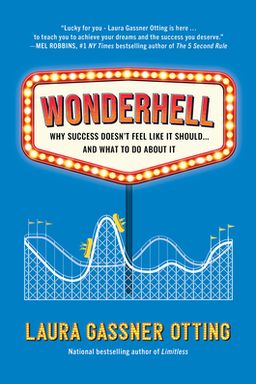
Wonderhell cover

Wonderhell

by Laura Gassner Otting

Wonderhell delves into the paradoxical nature of success, guiding readers through the emotional turbulence that follows achievement. Laura Gassner Otting draws on real-life stories to offer strategies for embracing discomfort, overcoming self-doubt, and finding balance between ambition and fulfillment.

Embracing Wonderhell: Thriving in the Space Between Success and Potential

Have you ever reached a long-coveted goal only to feel confused, anxious, or unexpectedly restless afterwards? In Wonderhell: Why Success Doesn’t Feel Like It Should … and What to Do About It, Laura Gassner Otting argues that these feelings aren’t symptoms of failure—they’re signs of growth. Success, she contends, isn’t an endpoint but an inflection point. Each achievement expands your sense of possibility, and with that expansion comes disorientation. You are thrilled by your potential, yet terrified by it. That tension—between wonder and hell—is where real transformation happens.

Gassner Otting, a former White House appointee turned executive recruiter and bestselling author, uses stories, research, and humor to show that success doesn’t simplify life—it complicates it. What if, she asks, your stress and uncertainty after success aren’t problems to fix but invitations to evolve? Wonderhell is an operating manual for navigating those moments when you realize you could be more than you ever imagined—and that realization both excites and terrifies you.

Understanding the Landscape of Wonderhell

The author frames Wonderhell as an amusement park—a whimsical yet demanding place filled with rides representing different stages of self-discovery. You enter this park after achieving something significant, expecting celebration and ease. Instead, you find curiosity intertwined with dread. Each ride represents emotional challenges: the Imaginarium asks you to dream bigger; Doubtsville tests your tolerance for uncertainty; and Burnout City forces you to redefine what enough means. This metaphor makes an abstract emotional state tangible. Success opens a gate—not to paradise, but to a bustling, demanding theme park of new ambitions.

Why Success Feels Wrong

According to Gassner Otting, society teaches that success leads to fulfillment. Yet once you achieve a goal, your vision expands, revealing higher peaks beyond. You can’t unsee your potential. That’s why, instead of peace, you feel hunger. The book’s core insight is simple but profound: the burden of your potential weighs as heavily as its promise inspires. You’ve glimpsed a future version of yourself and must now decide whether to live into it or retreat. This tension is uncomfortable but invaluable—it’s fertile ground for self-reinvention.

Three Pathways Through Wonderhell

Drawing from interviews with over a hundred achievers—entrepreneurs, Olympians, artists, and leaders—Gassner Otting identifies three main strategies for thriving in Wonderhell:

  • Embrace Ambition: Instead of apologizing for wanting more, recognize ambition as a source of creativity and growth. Success is not greed; it’s curiosity expanded.
  • Renegotiate Your Response: Anxiety, impostor syndrome, and uncertainty are not flaws but indicators of progress. Those emotions can be reframed as tools for direction rather than signs of danger.
  • Do It Again (and Again): Wonderhell recurs every time you level up. Learning to recognize and relive this cycle without collapsing under it becomes the essence of sustainable success.

In Gassner Otting’s view, thriving isn’t about erasing discomfort; it’s about surfing it. The high achievers she profiles—people like Paralympian Amy Purdy, business executive Sallie Krawcheck, and coach Alan Mulally—don’t seek the absence of fear or doubt. They reinterpret those emotions as proof that they’re heading somewhere meaningful. As one of her interviewees puts it, “If it doesn’t scare you, you’ve probably stopped growing.”

The Stakes: From Breakdown to Breakthrough

Why does this matter? Because many people treat these moments of doubt and restlessness as crises. They assume discomfort means something is broken. Gassner Otting invites readers to consider the opposite: maybe frustration and confusion are evidence you’ve entered a new developmental stage. Just as in an amusement park, exhilaration and fear coexist by design. This frame transforms the feeling of “What’s wrong with me?” into “What’s next for me?”

In essence, Wonderhell redefines success as a perpetually evolving experience, not a destination. Growth is cyclical: you achieve, you glimpse new potential, you wobble in uncertainty, and then you rise again. The real win isn’t escaping Wonderhell but learning to pitch your tent there—to accept that exhilaration and anxiety are intertwined. The point isn’t avoiding the ride, but enjoying it fully while it lasts.

Core Message:

Success expands what you believe possible, but with that expansion comes discomfort. Instead of resisting it, discover how to thrive in it—because that’s where your next breakthrough lies. Welcome to Wonderhell.


Embrace the Burden of Your Potential

Gassner Otting’s first major theme is learning to embrace ambition, not hide it. The moment you succeed, you unlock a new version of yourself—one you didn’t know existed until now. That glimpse is both thrilling and terrifying because it creates a new burden: the knowledge that you could be more. In this section, she likens success to stepping through the gates of an amusement park. Beyond them lies opportunity—and anxiety in equal measure.

Learning to Play Bigger

Through the metaphor of “The Imaginarium,” Gassner Otting shows how imagining greater possibilities changes you permanently. She tells the story of Simon Tam, founder of the Asian American band The Slants. When government officials denied his trademark request, labeling the band’s name “offensive,” Simon decided to fight back. The group’s Supreme Court victory didn’t just secure their rights; it expanded Simon’s sense of agency. He later started The Slants Foundation to support marginalized artists. Once he glimpsed what fighting for fairness could look like, he couldn’t unsee his own potential to lead change.

Gassner Otting encourages readers to apply the same principle: once you imagine yourself at a new level, you can’t fit back into your old mold. The only way forward is through self-belief and action. Playing small after seeing your capacity is a kind of self-betrayal.

Creating Luck and Listening to Intuition

In “The Fortune Teller,” the author explores how people make their own luck. She shares Dr. Richard Wiseman’s research identifying the habits of lucky people: openness to experience, awareness of opportunity, optimism, and resilience. Stories such as Cara Brookins building a house with her children after escaping domestic abuse underscore how bold action generates momentum. Likewise, Jackie Huba’s transformation into drag persona Lady Trinity demonstrates the magic of embracing hidden parts of yourself. Luck, Gassner Otting argues, is rarely accidental—it’s the by-product of courage and visibility.

Owning Your Identity and Authenticity

The “Hall of Mirrors” chapter explores identity. Brandon Farbstein, born with dwarfism, transformed his experience of being bullied into public advocacy, eventually shaping empathy legislation in Virginia. His lesson? You are not who others think you are—you are who you believe yourself to be. Similarly, Gassner Otting describes stepping into her bright yellow “Limitless” outfit onstage and realizing that confidence can be borrowed until it becomes your own. Identity, she notes, is elastic. The trick is to adapt it intentionally rather than hiding from its evolution.

Living Unapologetically

Finally, in “The Tent of Oddities” and “The Haunted House,” she shows how embracing quirks, introversion, and even demons can fuel authenticity. Auctioneer Lydia Fenet found explosive professional growth when she dropped her overly proper persona and infused humor into her work. CFO Anna Gomez discovered freedom when she merged her secret identity as romance novelist Christine Brae with her executive role. True alignment means bringing all of yourself—your eccentricities and all—to your pursuits. Gassner Otting insists that being unapologetically yourself attracts the right kind of opportunities. As Oscar Wilde’s quote at the start reminds us: “The gods have two ways of dealing harshly with us—first by denying our dreams, and second by granting them.”

To embrace ambition is to welcome discomfort. Once you step into the Imaginarium, you can no longer pretend your dream is impossible. You’ve glimpsed the next version of yourself—and that vision demands your full participation.


Renegotiate Your Relationship with Doubt

After embracing ambition, the second frontier of Wonderhell requires you to befriend the uncertainty that follows. In “Doubtsville,” Gassner Otting explores how fear, impostor syndrome, and insecurity appear the moment you reach new success. These emotions are natural signals, not malfunctions. Through anecdotes and metaphors—Roller Coasters, Trapezes, Scramblers, and Ferris Wheels—she offers strategies for managing the emotional chaos that comes with growth.

Managing Uncertainty

Kara Goldin, founder of Hint Water, built her beverage company while juggling family, exhaustion, and endless setbacks. Her secret? Keep showing up even when the path ahead is unclear. Kara’s story illustrates Gassner Otting’s central point: action precedes clarity. To regain confidence, take one small step forward. This echoes research on depression by Steven Levitt—people who make a choice, even arbitrarily, tend to be happier six months later than those who remain stuck.

Flying Without a Net

Perfectionism often disguises fear. Former NFL coach Jen Welter became the league’s first female coach by daring to lead differently—through whispering instead of yelling. She proved that authenticity can command as much respect as traditional authority. Likewise, Gassner Otting herself learned through improv training that life’s best performances come from saying “Yes, and…” when plans collapse. “There is no net,” she writes, “but there is always your training.”

Finding Your Own Way

In “The Scrambler,” writers Brad Meltzer and Tiffani Bova remind readers that pursuing meaningful work means accepting disorientation. Meltzer admits he still fears disappointing readers after every success; Bova turns audience feedback into improvement fuel. The lesson: the feeling of being lost is evidence that you’re carving new territory. Gassner Otting adds Seth Godin’s metaphor of “tattoo-worthy” work—create something you’d be proud to have etched permanently into the world.

Choosing the Right People

On the Ferris Wheel, you rise higher by choosing carefully who shares your ride. Trina Gray’s decision to live authentically with her partner Erin, despite backlash, illustrates the importance of surrounding yourself with those who celebrate your truth. And in the “Tunnel of Love,” Ford CEO Alan Mulally’s collaborative leadership shows how teamwork rooted in empathy can transform organizations. You thrive not by doing everything alone but by creating circles of trust—your “Ride or Dies” who both hold you accountable and cheer you on.

Doubt isn’t proof that you’re failing—it’s evidence that you’re expanding. Renegotiating your relationship with uncertainty allows you to keep moving even when you can’t see the net below you.


Redefine Success to Prevent Burnout

In the third act of Wonderhell—Burnout City—Gassner Otting explores how to sustain growth without destroying yourself. Success, she warns, can turn toxic when fueled by comparison and endless striving. Each achievement resets the finish line, tempting you to chase more rather than enjoy enough. This section dismantles “hustleporn” culture and replaces it with purpose-driven priorities.

Say No to Hustleporn

Jordan Harbinger, now a world-renowned podcaster, deliberately chose not to scale his platform into a corporate empire. He decided his real metric of success was time with family, not downloads. Gassner Otting echoes this wisdom: the cost of constant hustle is life itself. You don’t have to give the trophies back, she reminds overachievers—but you also don’t need to collect more endlessly. Purpose without peace leads to obsession, not success.

Focus on What Matters

In “The Whack-a-Mole Game,” we meet Melissa Wiggins, who founded a pediatric cancer nonprofit after her son’s illness but eventually faced burnout. Her turnaround came from identifying which tasks only she could do and which she could delegate. Gassner Otting suggests creating a “Perfect Calendar”—a proactive map of time aligned with your highest values. Productivity, she says, should serve fulfillment, not the other way around.

Quiet the Perfectionist

Jonathan Fields’ story reframes perfectionism as a prison. His antidote is grace: accepting incompletion as a normal part of creation. Michael Phelps and skier Alex Ferreira echo this truth—victory doesn’t eliminate vulnerability. Gassner Otting advises adopting what researcher Anders Ericsson called “deliberate practice”: small, consistent improvements over time instead of all-or-nothing perfection. Joy grows in the doing, not just in the done.

Standing Tall When the Floor Drops

When crisis hits, the floor may fall away—but that’s when clarity surfaces. During COVID-19, Spartan Race founder Joe De Sena kept his community moving with online workouts despite massive business losses. Gassner Otting, whose own speaking business evaporated, faced a parallel reckoning. Both learned that responsibility lies not in controlling circumstances but in reimagining responses. “We are the problem,” she writes—not as blame, but as empowerment. When you own your crisis, you can build your comeback.

Live with a Beginner’s Mind

Eventually, every peak becomes a plateau. The final ride, “The Loop-de-Loop,” challenges readers to reinvent again. Antonio Neves, a former TV host fired for complacency, rebuilt his career by accepting red ink—seeing critique as an investment in growth. For Gassner Otting, this means continually stepping into new “first days,” relinquishing mastery to stay alive creatively. In her words, “Staying too long at the top risks boredom; starting over restores curiosity.”

Lasting success isn’t about doing it all—it’s about doing what matters repeatedly, sustainably, and with joy. You can’t avoid the next Wonderhell, but you can meet it well-rested and ready to ride again.

Dig Deeper

Get personalized prompts to apply these lessons to your life and deepen your understanding.

Go Deeper

Get the Full Experience

Download Insight Books for AI-powered reflections, quizzes, and more.