
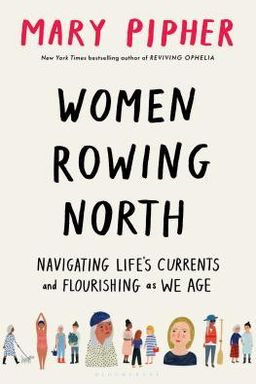
Women Rowing North cover

Women Rowing North

by Mary Pipher

Women Rowing North explores the transformative journey of women entering their sixties and seventies. Through heartfelt stories, the book addresses societal challenges like ageism and caregiving, offering insights on finding happiness, purpose, and community engagement in later life.

Women Rowing North: Aging as a Journey of Growth

What if aging wasn't a descent into decline but an ascent toward wisdom, joy, and authenticity? In Women Rowing North, Mary Pipher—psychologist, cultural anthropologist, and bestselling author of Reviving Ophelia—invites readers to reimagine the later decades of life not as a loss, but as a time of purposeful transformation. She argues that women in their sixties, seventies, and beyond are navigating a powerful current—one where cultural stereotypes collide with internal growth, loss intertwines with gratitude, and self-discovery meets a lifetime of accumulated experience.

For Pipher, the art of aging well is a process of learning new navigational skills: resilience, clarity, gratitude, the ability to craft a meaningful narrative, and above all, compassion—for oneself and others. As she reminds us, “If we don’t grow bigger, we grow bitter.” To flourish in what she calls the northern stretch of the river, women must grow in depth, wisdom, and capacity for joy—even while facing bodies that wear, friends who fade, and lives that transform.

The River as Metaphor for Life

The image of rowing north anchors the entire book. Pipher’s metaphor captures both movement and effort—it’s about direction, not drift. Each woman must row with intention, weathering the currents of loss, ageism, and self-doubt, while steering toward meaning, purpose, and inner peace. The northern river suggests beauty but also cold and challenge; it demands strength and cooperation. Older women, she argues, are like experienced navigators—capable of knowing the currents and staying steady even in turbulence.

Across the chapters, Pipher divides her lessons into four parts that mirror the flow of a journey: “Challenges of the Journey” (facing ageism, loss, and physical decline), “Travel Skills” (building resilience, community, and gratitude), “The People on the Boat” (relationships with partners, friends, and family), and “The Northern Lights” (the rewards—authenticity, wisdom, and awe—that await travelers who stay the course). Each section mixes Pipher’s psychological insights with stories of real women—Emma, Kestrel, Willow, and Sylvia—who embody different ways of navigating the river.

Reframing Aging Through a Feminist Lens

A crucial concept in Pipher’s argument is that aging women must resist the cultural scripts that diminish them. In a society obsessed with youth and beauty, old age is often portrayed as irrelevance. Pipher calls out this “social disease” of ageism, noting how older women—depicted as either pathetic or meddling—are ignored or mocked. Yet, she reminds readers that many women across the world grow more radical with age (echoing Gloria Steinem’s observation). Liberated from external expectations, older women can finally live on their own terms, speak truth without apology, and define beauty in their own image.

This feminist perspective aligns with the developmental psychologist Erik Erikson’s final life stage—integrity versus despair—but Pipher reframes it through a woman-centered, culturally aware lens. She weaves in her earlier work from Reviving Ophelia, drawing a parallel between adolescents and elders: both must reconstruct identity in a time of vulnerability and cultural misunderstanding. For teenage girls, it is a loss of childhood protection; for older women, it is the loss of youth and social visibility. Both must find their “North Star”—an internal compass toward authenticity.

The Central Skill: Resilience Built by Intention and Attention

Pipher insists that resilience is not a fixed trait but a skill—one developed through conscious practice. Life will deliver grief, illness, and change, but older women have experience on their side. They’ve survived heartbreak, raised families, held jobs, and reinvented themselves many times. By bringing mindful attention to their emotions and intentional choices to their daily lives, women can reframe pain as depth, solitude as peace, and limitation as freedom. She cites psychologist Laura Carstensen’s research showing that as people age, they experience less anger and anxiety—because they focus on what truly matters, not what is lost.

Emma, for example, finds solace in small joys: the laughter of her granddaughters, a cup of tea at sunset, or poetry read aloud. Sylvia learns to transform chronic pain and grief into gratitude and purpose through daily rituals—the art of building a good day. And Willow, once a work-obsessed executive, discovers in caregiving a profound tenderness that opens her heart. These stories illustrate that aging gracefully means choosing joy and meaning over control.

What Flourishing Looks Like in Old Age

Ultimately, Pipher defines flourishing not as perfection, but as engagement—with oneself, others, and the world. It’s about “anchoring in gratitude,” nurturing community, crafting compassionate stories about one’s past, and finding stillness in authenticity. In this northern stretch of life’s river, pain and beauty coexist. Women can rediscover purpose through activism, creativity, caregiving, friendship, or simply appreciating the “small treats” that make a day good. They can experience what Pipher calls “transcendent joy”—moments of awe that remind them they are part of something vast and enduring.

For readers, Women Rowing North offers both comfort and challenge. It acknowledges the real struggles of aging—physical decline, loneliness, death—and insists that these are not endpoints, but portals to a deeper, freer kind of living. It teaches that happiness at this stage is less about achievement and more about presence, kindness, gratitude, and perspective. Above all, it reminds you that aging is not retreat—it’s a continuation of the river’s journey, flowing unbroken toward wisdom and light.


Confronting Ageism and Cultural Scripts

Pipher begins her journey by naming a core enemy of women’s flourishing: ageism. In Western culture, she writes, age and beauty are framed as opposites, leaving older women socially invisible and emotionally disempowered. This, she says, is not an individual failing but a cultural pathology—one that can infect even the women it harms. As she observes through witty anecdotes, even powerful, accomplished women cringe at being called “old,” equating the term with loss rather than maturity.

Seeing Beyond the Mirror

For many women, self-worth has long been tethered to beauty and caregiving. As these roles shift, identity falters. We see this in Ava, a sixty-five-year-old woman stunned when a young man at a museum offers her a senior discount. In that small, offhand remark, she glimpses how the world now perceives her—no longer as a vibrant woman but as elderly. The shock forces Ava to confront how deeply cultural notions of desirability and usefulness have been internalized.

Pipher argues that liberation begins by unlearning these scripts. Aging should not mean diminishing yourself to fit society’s narrow focus on youth. Instead, she urges women to reinterpret aging as a time to live without apology—to speak freely, dress for comfort, and reject the performative niceness that has muted women’s power for generations.

The Sociocultural Roots of Fear

Our dread of aging, Pipher contends, stems from a society that worships productivity and consumerism. Old age, which slows and simplifies life, threatens this ideology. She points to research (from the Geena Davis Institute and the Yale School of Public Health) showing that older women are rarely portrayed in media except as stereotypes: cranky mother-in-laws, witches, or burdens. This erasure reinforces a collective gerontophobia—“a prejudice against one’s future self.”

“Invisibility can be freeing,” Pipher reminds us, “but ageism never is.”

She describes women like Suzanna, a confident hospital administrator who hides her true age at work, fearful that revealing it will tarnish her professional credibility. Even self-aware feminists internalize cultural disdain for wrinkles and gray hair. By voicing these contradictions without shame, Pipher shows that self-acceptance does not erase discomfort—but it does disarm it.

Resistance as Survival

True empowerment, Pipher explains, begins with resistance—speaking up, creating spaces where older women educate, advocate, and nurture one another. She draws inspiration from the Athabaskan legend of “Two Old Women,” who survive a harsh winter after their tribe abandons them for being too old to work. Their courage and grit transform them from burdens to culture-bearers. Similarly, Pipher believes older women must “reclaim the story” about themselves, asserting their wisdom as essential to the community.

She urges readers to correct ageist remarks, reject jokes that mock aging, and seek intergenerational friendships that challenge isolation. “Survival is resistance,” she writes, echoing Meridel Le Sueur’s maxim. Each act of authenticity—a woman choosing comfort over cosmetics, honesty over politeness—becomes a quiet rebellion against a system that profits from fear.

By reframing aging not as a deficit but as a radical opportunity for freedom, women can rewrite their personal and collective narratives—and, in doing so, model for younger generations how to live with grace and boldness along the northern river of life.


Building Resilience Through Change

Change, Mary Pipher notes, is the one certainty of aging. In fact, the pace of change accelerates precisely when stability feels most necessary. The shift from professional identity to retirement, from caregiver to cared-for, from social center to solitude—all of these transitions test the psyche. Yet they also invite growth. Pipher’s central promise is this: each loss can deepen our empathy, fortify our spirit, and recenter meaning, if we’re willing to approach it with attention and intention.

The Myth of Decline

In Western culture, aging is equated with decline, but developmental psychologists like Bernice Neugarten have long argued for more nuanced stages: young-old and old-old. Pipher adds a middle space she calls Adulthood II—years when physical changes arise, but vitality and purpose remain strong. This period, she argues, is not about resisting age but mastering the art of adaptation. “We outgrow earlier strategies,” she writes, “and must develop new ones.”

Willow’s story reveals this beautifully. A seventy-two-year-old nonprofit director, Willow fears becoming obsolete. When her husband Saul develops Parkinson’s, she confronts yet another loss—of independence and identity. But through caregiving, she discovers a new spiritual depth, calling her time caring for Saul “the most life-affirming work I’ve ever done.” By releasing her need to control outcomes, she becomes softer, more joyful, and paradoxically stronger.

Suffering as Teacher

Pain, Pipher insists, is a powerful teacher. When we resist it, we stagnate; when we lean in, it carves empathy. “Those who do not suffer become insufferable,” she writes. Her compassion for women like Sylvia—a Texas grandmother raising two grandchildren after her daughter’s addiction—illustrates this lesson. Sylvia’s body aches with arthritis, her heart with grief, yet she learns to “build a good day”: swimming, journaling, connecting with friends, and finding meaning in small pleasures. Her transformation exemplifies what Pipher calls the “calculus of growth”: the more that’s taken from us, the greater our capacity for appreciation.

Aging tests us with what Joanna Macy calls “the work that reconnects”—the process of feeling both grief for what is lost and gratitude for what remains. In this paradox, suffering becomes a crucible for mindfulness and expansion.

Attitude and Intentional Growth

Resilience, says Pipher, is built by two tools: attention and intention. Attention grounds us in the present moment—what she calls “rower’s awareness.” Intention directs us toward what matters most. Those who cultivate both adapt to change without losing center. She cites empirical studies by Laura Carstensen and Sonja Lyubomirsky showing that older adults report higher life satisfaction precisely because they focus on what brings meaning rather than achievement.

When you stop asking, “Why me?” and start asking, “What now?” you move from victimhood to agency. This mindset shift—one echoed in Viktor Frankl’s Man’s Search for Meaning—transforms aging from decay into ongoing creation.

For Pipher, each stage of aging is a new apprenticeship in living. Change may be inevitable, but suffering is optional when met with curiosity, gratitude, and the will to row forward.


The Art of Intentional Living

If resilience is the ability to weather storms, intentionality is the map that keeps you from losing direction. In the chapters “Understanding Ourselves” and “Making Intentional Choices,” Pipher offers a practical manual for living purposefully after middle age. She warns that without mindful choice, routines become ruts—and ruts deaden the spirit. Happiness, she writes, “is both a choice and a set of skills.”

Understanding Our Inner Compass

Self-awareness is where intention begins. Emma, a kind-hearted grandmother, has spent decades caretaking everyone’s needs—her husband’s, her daughter Alice’s, her grandkids’. In therapy, she learns to notice the subtle bodily cues of resentment and exhaustion. When she feels that inner “balk” at one more favor, she practices saying “no.” This act of boundary-setting is revolutionary for women taught that goodness equals self-sacrifice. Through yoga, journaling, and mindfulness, Emma discovers the voice inside her that says, “I am enough.”

Pipher draws here on Buddhist practices of awareness—what Sharon Salzberg calls “loving presence.” You can’t chart your northward course, she suggests, if you don’t first know where you are. Understanding yourself allows you to respond consciously rather than react impulsively—a difference she equates with freedom itself.

Choosing How to Frame Life

For Pipher, intention also involves reframing: choosing how to interpret what happens to you. Marlene, a woman living with epilepsy and poverty, refuses to see her limitations as destiny. “I always choose love and joy,” she says. By focusing on what she can give instead of what she lacks, she creates a life of color and community. As Pipher notes, outlook outweighs luck; genetics may shape half our happiness, but mindset shapes the rest (a conclusion echoed by positive psychology research).

Intentional living also means crafting definitions of wealth and success that fit your values. For some, wealth means money; for others, it’s “how many people you’re in loving relationships with.” When retired artist Samantha chose to downsize and spend her time making pottery and loving her family, she epitomized this wisdom. She said, “Money is tighter, but time is richer.”

Freedom Through Conscious Choice

Freedom, Pipher writes, is not doing whatever you want—it’s knowing what truly nourishes you and acting accordingly. Women like Willow and Kestrel find freedom by aligning action with value. Willow, once driven by work ambition, finds peace by caregiving with love. Kestrel, a reticent daughter learning to face her mother’s terminal illness, chooses vulnerability over control. Each learns that conscious decisions grounded in love, not fear, yield inner liberation.

Pipher acknowledges that choice always occurs within constraints. “We all keep appointments we did not make,” she writes. Illness, aging, grief—they’re not optional. But how we meet them is. The challenge is to live with both realism and optimism, to “row the river we’re on.”

Intentional living, then, is the quiet art of agency: noticing the current, setting direction, and rowing mindfully toward meaning.


Crafting Narrative Healing

In the second half of life, Pipher argues, storytelling is not indulgent—it’s survival. “We can’t change our pasts,” she writes, “but we can change the stories we tell about them.” How you narrate your life shapes how you feel about it. This insight, drawn from narrative therapy, runs through Women Rowing North: to flourish, you must make peace with your story and rewrite it in a voice of mercy.

Revising Stories of Suffering

Sylvia rewrites her story from tragedy to triumph. Once consumed by grief over her addicted daughter, she begins to frame her life around what she still has—her grandchildren, her husband, her faith. Her story changes not in facts but in focus. When she says, “I have a bed for my daughter,” we see someone who holds space for hope, not despair.

Similarly, Kestrel crafts a new narrative when she moves from suspicion to trust. Her mother’s illness cracks her emotional armor, allowing her to reconnect with love and vulnerability. Her story transforms from solitary defiance to connection and tenderness. Through these women, Pipher shows that editing our stories doesn’t falsify them; it enlarges them.

The Power of Redemptive Meaning

Positive psychology supports Pipher’s claim: people who frame adversity as transformative experience higher well-being (studies by Dan McAdams and Roy Baumeister). Redemption stories—where suffering yields growth—don’t deny pain; they integrate it. Pipher notes that even humor can redeem tragedy: the “vacation-from-hell” stories we share later become laughter that bonds us.

Equally powerful are “reconciliation stories.” When estranged relatives reconnect or forgiveness replaces bitterness, life feels coherent again. Pipher herself models this practice, writing eulogies to honor and integrate loss. “The heart heals through story,” she reminds us.

Sensory Memory and Creativity

Our five senses are portals to memory and meaning. A taste, a sound, a scent can unlock gratitude or grief. Pipher recalls how the smell of her grandmother’s kitchen revives belonging. She encourages writing, art, music, and reflection not to romanticize the past, but to inhabit it consciously, turning memory into wisdom.

When you consciously reinterpret your life, you cultivate perspective and forgiveness. You stop asking, “What went wrong?” and start asking, “What did I learn?” In this reframed narrative, aging ceases to be a fading story—it becomes a masterpiece continually in revision.


The Power of Connection and Community

For Pipher, joy and sanity depend on one truth: we need each other. Isolation is the quickest path to despair, but connection—through friendship, family, or activism—is the lifeboat that carries us northward. In her chapters on community and relationships, she dismantles the myth of independence, emphasizing interdependence as both human and healing.

Friendship as Lifeline

Emma and her solstice-camping friends illustrate how lifelong friendship sustains women through loss and change. Their annual circle by the campfire—singing, storytelling, and blessing one another—reaffirms belonging. When Soledad receives a terminal diagnosis, the group conducts a healing ceremony, giving her stones and flowers symbolizing courage. “Only women our age,” Emma observes, “could have created this.” Friendship becomes what the sociologist Émile Durkheim called “collective effervescence”: shared energy that renews the soul.

Pipher affirms what research by David Brooks also suggests: joining a meaningful group produces as much happiness as doubling your income. Women build such groups through honesty, humor, and mutual care—replacing the hierarchical networks of youth with egalitarian circles of support.

Family as Source of Identity

Pipher’s metaphor for family is a “shelterbelt”—trees that protect each other from wind. Families may wound or comfort, but they root us in time. Kestrel’s reunion with her brothers before her mother’s death reminds her that belonging and forgiveness can coexist. Similarly, grandparents like Sylvia or the author herself find purpose in nurturing grandchildren, passing on stories, rituals, and love. “If we are lucky,” Pipher writes, “we become the ancestors.”

Through storytelling, cooking, or shared traditions, family connects us to moral continuity. Even fractured families can rebuild ties through curiosity and compassion. As Eleanor Roosevelt said—a favorite of Pipher’s—“You can never really live anyone else’s life; the influence you exert is through your own.”

Community as Activism

Connection also extends beyond kin. Activists like Lynne and her Conscious Elders Network exemplify engaged elderhood—using experience to work for justice and ecological preservation. By turning fear into action, they exchange despair for purpose. Pipher distinguishes “actionable intelligence” (local, useful civic work) from “distractionable intelligence” (doomscrolling on distant crises). The former empowers; the latter depletes.

Even small acts—a neighborly check-in, a community garden, or mentoring youth—link personal meaning with public good. “Action is the antidote to despair,” she insists. Older women, she believes, are uniquely suited to build “beloved communities” that light the way for others.

In a culture of fragmentation, Pipher’s call is revolutionary: connection is not optional; it is salvation. Together, we row stronger.


Authenticity, Gratitude, and the Northern Lights

The final chapters—“Moon River,” “The Long View,” and “Everything Is Illuminated”—bring the journey to its luminous conclusion. Here Pipher explores what she calls the northern lights of aging: authenticity, gratitude, and awe. These are not abstract virtues but states of being earned through decades of living and forgiving. In these pages, the river widens, and the women, seasoned by storms, finally glimpse serenity.

Becoming Authentic

Authenticity, for Pipher, means integrating all versions of yourself—the child, the mother, the worker, the survivor—into one whole being. Emma, once over-accommodating, learns to act from her inner truth and feels freer with her daughter. Sal, a lesbian minister who overcame childhood abuse and addiction, finds authenticity by reclaiming her faith and founding her own church. Pipher calls this integration the “radiant sovereign self”—echoing Margaret Fuller’s belief that maturity means living from wholeness, not performance.

Anchoring in Gratitude

Gratitude, Pipher writes, is both shield and fuel. It transforms despair into presence. Studies by psychologist Robert Emmons show that gratitude journaling increases happiness; Pipher translates this into daily practice. When Emma, sick with flu, gives herself permission to moan for a day and be grateful the next, we see realistic gratitude in action. Or when Sally—wheelchair-bound but exuberant—declares, “Getting old is such a freaking privilege!” we sense the radical joy that gratitude sustains.

Gratitude often grows from suffering. Pipher describes terminal patients who, paradoxically, feel more alive than ever. As one oncologist tells a new cancer patient, “You’re about to experience the most life-affirming era of your lifetime.” Knowing time is finite intensifies appreciation. The message: there are no small pleasures—only unrecognized miracles.

The Long View and Illumination

With age comes perspective—what Pipher calls “deep time.” She honors ancestors, recalling family histories that stretch across wars, migrations, and generations. Her metaphor of the river’s continuity reminds readers that they, too, are part of something timeless. “Time,” she writes, “can take the sting out of life and make it sweeter.”

Illumination, finally, is the synthesis of gratitude, authenticity, and love. It’s the bliss Emma feels at her husband’s seventieth birthday by the lake, when the world shimmers and time stands still. It’s Jackie, dying of cancer, reciting Willa Cather’s line: “To be dissolved into something complete and great.” It’s the three-legged cat basking in sunlight—pure presence. These moments of awe affirm that even amid chaos, beauty abides.

At journey’s end, Pipher invites all women to embrace everything—the joy and the grief, the beauty and the loss. “Let us be radiant with all that is,” she writes. Aging, then, is not an ending but an illumination—the final gleam of the northern lights reflecting on the river of time.

Dig Deeper

Get personalized prompts to apply these lessons to your life and deepen your understanding.

Go Deeper

Get the Full Experience

Download Insight Books for AI-powered reflections, quizzes, and more.