
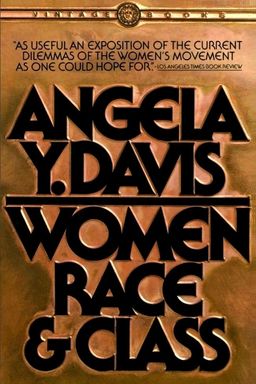
Women, Race & Class cover

Women, Race & Class

by Angela Y Davis

Angela Y. Davis''s ''Women, Race & Class'' delves into the intertwined struggles of racism, sexism, and classism within the women''s rights movement. This essential text challenges historical narratives, advocating for a comprehensive and inclusive feminist approach. Discover the overlooked voices and learn from past missteps to forge a path toward equality.

Interlocking Struggles: Women, Race, and Class

Why have women’s movements in the United States consistently struggled to include all women—especially women of color and working-class women—in their vision of equality? In Women, Race, & Class, Angela Y. Davis argues that sexism, racism, and class oppression are deeply intertwined forces that have shaped both women’s oppression and their resistance to it. Her central claim is that you cannot fully understand the women’s movement—or its limitations—without recognizing how it has been shaped by race and economic class.

Davis contends that throughout U.S. history, movements for gender equality and racial liberation have often developed side by side, sometimes aligning, sometimes colliding. White women’s suffrage leaders positioned their struggles around gender justice yet often excluded or subordinated Black women and working-class women to appeal to white male power holders. At the same time, Black women developed independent traditions of activism that combined demands for racial justice, gender equality, and workers’ rights.

The Web of Oppression

Davis approaches these issues through the concept of intersectionality before the term became widely known. Her historical analysis reveals that sexism, racism, and classism are not separate or additive issues—they are interlocking. For example, under slavery Black women were exploited both as workers and as women: they labored beside men in the fields and were also subjected to sexual violence by their owners. This dual oppression helped break down rigid gender categories among the enslaved population, creating a different kind of womanhood—harder, more self-reliant, less bound to the fragile femininity idealized among white women.

By contrast, the ideology of white womanhood in the nineteenth century painted women as delicate, dependent, and confined to domestic spaces. This ideal developed in tandem with industrial capitalism and slavery: the gentleness and purity attributed to bourgeois white women defined them in opposition to the supposedly degraded laboring and enslaved classes. The “cult of true womanhood” was in fact sustained by the labor of poor and enslaved women who cooked, cleaned, and raised children for the white middle and upper classes.

Black Women and the Legacy of Resistance

Against this backdrop, Davis recounts a rich legacy of Black women’s resistance, from Harriet Tubman and Sojourner Truth to the unsung women who led slave revolts, taught secretly during Reconstruction, and founded independent clubs in the early twentieth century. Their feminism was forged in the crucible of work, survival, and community struggle. These women viewed freedom not simply as the right to vote or own property but as freedom from exploitation, racial terror, and patriarchal control over their bodies. This perspective broadens the scope of what feminism could mean.

Davis emphasizes how this “radical womanhood” informed other major struggles. In the anti-slavery movement, for example, women like the Grimké sisters, Black abolitionists like Maria Stewart, and figures such as Frederick Douglass connected women’s subordination to slavery itself. Yet even within abolitionism, gender and race hierarchies persisted. The same contradictions reappeared in the suffrage movement, where white leaders such as Elizabeth Cady Stanton and Susan B. Anthony chose to exclude Black women to appeal to white Southern voters after the Civil War—a bargain that reinforced racism as the price of political strategy.

From Suffrage to Labor and Radical Politics

The book proceeds to trace the rise of the suffrage movement through its early middle-class leadership, confronting both its achievements and its betrayals. Davis then turns to the women often left out of those stories—working women, Black women, and later radical women in socialist and communist movements. She demonstrates how labor struggles, from early textile workers’ strikes to twentieth-century organizing efforts, were deeply gendered events where female solidarity illuminated a shared but unequal exploitation. Working-class feminists recognized that wages, union rights, child care, and social assistance were as crucial as the ballot in defining equality.

By the early twentieth century, women radicals such as Ida B. Wells, Mary Church Terrell, Ella Reeve Bloor, and later Claudia Jones reveal another feminism—one that sought liberation from capitalism and imperialism as much as from patriarchy. Through these figures, Davis redefines “women’s liberation” as inseparable from collective struggles for racial and economic justice.

Why This History Matters Today

For Davis, revisiting these histories is not mere archival recovery. It’s an urgent reminder that feminist politics stagnate when they ignore race and class. She wrote Women, Race, & Class at a time (1981) when the U.S. feminist movement was criticized for its whiteness and its middle-class bias. Her book pushed the conversation toward an intersectional understanding of freedom—one that connects reproductive rights, labor, education, sexuality, and economic justice. If you care about equality today, Davis would tell you that you must start where these struggles intersect—not where they diverge. The book’s enduring question is not simply “How can women be equal to men?” but “What kind of world makes equality for all people possible?”


The Legacy of Slavery and Black Womanhood

Davis begins her historical excavation in the brutal world of slavery, showing how it shaped Black womanhood in ways still felt today. The female slave was, first and foremost, labor: an agricultural worker, a domestic worker, a factory hand, and a reproductive worker expected to bear children for sale. As she writes, enslaved women were treated as “hands” in the fields and as “breeders” in the slave quarters. This dual exploitation—economic and sexual—defined the racialized gender order in America.

Work Without Rest or Recognition

Unlike the polite fictions of nineteenth-century femininity that confined white women to homes, Black women were worked like men. They harvested cotton, tilled the fields, constructed irrigation ditches, and performed the hardest tasks. A South Carolina court even declared that enslaved children were to be treated as livestock, their mothers having no legal claim to them. As one formerly enslaved woman recalled, when she was ten, her master ordered, “Get this here nigger to that cotton patch.” This experience, Davis explains, obliterated the very notion of sheltered womanhood for Black females—creating a new model of strength and endurance.

Motherhood Under Slavery

Motherhood was both demanded and denied. Slave women’s fertility was a matter of profit for owners, not a source of joy or autonomy. Children could be sold at any age, and lactating mothers were whipped when unable to meet field quotas. Davis quotes from enslaved women’s testimonies describing babies strapped to their backs as they worked sunup to sundown. This experience made nurturing both an act of love and resistance; caring for children in such inhuman conditions was itself political.

Sexual Violence as Control

Rape, Davis argues, was the cornerstone of the slave system. It wasn’t about sexual desire—it was an instrument of domination. When masters violated enslaved women, they reinforced their economic and racial power. This violence also served to demoralize Black men, destroying familial bonds and perpetuating subjugation. In one passage, Davis compares this to the use of rape in the Vietnam War, showing how sexual terror has long been used as a weapon of control. The white man’s “rights” over Black women’s bodies—and the systematic denial that rape could occur in slavery—set a precedent for later myths about Black female promiscuity.

Resistance and Equality in the Slave Quarters

Yet within this dehumanizing environment, Davis finds the roots of a radical egalitarianism. Because both men and women suffered the lash, gender hierarchy held little ground among the enslaved population. Women took part in rebellions, defied overseers, poisoned masters, and led escapes—Harriet Tubman being the best-known example. They formed the backbone of collective survival and, by doing so, forged a new model of womanhood grounded in strength and shared struggle rather than dependence or purity. In this way, Davis reinterprets slavery not only as an atrocity but also as the crucible that produced an enduring Black feminist tradition of resilience and resistance.


From Abolition to Women’s Rights

If slavery forged Black women’s strength, the abolitionist movement provided the first arena where women—black and white—challenged multiple forms of oppression. Davis explores how female abolitionists linked their fight against slavery to their own struggle for equality, even as they wrestled with the sexism of their male allies and the racism among white reformers.

The Double Struggle

White women like Lucretia Mott, the Grimké sisters, and Abby Kelley discovered through anti-slavery activism that moral conviction could lead to political defiance. When they were barred from speaking publicly or voting in abolitionist societies, they began to articulate women’s rights. Sarah and Angelina Grimké—southern-born daughters of slaveholders—became among the first to assert that “whatever is right for man is right for woman.” Yet, as Davis notes, their understanding of equality was still shaped by their class and race background. They framed liberation largely in terms of moral and spiritual uplift rather than material justice.

Black Women’s Leadership

In contrast, Black women abolitionists like Maria Stewart, Sojourner Truth, and Harriet Tubman rooted their activism in lived oppression. Maria Stewart gave some of the first public speeches by an American woman. Sojourner Truth’s famous challenge—“Ain’t I a woman?”—confronted the entire racial and gender order by pointing out that the femininity celebrated by white society excluded women like her. Black women’s activism emphasized liberation as a collective project, not as individual advancement; they were fighting for freedom from bondage, for survival, and for the recognition of their humanity.

Racism Within Abolitionism

Even within the reform movements of the time, racism persisted. Prudence Crandall, a white teacher who dared to educate Black girls in Connecticut, was jailed for her defiance. Her story revealed how white women risked ostracism and violence when they challenged racial taboos. But many others remained complicit in racial separation. This divided solidarity foreshadowed future fissures between white and Black feminism.

The Birth of Feminism

Davis argues that the women’s rights movement was born not solely from women’s “awakening” but from the crucible of abolitionism. The 1848 Seneca Falls Convention, often hailed as the beginning of feminism, emerged from the exclusion of women delegates at abolitionist meetings. Frederick Douglass, one of the few male voices supporting full gender equality, linked the two struggles explicitly. Thus, while white women discovered politics through fighting slavery, Black women were forced to remind them that gender liberation could not be won on the backs of racial injustice—a theme that would echo for more than a century.


Race and Class in Early Feminism

The story of feminism in the United States is often told through the triumph of the suffrage movement. Davis tells a more divided story: at Seneca Falls, only a handful of working women were present, and none were Black. The Declaration of Sentiments, while radical in its claims, reflected the grievances of middle-class white housewives, not those of factory laborers or enslaved women.

The Working Woman’s Rebellion

Long before Seneca Falls, working women had been organizing and striking. In the 1830s the “mill girls” of Lowell, Massachusetts protested low wages and long hours, chanting, “Oh, I cannot be a slave.” Their comparison of industrial labor to slavery reflected a consciousness of class exploitation that middle-class feminists rarely shared. By 1848, working-class women were already petitioning for shorter workdays and fair wages—real economic rights that would help them survive. Yet these struggles were largely ignored by the suffrage leaders, who focused on legal equality over class justice.

Exclusion of Black Women

Even more glaring was the absence of Black women. Despite their centrality to the abolitionist struggle and their leadership among the freedpeople, they were neither invited nor represented at Seneca Falls. Sojourner Truth would later expose this hypocrisy when she stood at the 1851 Akron Women’s Convention and asked, “Ain’t I a Woman?” Her speech transformed the concept of womanhood itself, merging labor, motherhood, and racial survival into a defiant claim to humanity that clashed with the white ideal of fragility. Truth’s words, Davis notes, remain one of the founding texts of intersectional feminism.

Class Blinders of Suffrage

Davis shows how the suffrage movement’s focus on the vote obscured more immediate material struggles. To a laundress or sharecropper, the right to vote meant little without food, education, or freedom from debt. This disconnect between bourgeois ideals and proletarian needs foreshadowed enduring tensions within feminism. The laboring women’s proud defiance—embodied by Charlotte Woodward, the only working woman from Seneca Falls to live long enough to cast a ballot—symbolizes both inclusion and erasure. For Davis, understanding these class divisions is essential for any modern feminism that seeks to be both just and revolutionary.


The Color Line in the Suffrage Movement

After the Civil War, feminist leaders faced a moral crossroads. The 14th and 15th Amendments promised rights for male freedmen, not for women. How feminists responded to this shaped the movement’s future. Davis recounts how figures like Elizabeth Cady Stanton and Susan B. Anthony, once abolitionist allies, turned sharply racist when Black men gained the vote before white women. They denounced what Stanton called “Sambo’s” enfranchisement as an insult to educated white women.

Solidarity Shattered

Frederick Douglass—adamant that Black suffrage was a matter of survival amid Reconstruction violence—found himself isolated from his old comrades. When he argued that Black men’s need for the ballot was urgent, Stanton and Anthony accused him of protecting “ignorant Negroes.” Davis exposes the irony: feminists justified their exclusion by echoing white supremacist arguments about race and intelligence. The episode split the movement into rival associations and exposed its class bias as well—educated women aligning with political elites rather than poor or Black people.

Strategic Racism

To court Southern support, later suffrage organizations openly embraced racist rhetoric. They argued that enfranchising educated white women would ensure “white supremacy through the ballot box.” Susan B. Anthony herself chose expediency, asking Frederick Douglass not to attend campaigns in the South for fear of offending white delegates. By the turn of the century, racism had become entrenched even in supposedly progressive circles. Figures such as Mississippi’s Belle Kearney claimed that woman suffrage would guarantee “immediate and durable white supremacy.”

Voices of Resistance

Black feminists refused to be silent. Ida B. Wells publicly confronted Anthony for excluding Black women from national conventions. Mary Church Terrell and Frances Ellen Watkins Harper worked to reframe woman’s equality as part of a larger fight against lynching, segregation, and economic injustice. Their insistence on connecting gender to race was revolutionary for its time and remains a model for intersectional politics today. Davis’s reconstruction of this painful history reminds readers that progress built on exclusion is not true progress at all.


Black Women, Labor, and Radical Politics

Across Reconstruction and industrialization, Black women continued to anchor both economic and political life. They were laundresses, domestics, factory workers, and organizers—and their conditions exposed the myth of emancipation. Davis situates their struggle at the heart of the American working class, showing how race, gender, and class combined in their exploitation and their resistance.

Working in “Freedom”

After 1865, freedom meant crushing labor contracts, peonage, and domestic servitude. By 1890, nearly 70% of employed Black women were either in field labor or household work. They cooked, nursed, and cleaned under conditions “just as bad as during slavery,” one Georgia woman lamented. Rape by employers and lack of legal recourse were common. At the same time, these women sustained entire communities, helping build schools, churches, and early labor associations.

Club Women and Community Organizing

Black women’s activism coalesced in the club movement of the late nineteenth century, which Davis interprets as a working-class feminism. Led by figures like Josephine St. Pierre Ruffin and Mary Church Terrell, the National Association of Colored Women united “lifting as we climb” with radical resistance to lynching and racial terror. These clubs established kindergartens, employment bureaus, anti-lynching campaigns, and mutual aid societies—what Davis calls the infrastructure of Black survival.

From Labor to Socialism

By the twentieth century, the struggle moved leftward. Black and white working women joined socialist and later communist movements. Leaders like Lucy Parsons, Ella Reeve Bloor (“Mother Bloor”), and later Claudia Jones brought feminist analysis into class struggle, insisting that women’s emancipation demanded collective ownership of labor and the end of racial exploitation. For Davis, this radical lineage—from the slave rebels to the labor agitators—demonstrates that the fight for women’s liberation is part of the global battle against capitalism itself.


Reproductive Rights, Racism, and Liberation

In one of her most forward-looking chapters, Davis tackles reproductive rights, exposing how birth control and abortion have been historically entwined with racism and class politics. Her critique challenges the idea that reproductive freedom can exist without social justice.

From “Voluntary Motherhood” to Eugenics

Nineteenth-century feminists like Sarah Grimké and Victoria Woodhull first demanded “voluntary motherhood,” opposing wives’ obligation to satisfy their husbands. But by the early twentieth century, birth control advocacy aligned with eugenics—the pseudoscience of racial hierarchy. Even Margaret Sanger, founder of Planned Parenthood, adopted the language of “more children from the fit, fewer from the unfit.” Black women and poor women were targeted for forced sterilizations, not empowered with contraceptive choice.

The Racial Politics of Birth Control

Davis dissects how population control replaced feminist advocacy. In the 1930s, the “Negro Project” promoted birth control in Black communities under the guise of uplift but was rooted in white fears of “overpopulation.” She cites Sanger’s own correspondence warning associates not to let word get out “that we want to exterminate the Negro population.” In the 1970s, women of color led campaigns against mass sterilization as the U.S. government subsidized procedures that robbed them of fertility while denying access to safe abortions. These abuses—from Puerto Rico to Alabama—made Black and Latina women understandably wary of “choice” rhetoric divorced from economic reality.

A Broader Definition of Freedom

For Davis, true reproductive freedom means more than access to contraception or abortion—it requires freedom from the social conditions that make motherhood a burden. Housing, healthcare, education, and jobs are family-planning issues too. She calls this a socialist feminist perspective: reproductive rights cannot be separated from the struggle against racism, poverty, and imperialism. Her analysis anticipated modern reproductive justice movements, which define autonomy not as isolation but as the collective right to raise children in safe, sustaining communities.


The Politics of Home and Work

Davis concludes by reimagining housework and domestic life through a Marxist feminist lens. She argues that the endless, unpaid labor of women in the home is a central pillar of capitalism, yet it can and should be transformed.

The Housewife’s Burden

Housework, she writes, is “invisible, repetitive, exhausting, unproductive, and uncreative.” While liberal feminists asked for men to help, Davis envisioned something far more radical: the socialization of housework. Cooking, cleaning, and child care should become public services staffed by well-paid workers, liberating both men and women from the privatized grind of domestic life. She draws on Charlotte Perkins Gilman’s early argument that the home is an underdeveloped, archaic institution—an isolated workshop in a modern industrial economy.

Working-Class Feminism

For working-class women, paid employment never freed them from domestic drudgery; they carried the “double burden” of wage labor and housekeeping. Black women have long embodied this reality, often laboring as domestic servants for white families while struggling to sustain their own. Davis argues that these women’s survival strategies anticipate the collective systems that could replace the isolated nuclear household. In this sense, the future of women’s liberation lies in revaluing domestic labor and reorganizing society—not just expecting men to wash more dishes.

Toward a Socialist Future

Echoing Engels, Davis asserts that housework under capitalism will become obsolete only when economic priorities shift from profit to human need. The industrialization and socialization of domestic labor, accessible child care, and equality in employment are steps toward that goal. The home must evolve from a site of confinement into a community of shared labor and care. In that transformation, the feminist dream of genuine freedom—for all women, across race and class—can finally begin to materialize.

Dig Deeper

Get personalized prompts to apply these lessons to your life and deepen your understanding.

Go Deeper

Get the Full Experience

Download Insight Books for AI-powered reflections, quizzes, and more.