
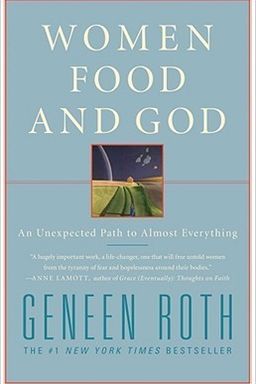
Women, Food and God cover

Women, Food and God

by Geneen Roth

Women, Food and God by Geneen Roth explores the intricate link between food, emotions, and spirituality. Roth reveals how our eating habits reflect deeper emotional struggles and offers a path to healing through self-awareness, meditation, and embracing our true selves.

Women, Food, and the Search for Belonging

Have you ever promised yourself that the next diet would finally fix your life—and then found yourself in the same emotional place despite losing (or gaining) the weight again? In Women, Food and God, Geneen Roth argues that our relationship with food is never just about food. It’s a mirror reflecting every belief we hold about love, loss, shame, joy, and the presence—or absence—of the divine in our lives.

Roth contends that compulsive eating, dieting, and body hatred are forms of spiritual exile. We turn to food to manage the unbearable—pain, loneliness, grief—and to fill a void left by what we perceive as divine indifference or personal unworthiness. But paradoxically, the very thing that keeps us stuck—our obsession with food—is also the key that, if examined with awareness and compassion, can bring us home. “Every time you want to eat when you are not hungry,” Roth says, “you have a chance to touch what you believe cannot be touched.”

Suffering as a Doorway to Awareness

Roth’s journey began with despair. As an eleven-year-old, she prayed to God for peace in her turbulent home and got none. Food became her sanctuary. When she ate, the world shimmered; when the Hostess Sno Ball was gone, she collapsed back into shame. By adulthood, she’d cycled through decades of diets, binges, and self-hatred. And yet it was that very suffering, she writes, that cracked her open to something sacred beyond her pain—a “presence of loveliness” without name or religion but resonant with truth. In her view, the way we eat matches the way we live: when we obsessively control our bodies, we reflect our fear of life itself; when we numb ourselves with food, we avoid the infinite tenderness of simply being alive.

The Core Argument: Food as a Gateway to God

The book’s central claim is radical yet deceptively simple: the path to spiritual wholeness is through food, not around it. Roth invites readers to examine the beliefs shaping their eating habits—the fear of scarcity, the need for control, the conviction of being unworthy of joy—and to treat those patterns as a map to their deepest truths. She rejects the traditional image of God as patriarch or punisher and redefines divinity as the vast awareness that holds both suffering and love. “The only definition of God that makes any sense,” she writes, “is the one that uses this human life and its suffering as the path to the heart of love itself.”

This is not theology but embodiment. Roth insists that awakening happens through the tangible, everyday act of eating. When you pause before a meal, feel hunger fully, taste consciously, and stop when satisfied, you are practicing presence—the same awareness that underlies all spiritual traditions, from Buddhism’s mindfulness to the Sufi idea of union. In this sense, eating becomes prayer.

Rejecting the War Within

Roth challenges the cultural obsession with dieting, calling it “a form of acceptable self-hatred.” Diets, she argues, are built on the false promise that deprivation will lead to peace. But peace cannot grow from war. Every diet enforces the idea that you are fundamentally flawed and must earn your worth through suffering. “If you hate yourself enough,” she writes, “you will love yourself.” It’s an impossible equation. Instead, Roth suggests something her students find unthinkable: stop fixing yourself. Stop dieting. Stop colluding with the belief that you need to change to deserve love. The moment you stop trying to fix what was never broken, she says, “you evoke divinity itself.”

The book traces how we learned to equate being good with being thin, productive, or deserving, and how that learned shame became a spiritual wound. Through retreats and exercises—like eating meditations and dialogues with one’s “inner voice”—Roth shows women that there is something whole beneath the self-hatred. To “reteach loveliness,” as poet Galway Kinnell wrote, is to remember the luminous worth that has always been there. (This notion echoes Brené Brown’s idea of reclaiming self-worth through vulnerability rather than perfectionism.)

The Journey from Control to Connection

Across the chapters, Roth explores a progression familiar to anyone caught in patterns of compulsion: from control to surrender, from numbness to embodiment, from fear to love. She identifies two archetypes—the Restrictor and the Permitter—that represent our survival strategies around food. Restrictors seek safety in control; Permitters seek safety in denial. Both patterns, she explains, are relics of childhood defenses against pain. Healing requires dismantling these defenses not by force but by awareness. “Our work,” she tells her students, “is not to change what you do, but to witness what you do with enough tenderness that the lies fall away.”

To sustain that awareness, Roth integrates practices from meditation, inquiry, and self-compassion. The Eating Guidelines she teaches—“Eat when you’re hungry, eat what your body wants, stop when you’ve had enough”—sound simple but demand a radical trust in your body’s wisdom. Over time, they transform eating from an act of control into an act of reverence.

Why This Matters

At its core, Roth’s message extends beyond food to the very heart of being human. Her book captures the loneliness of women who have been taught to fear their hungers—literal and emotional—and offers a path home through the body itself. In a world that profits from our self-loathing, to feed yourself with awareness is an act of rebellion and grace. “It’s possible,” she writes, “to come home after a lifetime of being exiled.”

By reframing food as a spiritual teacher rather than an enemy, Roth merges therapy, mysticism, and practical wisdom. The result is a conversation not about calories but about consciousness—a call to stop waging war against your body and start listening to the sacred intelligence that lives within it.


Ending the War with Food and the Self

From the moment Roth’s students arrive at her retreats, she tells them something designed to shock them: their suffering around food is not a curse but a blessing. Because food is how they have survived—and how they will awaken. Her approach defies the instinct to fight or fix; the real transformation begins when they learn to sit still amid discomfort rather than flee from it.

Dieting as a Spiritual War

Roth describes dieting as modern asceticism, a socially approved form of self-hatred dressed up as discipline. For women, especially, the war with the body becomes a measure of moral worth—a secular penance in a world without gods. We strive for righteousness through calorie counting. “Diets,” she says, “are the outpicturing of your belief that you have to atone for being yourself to be worthy of existing.”

Calling off that war means dismantling an identity built on striving. It’s terrifying for many of her students who have never known who they are without a problem to solve. She compares chronic dieters to Sisyphus, doomed to push the boulder of self-improvement up the hill only to let it roll down again. The endless striving gives structure, belonging, even meaning. To let it go feels like death.

Facing the Real Hunger

In one poignant story, Roth describes a student named Laurie who realizes during a silent eating meditation that she doesn’t want the soup in front of her—she wants comfort. What she hungers for is not calories but connection. When Roth asks her to be present with that loneliness instead of eating over it, Laurie breaks down. For the first time, she sees that what she has always avoided through food is the ten-year-old inside her who felt hopeless and unseen. Making room for that pain, Roth says, is the beginning of freedom. “The simple fact that the pain can be touched and won’t destroy you means that all is not lost.”

From Control to Curiosity

When you turn toward the discomfort you’ve been trying to silence—grief, rage, emptiness—you stop needing food to numb it. Roth teaches her students to treat these feelings as portals rather than enemies. This advice mirrors Buddhist teacher Pema Chödrön’s teaching on “leaning into the sharp points”: liberation lies not in escape but in intimacy with what scares you. By staying, you discover that every painful feeling, when fully met, leads to compassion, tenderness, and presence. Dieting and bingeing, therefore, are both distractions from this direct encounter with life as it is.

The Return to Wholeness

For Roth, “ending the war” doesn’t mean indulgence—it means peace. Eating with awareness becomes a meditation; feeling becomes prayer. When you learn to stop abandoning yourself, food loses its power to dominate you. You begin to remember what she calls “the missing heart”—the radiant home you were exiled from when you decided that you were broken. In that remembering, transformation begins not with more discipline but with radical kindness.


Never Underestimate the Inclination to Bolt

Roth’s third chapter lays bare one of the great truths of human change: we will do almost anything to avoid pain, even when the avoidance keeps us suffering. “Bolting,” as she calls it, is the act of leaving ourselves just as things get real—through food, anger, rushing, distraction, or blame. Compulsive eating, she says, is nothing if not a refusal to stay present.

Compulsion as Escape

At a Buddhist retreat decades ago, Roth found herself ready to rent a helicopter to escape the silence after just fifteen hours of meditation. That desperation became the model for how her students react when their eating patterns surface: terror, boredom, and the sudden conviction that they must flee. “Never underestimate the inclination to bolt,” she tells them. Because eating when not hungry, like calling the helicopter, is a way to outrun the rawness of being alive.

The Many Ways We Leave Ourselves

Bolting doesn’t always mean leaving physically. You can bolt through busying yourself, daydreaming about a different life, picking a fight, or blaming someone else. Each form of escape keeps you one step removed from your own heart. “Obsession is a way of organizing your life so you never have to deal with the hard part,” Roth says. The irony is painful: our desperate attempt to avoid heartbreak guarantees a deeper, endless ache.

Staying Instead of Running

The cure for bolting is deceptively simple—stay. When you feel the pull to run, stay curious. Stay with your breath, your body, the discomfort itself. When a student told Roth she couldn’t bear the emotional pain of her mother’s dementia, Roth guided her toward feeling each wave of grief directly. “You sob, you heave, and at the end of every day, you’re still alive,” she tells her. Staying lets you experience that your feelings are survivable. You realize that the part of you who feared annihilation is just an old self-image; you are far vaster than your pain.

Living Among the Brokenhearted

This practice of staying is both spiritual discipline and courage training. Roth ends the chapter with the story of Stephen and Ondrea Levine, Buddhist teachers who, even while dying, wish for the other to die first so that the surviving one doesn’t have to suffer alone. “It’s the opposite of bolting,” she says—it’s walking directly into pain with love. Compulsive eaters learn to live “among the brokenhearted,” where tenderness replaces shame and the need to escape dissolves into grace.


Reteaching Loveliness

In one of the book’s most heart-centered chapters, Roth quotes poet Galway Kinnell: “Sometimes it is necessary to reteach a thing its loveliness.” After decades of abuse through diets, restriction, and shame, she says, women must relearn how to see themselves as worthy—not because they’ve changed, but because they’ve stopped waging war against their own being.

The Insanity of Hatred-as-Healing

Roth skewers the logic at the core of dieting culture: hate yourself until you love yourself. Torture leads to peace. She calls this “absolutely insane,” and yet it governs how women live. The belief that more self-loathing equals more transformation is the culture’s cruelest hypnosis. Not once, she insists, has she met anyone who shamed themselves into joy or restriction into freedom. You cannot build a skyscraper of love on a foundation of self-hatred.

Understanding Before Change

When asked how to change, Roth replies with a single word: “Understand.” Until you comprehend who you take yourself to be—the inner child convinced she’s damaged—no external success will satisfy you. You can lose weight, find love, or earn praise, but you’ll still feel like an imposter. The shape of your body, she says, obeys the shape of your beliefs about love and value. To change the body, you must first understand what is shaping it—not fight it.

Kindness as the Only Sanity

Roth guides students to stop labeling their hunger, shape, or humanity as catastrophes. “You are not a problem to be solved,” she writes. When you stop manipulating and instead relax into awareness, “something bigger than your fear will catch you.” With repeated experiences of gentleness, you learn to trust your being over any set of rules. The work becomes teaching yourself loveliness again—treating your body with the respect you once reserved for the thin, the holy, or the perfect.

As one retreat student beautifully put it after twenty-five pounds lost and a lifetime reclaimed: “It is a steady journey of remembering… of being able to feel love for myself—and from that love, for everyone else.”


Breath, Body, and Coming Home

Most of us, says Roth, live “a short distance from our bodies.” We treat our physical form like an inconvenient accessory to the mind’s drama. Yet the body—aching, aging, alive—is the only portal through which real change can occur. In the chapter “Breath by Breath,” she teaches that returning to the body is both the path and the destination of freedom from compulsive eating.

The Body Doesn’t Lie

Through vivid stories—like the woman who spend thousands on liposuction only to find that her self-hatred survived—the author underscores a universal truth: you can’t hate yourself into wholeness. “When you love something,” she writes, “you wish it goodness; when you hate something, you wish to annihilate it.” Presence, not punishment, is the foundation of change. When you live in your body instead of observing it “through bank-camera eyes,” taking care of it becomes inevitable, not forced.

Pain as a Portal

Roth acknowledges how terrifying embodiment can be for those who fled their bodies as a survival tactic in childhood trauma. But she redefines returning to the body as a gentle homecoming, not a threat. Each breath is an anchor: you notice your lungs fill, your feet meet the floor, the warmth of your skin. Forgetting and remembering become a rhythm of grace. “There is no way back to the body,” she writes. “The body is the way.”

Gratitude as Spiritual Alignment

To inhabit your own body is to experience gratitude as a state of awareness, not obligation. She asks her students to imagine what the 151,000 people who died today would give for one more moment inside their arms, legs, and breath. That recognition transforms ordinary sensation—tight jeans, sunlight, heartbeat—into evidence of divinity. When you stop abandoning your body, you stop needing food as proof that you exist. You come home.


The Eating Guidelines: If Love Could Speak

Late in the book, Roth unveils her deceptively simple Eating Guidelines—the distilled wisdom of three decades of teaching. They sound basic: eat when hungry, eat what your body wants, stop when you’ve had enough. But practicing them, she warns, is revolutionary. They dismantle the diet mentality and replace it with love.

When Love Gives Instructions

After years of watching her students rebel against any new “rules,” she rebranded the Guidelines as the If Love Could Speak Instructions. “If love could speak to you about food,” she says, “it would say, ‘Eat when you’re hungry, sweetheart… stop when you’ve had enough, otherwise you’ll be uncomfortable.’” Framed this way, eating becomes an extension of self-care. The message isn’t control—it’s tenderness.

Food as a Spiritual Practice

For Roth, eating by these principles is as sacred as meditation. Each bite is a chance to choose reverence over self-abandonment. When students complain that awareness is “too hard,” she replies that unconsciousness is harder. The discomfort we call deprivation is often the growing pain of returning to presence. As one diabetic student discovered, her suffering didn’t come from avoiding sugar—it came from wishing her condition away.

Freedom Beyond Rules

Roth reminds us that every argument with the Guidelines is not about food but about the outdated self who believes she must rebel or obey to exist. “It’s not about food, it’s about who you take yourself to be,” she writes. When you finally stop fighting reality—when you stop saying, “Oh shit, I hate this”—you open to what’s been here all along: an animating presence that’s beyond hunger or fullness, right or wrong, broken or healed. Following the Guidelines isn’t about being good; it’s about coming alive.


Discovering the God Within

By the book’s end, Roth’s definition of God crystallizes—not as an external being but as the stillness that saturates every moment we stop resisting ourselves. “God,” she writes, “has been here all along—in the sorrow of every ending, in the rapture of every beginning.” Through food, we find the sacred in the mundane—the divine in digestion.

The Three Journeys

Borrowing from Sufi philosophy, Roth describes three stages of awakening mirrored in our relationship to food: the Journey from God (where we forget who we are and use food to fill the void), the Journey to God (where we begin to see the truth but cling to old habits), and the Journey in God (where awareness itself becomes our home). Each meal offers access to the last stage—a chance to taste heaven in the present moment.

The Ordinary as Holy

The ordinary act of feeding oneself becomes in Roth’s work a form of worship. She reminds her students at the end of each retreat that “some people have to go to India” to find God, but “you have food.” Eating is your meditation hall, your altar, your mirror. Through awareness—bite by bite, breath by breath—you dissolve shame and rediscover what was never lost.

Freedom from obsession, she concludes, is not about weight or willpower but love. “When you pay attention to yourself,” she writes, “you fall in love with the life force that animates your body.” The journey ends where it began: not at the dinner table or the diet chart, but in the awakened presence that has always been home.

Dig Deeper

Get personalized prompts to apply these lessons to your life and deepen your understanding.

Go Deeper

Get the Full Experience

Download Insight Books for AI-powered reflections, quizzes, and more.