
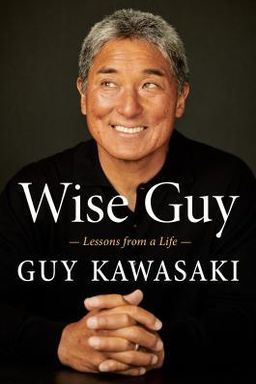
Wise Guy cover

Wise Guy

by Guy Kawasaki

Wise Guy offers an engaging look into Guy Kawasaki’s life, from his entrepreneurial achievements with Apple to personal growth as a parent and surfer. With humor and wisdom, Kawasaki shares lessons on seizing opportunities and embracing life''s surprises, inspiring readers to pursue their own path to success.

Living a Life of Practical Wisdom

What actually makes a life meaningful? Is it career success, accumulation of wealth, or something far simpler—like kindness and integrity? In Wise Guy, legendary entrepreneur and evangelist Guy Kawasaki compiles a lifetime of lessons learned from Silicon Valley boardrooms, surf breaks, family dinners, and the playing fields of Hawaii. Rather than a traditional memoir, it’s a personal guide to living with purpose and joy in an unpredictable world. Kawasaki calls it a “moral operating system”—small stories that together form a life philosophy focused on humility, curiosity, and helping others.

Throughout the book, Kawasaki invites readers to reimagine success not as a climb to the top, but as a way of becoming wiser through experiences. He draws wisdom from his Japanese-Hawaiian roots, formative teachers, his years at Apple under Steve Jobs, and his later ventures in writing, business, and parenting. The book evolves from gratitude for ancestors who emigrated for opportunity, to lessons learned from mentors, mistakes, and family—revealing how personal values anchor a meaningful career and a fulfilling life.

An Operating System for Being Human

Kawasaki doesn’t preach success in the motivational-speaker sense. Instead, he shares a deeply human vision—that wisdom accumulates through everyday choices. Each chapter pairs an anecdote with a reflection, extracting universal lessons from seemingly ordinary events: growing up in Kalihi Valley, learning respect through fear of a drill sergeant, quitting law school, or telling the truth to Steve Jobs and almost getting fired for it.

The point is simple yet profound: wisdom isn’t found in the extraordinary; it’s forged in the ordinary. You grow wiser by staying honest, taking risks, quitting when necessary, and recognizing that people matter more than prestige. Life’s trajectory, he argues, often rests on small moments—an observant teacher, a wrong decision corrected early, or a lucky encounter that turns into opportunity.

Themes That Connect the Journey

Across twelve thematic sections—from Immigration, Education, and Inspiration to Business, Values, and Parenting—Kawasaki unpacks life as an unfolding process of learning. Several recurring ideas thread throughout:

  • The value of education and mentors—those who inspire you to change course or challenge your potential.
  • The courage to quit or pivot when the dream doesn’t fit.
  • Honesty, humility, and integrity as the bedrock of all enduring relationships.
  • Family as the ultimate measure of success—both the one you’re born into and the one you build.
  • A deep appreciation for curiosity and grit over genius or pedigree.

From Detours to Dharma

As an entrepreneur, Kawasaki lived through much of Silicon Valley’s mythology—working directly under Steve Jobs, founding a software company, and later advising start-ups like Canva. Yet his most powerful stories focus less on hustle and more on character formation. Being fired, making mistakes, and even being robbed become launching points for reflection on how setbacks plant the seeds of wisdom. (In spirit, his tone recalls Shoe Dog by Phil Knight—another founder who turned failures into fables.)

Kawasaki also taps into Eastern values—gratitude, humility, and familial loyalty. From his father, a Hawaiian state senator, he inherits a sense of civic duty and fairness. From his mother, discipline and neatness. Both influenced his lifelong devotion to helping others “find their way,” particularly through education and kindness. In one chapter, he distills this ethos: “Remember the opportunities you were afforded. After you’ve ‘made it,’ provide opportunities to others.”

Why This Book Matters Now

In a culture obsessed with optimization and personal branding, Wise Guy argues for something timeless: wisdom over cleverness, substance over flash. Kawasaki writes not as an infallible guru but as a self-effacing mentor who’s seen both the peaks of tech celebrity and the grounding lessons of family life. He reminds us that wisdom is not about knowing more but about understanding what truly matters.

Readers are left with practical examples of how to live wisely: tell the truth even when it’s risky, take opportunities even when underqualified, laugh at yourself often, and never stop learning. Through stories that range from hilarious (“Are you Jackie Chan?”) to deeply emotional (adopting his two Guatemalan children), Kawasaki models the humility of someone who’s lived fully and learned continuously. His guiding insight—“Life isn’t linear, but wisdom compounds”—invites everyone to reflect on their own journey and ask: what kind of story am I weaving into the lives of others?


The Roots of Grit and Gratitude

Kawasaki’s story begins not in Silicon Valley but in the sugarcane fields of Hawaii, where his grandparents fled from Japan to escape economic hardship and military conscription. This first chapter, “Immigration,” sets the moral compass for his life: the belief that luck, opportunity, and hard work—not privilege—define one’s path. By honoring his ancestors’ courage, Kawasaki reminds readers that gratitude is the foundation of self-discipline and purpose.

Family as a Source of Strength

His father, Duke, embodied civic duty. A fireman turned state senator, he taught Guy two lessons that shape the book’s moral spine: never stop learning, and always leave a place better than you found it. His mother, Lucy, taught him self-respect and tidiness—a metaphor for order and integrity in life. Small household rules like “leave a place neater than you found it” became lifelong habits of accountability.

Change a Losing Game

From his grandparents’ story, he extracts a key idea: move to opportunity. They risked everything to immigrate, and their decision reverberated across generations. Kawasaki uses this to underscore an action principle for anyone feeling stuck: when your environment limits growth, change it. Don’t wait, act. If his grandparents hadn’t left Hiroshima, he jokes, he might never have been born—or might have perished during World War II. (Compare with Angela Duckworth’s Grit—Kawasaki’s lesson is not just perseverance but courageous adaptation.)

Gratitude as Momentum

Unlike many business autobiographies that celebrate achievement, Kawasaki continually circles back to gratitude as a force multiplier. His family’s sacrifices, modest home in Kalihi Valley, and multicultural Hawaii upbringing instilled a “you’re lucky to be here” mindset. It’s from that baseline of humility that ambition becomes sustainable. Gratitude doesn’t blunt aspiration; it grounds it in responsibility. His takeaway: document your family’s history while you can—because knowing where you came from gives meaning to where you’re going.


Learning from Teachers and Turning Points

Few people capture the life-changing power of education as vividly as Kawasaki. In “Education,” he credits entire chapters of his life to teachers who saw potential before he did. His sixth-grade teacher, Trudy Akau, convinced his parents to send him from a public school in Honolulu to the prestigious ‘Iolani prep school, even though tuition consumed much of their modest income. That one intervention changed everything—eventually leading him to Stanford and Apple. The message is timeless: invest in others’ education; one caring voice can redirect a life.

The Toughest Teachers Are the Best Ones

At ‘Iolani, Kawasaki’s English instructor, Harold Keables, taught him the value of precision and discipline. Keables demanded that students correct every grammar mistake by rewriting the sentence and quoting the rule violated—a ruthless but enlightening process. It instilled in Kawasaki a permanent disdain for the passive voice and a lifelong respect for strong writing. This obsession later shaped his fifteen books. His advice to readers echoes the message of Carol Dweck’s Mindset: seek challenge, not comfort, because rigor breeds excellence.

Lessons in Respect and Reality

Through small childhood episodes—dropping rice on a military base or triggering a fire alarm—Kawasaki learned respect the hard way. Fear, he admits, sometimes builds character. His conclusion may feel old-fashioned but relevant: sometimes a little fear teaches more than endless praise. It’s not cruelty but consequences that form resilience.

Beyond Black and White Thinking

His uncle’s petty theft of a few screws from a store shattered Kawasaki’s belief that people fit neatly into “good” or “bad.” This story becomes a meditation on human complexity: ethical maturity requires accepting gray areas. He cites scholars like Jacob Lomranz, who define this “ability to live with incongruence” as aintegration. The mature mind recognizes contradictions—not as moral failure, but as the fabric of humanity. It’s a lesson in empathy that echoes throughout his parenting and leadership philosophies.


Finding Inspiration in the Ordinary

In “Inspiration,” Kawasaki demolishes the myth that motivation must come from grand visions or world-changing ideals. His first goal wasn’t peace or innovation—it was to drive a Cadillac instead of a Toyota Corona. It’s honesty like this that makes his lessons memorable. Small, tangible desires can ignite great effort if pursued with integrity.

Ordinary Ambition, Extraordinary Drive

As a teenager, Kawasaki’s motivation came from seeing classmates’ parents drive Ferraris and Rolls-Royces at Stanford parent weekends. Those glimpses didn’t make him greedy; they gave him a work ethic and a target. “While some heroes strived to change the world, I only wanted to change the car,” he writes, with tropical humor. The takeaway: don’t judge your motivation—leverage it. Every big purpose starts with a small craving that pushes you forward.

Books That Change Everything

Later, a different kind of vehicle drove him: literature. When his wife gave him If You Want to Write by Brenda Ueland, its central message—“Just write! You don’t need permission”—liberated him from self-doubt. Kawasaki extends Ueland’s advice beyond writing: replace the word “write” with any creative act. Want to code, paint, or start a business? Don’t wait for validation. Creation requires action, not approval.

Quitting as Self-Awareness

Perhaps the most countercultural story he tells is about quitting law school after just one week. Instead of shame, he celebrates this as a triumph of honesty over obligation. His father’s reaction—“It’s okay, as long as you make something of yourself”—taught him that quitting the wrong path isn’t weakness, it’s wisdom. The story reinforces his core idea: failure properly framed becomes fuel for growth.

Inspiration from Others' Triumphs

Kawasaki learned to turn envy into empowerment. When he realized software CEO Sandra Kurtzig had $250,000 in her checking account, he didn’t feel resentment; he felt possibility: “If she can do it, so can I.” Whether from role models or rivals, others’ success can expand your sense of what’s achievable. The only requirement is to watch with curiosity, not comparison.


Lessons from Apple and Steve Jobs

If Hawaii taught Kawasaki humility, Apple taught him excellence. In both his tours of duty at Apple—from the Macintosh Division in the 1980s to the company’s near-death in the 1990s—he absorbed Steve Jobs’s relentless pursuit of simplicity, design, and truth. These lessons shaped his professional credo and personal ethics: tell the truth, deliver results, and obsess over value.

Getting In and Standing Out

Kawasaki’s career at Apple began through a friend’s recommendation—an early lesson that connection opens doors, but performance keeps you inside. Despite lacking technical credentials, his passion for computers and sales experience earned him a spot evangelizing Macintosh software. His takeaway: qualifications may get you rejected; determination makes the impossible negotiable. Within black humor, he admits Jobs hired him reluctantly: “You can hire Guy, but you’re betting your job on him.”

Honesty as Competitive Advantage

Kawasaki recalls telling Jobs a prospective partner’s products were “mediocre and boring.” Jobs then introduced him to that CEO on the spot, quipping, “See? That’s what I told you.” Awkward—but instructive. Jobs valued brutal honesty over diplomacy. The moral: truth earns respect faster than flattery ever can. Lies are expensive because they require maintenance; truth sustains itself. (This echoes radical candor champions like Kim Scott.)

The Gospel According to Jobs

Toward the end of the Apple section, Kawasaki condenses eleven commandments of Jobs’s leadership. Among them: only excellence matters; innovation happens on the next curve; less is more; and some things must be believed before they are seen. Jobs didn’t ask customers what they wanted; he imagined what they’d love. For Kawasaki, this taught that vision precedes validation. If you wait for consensus, you’ll always be late. Yet alongside admiration lies critique—Jobs was mercurial, but his bar for quality forced everyone to grow.

Leaving Well and Knowing When to Return

Kawasaki quit Apple twice and refused Jobs’s later invitation to return a third time. In hindsight, he estimates that decision cost him “tens of millions,” but he gained family time, creative freedom, and a portfolio of meaningful ventures. His story warns readers: don’t let a résumé define your life. Sometimes the richest outcomes follow the exits you’re brave enough to take.


How to Work and Sell Without Losing Your Soul

In “Business,” Kawasaki fuses old-school street smarts from his days selling jewelry with the high-tech ethos of Silicon Valley. His bottom line: everything is sales. Whether you’re pitching a product, raising capital, or convincing a child to eat vegetables, persuasion and integrity walk hand in hand.

Sales as Lifelong Skill

Working for a Los Angeles jewelry firm taught Kawasaki to respect “hand-to-hand combat” business. Buyers haggled by weighing gold on scales, not reading pitch decks. “Life is sales,” he writes. You must earn trust by delivering real value, not buzzwords. That grounded approach later defined his tech evangelism: serve customers before you sell to them.

The Value of Paying Dues

Kawasaki defends unpaid or low-paid work as apprenticeship rather than exploitation. When he launched a design contest for his book cover, critics called it unethical because only the winner was paid. He countered that real growth often starts with free effort—like speaking at unpaid events or building a portfolio. Opportunity, not pay, is the first dividend of passion. (It aligns with Cal Newport’s argument in So Good They Can’t Ignore You—mastery precedes money.)

Entrepreneurship and Serendipity

From fried manapua to Viagra’s accidental chemistry, Kawasaki illustrates that many breakthroughs begin as creative mistakes. The entrepreneur’s gift lies in curiosity—asking “Therefore, what?” rather than dismissing failures. It’s the mindset of discovery that separates pioneers from planners. As he notes, most great companies didn’t follow a blueprint; they followed their noses.

Stories over Superlatives

Kawasaki warns against the adjective inflation that plagues business pitches (“revolutionary,” “innovative,” “disruptive”). Instead, he urges storytelling—the Pez-dispenser myth that made eBay relatable, for example. Stories make people care; adjectives make them tune out. His rule: open with a story, follow with facts, and close with hope.


Values that Outweigh Victories

After recounting decades of deals and detours, Kawasaki turns inward to reflect on what endures beyond career wins. The “Values” section reveals that character is compound interest—each small act of integrity multiplies over time. From repaying old debts to honoring mentors, he shows how to succeed without sacrificing your soul.

Honor and Humility

Perhaps his most moving story involves Steve Case of AOL who, years after a forgotten consulting engagement, tracked Kawasaki down to give him the stock options he’d promised. That gesture turned into a fortune worth far more than the original fee. Kawasaki calls it proof that honor pays dividends. Similarly, he tells of iStockphoto founders who insisted on granting him extra equity for unpaid help. Integrity, he concludes, “outperforms contracts.”

The Flip Side: Dishonor

Not all stories shine. Unscrupulous agents who withheld his speaking fees taught him a second kind of wisdom: assume goodness—twice. After that, stop being the fool. Trust, but verify. When people lie, confront early. But when they fail honestly, give grace. The line separating error from deceit is accountability.

Humility and Generosity

Kawasaki’s encounter with Richard Branson famously polishing his shoes sums up the virtue of humility-in-success. If a billionaire knight can kneel to earn one passenger, so can you. Generosity and gratitude, he insists, are the only real currencies. When he gave groceries to a homeless man outside Walgreens, it wasn’t showmanship—it was reflex. “Help when you can, where you can,” he writes. The measure of goodness is how you treat those who can’t repay you.

Courage to Stand for What’s Right

His decision to publicly oppose Donald Trump on social media despite losing followers demonstrates moral courage. “Eat when served,” he writes—take help when offered, but also take a stand when conscience calls. Influence comes with responsibility. In today’s divided world, wisdom demands resistance to fear and apathy alike.


Parenting, Patience, and Perspective

The heart of Wise Guy beats loudest in “Parenting.” After years of professional adventure, Kawasaki finds his deepest lessons at home. His definition of success narrows to one simple goal: raising kids who are joyful, productive, and kind. Parenting, for him, is both comedy and commandment—a series of humble tests that mirror everything he learned about leadership.

Adoption and Empathy

Kawasaki and his wife adopted two children from Guatemala, expanding their family from two to four and learning firsthand that love transcends DNA. When a friend warned that “adopted children have problems,” Kawasaki chose silence over argument—teaching a subtler point: not every opinion deserves a response. “Sometimes it’s best to shut up,” he writes, redefining wisdom as restraint.

Parenting Without Control

From bribery with miniature horses to teaching kids to cope with failure, his stories brim with humor. He calls parenting “being a Lyft driver and ATM rolled into one,” yet he embraces it joyfully. When his son failed his driving test twice, Kawasaki turned coaching into strategy—studying examiner routes. Another father tried the same trick, got caught, and his daughter failed. Moral: there’s an art to preparation, but a limit to control.

Humility in the Household

His children routinely humbled him: the daughter who racked up $2,500 in in-game purchases; the son who asked a UCLA vice chancellor where the hockey team practiced. Instead of frustration, Kawasaki found humor and empathy. Great parenting, he concludes, is letting children chart their own paths—and learning not to take yourself so seriously while they do.

Full Circle Lessons

A haunting moment arrives when his surfer daughter critiques his mediocre wave-reading, echoing the impatience he once showed his own father practicing piano. The karmic symmetry devastates him—but it also closes a life loop. “What goes around comes around,” he admits, a final nod to humility learned at home. In the end, parenting refines Kawasaki’s biggest idea: wisdom is love widened by humor.


Surfing Toward Wisdom

In later years, sports became Kawasaki’s metaphor for mastery and mindset. From football to hockey to surfing at sixty, he proves that curiosity outlasts youth. Each new sport rekindles a beginner’s mind—a Zen concept that echoes Steve Jobs’s love for continuous renewal.

The Beginner’s Freedom

Learning hockey in middle age (at his wife’s urging) taught him humility—and connection to his sons. “If Canadians can start at four, I can start at forty-eight,” he jokes. The rink became his classroom for courage. No slide decks, no job titles, just the joy of failing forward. Later, surfing with his daughter extended that philosophy into the ocean: balance, patience, and letting go of ego. “Ignore the naysayers,” he advises; wisdom belongs to those who keep paddling.

The Surfer’s Code

Mentored by legends like Jeff Clark and Shaun Tomson, Kawasaki translates surf lessons into life commandments: perseverance (“Always paddle back out”), empathy (“We are joined by one ocean”), optimism (“There will always be another wave”). His surfing chapter becomes a poem of rebirth—proof that it’s never too late to start over. At sixty-two, each wave is both adventure and meditation, each wipeout a reminder that wisdom demands humility before nature.

Riding Life’s Waves

When fellow surfers complained that his kids caught too many waves, he found two lessons: for his kids, respect the code of taking turns; for the complainers, get better instead of jealous. In classic Kawasaki wit, he ends by hoping one day others will complain about him catching too many. The ocean, like life, doesn’t reward entitlement—it rewards effort, patience, and presence.


The Art of Speaking, Writing, and Evangelizing

Kawasaki’s final chapters, grouped under “Skills,” transform decades of practice into timeless craft lessons. He deconstructs evangelism, writing, public speaking, and social media—the modern skill set for spreading ideas without selling out. His approach is part technical manual, part moral instruction.

Evangelism: Turning Products into Causes

Drawing from his Apple years, Kawasaki defines evangelism as “bringing the good news.” To evangelize effectively, he says, treat your product as a cause, not a commodity. Touch gold—because it’s near impossible to preach crap. Give demos, tell authentic stories, and help the agnostic before the faithful. Evangelism succeeds when belief replaces persuasion.

Writing: Editing Is the Real Writing

He dismantles the romantic myth of the author. Writing, he insists, is rewriting. Read voraciously, master style guides, and murder adverbs. He rewrites every book up to twenty times, chasing simplicity like Steve Jobs chased design purity. “The key to writing,” he notes, “is editing through dozens of drafts after you think you’re done.”

Speaking: Tell Stories, Not Bullet Points

For a man who’s delivered over a thousand keynote speeches, Kawasaki’s advice is disarmingly practical: dark slides with white text, a maximum of ten frames, and a fighter jet takeoff—fast and focused. Befriend the AV crew, engage the audience before the speech, and fill every talk with stories. Slides fade; stories stick. Above all, less is more—just as TED’s 18-minute rule affirms.

Social Media: Provide Value First

Unlike performative influencers, Kawasaki uses social media as service, not spectacle. Offer insights, humor, and help before ever promoting yourself. Think NPR, not an ad campaign—earn attention through value. Be positive or be silent; optimize your avatar; and don’t fear repeating posts. His mindset echoes timeless marketing wisdom: generosity is the most persuasive strategy of all.

In all these skills runs a moral thread—clarity over cleverness, kindness over vanity. Communication, in Kawasaki’s philosophy, is not about impressing others; it’s about empowering them to act.


Ten Lessons for a Wise Life

Kawasaki closes Wise Guy with a final summation—his “Top Ten Wisdoms.” These are not abstract ideals but daily navigation tools, distilled from decades of trial and gratitude. Together, they form a portable playbook for living meaningfully in any era.

  • Get high and to the right: Become both unique and valuable. Don’t chase crowded middle grounds; develop skills few possess in markets that need them.
  • Adopt a growth mindset: Keep learning long after formal education ends; curiosity compounds faster than interest on capital.
  • Embrace grit: Success is implementation, not inspiration. Hard work beats brilliance when brilliance won’t work hard.
  • Smile: Kindness is strength. He writes, “You can never go wrong being nice.”
  • Default to yes: Help first; the upside of generosity outweighs the risk of being used.
  • Raise the tide: Life isn’t zero-sum. Success shared expands the pie.
  • Pay it forward: Karma keeps score. Do good even when unseen.
  • Examine everything: Be skeptical, not cynical—challenge assumptions, including your own.
  • Never lie, seldom shade: Truth simplifies life. Lies require management; honesty manages itself.
  • Enable people to pay you back: Let generosity empower dignity, not obligation.

He ends with simple joy: dance to your own music. Life is finite; approval is overrated. If you’ve smiled, helped others, and stayed honest—you’ve already lived wisely.

Dig Deeper

Get personalized prompts to apply these lessons to your life and deepen your understanding.

Go Deeper

Get the Full Experience

Download Insight Books for AI-powered reflections, quizzes, and more.