
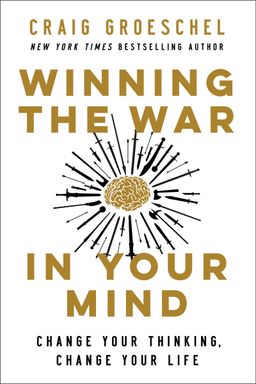
Winning the War in Your Mind cover

Winning the War in Your Mind

by Craig Groeschel

Craig Groeschel''s ''Winning the War in Your Mind'' explores how the Bible''s timeless wisdom can enhance mental health. By changing thought patterns and embracing God''s love, readers can overcome negativity and self-doubt, paving the way for a resilient and purposeful life.

Winning the War in Your Mind

Have you ever felt trapped by your own thoughts—like your mind is a battlefield you can’t win? In Winning the War in Your Mind: Change Your Thinking, Change Your Life, pastor and author Craig Groeschel argues that most of life’s battles are won or lost in our minds. Throughout this deeply practical book, he contends that transforming your life starts with transforming your thoughts. The war is real, but victory is possible when you learn to identify lies, rewire your brain, reframe your perspective, and rejoice in God’s truth.

Groeschel fuses ancient biblical wisdom with modern neuroscience to show that our thinking literally shapes our reality. He begins by stating a striking thesis: “Our lives are always moving in the direction of our strongest thoughts.” That’s not just a preacher’s metaphor—it’s both spiritually and scientifically true. The thoughts you choose to believe create neural pathways in your brain that make your beliefs feel more and more natural over time. The result? The future you experience flows directly from the mental stories you tell yourself today.

The Battle for the Mind

Groeschel reminds us that the human mind is under constant assault from lies. Drawing from passages like Ephesians 6 and 2 Corinthians 10, he asserts that Satan’s main weapon is deception. Much like the locked door in Groeschel’s humorous story about his fellow pastor Kevin—who stayed trapped in an unlocked closet because he believed a lie—we often live imprisoned by falsehoods of inadequacy, fear, or shame. The moment we identify these lies is the moment we begin to experience freedom. As Groeschel puts it, “You cannot change what you do not confront.”

But confronting lies isn’t simply a matter of positive thinking. Groeschel invites readers to engage both spiritual renewal and behavioral science, showing how the brain can literally be rewired. He notes that cognitive behavioral therapy (CBT) validates what Scripture has long taught: when you replace toxic thoughts with truth, your emotions and behavior follow suit. God designed the mind with plasticity—the remarkable ability to change itself through repetition and habit.

Four Principles for Mental Renewal

Groeschel organizes the book around four transformative principles:

  • The Replacement Principle: Remove lies and replace them with God’s truth. Recognize false narratives like “I’m not enough” and replace them with the spiritual reality that “I am who God says I am.”
  • The Rewire Principle: Rewire your brain and renew your mind. Groeschel draws from neuroscience to show how new thought patterns carve out mental “trenches of truth.”
  • The Reframe Principle: Reframe your mind to restore your perspective. Life’s events don’t change, but the way you interpret them can. Like Paul in prison, you can see God’s purpose in your setbacks.
  • The Rejoice Principle: Revive your soul and reclaim your joy. Gratitude, prayer, and praise shift your focus from problems to God’s presence.

Each principle is accompanied by practical exercises—part devotional reflection, part psychological audit—designed to transform theory into daily practice. In this way, Groeschel makes the journey deeply personal, guiding readers through structured “thought audits,” truth declarations, and mental rewiring exercises.

Faith Meets Neuroscience

The beauty of Groeschel’s approach is its synthesis of faith and science. He references neuroplasticity—the brain’s ability to change in response to repeated thought patterns—and compares it with scriptural renewal. Romans 12:2 (“Be transformed by the renewing of your mind”) becomes both spiritual command and biological truth. Thoughts are not static; they can be reprogrammed through discipline, prayer, and persistent declaration of truth.

Groeschel’s own transparency makes these concepts relatable. He shares personal experiences of feeling inadequate—early failures as a preacher, rejection by religious leaders, and constant inner criticism—yet points to God’s voice breaking through the lies: “You are not who others say you are. You are who I say you are.” His vulnerability transforms abstract teaching into proof that mental renewal is possible for anyone willing to engage the process.

Why This Matters

This message arrives in an age dominated by anxiety, distraction, and negative self-talk. Groeschel’s central insight—that your thoughts determine your destiny—echoes both spiritual classics like Joyce Meyer’s Battlefield of the Mind and modern psychology’s focus on mindset (popularized by Carol Dweck’s Mindset). The difference is how Groeschel integrates God’s Word with cognitive science, making inner renewal both accessible and sacred.

Ultimately, Winning the War in Your Mind is not just a manual for positive thinking; it’s a framework for spiritual warfare and personal growth. It invites you to partner with God in reshaping the very neural and spiritual architecture of your mind. As Groeschel declares, “You can’t have a positive life when you have a negative mind.” But through deliberate practice, truth-telling, and faith, you can live in freedom and purpose. The battle is in your mind—but it’s a war you were born to win.


The Replacement Principle: Remove Lies, Replace with Truth

Groeschel begins the transformation process with what he calls The Replacement Principle: the practice of identifying lies, exposing them, and replacing them with truth. This principle is grounded in both Scripture and experience. Lies, he says, are the locks on the mental prisons that keep us captive. The moment you replace a lie with truth, the door swings open.

Recognizing the Prison of Lies

Groeschel illustrates this truth through a story from his own church—a friend named Kevin once hid in a closet during an office prank, unaware that the door was never actually locked. Kevin’s belief made him a prisoner even though freedom was available all along. The same happens to us when we accept Satan’s lies about our worth or God’s love. “A lie believed as truth,” Groeschel writes, “will affect your life as if it were true.”

He calls readers to name their personal lies—statements like “I’m not good enough,” “I’ll never change,” or “God doesn’t care about me.” Each must be confronted directly. Defeating deception requires awareness.

Replacing Lies with Truth

Replacing the lie requires “fighting back with Scripture.” Groeschel compares this process to Jesus’ temptation in the wilderness: each time Satan twisted truth, Jesus responded with the authoritative phrase, “It is written.” Likewise, we must fight thought with Word. He encourages readers to create truth declarations—short, Scripture-based statements to reinforce new neural and spiritual pathways. For instance, if the lie says, “I am a failure,” the declaration becomes, “God works all things together for my good.”

Groeschel offers his own experience. For years, he was haunted by feelings of inadequacy, especially after being told by church leaders that he “did not have what it takes” to be a pastor. Only when he began reciting God’s truths (“You are not who others say you are”) did the lie lose power. This echoes advice from Christian counselor Neil Anderson (Victory Over the Darkness) who teaches that identity in Christ is the foundation for freedom.

Practicing Lie Detection

Groeschel introduces a practical “Thought Audit,” a reflection exercise designed to evaluate your mental patterns. He divides it into defense questions (Are my thoughts tearing me down?) and offense questions (Are my thoughts building me up?). The purpose is to reveal negative loops that often go unnoticed. Once exposed, these can be replaced with truthful, faith-based thinking that aligns with God’s promises.

You cannot change what you do not confront. To win the battle in your mind, you must become your own thought warrior—willing to challenge every falsehood and replace it with God’s unshakable truth.

By applying The Replacement Principle, Groeschel shows that spiritual freedom is as practical as it is supernatural. The moment you stop living by lies and start replacing them with biblical truth, your identity, habits, and relationships all begin to shift. You start to live as someone fully free—because the truth really does set you free.


The Rewire Principle: Changing Your Brain with Truth

In Part Two, Groeschel moves from identifying lies to transforming the physical and mental structure that sustains them. He calls this the Rewire Principle, and it builds on neuroscience’s concept of neuroplasticity—the brain’s ability to reorganize itself by forming new connections. Simply put, the more you think a thought, the easier it becomes to think it again.

How Neural Pathways Work

Groeschel uses vivid metaphors to make this science understandable: our repeated thoughts are like deep ruts carved into a muddy road. Every time you believe “I can’t do this” or “Things never work out,” the mental wheels sink deeper into that rut, until you begin traveling that route without conscious effort. The good news is that you can dig new “trenches of truth” that divert those patterns toward life-giving thinking.

Groeschel’s story of his grandmother’s financial fear—teaching him that economic collapse was inevitable—illustrates how early experiences program our neural pathways. Decades later, even with financial stability, he lived as if scarcity were still around the corner. Rewiring required not just prayer but disciplined thought replacement using Scripture’s assurance of God’s provision.

From Ruts to Trenches of Truth

Groeschel introduces the concept of “digging trenches of truth.” A rut is a negative pattern formed unintentionally; a trench is a positive pattern dug intentionally. By crafting new declarations rooted in Bible verses, your brain begins to favor truth pathways over fear-based ones. For example, his truth declaration reads: “Money is not and never will be a problem for me. My God is an abundant provider who meets every need.” Repetition of such affirmations, combined with gratitude, rewires both thought and emotion.

To make this real, Groeschel draws on Philippians 4:12 (“I have learned the secret of being content in any and every situation”) as a spiritual model of mental resilience. Like Paul, we can learn contentment through consistent mental training.

The Power of Meditation and Repetition

Groeschel redefines Christian meditation as strategic focus—not emptying the mind, but filling it with God’s truth until it becomes automatic. Drawing parallels to psychology, he notes that repetition is the reason habits stick—and that includes mental habits. This is why he urges readers to “write it, think it, confess it until you believe it.” The more you internalize truth, the easier it becomes to live by it.

Repetition is the reason for ruts—but it’s also the reason for renewal. What once programmed you for fear can now train you for faith.

Groeschel’s emphasis on neuroscience makes this deeply practical. Changing your life requires changing your neural architecture through deliberate, truth-based thought repetition. By reprogramming your mental defaults, you align your mind with God’s design—achieving not shallow positivity but profound transformation.


The Reframe Principle: Seeing Life Through New Lenses

Once you’ve replaced lies and rewired your thinking, Groeschel says it’s time to change how you see life itself. In The Reframe Principle, he explains how perspective determines peace—and how learning to reframe your thoughts restores hope.

How Your Lenses Shape Reality

Groeschel opens with a humorous story: his wife’s new glasses made his face look discolored—until she removed them and realized the lenses were flawed. The lesson? We all view life through mental lenses tinted by experience, bias, and belief. Psychologists call this cognitive bias. Whether it’s assuming “everyone’s out to get me” or “God isn’t answering,” those filters distort truth.

Groeschel teaches readers to identify these filters by asking probing questions: Why do I interpret things this way? What past experience shaped this reaction? Just as therapy uses reframing to change thought patterns, believers can use biblical truth to refocus perception.

Reframing and Preframing

The apostle Paul becomes Groeschel’s prime example. Though imprisoned, Paul chose to frame his suffering as a platform for spreading the gospel. “What has happened to me,” Paul wrote in Philippians 1, “has served to advance the gospel.” He could not control his circumstances—but he could control his frame. Likewise, we can choose to reframe hardships as opportunities for spiritual growth.

Groeschel also introduces preframing—deciding ahead of time how you’ll approach future situations. This proactive mindset allows faith to guide your response before stress hits. It’s the mental version of putting on the armor of God before entering battle.

Thanking God for What He Didn’t Do

One of the most moving applications of reframing is gratitude for God’s “nos.” Groeschel recounts his teenage dream of baseball stardom, shattered by a hand injury. Yet that closed door led him to tennis, where he met his future wife Amy and eventually his ministry calling. Later, when his son’s Sunday birth forced him to deliver a sermon by video—a technical compromise—he discovered the model that grew Life.Church into a worldwide network. Both moments illustrate his principle: thank God for what He didn’t do.

Reframing is not denying reality—it’s redefining meaning. You can’t always control what happens, but you can always control how you see it.

Through reframing, Groeschel invites us to adopt a God-centered narrative: to see obstacles as setups, and pain as preparation. When you change your frame, you don’t just see life differently—you experience it differently.


The Rejoice Principle: Prayer, Presence, and Praise

In the final stage of mental transformation, Groeschel turns from thinking to worship. The Rejoice Principle links mindfulness, prayer, and praise as the ultimate antidotes to anxiety and fear. Drawing from Philippians 4, he repeats Paul’s four commands: rejoice, don’t be anxious, pray with thanksgiving, and experience peace.

From Panic to Presence

Groeschel introduces the brain’s two combatants: the amygdala (fear center) and the prefrontal cortex (logic and faith). When panic hits, the amygdala hijacks reason, creating irrational anxiety. The solution, he says, is prayer. Quoting neuroscience research by Dr. Andrew Newberg and Dr. Caroline Leaf, he explains that prayer not only touches God’s heart but rewires the brain—reducing stress, strengthening compassion, and quieting fear responses.

For Groeschel, prayer is the act of transferring worry to God. Through what he calls “The God Box,” readers physically write down fears, place them in a box labeled “God,” and symbolically release them. If you take them back by worrying, you’re saying, “God, I don’t trust you.” The physical ritual helps embody surrender, turning faith into action.

The Perspective of Praise

Prayer leads naturally into praise. Referencing Paul and Silas singing in prison (Acts 16), Groeschel emphasizes that praise precedes provision. They didn’t worship after God delivered them; God’s deliverance came as they worshiped. “They praised God for the who, not the what,” he writes—because God’s goodness is constant even when circumstances aren’t. He challenges readers: If you wait to thank God until He answers, you’ve missed the power of praise.

Groeschel himself experienced this firsthand. In 2019, overwhelmed by speech deadlines, house repairs, and his newborn granddaughter’s health crisis, he hit emotional burnout. His recovery began with worship—not productivity. As he praised God in exhaustion, peace and perspective returned. Neuroscientifically, praise activates the brain’s reward circuits; spiritually, it invites God’s presence.

Living Secure in God’s Presence

In the end, rejoicing is not about denying problems but remembering divine proximity. “The Lord is near,” Paul writes; therefore, you can trade panic for peace. Groeschel summarizes: when you raise both hands—one in prayer (surrender) and one in praise (victory)—God’s peace guards your mind. As he puts it, “When you’ve had enough, God is enough.”

With joy as the final weapon, Winning the War in Your Mind ends where faith begins: trusting that God’s truth, presence, and goodness can transform even your thoughts into worship.

Dig Deeper

Get personalized prompts to apply these lessons to your life and deepen your understanding.

Go Deeper

Get the Full Experience

Download Insight Books for AI-powered reflections, quizzes, and more.