
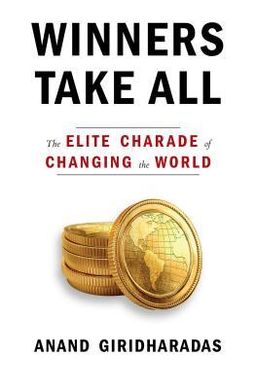
Winners Take All cover

Winners Take All

by Anand Giridharadas

Winners Take All exposes the paradox of elite-driven social change. Through a critical examination of philanthropy, corporate practices, and thought leadership, Anand Giridharadas reveals how these efforts often sustain the very inequalities they claim to address, challenging readers to rethink the dynamics of power in today''s world.

The Age of MarketWorld

You live in a time when the richest and most powerful claim not only the right to shape markets but also to fix society itself. In Winners Take All, Anand Giridharadas argues that a global elite culture—what he calls MarketWorld—has seized moral authority by redefining social change in its own market-friendly image. He contends that this culture believes business methods, competition, and "win-win" thinking can solve inequality and injustice without redistributing power or wealth.

MarketWorld is a complex system of conferences, consultancies, philanthropies, tech platforms, and academic programs that train people to approach civic problems through the lens of private enterprise. Its institutions—from Georgetown’s Baker Scholars to the Clinton Global Initiative—promote a way of seeing that packages moral purpose inside the logic of business and scale. You are encouraged to believe that helping others should never require threatening your own material comfort.

What MarketWorld Promises

The promise is seductive: social change can be profitable, efficient, and harmonious. The language of impact replaces that of justice; optimization replaces redistribution. Figures like Hilary Cohen—studied in the book—illustrate how idealistic young people are recruited into this mindset. A Georgetown graduate who wanted to help people, Cohen was channeled into jobs at Goldman Sachs and McKinsey, where she learned to view human problems through analytical frameworks designed for corporate clients. Her journey shows how MarketWorld socializes future leaders to equate moral impact with professional success.

The Machinery Behind the Ideal

Behind the rhetoric lies a machinery of problem-framing. Consulting protocols and philanthropic toolkits repackage social issues—poverty, inequality, education gaps—into measurable business-style problems: scale, efficiency, connectivity. Organizations like TechnoServe or Bridgespan diagnose poverty as a missing link in markets, not as a product of political power or exploitation. These protocols give elites authority to define what counts as solvable and who gets to solve it. When problems fit the spreadsheet, local histories and structural injustices disappear.

Win-Win and Its Moral Limits

At the core of MarketWorld sits the win-win gospel—the belief that what benefits business can also benefit society. Silicon Valley start-ups like Even and Asana exemplify this faith: they promise empowerment but privatize public problems. Even smooths the paychecks of hourly workers for a fee rather than changing unfair labor laws. Asana increases productivity but leaves structural wage inequalities intact. The result is a world of private "Band-Aids" applied to public wounds. The winners get to look virtuous while the systemic drivers of inequality remain untouched.

Rebel Kings and Tech Myths

Another variant of MarketWorld thinking lives in the technology elite. Giridharadas profiles figures like Shervin Pishevar who describe Uber and Airbnb as moral insurgencies against corrupt systems. Yet these "rebels" act like new monarchs—concentrating power in platforms that dominate entire industries. The myth of rebellion allows them to escape accountability. They claim to liberate users but often exploit workers and undermine public oversight. Judges and scholars have exposed how these platforms exercise power while pretending to be neutral arbiters.

Philanthropy's Shield

Elites extend their moral narratives through philanthropy. From Andrew Carnegie's gospel of wealth to modern donors like the Sacklers, giving becomes a form of immunity: a way to justify extreme accumulation. Carnegie believed the rich should act as trustees of society’s surplus, legitimizing inequality as the price of progress. The Sacklers perfected this logic—funding museums and universities with profits from Purdue Pharma’s OxyContin, even as their drug ravaged communities. Giridharadas contrasts this with Ford Foundation’s Darren Walker, who urges donors to ask how their fortunes were made, not just how generously they are spent.

Thought Leaders and the Market for Ideas

The intellectual wing of MarketWorld shapes public understanding through conferences and TED talks. The rise of "thought leaders"—Amy Cuddy, Simon Sinek, Charles Duhigg—signals a shift from critique to packaging. Thought leaders sell optimism and actionable advice, not systemic reckoning. Public intellectuals who challenge power rarely get invited to the same stages or funded by the same sponsors. The idea market thus tilts toward comfort rather than confrontation, producing a culture where elites receive soothing messages about their own goodness.

Alternatives and Moral Reckoning

Giridharadas ends with a call for honest alternatives. Movements like platform cooperativism show that technology can be owned and governed by users rather than investors. Scholars like Trebor Scholz and philosophers like Chiara Cordelli argue that true justice requires structural reform and democratic renewal. Cordelli’s painting analogy captures the moral heart of the book: if you possess wealth derived from systems that deprived others, you owe not charity but restitution through political means. Money alone won’t restore justice; only power shared through democratic institutions can.

MarketWorld’s central illusion is moral outsourcing: the powerful act as saviors to avoid acting as citizens.

The book’s challenge to you is simple yet radical: stop asking how the winners can save the world, and start asking how the world can be governed to limit the winners’ power. True change may be uncomfortable, but it demands justice, not charity.


The Win-Win Gospel

Giridharadas traces how the language of win-win became the moral software of the elite. The concept sounds admirable: business success and social good align. But you soon see that this idea often functions less as a bridge than as a shield. It recasts demands for justice as opportunities for profitable alignment, turning public concern into private enterprise.

The Logic of Win-Win

Win-win ideology insists that capitalism, properly tweaked, can solve inequality. Michael Porter’s “shared value” theory, the rise of B Corporations, and conferences like TED carry this message. Entrepreneurs are painted as hyperagents—unique problem solvers who can scale compassion more effectively than governments. As Vinod Khosla said, maybe redistribution will be necessary “to avoid unrest,” but for now technology feels like enough.

Its Appeal and Its Trap

You are drawn to win-win because it promises harmony: you can keep your privileges and still help others. Philanthrocapitalism sells a psychology of benevolence without conflict. Yet the data show otherwise. Rosenstein’s Asana raises productivity for teams but does not raise wages. Even’s app helps workers manage unstable paychecks for a fee. These are not neutral improvements; they sustain the conditions they claim to soften.

The Distributive Blind Spot

The crucial fissure is distribution. Productivity and innovation matter, but unless you confront power, the gains accrue upward. Win-win becomes a pattern of incremental fixes without redistribution. By eliminating conflict, MarketWorld erases the political nature of inequality itself (note: similar critiques emerge in Elizabeth Anderson’s work on equality as relational justice).

Win-win lets charity masquerade as justice; it’s a peace treaty written by those who profit from the war.

You can still pursue mutual benefit—but Giridharadas reminds you to scrutinize who wins first, who wins most, and who defines the terms of the game.


Thought Leaders and Market-Friendly Ideas

In MarketWorld’s universe, ideas themselves become consumables. Giridharadas distinguishes between public intellectuals—critics who question power—and thought leaders—consultants of optimism who sell palatable insights. This distinction shapes what you hear on TED stages and bestseller lists: the problems of injustice are reframed into personal betterment exercises.

How Thought Leadership Works

The thought-leader formula follows a three-step structure: highlight a victim, individualize the problem, and offer a feel-good fix. Amy Cuddy’s “power posing” turns workplace sexism into a lack of confidence, solvable via body language. Simon Sinek’s “Start With Why” turns organizational dysfunction into a motivational slogan. Such ideas comfort elites because they invite no structural challenge.

Market Incentives

Universities, conferences, and corporate sponsors fuel this intellectual economy. It rewards clarity and uplift, not critique. Daniel Drezner’s taxonomy explains why: the global idea market pays far more for inspiration than resistance. Giridharadas observes how journalists like Charles Duhigg moved from investigative reporting to self-help writing because audiences (and funders) preferred productivity hacks over political exposés.

When power pays for ideas, ideas stop challenging power.

You’re not told to reject accessibility or optimism; you’re invited to notice who funds your hope and whether that hope serves justice or convenience.


Consultants and the Framing of Problems

One of MarketWorld’s most influential tools is the consulting frame. You learn to see every civic issue as a solvable business case: define the problem, gather data, select metrics, and optimize. Giridharadas shows how this mindset, taught by firms like McKinsey and by foundations like Bridgespan, translates messy politics into clean spreadsheets—and in doing so, defines away conflict.

The Power of Protocols

Protocols make problems legible to elites familiar with analytical tools: issue trees, hypotheses, MECE frameworks. Organizations like TechnoServe describe poverty as missing market linkages; once that framing takes hold, the solvers are consultants, not communities. Sean Hinton named the danger the “trying-to-solve-the-problem-with-the-tools-that-caused-it issue.” It crystallizes how good intentions can reproduce structural blindness.

Optimization and Disconnection

Michael Porter helps you see how optimization and detachment—core business virtues—became civic liabilities. Dynamic scheduling in retail, outsourcing, and financialization raise efficiency but destroy stability. Firms unmoored from place stop investing in schools or local infrastructure. Friedman’s shareholder creed transforms civic duty into quarterly gains. You may improve metrics while erasing communities.

Efficiency without empathy becomes cruelty in disguise.

You’re encouraged to keep consulting tools’ rigor but to ask: what does this framing make invisible? The answer usually points toward power.


Philanthropy and Moral Immunity

Philanthropy, in Giridharadas’s view, offers cultural absolution to the winners. From Andrew Carnegie onward, the wealthy framed their giving as moral stewardship—a way to justify accumulation by redistribution. But generosity can also serve as armor: it protects the structures that made wealth possible while deflecting public pressure for reform.

From Carnegie to the Sacklers

Carnegie’s creed—that the rich should administer society’s surplus better than the public could—set the tone for modern philanthropy. The Sackler family’s donations to cultural institutions exemplified the perverse extreme: their charitable visibility masked Purdue Pharma’s role in spreading addiction through OxyContin marketing. Philanthropy thus functioned as a moral whitewash.

Walker’s Moral Counterproposal

Ford Foundation president Darren Walker proposes a reversal: generosity must include self-examination. Ask not only how you give but how you gained. The deeper reform is political—supporting fair wages, progressive taxes, and institutions that ensure equality under law. Giving can be good, but if it replaces justice, it becomes complicity.

Philanthropy without accountability turns taking into virtue.

To act ethically, you must shift from private redemption to public duty—repair the system, not just your own conscience.


Private Solutions vs Public Politics

Giridharadas warns you about the rise of “private world-saving”—a substitute for democratic governance that thrives at summits like Bill Clinton’s Clinton Global Initiative. Here, global problems are discussed not in parliaments but at sponsored gatherings where CEOs make public pledges. These spaces claim to solve what politics cannot, but in doing so, they privatize public deliberation.

CGI and the Parallel Public Sphere

CGI transformed UN Week into MarketWorld Week by organizing commitment sessions where corporations and philanthropies pledged aid projects. Media loved the spectacle of action, but participation depended on wealth and access. The public sphere became invitation-only. Dalberg’s calendars showed dozens of paid, gated events—proof that public interest now traded in private rooms.

Democracy Replaced by Networking

Economist Dani Rodrik and sociologists Horvath and Powell warn that this privatization of politics undermines legitimacy. When elites bypass elected institutions to set agendas, citizens lose voice. MarketWorld’s hostility to government—claiming bureaucracy is slow and inefficient—becomes self-fulfilling when the powerful withdraw and take politics private.

Private problem-solving is efficient; democracy is legitimate. You cannot trade one for the other.

You may admire the speed of private initiatives, but you should defend inclusion and accountability as their democratic counterweights.


Duty, Politics, and Real Alternatives

Near the end of the book, Giridharadas turns from critique to remedy. He introduces thinkers and activists—Trebor Scholz, Chiara Cordelli, and reformers like Andrew Kassoy—who seek genuine alternatives. Each challenges you to reinvest moral energy in civic institutions rather than elite benevolence.

Platform Cooperativism

Scholz’s movement offers a concrete antidote to tech feudalism: build digital platforms owned by workers and users. Examples like Up & Go in Brooklyn show how co-ops can distribute power and profit more fairly. This model reframes design itself as political—it’s not the app that changes lives but the ownership structure behind it.

B Corps and Voluntary Reform

Andrew Kassoy’s B Corp certification aims to make “good” business easy. It has succeeded in branding ethics but not yet in universalizing them. Opt-in models leave exploiters untouched. Kassoy eventually admits that you cannot replace law and regulation with voluntary virtue. Market fixes work best when paired with public governance.

Cordelli’s Moral Duty

Philosopher Chiara Cordelli provides the moral anchor. Her painting analogy—that possessing stolen art obliges restitution—forces you to reconsider elite wealth as collective debt, not private luck. She insists that moral legitimacy arises only from democratic consent. Private actors cannot stand in for public decision-making; they owe repair to the institutions that gave them power.

True social change begins when winners stop saving the world and start surrendering power to it.

You can build better enterprises and donate generously, but Giridharadas leaves no doubt: justice lives in shared governance, not private virtue.

Dig Deeper

Get personalized prompts to apply these lessons to your life and deepen your understanding.

Go Deeper

Get the Full Experience

Download Insight Books for AI-powered reflections, quizzes, and more.