
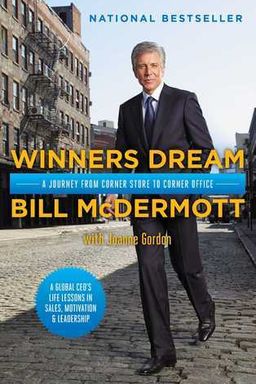
Winners Dream cover

Winners Dream

by Bill McDermott

Winners Dream is a compelling narrative of Bill McDermott’s rise from humble beginnings to becoming the CEO of SAP. It offers actionable insights into achieving success through big dreams, empathy, and strategic adaptability, inspiring readers to pursue their own winning dreams.

Turning Adversity Into Purposeful Leadership

How do you turn setbacks into platforms for growth? In Winner’s Dream, Bill McDermott argues that optimism, discipline, and empathy—cultivated through adversity—can propel an ordinary person into extraordinary leadership. The book follows his journey from a blue-collar childhood in Amityville to becoming CEO of SAP, showing how resilience and purpose build not just careers but cultures.

McDermott’s central claim is that success begins not with privilege but with mindset. From losing his childhood home to surviving personal tragedies later in life, he demonstrates how people can convert painful experiences into actionable optimism. This belief shapes everything that follows—entrepreneurial hustle, disciplined sales craft, and visionary organizational leadership.

From Reframing to Resilience

You first encounter optimism as something practiced, not naive. When twelve-year-old Bill’s house burns down, his mother calmly insists that “this isn’t a sad moment; we’re safe.” That emotional reframing becomes the foundation for resilience—acknowledge reality, choose a positive lens, and act quickly. This muscle of reframing reappears throughout his life: when floods destroy property, when jobs are lost, when setbacks arrive, he moves from despair to repair. (In Angela Duckworth’s Grit, similar reframing transforms failure into perseverance.)

Resilient optimism also powers creativity. Whether rebuilding a flooded house or steering a struggling company, McDermott emphasizes that optimism is functional—it unlocks problem-solving and agency. You’re not pretending the issue is small; you’re insisting it’s solvable.

From Hustle to Discipline

McDermott learned hustle by necessity. His paper route became a lesson in operations and customer trust: track payments, knock on doors, design repeatable systems. Later, his Amityville deli taught him segmentation and innovation—delivering to seniors, adding arcade machines for recurring revenue, and financing through consignment deals. These experiences show that entrepreneurial hustle thrives on two ingredients: empathy for customers and rigorous process. (Note: Like Ray Kroc of McDonald’s, McDermott scales through routine discipline rather than luck.)

Work ethic is at the center. Low expectations from teachers and hard labor jobs fuel an underdog mindset: work harder, prove credibility, and keep promises. This becomes the DNA of his later leadership—doing boring things brilliantly, maintaining integrity in every transaction, and treating each customer interaction as a professional moment.

Empathy, Tactics, and Trust in Sales

When McDermott joins Xerox, he redefines sales as empathy in action. He reads rooms—responding to the cat who jumps on him during a pitch, listening to a frustrated synagogue client, befriending doormen who influence access. Empathy here is strategy: understand human motives first, technical needs second. Coupled with hustle and preparation—making promises and overdelivering—McDermott turns empathy into measurable performance, achieving more than a thousand percent of quota.

Integrity cements trust. When an unhappy client threatens to report him to the CEO, McDermott calls the CEO first to explain and own his mistake. That blend of speed, transparency, and ethics becomes his signature leadership habit.

From Team Builder to Visionary

Leadership arrives as a natural extension of sales discipline. As manager of Team F at Xerox, McDermott becomes a player-coach—running with reps, teaching tactics, celebrating wins, and setting audacious group goals. His teams learn discretionary effort: hitting targets, then helping others do the same. This participatory style later scales at SAP, where rituals (Top 20 Calls, Famous Breakfasts, Winners’ Circle) anchor accountability and culture change.

Vision expands in later chapters. “Ground Xero,” his strategic manifesto, reframes Xerox’s future; at SAP he crafts pageantry like the San Antonio kickoff and aligns bold dreams—customer centricity, cloud transformation, cultural renewal—with measurable results. Vision here is not charisma alone but a structured narrative people can believe and act upon.

Purpose and Transformation

McDermott’s later career transitions—from Xerox to Siebel to SAP—embody purposeful risk-taking. He rejects lucrative offers misaligned with his values, studies at Kellogg to fill strategic gaps, and seeks roles that let him lead through cause rather than comfort. At SAP, he applies customer obsession and sales discipline at scale, launching Value Engineering and embedding urgency rituals. Strategic boldness—through acquisitions like Sybase and SuccessFactors—extends SAP’s market leadership while preserving culture.

Finally, resilience meets humanity. Facing Julie’s cancer and his mother’s death, McDermott models presence and empathy, proving that leadership is tested most in private crises. Faith, humility, and compassion become permanent features of his approach. Across all chapters, the narrative argues that optimism plus disciplined empathy transforms adversity into leadership—reminding you that success isn’t about avoiding hardship but learning how to use it for purpose.


Resilient Optimism and the Underdog Mindset

Resilient optimism begins as emotional training. When your world burns—literally, in Bill McDermott’s childhood house fire—you learn to name reality, then choose reaction. His mother reframes loss as safety, creating a mindset that enables motion instead of paralysis. This template repeats through floods, sibling loss, and financial strain. Optimism here is practical psychology: it keeps you functional under shock.

How optimism converts to action

Resilient optimism requires structure: acknowledge facts, reframe quickly, make small plans, anchor in routines. Kathy McDermott's use of a Saint Jude statue after floods is emblematic—rituals reinforce belief and predictability. Later, when adult McDermott faces corporate setbacks, he uses the same pattern: diagnose, reframe, plan, rebuild with others. You can practice this formula anytime setbacks arrive.

The underdog edge

Being underestimated breeds urgency and creativity. When a teacher suggests Bill will be lucky to be a truck driver, he internalizes that as a call to exceed expectations. Hard circumstances become habit-forming teachers—early jobs, endless commutes, and late-night shifts teach punctuality, dress, and respect. You can duplicate this mindset: treat discipline as identity, not as sacrifice.

This combination—optimism plus discipline—creates a competitive advantage. It translates into leadership later: reframing crises into solvable challenges, working harder when ignored, and keeping promises as moral currency. Underdogs become leaders by mastering emotional agility and relentless follow-through.


Hustle, Experimentation, and Customer Empathy

McDermott’s entrepreneurial lessons stem from the neighborhood: you hustle not to look busy but to learn systems. His paper route and deli were miniature business schools—tracking payments, designing delivery routes, securing supplier trust via handshake deals. Hustle means measurable effort backed by integrity.

Customer empathy as your advantage

At the Amityville deli, customer observation drives strategy. Seniors need delivery, blue-collar workers need big sandwiches and respect, teens need belonging. Service design follows empathy. Later at Xerox, Bill learns the same truth: read the room and connect emotionally before pitching. Whether it’s the cat on his lap or an angry synagogue board, empathy unlocks credibility.

Creative experimentation and risk

Entrepreneurship flourishes under constrained resources. When the deli floods, Bill structures financing that protects investors and motivates himself—early versions of venture discipline. He adds arcade machines that create recurring revenue without major investment. You can use this model: small experiments, partnerships, upside splits.

Across all ventures, trust accumulates as capital. Suppliers deliver on consignment; customers pay because they believe in fairness. Hustle, when fused with empathy and ethics, produces sustainable opportunity—and becomes the prototype for later corporate leadership.


Sales Discipline and Outperforming Through Integrity

In sales, McDermott treats execution as craft. Speed, preparation, and manners define hustle. He organizes fifty calls a day, delivers copiers by noon, and follows the 24-hour rule—thank and summarize immediately. Hustle is systematized persistence.

Integrity-driven performance

True hustle demands ethics. When a customer threatens to escalate a complaint, McDermott preempts it with honesty to CEO David Kearns. The act earns trust rather than discipline. Speed without virtue burns out; integrity sustains reputation. This principle—promise carefully, overdeliver consistently—anchors his 1,004% quota win.

Empathy and ecosystem mastery

Selling means understanding networks. McDermott builds influence not only with buyers but also doormen, receptionists, secretaries—gatekeepers who reveal information. Respect circulates as hidden leverage. Every transaction is human first, technical second.

His methodology foreshadows SAP’s later sales architecture: measurable activity metrics, visible accountability, and service rooted in empathy. If you want sustained success, measure output, treat every interaction as relationship stewardship, and practice moral speed.


Player-Coach Leadership and Cultural Change

Leading teams requires scaling the hands-on habits of performance. As “player-coach,” McDermott models what good looks like—doing ride-alongs, role-playing, and praising publicly. His teams win because leadership is visible and shared.

Creating shared purpose

Goals at Xerox Team F aren’t administrative—they’re emotional missions: send everyone to President’s Club. Such goals transform tasks into history-making efforts. You can motivate similarly by connecting measurable outcomes to personal meaning.

Building culture through ritual

At SAP, McDermott codifies this approach into rituals—Famous Breakfasts for truth-telling, Top 20 Calls for accountability, Winners’ Circle for celebration. Values like Success, Accountability, Professionalism, Teamwork, and Passion become operational: you demonstrate them daily or risk exclusion. (Compare to Jim Collins’ Good to Great: disciplined culture precedes results.)

Culture change is achieved through example and repetition. Rituals replace slogans, and leaders embody urgency. If you want transformation, embed new values as daily practices and hire leaders who teach by doing, not commanding.


Customer Obsession and Repeatable Value Systems

McDermott’s hallmark at SAP is putting customers at the center—and building repeatable systems that deliver measurable outcomes. He institutionalizes accountability with weekly deal reviews, pipelines, and Value Engineering, turning good intentions into structure.

Customer-centric execution

Every team, from finance to facilities, is aligned around external success. The Top 20 Call forces realism: each week, deals are interrogated by executives who ask for board access, ROI metrics, and next steps. It trains muscular discipline—sales becomes a science, not folklore.

Designing value systems

Value Engineering translates SAP’s technical power into business impact. Chakib Bouhdary and team benchmark industries and produce one-page ROI documents for CEOs. The approach operationalizes empathy: instead of demos, you deliver financial clarity. The result—90% win rates when used. Pairing methodology with ritual (Top 20 Calls) scales insight across the company.

Discipline plus empathy equals repeatable excellence. When customer success becomes everyone’s metric, culture aligns and performance compounds.


Strategic Boldness and Purposeful Risk

Strategic leadership means defending the core while betting boldly. McDermott exemplifies this through SAP’s transformation from software vendor to global platform—anchored in simplicity and trust.

Platform thinking and expansion

By defining OnPremise, OnDemand, and OnDevice strategies, SAP doubled its addressable market. HANA became a platform rather than a product, enabling co-innovation with partners. Platform logic magnifies reach and pace.

Acquisitions as cultural extensions

Sybase, SuccessFactors, and Ariba were not random purchases—they filled strategic gaps and aligned with SAP’s leaders. Deals closed quickly due to personal trust cultivated through direct CEO relationships. Boldness succeeds when coherence and integrity align.

Career recasting and personal risk

McDermott’s own career shifts mirror the same logic: each leap tests motive and fills a skill gap, from Kellogg’s education to Siebel’s software exposure. Declining flashy jobs like Techies.com kept his ambition purpose-driven. Risk is strategic—taken with self-awareness and family grounding.

Boldness without clarity breeds chaos; clarity without boldness breeds stagnation. Purpose aligns courage with coherence.


Resilience, Faith, and Human Leadership

Leadership shows its true form in crisis. When Julie McDermott faced cancer, Bill balanced devotion and duty, proving that presence itself is power. Later tragedies—the death of his mother, moments with Father Mychal Judge—deepened his sense of compassion and faith in action.

Presence under pressure

Being there—at hospital beds or customer meetings—signals values. McDermott’s commitment to family, while leading SAP through intense growth, teaches that empathy doesn’t weaken performance; it strengthens loyalty.

Faith and humility

Faith functions here as grounding perspective. Leaders need spiritual or moral anchors when systems fail. McDermott’s reliance on prayer and gratitude reorients power around service. He later channels these beliefs into social causes—Month of Service, (RED), playground builds—proving that doing good reinforces business legacy.

Resilience is not stoic endurance alone; it’s the courage to remain human through responsibility. When you lead with empathy, people follow with conviction.

Dig Deeper

Get personalized prompts to apply these lessons to your life and deepen your understanding.

Go Deeper

Get the Full Experience

Download Insight Books for AI-powered reflections, quizzes, and more.