
Idea 1
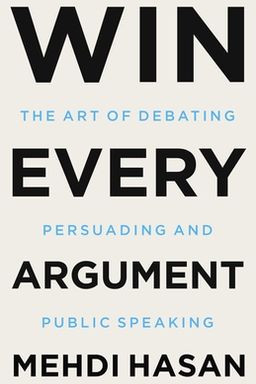
Win Every Argument Through Strategic Persuasion
How can you win hearts, minds, and rooms full of skeptics? In Win Every Argument, Mehdi Hasan argues that persuasion is not only about logic—it’s about connection, timing, emotion, credibility, and relentless preparation. His central idea: you win arguments not by defeating opponents but by convincing audiences. The audience—not the moderator, not the opponent—decides who won. Everything you say and how you say it should be oriented toward them.
Hasan blends Aristotelian rhetoric (ethos, pathos, logos) with the modern lessons of neuroscience, political debate, and journalism. He distills decades of public arguing—from Oxford Union stages to MSNBC and BBC panels—into a systematic toolkit you can learn and apply. His aim is not just to help you speak better—but to convince more effectively with honesty and courage.
The Three Pillars of Persuasion
Every great argument relies on three ancient Greek pillars: ethos (credibility), pathos (emotion), and logos (reason). Hasan modernizes these ideas with concrete practice. You gain traction by building ethos—credibility rooted in trust. You move people through pathos—feeling before fact. And you seal your case with logos—evidence timed for maximum impact.
But Hasan’s originality lies in the sociology of persuasion. He shows that no argument exists in a vacuum. When you argue, you face not just an opponent but an audience with its own culture, values, and expectations. His insight: you don’t change minds by overpowering; you translate truths into the audience’s dialect.
Audience as the Real Jury
In Crewkerne, a small English town, Hasan confronted a conservative audience furious about terrorism cases. Instead of quoting Amnesty International, he cited the Magna Carta—a text they revered. The crowd applauded. That’s the art: adapt examples without compromising principles. Wherever you speak—whether online or in person—winning hearts means seeing who’s in front of you. You ask yourself: what do they already believe, what sources do they trust, what language do they respond to?
Emotion and Story as Catalysts
Hasan warns that facts alone rarely change behavior. Neuroscientist Antonio Damasio calls humans “feeling machines that think.” Emotional resonance primes rational reflection. Stories, names, and imagery forge empathy: think of Hasan’s invocation of Raif Badawi or Amal Hussein in a Saudi Arabia debate. You remember people, not pie charts. (As storytelling expert Jonathan Gottschall notes, our brains sync with narratives, not data streams.) Hasan’s formula is simple but powerful: feel first, think second, act last.
Evidence as Ammunition—Not Decoration
Yet emotional truth must be anchored in proof. Hasan elevates the modern credo “show me the receipts” to the centerpiece of journalistic and debating integrity. Documents, transcripts, statistics—these are weapons if timed correctly. He illustrates this with his viral interviews, like quoting John Bolton’s 2010 MEK speech to dismantle a denial. The lesson: evidence is not only what you have, but when you use it.
Holding back a key fact until the right moment—like Elizabeth Warren’s takedown of Michael Bloomberg—creates rhetorical shockwaves. The point is not to flood the stage with data but to deploy receipts at the instant of maximum tension.
Confidence, Calm, and Performance
True persuasion also depends on grace under pressure. Hasan outlines how confidence is built through preparation, visualization, and deliberate body language. He borrows from Amy Cuddy’s “fake it till you become it”: perform calmness until your body catches up. Controlled breathing steadies neural responses (Mark Krasnow’s Stanford research). Humor, posture, voice modulation—the 4 Ps of communication (pitch, pace, power, pause)—transform nervous energy into controlled authority. Hasan’s encounters with towering figures like Vitali Klitschko underscore that the calmest speaker often commands the moment.
The Craft of Practice and Structure
Behind Hasan’s on-air composure lies practice. Preparation (what he calls “The Document”) turns unpredictability into choreography. He rehearses every opponent’s likely response, anticipates contradictions, and structures speeches using the Rule of Three—a pattern proven by Cicero, Blair, and Steve Jobs to resonate with human memory. Debates become performance art built on discipline, not spontaneity. Hasan insists: if you want to sound natural, you must rehearse unnaturally hard.
He also equips you with tactical maneuvers—judo concessions, reframing, setting booby traps—and the antidote to the modern “Gish Gallop,” where propagandists flood the zone with falsehoods. His step-by-step formula—pick your battle, don’t budge, and call out the tactic—turns chaos into clarity.
Closing the Loop: Endings and Ethics
The finale of any persuasive effort—what the ancients called the peroration—should blend logic and emotion into an unforgettable close. Hasan urges repetition, human story, quotation, and call to action. A strong ending—not merely a summary—cements memory. Churchill’s wartime crescendos and Obama’s “Yes we can” peroration embody this power. But Hasan insists on ethical persuasion: don’t humiliate, mislead, or pander. Debate with integrity; win with substance.
In essence, the book argues that winning every argument is not about dominance but about disciplined empathy. When you blend emotional intelligence with factual rigor, confidence with humility, and preparation with spontaneity, you stop debating to impress—and start persuading to change minds.