
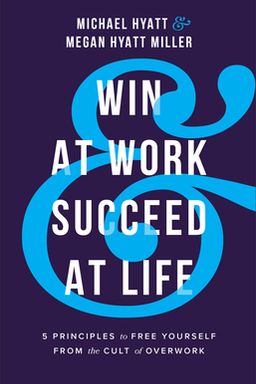
Win at Work and Succeed at Life cover

Win at Work and Succeed at Life

by Michael Hyatt and Megan Hyatt Miller

Win at Work and Succeed at Life offers a transformative approach to redefining success by prioritizing work-life balance. Michael Hyatt and Megan Hyatt Miller provide actionable insights to help professionals escape the trap of overwork, enhancing both career success and personal fulfillment.

Winning at Work and Succeeding at Life: The Double Win

Would you trade your health, relationships, or personal joy for career success? Most high achievers assume they have to choose between excelling at work and living a meaningful life. In Win at Work and Succeed at Life, Michael Hyatt and Megan Hyatt Miller argue you don’t have to choose—you can achieve what they call the Double Win. Their central message: you can create a thriving career while also nurturing the life that makes that career worthwhile.

The Double Win challenges the pervasive Cult of Overwork—a cultural myth that glorifies endless hustle, late nights, and sacrificed weekends as paths to success. Hyatt and Miller contend this mindset is not only false but dangerous, leading to burnout, broken relationships, and declining health. Instead, they offer a framework of five principles that unlock sustainable productivity and fulfillment: (1) recognizing work as one dimension of life, not its center; (2) embracing constraints as catalysts for freedom; (3) understanding that balance is achievable and dynamic; (4) reclaiming the power of nonachievement; and (5) valuing rest as the foundation for meaningful work.

The False Choice: Hustle or Brake

Hyatt and Miller open with stories from their own lives. Michael spent decades chasing professional success at Thomas Nelson Publishers—amassing wealth and respect but neglecting his wife, health, and family. Megan faced her own dilemma as an executive and mother: take the promotion that demanded more hours or care for her newly adopted children. Both felt trapped by an “impossible choice”—either hustle harder or apply the ambition brake. The breakthrough came when they discovered a third way: redefine success to include both achievement and well-being.

This “Double Win” concept reframes how you see work and life. Rather than competing forces, work and life become partners that energize each other. According to the authors, when you honor your personal boundaries and health, you show up sharper and more creative at work. When you succeed professionally, you feel more confident and capable at home. That synergy—rather than sacrifice—is what truly drives success.

Escaping the Cult of Overwork

The book identifies the cultural and psychological traps that keep people chained to overwork. From Elon Musk’s stereotype of eighty-hour workweeks to our constant email-checking habits, the cult of overwork tells us that long hours prove commitment. Hyatt and Miller dismantle myths such as “rest wastes time” and “constraints stifle productivity.” They show the tragic cost instead: stress-related diseases, skyrocketing divorce rates, and executive burnout. Studies cited—from the Yale Center for Emotional Intelligence to Harvard Business Review—reveal that fatigue actually erodes creativity and decision-making.

Breaking free starts with replacing bad ideas with better ones. The authors call this breaking an “idea trap.” Common sense isn’t enough—you must redesign the assumptions that shape your days. You learn to define success on your own terms, balance ambition with presence, and set boundaries that make space for relationships and rest.

The Five Principles of the Double Win

Throughout the book, Hyatt and Miller unfold five interlocking principles that create sustainable success:

  • 1. Work is only one way to orient your life. Life is multidimensional, composed of domains like health, family, friendships, and spirituality—all contributors to real success.
  • 2. Constraints foster productivity, creativity, and freedom. Time limits aren’t obstacles; they’re boundaries that sharpen focus, encourage innovation, and create margin for life outside work.
  • 3. Work-life balance is possible—and dynamic. Balance is not about perfection but continual adjustment, like a gymnast maintaining equilibrium.
  • 4. Nonachievement matters. Hobbies, leisure, and play rejuvenate creativity and help you process problems subconsciously.
  • 5. Rest powers productivity. Sleep, sabbaths, and pauses replenish the mind and body, making high performance sustainable.

Hyatt and Miller’s firm, Michael Hyatt & Co., built its culture around these principles. They experimented with six-hour workdays and watched productivity soar as employees gained freedom and focus. Their clients—entrepreneurs, executives, and nonprofit leaders—consistently doubled revenue while cutting work hours.

Why This Matters Now

In an era when technology stretches work into nights and weekends, the Double Win offers a way out. It replaces anxiety with intentional living, transforming how we define success itself. The authors remind you that an overbusy life isn’t an economic necessity—it’s a failure of imagination. By embracing boundaries, balance, and rest, you can do your best work while living your best life.

“An overbusy life is not an economic necessity; it’s a failure of imagination.”

—Michael Hyatt & Megan Hyatt Miller

The Double Win philosophy isn’t merely theoretical—it’s a movement against the glorification of burnout. With evidence, real-life stories, and practical frameworks, Hyatt and Miller show how you can stop reacting to demands, reclaim your time, and design a life defined by clarity, limits, and joy. Ultimately, they ask you not just to succeed—but to thrive.


Work Is Only One Dimension of Life

What if success meant thriving across all areas of your life—not just your career? Hyatt and Miller’s first principle reminds you that work is only one domain among many. They identify ten life domains: spiritual, intellectual, emotional, physical, marital, parental, social, vocational, avocational, and financial. True fulfillment comes when each of these thrives in harmony.

The Problem of Overidentifying with Work

Most professionals make work their identity, seeing it as the primary way to measure value. Elon Musk represents this pattern, famously advocating eighty-hour weeks and sleeping on factory couches. His case illustrates how achievement can crowd out health, relationships, and rest. Hyatt and Miller argue this imbalance leads to predictable pain—burnout, neglected families, and one-dimensional lives.

Megan Hyatt Miller’s childhood story provides a more human angle. Her father’s dedication to work meant he missed her horseback competitions and even moments of injury. For her and her siblings, this absence shaped their understanding of success—until they realized that presence mattered more than productivity. The lesson: success that ignores family is self-defeating.

Three Nonnegotiables: Self-Care, Relationships, Results

The authors encourage prioritizing three nonnegotiables: (1) self-care, which means sleep, nutrition, movement, and reflection; (2) relational priorities, such as meaningful time with loved ones; and (3) professional results, the work outcomes that matter most. Balancing these allows you to give your best at the office and at home. Like budgeting money for essential expenses, you must allocate time for these priorities before everything else fills your schedule.

How to Budget Time Intentionally

Hyatt and Miller teach that without clear boundaries, life’s urgent tasks swamp what truly matters. By blocking time for health routines, date nights, and personal reflection, you ensure that the urgent doesn’t eclipse the important. Historian Richard Brookhiser’s insight fits here: “You are the tool that is never put back in the box.” Maintaining yourself is the foundation for all your other roles.

Ultimately, when you treat your work as one aspect of a rich, multifaceted life, you gain perspective. The real win is living a life you’re proud of—not just climbing the ladder faster. You can’t sustain success in one area if every other area collapses. Balance is the fuel, not the reward.


Constraints as Creative Freedom

Hyatt and Miller’s second principle sounds paradoxical: constraints create freedom. Many high achievers see limits as restrictions. The cult of overwork suggests that more time equals more success. But the authors—supported by research and real-world experiments—reveal that boundaries actually drive creativity, focus, and productivity.

Why Less Time Produces Better Results

Consider Tiffany, an agricultural entrepreneur who believed success correlated with hours worked. She labored evenings and weekends for years but plateaued. After embracing constraints—a shorter workday and defined edges around weekends—her company’s revenue surged 60 percent in two years. With fewer hours, she restructured tasks, focused on what mattered, and delegated the rest. Her results exploded because constraint forced clarity.

The Six-Hour Workday Revolution

Hyatt and Miller applied the same principle within their company, formally adopting a six-hour workday during the pandemic. Instead of less productivity, they found sharper focus and faster innovation. Employees stopped wasting energy on low-leverage work, collaborated better, and embraced new tools. The shortened schedule preserved margin for family and rest—fuel for stronger performance.

Constraints Spark Creativity

To illustrate this creatively, the authors spotlight artist Phil Hansen. A hand tremor ended his pointillism technique, but instead of quitting, he “embraced the shake.” By working within his limitation, he painted using karate chops, body art, and single-dollar supplies—his most inventive period ever. Research echoes this truth: boundaries compel deeper exploration and novel solutions.

Hyatt’s Corollary to Parkinson’s Law

“Work contracts to the time permitted.” When you impose boundaries, your brain stops stretching tasks endlessly and focuses on what counts.

Constraints liberate you from the illusion of infinite time. They sharpen focus, inspire creativity, and protect margin for life’s other domains. As Warren Buffett says, “The difference between successful people and really successful people is that really successful people say no to almost everything.”


Rediscovering True Balance

Is work-life balance a myth? Hyatt and Miller say no—it’s misunderstood. Their third principle teaches that balance is possible but dynamic. Balance isn’t perfect equilibrium; it’s intentional adaptation. Like a gymnast constantly shifting on a beam, you maintain balance through micro-adjustments rooted in self-awareness and priorities.

Dynamic, Not Static

Michael Hyatt likens balance to a ropes course exercise. When multiple people walk the same tightrope, everyone wobbles and adjusts. Success comes from continual correction, not stillness. Work-life balance works the same way: constant recalibration, not permanent stability.

Balance through Trade-Offs

The authors highlight four trade-offs that threaten balance—health, family, friends, and effectiveness. Overwork sacrifices each in turn. Dick Costolo at Twitter exemplifies prioritizing health; he argued that twenty minutes of exercise offers more ROI than twenty extra minutes in meetings. Similarly, strong friendships and marriages fortify emotional health, something CEO studies prove enhances professional performance.

The Gender Imbalance

Megan Hyatt Miller explores how women often bear disproportionate loads at home and work. Citing Brigid Schulte and Anne-Marie Slaughter, she notes that societal expectations still hinge on the “Don Draper ideal”—the tireless male worker without family constraints. Women, she argues, need systemic reform and personal advocacy. By renegotiating hours, boundaries, and norms—as P&G manager Melanie Healey did—you can reclaim fairness and focus.

Balance isn’t perfection—it’s power through prioritization. By learning to make strategic trade-offs, both men and women can design lives that sustain rather than drain them.


The Profitable Pause: Power of Nonachievement

If doing more isn’t the answer, what about doing less? The fourth principle—the Power of Nonachievement—shows that periods of rest, leisure, and stillness often spark your greatest breakthroughs. Hyatt and Miller use vivid examples to make the point.

When Doing Nothing Creates Genius

Consider J.K. Rowling’s four-hour train delay when she conceived Harry Potter. Her mind wandered freely—the perfect state for creative insight. Similarly, Hyatt’s client Amy discovered her entrepreneurial calling while sitting idly in her backyard for two weeks. What felt like “doing nothing” surfaced clarity, revived passion, and led to a multimillion-dollar business.

White Space as a Resource

Nonachievement provides white space—mental and emotional margin for reflection. Just as text on a page needs whitespace to be readable, life needs margin to be livable. During downtime, different parts of the brain activate, enabling subconscious insight and idea incubation (psychologist Adam Waytz calls leisure our “killer app”).

Intentional Idleness

Stories of Roy, Tamara, and Google engineers reinforce this lesson. Roy’s idea for a software tool earning him millions came while disconnecting for creative thinking. Google’s famous “20 percent time” policy—letting employees pursue side projects—produced Gmail and Google News. Breakthroughs arise when minds wander without pressure to achieve.

Key Insight

“No pause, no profit.” Hyatt and Miller remind you that rest nourishes creativity. Business innovation depends not on nonstop doing but on space to think.

Nonachievement isn’t laziness; it’s strategy. By stepping back, you give your brain the bandwidth to connect dots that frantic effort obscures. The most profitable pauses happen when you stop treating rest like a waste and start treating it like an investment.


Rest: The Hidden Key to Peak Performance

Hyatt and Miller’s fifth principle is both simple and revolutionary: Rest is the foundation of meaningful, productive work. Most achievers see sleep as optional—a necessary evil that steals time from success. The authors flip that script, arguing that sleep is the ultimate productivity tool.

The Cost of Sleep Deprivation

Through client stories and scientific research, the book exposes what happens when rest is sacrificed. Tanya, a manufacturing CEO, worked on two hours of sleep, juggling business crises and family travel. Her performance suffered, her health declined, and she felt perpetually overwhelmed. The authors cite neuroscientific evidence showing that sleep deprivation mimics intoxication—impairing judgment, creativity, emotional regulation, and even ethics.

Sleep Braggadocio and the Culture of Exhaustion

Modern leaders often brag about how little they sleep. Elon Musk and Martha Stewart epitomize this “sleep braggadocio,” equating exhaustion with importance. Hyatt and Miller expose it as toxic theater. Research by Rand Europe found America loses 3% of GDP annually due to insufficient sleep—proof that sleepless productivity is self-defeating.

Rest as Renewal

Rest reshapes both brain and body. During deep sleep, memory consolidates, creativity recharges, and stress chemicals are suppressed. Sleep transforms you into a sharper thinker, steadier leader, and more empathetic human. Harvard theologian Peter Leithart calls sleep a “daily sabbath”—rest that starts your workday renewed, not depleted.

Practical Sleep Rituals

  • Darken your room and lower temperature to 65°F for optimal sleep.
  • Eliminate late caffeine and evening tech to calm your mind.
  • Use sound conditioners or calming music as ritual cues.
  • Treat bedtime as the beginning of tomorrow’s success, not the end of today’s.

In redefining rest, Hyatt and Miller reject hustle culture’s glorification of exhaustion. The real secret to sustaining focus, creativity, and leadership isn’t wakefulness—it’s sleep.


Designing Your Own Double Win

In their final chapter, Hyatt and Miller show you how to apply the Double Win personally and professionally. Whether you lead a company or simply your own calendar, the steps to transformation are clear: define what you want, communicate it, and arrange your life to support it.

Be On Your Own Side

Megan Hyatt Miller recalls a mentor’s advice during illness: “Be militantly on your own side.” Too many professionals suffer “corporate Stockholm Syndrome,” defending cultures that exploit them. You must learn to advocate for your own well-being—starting with clarity about what success means to you across all life domains.

Communicate and Collaborate

Once you know your priorities—your work hours, family commitments, and personal goals—communicate them clearly. Persuade colleagues, clients, and leaders why supporting your boundaries benefits everyone. Roy’s earlier story exemplifies this: by asking his team to measure his success through profit and team retention, he earned respect for his boundaries.

Leaders as Culture Shapers

For leaders, making the Double Win contagious means reshaping workplace norms. Hyatt and Miller outline five steps: model balanced behavior, connect employees to the company vision, grant autonomy, constrain the workday, and properly resource the vision. When leaders embody equilibrium, teams respond with greater engagement and creativity. (MIT professors Erin Kelly and Phyllis Moen found autonomy and flexibility correlate directly with better health and loyalty.)

Design, Don’t Drift

The metaphor of Hyatt’s snorkeling near-disaster captures the lesson beautifully: strong currents of overwork will drag you away unless you consciously swim toward shore. Designing your life requires intentional decisions about what matters most. Gail and Michael’s story closes the book on a powerful note—after years of imbalance, they now take thirty-day sabbaticals, watch sunrises, and truly live the kind of life their company teaches.

Final Takeaway

“An overbusy life isn’t destiny—it’s a decision.” Hyatt and Miller urge you to redefine what success looks like and design the conditions to experience it every day.

The Double Win isn’t a one-time fix—it’s a lifestyle of clarity, boundaries, and intentional living. You won’t drift into it. You must design it. And the view, as the authors conclude, is spectacular.

Dig Deeper

Get personalized prompts to apply these lessons to your life and deepen your understanding.

Go Deeper

Get the Full Experience

Download Insight Books for AI-powered reflections, quizzes, and more.