
Idea 1
Willpower Doesn’t Work: Shaping Environments for Lasting Change
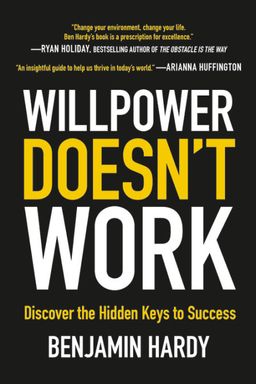
Have you ever sworn you’d stick to a new habit—only to find yourself failing days later? In Willpower Doesn’t Work, Benjamin Hardy argues that your problem isn’t a lack of grit or discipline—it’s your environment. He contends that willpower is a finite, fleeting resource that can’t carry you through long-term change, especially in today’s overstimulating, distraction-saturated world. Instead, success and transformation stem from designing external conditions that make the behaviors you want effortless—and the ones you don’t want, impossible.
We often imagine that self-control is what distinguishes high achievers from the rest of us. Hardy flips this assumption on its head: it’s not internal strength that fuels success, but external design. From the foods in your fridge to the people in your social circle, everything around you is silently shaping your choices, focus, and growth. “If you don’t shape your environment,” Hardy warns, “it will shape you.”
Why Willpower Fails
Hardy begins with a simple truth modern science has made clear: willpower is like a muscle—it depletes with use. Each decision drains energy from a limited daily reserve. That’s why you can start your morning strong, but by evening you’re eating ice cream straight from the tub. In a world of constant digital noise, advertising, and instant gratification, your willpower is attacked from the moment you wake up. The more you rely on self-discipline, the faster it burns out.
The solution, Hardy insists, is to stop fighting your environment and start designing it. Rather than battling temptation, make temptation invisible. Rather than trying to “will yourself” to focus, remove distractions before they beckon. If you truly want to thrive, you must stop depending on inner strength and build external systems that make your success automatic. In his words: “Willpower is for people who haven’t made up their minds.”
The Power of Environment
Drawing from psychology, evolutionary biology, and his own experience as a foster father and organizational psychologist, Hardy demonstrates that humans are products of context. Like the goldfish that grows to fit its bowl, your potential expands or shrinks depending on the conditions you live in. He references the social science insight that we are “the average of the five people we spend the most time with,” and extends it beyond relationships: your physical surroundings, technology use, routine, and even the light in your workspace recalibrate your behavior on a subconscious level.
Environmental psychology calls this phenomenon automaticity—when repeated behaviors become unconscious responses to contextual cues. In poor environments, your habits sabotage you; but in enriched environments, your goals become effortless. As Hardy puts it, “When you outsource your behavior to a goal-enhancing environment, desired behavior becomes automatic.”
Two Types of Enriched Environments
Hardy identifies two complementary categories of environments that sustain high performance: those built for positive stress and those designed for deep recovery. Growth happens, he explains, through cycles of intense challenge and deliberate rest. Without recovery, stress leads to burnout. Without challenge, recovery devolves into stagnation. The most effective performers—from elite athletes to world-class entrepreneurs—use both.
He illustrates this with young entrepreneur Courtney Reynolds, who spends half her month grinding 18-hour days in a minimalist, distraction-free Denver apartment, and the other half relaxing in an art-filled, restorative home in Las Vegas. Her productivity comes not from constant strain, but from structured cycles of exertion and renewal. That intentional contrast, Hardy argues, is what builds resilience and creativity.
Redesign Yourself by Redesigning Context
The book’s central thesis grows more powerful as it unfolds: you and your environment are two sides of the same coin. Change one, and you automatically change the other. This means self-improvement isn’t about strengthening internal resistance—it’s about altering the external forces that exert pressure on you. Hardy likens this to Darwin’s theory of evolution: the species that survive aren’t the strongest or smartest, but those most adaptable to change. You can’t wish yourself into a new level of performance—you must adapt to environmental conditions that demand more of you.
From the design of your morning routine to the people you collaborate with, each chapter of Willpower Doesn’t Work provides a method for engineering these external “forcing functions.” Hardy shows how to embed constraints that force positive action, how to rotate between environments to sustain energy, how to remove conflicting influences, and how to create triggers that prevent self-sabotage. Ultimately, his message is empowering but sobering: your freedom doesn’t lie in limitless choice—it lies in the choices you deliberately remove.
Why It Matters
Hardy’s argument matters because it reframes how we pursue transformation in a hyper-stimulated age. Traditional self-help glorifies inner resolve, but Hardy insists that trying harder in a toxic environment is like swimming upstream in a polluted river. Instead, the real work is in cleaning the water. When your surroundings align with your values, change stops being exhausting—and starts being inevitable. You become, as Hardy writes, “the designer of your destiny, not the victim of your circumstances.”
In the pages that follow, Hardy reveals practical frameworks for doing just that: from creating sacred spaces and establishing new norms, to automating decisions and building high-stakes conditions for growth. The lesson is both humbling and empowering: your environment is either your greatest enemy or your strongest ally—and it’s always your choice which one it will be.