
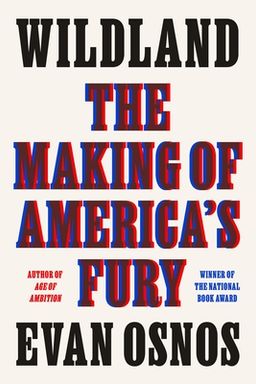
Wildland cover

Wildland

by Evan Osnos

Wildland by Evan Osnos explores the unraveling of America over two decades, examining stories from Greenwich, Clarksburg, and Chicago. It reveals the seismic shifts in wealth, politics, and race that culminated in the January 6 insurrection, offering a compelling narrative of a country in turmoil.

A Nation Primed to Burn

What happens when a society becomes as dry and flammable as its land? In Wildland, Evan Osnos argues that the United States has entered an epoch where institutions, communities, and the moral fabric of politics have withered enough that a single spark—literal or political—can ignite national conflagration. The prologue’s Mendocino Complex Fire is more than a story about drought and heat; it’s an allegory about a political climate primed to burn.

The metaphor of wildland

A wildland is not merely forest and brush—it is a social condition where tinder accumulates. Drought, inequality, and institutional decay make sparks catastrophic. When a rancher’s hammer strike triggers California’s largest fire, Osnos asks you to see how small acts can produce outsized outcomes when underlying systems fail. The same applies to politics: when civic trust erodes, stray rhetoric or scandal can become national crisis.

From 9/11 to January 6

The narrative stretches between two bookends—September 11, 2001 and January 6, 2021—to trace how fear, polarization, and economic deregulation reshaped the American psyche. After 9/11, wars lengthened, inequality widened, and civic institutions hollowed out. By 2021, those conditions had metastasized into distrust, conspiracy, and outright insurrection. The terrain—political, economic, and cultural—had been primed for ignition.

Three emblematic places

Osnos returns to places he knows well—Clarksburg, Chicago, and Greenwich—each a microcosm of the nation. Clarksburg reveals the collapse of local journalism and civic accountability; Chicago illustrates inequality, violence, and incarceration; Greenwich dramatizes how elite finance transformed wealth into moral corrosion. Together, they form a mosaic of what happens when institutions stop mediating between power and people.

Why it matters

The book’s argument is less about partisan blame and more about civic vulnerability. The “spark” of disaster—whether financial fraud in Greenwich, gun violence in Chicago, or populist rage in West Virginia—ignites only because the environment has become combustible. As Osnos puts it, you cannot explain what burns without knowing how the land dried out. You walk away understanding that the United States did not stumble into crisis by accident; it was prepared, piece by piece, by decades of extraction, neglect, and disenchantment with common truth.

The book’s essential question

How does a single spark—economic greed, partisan manipulation, or disinformation—become an inferno? Osnos’s answer: through an ecology of decay where inequality, disinformation, and institutional surrender serve as the oxygen of the modern American crisis.

Across its chapters, Wildland teaches you that renewal requires understanding why fires start—not only which match is struck, but why everything around it has become ready to burn.


Finance and the Moral Weather

Osnos shows how money became not just an economic force but a moral climate. In Greenwich, Connecticut, hedge funds and private equity reshaped not only markets but the local definition of virtue. The story of Chip Skowron—physician turned hedge-fund star turned felon—captures this shift from stewardship to extraction. When performance pay and deregulation become the only metrics of success, corruption follows as ordinary behavior, masked by glamour and scale.

The rise of hedge-fund ethics

Hedge funds created new incentive structures: vast payouts for short-term wins and almost none for patience or social obligation. The repeal of Glass-Steagall and the spread of Rule 10b-18 stock buybacks cemented this model. In Greenwich’s Golden Triangle, mansions, yachts, and philanthropic institutions symbolized the triumph of private wealth over public investment. People built walls, not schools; private foundations, not local governance.

Moral and political consequences

This “weather system” of wealth flows into politics as donors create ideological infrastructure—AEI’s D’Aniello Center or Mercer-backed networks—that legislate self-interest. Philanthropy morphs into policy leverage. What looks like charity becomes doctrine: markets rule, taxes punish success, and inequality becomes virtue.

The invisible cost

When investment replaces production and speculation replaces ethics, society rewards extraction. Greenwich, in Osnos’s telling, is America’s mirror: its prosperity conceals the moral vacancy that lets institutions burn unnoticed.

The lesson is personal and civic: when finance governs value, democracy itself becomes an investment vehicle—one where returns matter more than repair.


Broken Gatekeepers and the Capture of Power

You watch Washington succumb to capture. Lobbyists, donors, and dark money convert governance into a pay-to-play market. Osnos details how Citizens United accelerated the flood—letting a few hundred wealthy people fund campaigns worth hundreds of millions. Congress’s schedule shifts toward 'call time,' with members and staffers serving donors more reliably than districts.

Money as operating system

Institutions that once mediated public will now run on capital. Mitch McConnell’s use of the filibuster and shutdown politics demonstrates how obstruction becomes profitable: in paralysis, donors thrive. Lawrence Lessig’s Mayday PAC—a reform effort to use big money to fight big money—fails precisely because the system consumes attempts at cleansing. Reform proves self-defeating in a politics built to protect funding pipelines.

The politics of resignation

Osnos calls the quiet acceptance of donor dominance a civic numbness. People still vote, but few expect performance. It's not corruption in scandal form; it's everyday bribery embedded in the operating code of the republic.

When money rules deliberation, democracy degrades into rivalry for capital, not for citizens. You learn that restoring function means rebuilding gatekeepers—journalists, regulators, and local civic leaders—whose extinction created the vacuum that money filled.


Collapse of Local Life

Through Clarksburg, West Virginia, Osnos shows how the death of local journalism and industry makes democracy brittle. The Exponent Telegram once tethered citizens to accountability—publishing school scores, mining reports, and obituaries—but digital disruption and advertising loss stripped it down to skeletal operations. Without local news, corruption thrives, turnout crashes, and nationalized outrage replaces local care.

A civic food web drying up

Studies Osnos cites reveal measurable consequences: when local papers vanish, borrowing costs rise and officials misbehave. This erosion parallels Postman’s warning in Amusing Ourselves to Death: spectacle replaces substance. People know more about Washington scandal than city budgets. That inversion of attention hollows all grassroots democracy.

Renewal and fragility

When new owners like Brian Jarvis try to save local papers, they revive memory but face brutal economics. Their coverage of opioids, mountaintop removal, and small-town FBI complexes stands as proof that communities need their own mirrors. Without them, the concept of 'public' dissolves.

A civic axiom

Lose your local paper and you lose the conversation that defines community. Democracy, Osnos insists, is not a national broadcast—it’s a local habit.

You learn that rebuilding governance means starting where most collapse began—with neighborhood institutions that let people see and speak to one another again.


Extraction and Abandonment

In Appalachia, environmental collapse mirrors financial greed. The Caudill family lives beside Hobet Mine as mountaintop removal pulverizes centuries of homeplace into irreversible ruin. Selenium builds in rivers, fish deform, forests vanish—and corporate structures shed liabilities with the same mechanical efficiency they used to extract coal. The creation of Patriot Coal from Peabody’s spinoff becomes a case study: profits stay; pensions and health care evaporate.

Finance as discard mechanism

Osnos names vulture investors like Knighthead and Aurelius, who buy bankrupt mines to strip assets while communities plead for cleanup funds. It’s capitalism at its purest and most callous: legality without morality. Letters from miners like David and Ruth Ann Efaw read as human ledgers of suffering.

The landscape as ledger

West Virginia’s scarred ridges and plateaued mines become metaphors for societal dysfunction. When finance turns earth and labor into temporary assets, both ecology and democracy erode. (Note: Like John McPhee or Wendell Berry, Osnos treats geography as moral evidence.)

A regional indictment

“The mine devours its mountain and yields a training field for war.” The cycle—extraction, decline, militarized reuse—encapsulates America’s pattern of consuming and discarding both landscapes and lives.

This chapter’s moral insight: when land becomes a commodity and bodies become liabilities, civilization mistakes survival for prosperity, leaving behind only scorched earth and betrayed workers.


Violence and the Closed Horizon

Chicago embodies the urban version of the same decay. In neighborhoods carved by redlining and job loss, Osnos tracks youths like Phillip Dupree and Reese Clark whose lives cycle between gang violence and prison. When opportunity disappears, neighborhoods compress into self-contained worlds ruled by cliques and fear. Violence ceases being anomaly; it becomes the governing rhythm.

Segregation as destiny

Studies by Robert Sampson and Raj Chetty show that geography locks futures as surely as genetics. A few blocks can halve life expectancy and multiply homicide rates. Osnos connects this to decisions about housing policy, police conduct, and prison reentry—all operating as inherited architecture of exclusion.

Punishment without return

Reese Clark’s inability to find a job after parole reveals America’s scarlet letter economy. Every temporary gig reminds him of civic rejection. When survival demands hustle, relapse into crime becomes rational choice. Osnos paints this not as moral failure but social design—systems made to recycle despair.

The meaning of violence

In these stories, shootings are not random—they are the audible metrics of inequality. When society compresses futures, bullets expand inevitability.

You leave this section understanding justice reform as social repair, not mercy—and that cities burn when their people run out of horizon.


War and the Unhealed Republic

Sidney Muller's ordeal connects foreign wars to domestic trauma. His journey from Clarksburg to Sangin, Afghanistan, and back shows how endless conflict corrodes the body politic. Osnos documents Muller's PTSD diagnosis, medication regimen, and ultimate collapse into a shooting tragedy that kills Fred and Freddie Swiger. The story becomes an x-ray of how the nation treats its veterans: gratitude without reintegration.

Invisible wounds

Twenty-nine dead and 184 wounded in a single battalion mark a scale of trauma few civilians comprehend. Disability payments and prescriptions address symptoms but not meaning. When Muller returns to isolation and substance abuse, Osnos exposes a moral deficit as large as the fiscal one: a society that funds war more readily than recovery.

Accountability as promise

Secretary Robert Gates’s assurance—“If there’s anything you need…”—echoes bitterly after Muller’s downfall. The promise of care becomes bureaucratic paperwork. Herman Lubbe’s survival contrasts as physical repair versus moral ruin. When civic structures dissolve, veterans carry the burden alone until it erupts.

A civic obligation

Osnos forces you to ask: who pays for wars when soldiers come home broken and the towns they left are dying? Healing requires community, not just medicine.

The war chapters remind you that the cost of empire is written in the unattended lives of veterans—and that national renewal demands social healing as much as strategic restraint.


Populism and the Unmaking of the Machines

From Rick Santelli’s 2009 Tea Party rant to the Trump presidency, Osnos maps how anger turned institutional wreckage into populist ascent. The old party 'machines'—Chicago’s Democratic establishment, Greenwich’s old Republicans, West Virginia’s unions—lose credibility, replaced by personalities and spectacle. The book calls this the unmaking of the machines: a shift from organized systems of governance to improvised networks of resentment and cash.

How elites and street anger merge

The Tea Party fuses donor money (Kochs, Mercers) with popular outrage, creating a party that weaponizes dysfunction. Trump’s rise completes the cycle: he embodies grievance, entertainment, and cash flow. In Greenwich, wealthy conservatives rationalize supporting him as policy pragmatism; in West Virginia, former Democrats turn populist as their economy collapses. Machines die because people stop believing they serve anyone but insiders.

The decay of credibility

Rahm Emanuel’s concealment of the Laquan McDonald tape in Chicago epitomizes institutional rot—actions that destroy trust faster than reform can rebuild it. When citizens see manipulation everywhere, even competent governance looks suspect. You learn why spectacle replaces policy: accountability no longer sells.

Outcome of failed machines

When stabilizing structures collapse, people turn to combat instincts—armed identities, conspiracy networks, and self-preservational elites—all symptoms of lost civic mediation.

The unmaking of machines isn’t nostalgia; it’s diagnosis. You can’t repair democracy by nostalgia alone—but you can’t understand its failures unless you remember how its gears once turned.


The Combat Mindset and Political Fear

Osnos describes an age when citizens are encouraged to view each encounter as potential conflict—a combat mindset that fuses commerce and identity. Gun companies, media hosts, and politicians profit from this posture. The NRA convention in Louisville, where Donald Trump performs as salesman of armed citizenship, exemplifies how survivalism becomes ideology.

Commercializing vigilance

With hunting in decline, the gun industry markets tactical life: AR-15s, modular accessories, 'self-defense insurance,' and branded tribes. It converts consumers into political soldiers. Jeff Cooper’s original military ethos—constant readiness—spills into civilian paranoia. 'Fight' becomes both slogan and shopping list.

Politics as survival theater

When politicians simulate combat—Joe Manchin shooting a bill, campaign ads framed like war films—they normalize violence as expression of identity. Combine this with disinformation ecosystems and you get a population primed for armed confrontation. January 6 was not spontaneous—it was the culmination of years of commercialized aggression and rhetorical arson.

Understanding the danger

The combat mindset turns politics from dispute into existential defense. To undo it, you must rebuild norms of shared safety and dispute without warfare.

This section teaches you that fear, when monetized and armed, becomes the most profitable—and dangerous—political resource in America.


Disinformation and the Collapse of Shared Reality

Without a common body of fact, no democracy can function. Osnos examines how manufactured doubt—from tobacco to QAnon—eroded truth as civic infrastructure. When Kellyanne Conway coined “alternative facts,” she merely voiced a method long perfected by corporations: weaponize uncertainty until truth itself looks partisan.

Mechanics of doubt

The original blueprint comes from tobacco’s “Doubt is our product” memo. Modern versions—Cambridge Analytica’s psychographic targeting, viral conspiracies like Pizzagate—inject tailored fear. Algorithms privilege anger; anger breeds engagement; engagement monetizes deceit. The collapse of local journalism accelerates contagion by removing verification layers.

Consequences

In this fragmented world, citizens inhabit parallel realities. Violence erupts when delusion meets conviction. Comet Ping Pong’s shooting shows how swiftly virtual myth becomes physical harm. January 6 was merely the largest stage of an ongoing information war.

The cure

Healing requires institutions that reestablish verification—local journalism, independent science, transparent data. Truth must again be a shared civic utility, not a factional commodity.

Osnos’s warning is simple: if lies outperform facts, fire will always find fuel.


Antibodies of Renewal

Even amid decay, Osnos shows you the rise of antibodies—grassroots responses that restore political immunity. Teacher strikes, #MeToo, and local campaigns reveal the persistence of civic life. The 2018 West Virginia teachers’ strike becomes emblematic: 22,000 workers walk out, win raises, and rediscover collective efficacy. That spark replicates in Arizona and Oklahoma—proof that solidarity still works.

Rebuilding from below

Organizers like Katey Lauer and Stephen Smith turn protest into politics through West Virginia Can’t Wait. Their rules—no corporate donations, community-first policies—act as civic antibodies against infection by money. This reinforces Osnos’s essential theme: healing starts locally, where damage began.

Cultural antibodies

Movements like #MeToo deepen moral renewal. Christine Blasey Ford’s testimony triggers a surge of women into public office—34,000 inquiries to Emily’s List in one year. Representation becomes cure: the more voices enter politics from lived reality, the less easily disinformation and fear rule.

Practical lesson

Antibodies remind you that despair is political submission; organization is recovery. Institutions can regenerate if citizens act as their immune cells—repairing what money and apathy corrode.

The book closes on this hopeful note: renewal begins wherever ordinary people refuse to surrender the possibility of deliberate civic life.

Dig Deeper

Get personalized prompts to apply these lessons to your life and deepen your understanding.

Go Deeper

Get the Full Experience

Download Insight Books for AI-powered reflections, quizzes, and more.