
Idea 1
Facing Life’s Wild Problems
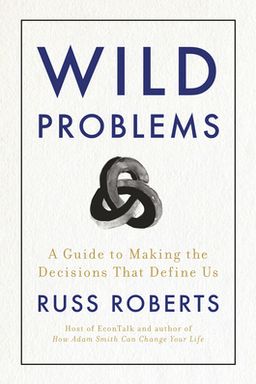
When you think about life's biggest decisions—whether to marry, have children, change careers, or pursue a calling—how do you decide? In Wild Problems, economist and philosopher Russell Roberts explores the limits of rationality and measurement in navigating these momentous, life-defining forks in the road. He argues that while science and data help us tame certain challenges, the deepest human questions—the ones that shape who we become—cannot be solved by formulas or algorithms.
Roberts calls these moments wild problems. They differ from “tame problems,” such as improving a cell phone’s battery life or optimizing traffic flow, which respond to logic, data, and measurable goals. Wild problems, by contrast, resist quantification. Their outcomes are uncertain; their consequences unfold in ways that transform us, changing even what we value. Roberts contends that life’s most meaningful choices define us not through rational analysis but through the act of living them.
Tame vs. Wild: The Limits of Rationality
Trained as an economist at the University of Chicago, Roberts was steeped in the belief that rational choice and trade-offs optimize well-being. But he came to see that when dealing with marriage, parenthood, vocation, or moral dilemmas, such approaches fall short. Data cannot measure devotion, love, regret, or meaning. In fact, relying on measurement can mislead us, like searching for lost keys under a streetlight simply because that’s where the light is brightest. The measurable is easy, but often irrelevant; the immeasurable, shadowed but vital, defines the richness of life.
Darwin’s Dilemma: An Example of the Wild
Roberts illustrates his point with Charles Darwin’s famous pros-and-cons list about whether to marry. Darwin meticulously cataloged the benefits (companionship, someone to care for the house) and costs (loss of autonomy, less time for work). His reasoning was impeccable—but misguided. He lacked data about the emotional and existential realities of marriage. His “cost-benefit analysis” imagined only superficial trade-offs, not how marriage might transform his identity, deepening his humanity, expanding his empathy, and reframing his sense of purpose. In Roberts’s interpretation, Darwin could not calculate the unknown—the inner flourishing marriage could produce.
So why did Darwin, the prototype of rational inquiry, ultimately choose marriage? Because his heart, not his algebra, demanded it. His journal ends with a spontaneous outburst—“Marry—Marry—Marry Q.E.D.”—revealing that emotional conviction, not expected utility, made the choice possible. Roberts uses Darwin’s leap into uncertainty to illustrate how wild problems require courage, not calibration.
Utility vs. Flourishing
Drawing from philosophers such as Aristotle and John Stuart Mill, Roberts distinguishes between utility—the pursuit of pleasure and avoidance of pain—and flourishing—living fully in alignment with virtue, meaning, and authenticity. Economists, following Bentham’s utilitarianism, have long assumed people maximize happiness; yet flourishing transcends mere hedonism. “Better to be Socrates dissatisfied than a pig satisfied,” Mill wrote. Roberts agrees: living well is more than maximizing pleasant experiences. It’s about becoming who you aspire to be.
Wild problems thus pull us beyond tallying costs and benefits. They invite transformation. When you decide to become a parent, join a religion, or act on principle instead of convenience, you’re not merely choosing experiences—you’re choosing a self. The future you will see the world differently, and so the calculus itself shifts. Before the choice, you’re blind to the dimensions that matter most. Afterward, they define you.
Living with Uncertainty
The challenge, Roberts says, is learning to live in the dark. Encouraged by modern rationalism, we crave prediction and control. Yet the essence of being human, as novelists like Ursula Le Guin and thinkers like Adam Smith remind us, lies in uncertainty. Because wild problems shape identity, they cannot be resolved through data—they must be lived through. “The only thing that makes life possible,” Le Guin wrote, “is permanent, intolerable uncertainty.” Roberts translates that truth into practical philosophy: our freedom lies in our willingness to step into the unknown, letting choices craft our selves.
Why This Matters
In a world obsessed with optimization, Roberts offers a counterpoint: life’s most important pursuits—love, virtue, creativity—cannot be optimized. They must be experienced. He invites readers to embrace a mindset of exploration rather than control, serendipity rather than certainty, artistry rather than algorithm. By accepting the wildness of our deepest problems, we learn to live meaningfully rather than merely efficiently.
Ultimately, Wild Problems is both philosophical and practical. It teaches that maturity means confronting the unknown not with data but with faith, imagination, and aspiration. Roberts’s answer to “the decisions that define us” isn’t a formula—it’s an attitude: humility before the mystery of life and the courage to engage with it.