
Idea 1
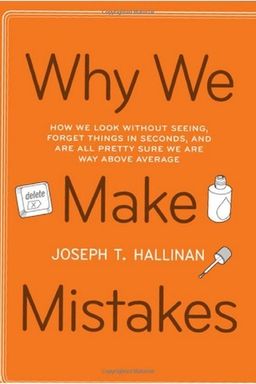
Why We Make Mistakes and What That Reveals About Us
When was the last time you made a mistake—maybe misplaced your car keys, forgot a password, or made a foolish purchase you instantly regretted? In Why We Make Mistakes, journalist and Pulitzer Prize winner Joseph T. Hallinan argues that such blunders aren’t anomalies to be ashamed of—they’re essential clues to how the human brain works. His central claim is simple but profound: we make mistakes not because we are careless or lazy, but because our minds evolved to interpret the world in shortcuts and patterns that worked brilliantly in some contexts—and fail spectacularly in others.
Hallinan draws from decades of cognitive psychology, neuroscience, and real-world stories—from airline disasters and medical errors to supermarket pricing tricks—to make the case that error is not the exception but the rule of human life. Understanding why we err, he contends, can make us humbler thinkers and smarter decision-makers.
The Pattern-Seeking Brain
At the heart of Hallinan’s thesis is the idea that our brains don’t passively record the world—they actively interpret it. We look for patterns and meaning, even when none exist. This tendency to “connect the dots” helps us make sense of complexity but also leads us astray. When we see a person behaving angrily, we instantly invent a story about their personality, ignoring situational factors. When we see trends in stock prices or sports results, we imagine we’re spotting patterns instead of randomness. Our bias toward meaning-making is one of humanity’s greatest strengths—and its biggest weakness.
Seeing Without Seeing
One of the opening chapters reveals a stunning truth about perception: we see far less than we think we do. Our eyes have clear focus across only about two degrees of our visual field—roughly the width of your thumb at arm’s length—yet we’re convinced we perceive everything vividly. Hallinan recounts experiments by psychologists like Daniel Simons, where people watching a video of basketball players entirely miss a man in a gorilla suit walking through the scene. Even professionals like radiologists and airport security screeners suffer similar “change blindness.” This illusion of completeness in our vision becomes a metaphor for how we overestimate our knowledge across all domains.
Memory, Meaning, and Misremembering
Humans also remember meaning, not details. Hallinan describes psychologist Harry Bahrick’s long-term memory studies showing that former students could recognize high school classmates’ faces after fifty years—but forgot most of their names. Similarly, we can visualize a penny but have trouble recalling the placement of its inscriptions because meaning, not precision, is what sticks. We misremember events and polish them until they fit our self-image. People inflate their high school grades, parents recall being more attentive than they were, and eyewitnesses confidently identify the wrong person—all examples of memory as reconstruction, not retrieval.
The Brain’s Built-In Biases
Hallinan shows that biases are embedded in how we interpret, focus, and decide. We are overconfident (“I can’t forget that password” or “I’ll use this gym membership”), we favor what confirms our expectations, and we mistake correlation for causation. One striking example is the story of anesthesiologists who drastically reduced fatal mistakes—not by blaming individuals but by redesigning their systems: standardizing equipment, using checklists, and flattening hierarchy so nurses could challenge doctors. Their approach, Hallinan suggests, shows that the key to reducing error is not perfection of people but redesign of environments.
The World Isn’t Built for Our Minds
The book goes further: modern life constantly pits our Stone Age brains against systems that assume we remember passwords, multitask efficiently, and absorb complex instructions. Yet humans can only retain about five unrelated items in short-term memory. That’s why pilots forget landing checks and drivers crash while fiddling with GPS devices. When things go wrong, we wrongly blame “human error” rather than poor design—just as Captain Loft did before crashing Eastern Airlines Flight 401 while distracted by a $12 lightbulb.
Learning to See Our Mistakes
Ultimately, Hallinan’s book is about awareness. By understanding how illusions, biases, and limits shape our perception and memory, we can adjust environments to fit our humanity rather than the other way around. Mistakes, he argues, aren’t moral failings; they are the price of being human. Learning from them—like doctors who adopted aviation-style safety checklists or investors who keep journals of their decisions—can help us make fewer or at least more intelligent mistakes.
If Daniel Kahneman’s Thinking, Fast and Slow explains the mechanics of cognitive bias, Hallinan’s Why We Make Mistakes makes that science personal—grounded in vivid stories, quirky research, and relatable confessions. It’s a compassionate reminder that our errors, far from undermining intelligence, reveal the contours of how our astonishingly adaptive—but imperfect—minds really work.