
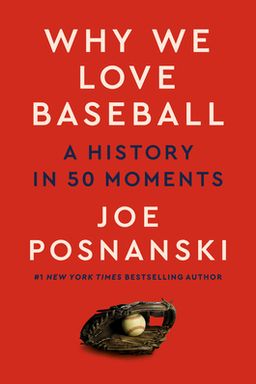
Why We Love Baseball cover

Why We Love Baseball

by Joe Posnanski

The author of “The Baseball 100” brings to life 50 moments in baseball’s history.

Baseball Is Made of Moments

How do you hold on to a game that unfolds slowly, almost invisibly, over a summer and a lifetime? In this book, Joe Posnanski argues that baseball lives not in statistics or even final scores but in moments that stick. He contends that what you love most about the game are the flashes that lodge in memory: a Bryce Harper blast that makes a city roar, a pitcher’s perfect stretch against impossible odds, a trick play that fools everyone, or a civic awakening launched by a single double down the line.

The claim is simple but radical: if you track the moments, you understand the game. Those moments braid together three strands — your senses, your personal history, and the wider narrative — to become the stories you retell for decades. The book then widens your lens: it shows how myth and media sculpt these memories, how errors can matter as much as heroics, how counting streaks turns time into story, and how the moral arc of race and integration runs through everything.

The three forces of memory

First, the sensory: you feel the grass, hear the bat, and taste evening air. Those impressions prime you to notice something extraordinary. Second, the personal: you carry your own rituals and talismans — like Posnanski’s Duane Kuiper bobblehead, or the living-room bases he ran as a kid — so a stray play can become sacred. Third, the narrative: baseball is a theater of underdogs, comebacks, and last-out heroes. When Gaylord Perry hits his first homer minutes after the moon landing, it knits your life to history in a single frame.

From diamond to city square

Moments remake places. Edgar Martinez’s Double in 1995 does more than beat the Yankees; it snaps Seattle awake. You feel how the Kingdome’s grayness gives way to blue-collar belief and how a shouted Refuse to Lose becomes civic identity. David Ortiz’s post‑Marathon address — this is our f---ing city — and Dave Roberts’s steal in 2004 work the same way: a play becomes public ritual, a sentence becomes a city’s stance.

Pitching as living drama

Pitchers write epics one pitch at a time. Pedro Martínez turns fury into a 17‑strikeout jewel in the Bronx; Nolan Ryan marries unhittable genius with wildness to forge myth; Harvey Haddix spins 12 perfect innings and tastes heartbreak on an error. Perfect worlds wobble. Don Larsen, famously imperfect, throws the perfect World Series game; Armando Galarraga finds immortality in a near-miss because grace matters as much as outcomes. You watch craft, stamina, and emotion fuse into theater.

The improbable delights

Baseball saves a special joy for the unlikely — Rick Camp’s 18th‑inning homer at 3 a.m., Tom Lawless’s World Series bat flip, Al Weis turning Miracle Met, Bartolo Colón circling the bases like a slow parade. These aren’t record‑book epics; they are human-scale surprises that flip expectations and make you feel that anything can happen in your own life, too.

Myth, media, and the fight over truth

What you remember is partly what storytellers shape. A cameraman chooses Carlton Fisk over the ball and invents an icon; the rediscovered Bing Crosby kinescope lets you re‑see Mazeroski’s swing; Joshua Prager’s research stains and complicates the Shot Heard 'Round the World; the Babe Ruth Called Shot and Dottie’s dropped ball live because you argue about them. Legend and ledger wrestle — and that argument keeps the sport alive (think of Buck O’Neil retelling Satchel Paige and Josh Gibson yarns to preserve truth through myth).

Counting as story scaffolding

Chases and streaks serialize your days. Ted Williams risks everything to finish at .406; Joe DiMaggio turns America’s daily question into did he get a hit; Cal Ripken’s 2,131 lights a post‑strike healing; Hank Aaron passes Ruth through hatred and becomes dignity incarnate. The numbers matter, but context crowns them. A total without a tale is trivia; a number with a nation behind it is meaning.

Rules, tricks, and human error

Cleverness and fallibility shape the plot. The Grand Illusion dupes a runner with pure theater; the 1893 Ice Wagon ruse births an entire rule; the Pine Tar Game blends comedy with jurisprudence; A. J. Pierzynski sprints on a dropped‑third strike and flips a series. And then there are the wounds: Merkle’s boner, Jeremy Giambi not sliding, Buckner’s booted roller, Bartman’s scapegoating, Jim Joyce’s miss and Galarraga’s forgiveness. Errors turn into moral tales because baseball is a human enterprise.

Core claim

If you learn to look for moments — sensory, personal, and narrative — you will see why this leisurely sport grips your heart so tightly.

(Note: In the spirit of Roger Angell and Bill James, Posnanski bridges feeling and fact — he loves the story, but he also shows how evidence, cameras, and context shape what endures.)


Small Wonders, Big Joy

Posnanski makes a passionate case that the most endearing parts of baseball are often the tiniest ones — the private memories, the unlikely heroes, the bleacher rituals — because they give you a piece of the game you can hold. He invites you to value a neighborhood tale as much as a World Series clincher. When you do, your fandom becomes portable and intimate.

The improbable homer as human mirror

Unlikely homers thrill because they invert expectation. Rick Camp, a lifetime .059 hitter, goes deep in the 18th inning long after midnight; Tom Lawless, a utility man, sneaks a World Series ball over the fence and punctuates it with a wicked flip; Al Weis, lightly regarded, rewrites the 1969 Series mood; Bartolo Colón, 42 and joyously rectangular, rounds the bases with the longest trot you can remember; Gaylord Perry belts his first minutes after Apollo 11 lands. Each blast says you can be ordinary and extraordinary at once.

Your hometown hero matters

Duane Kuiper’s single career home run becomes cathedral music for a Cleveland kid who sprints imaginary bases in a living room. That homer means almost nothing in a record book, but it matters endlessly to a boy who loves a second baseman who dives for everything. You likely have your own Kuiper — a role player whose grit taught you what effort looks like (in the same way Chelsea Baker’s knuckleball or Ponderous Joe Bauman’s small‑town slugging becomes local myth).

Bleachers as performance space

The stands are a stage. In the world of Bleacher Bums, characters — Len the clothier, Robby the trivia kid, Tom Bujnowski with 16 K cards for Kerry Wood’s masterpiece — turn fandom into identity. You do not just watch; you rehearse, you chant, you hold up signs, and you share codes. Ballparks teach you how to belong in public, one roll call at a time.

Comedy as affection

Baseball’s oddities prove the sport’s personality. The Pine Tar Game marries outrage to slapstick; a ball off José Canseco’s head bounces over for a home run you can’t stop replaying; Roger Clemens flings a bat shard near Mike Piazza and everyone wonders, did that really happen? Laughter here is not mockery; it is love. You cherish the pratfalls because they reveal the game’s human seams.

Private rituals, public resonance

Your favorite memory might be a radio call in your grandparents’ kitchen, a bobblehead on a shelf, or the smell on a July night. These details are the hooks that hold larger stories. When Bryce Harper launches a cold‑blooded October shot and a city makes a sound of incomprehensible joy, that feeling overlaps with your own quiet archive. The small feeds the big; the big legitimizes the small.

Why it sticks

A tiny, self‑contained story is easy to carry and easy to tell. Baseball gives you thousands; you adopt a handful as your own.

(Note: If you love sabermetrics, think of these micro‑stories as high‑leverage joys. They rarely move WAR, but they move you.)


Pitching, Fury, and Craft

Pitching is baseball’s most concentrated drama — every throw is a decision, every body twitch a clue. Posnanski shows you pitchers as playwrights and actors, mixing emotion, craft, and endurance to create spectacle. When you watch with this lens, you see the game’s pulse in the space between the mound and the plate.

Anger into art: Pedro in the Bronx

On September 10, 1999, Pedro Martínez arrives at Yankee Stadium seething at everything — snubs, flights, critics — and channels it into near‑perfect control: 1 hit, 17 strikeouts, a surgical dismantling of champions. His changeup twins his fastball until hitters swing at ghosts. You learn that emotion is not a distraction; harnessed, it is a performance enhancer.

The duality of Nolan Ryan

Ryan is chaos and awe. In Detroit, July 1973, he wields the best curve he ever had, strikes out 16 through seven, stumbles, and still closes a no‑hitter while Norm Cash famously grabs a table leg in defeat. He walks batters, courts wildness, and yet seems invincible. You see how myth tolerates contradiction; the walk machine and the unhittable ace live in one frame.

Perfection and its heartbreaks

Harvey Haddix retires 36 straight and loses. His first thought — we lost — reveals the pitcher’s paradox: perfect process, brutal result. Don Larsen, the opposite archetype, drifts into the only perfect World Series game. Then there is Armando Galarraga, denied by Jim Joyce’s miss, who responds with grace and converts a near‑perfect into a perfect example of character. In each case, you learn that meaning can outrun the box score.

Duels as chess matches

The great duels compress time. Marichal and Spahn throw 227 and 202 pitches, respectively, in a single night of stubborn genius; in the Negro Leagues, Chet Brewer’s emery ball dances under the lights against Smokey Joe Williams’s heat. You watch sequencing, tunneling, and the weary courage to throw the right pitch when it hurts. Old‑school stamina meets modern nuance.

Defense completes the masterpiece

Pitching feats depend on partners. Willie Mays’s over‑the‑shoulder basket preserves a world’s fair of a moment; in Jim Abbott’s no‑hitter, fielders glove balls exactly where luck and anticipation meet. You start to notice that perfect is a team verb even when a single name takes the credit line.

Your watcher’s checklist

Before each pitch, ask: what did the last swing teach, what does the catcher show, where is the hitter’s eye, and how does the pitcher’s body language hint at conviction or doubt?

(Note: This framing echoes Tim Kurkjian’s love for tiny pitcher‑hitter negotiations, but Posnanski adds the mythic layer — the why you will tell this start to your kids.)


Cities Remade by a Swing

Some plays reach beyond a team to touch a city’s soul. Posnanski treats these as civic miracles — moments that melt cynicism and rewrite local identity. When you see a town change because of a bat or a sentence, you understand sport as a public art.

Edgar’s Double and Seattle’s rebirth

The Mariners once lived in gray: the Kingdome’s echo, small crowds, no pennants, default pessimism. Then 1995 happened. August and September turned wild; Refuse to Lose became posture and prayer. In Game 5 of the ALDS, with Griffey on second, Edgar ripped the line‑drive double that sent Junior home. Dave Niehaus’s call splashed forever across the Sound. The city felt newly possible, and baseball became the civic language.

Rituals of recovery and resolve

After the Boston Marathon bombing, David Ortiz stood on the grass and said what Boston needed. One sentence — raw, un‑polished — turned Fenway into a town square and grief into defiance. In 2004, Dave Roberts’s steal lit the fuse for a historic comeback; years later that dash still functions as a civic password. You learn that public words and tiny physical acts can be civic medicine.

Counting as community ceremony

Cal Ripken’s 2,131 was not only a workplace feat; it was a national halftime show after a lost World Series. Flags unfurled, cannons boomed, the President applauded, and a workman’s habit soothed a wounded sport. When numbers gather a crowd and a mood, they become rituals, not just records.

Collective release

Bryce Harper’s playoff blast in 2022 produced a roar of incomprehensible joy. That sound is as important as the exit velocity. Communities need catharsis — a chance to shout in unison and wash the dust off hard seasons and harder news cycles. Baseball offers that chorus more reliably than almost anything else in American life.

Civic lesson

A single swing can make strangers kin for a night — and sometimes for a generation.

(Note: In the tradition of David Halberstam’s sports‑as‑civic‑history, Posnanski shows how a team becomes a town’s mirror, even when no championship follows.)


Cunning, Chaos, and the Rulebook

Baseball is a system of rules constantly stress‑tested by human creativity and fallibility. The sport’s silliest moments and darkest heartbreaks often arise where the rulebook meets theater. Posnanski delights in both the art of deception and the drama of mistake, because each exposes what the game expects of you — and what it forgives.

The beauty of trickery

Miami’s Grand Illusion, staged at the 1982 College World Series, is baseball as Broadway: a fake pickoff, players sprinting toward imaginary chaos, bat girls fleeing with practiced panic, and a runner duped into doom. Decades earlier, an 1893 ruse inspired the infield fly rule itself — a reminder that cunning pushes the game to clarify its ethics. Even in modern times, Javy Báez tags with a flourish and grin, winning with hands and theater alike.

Gamesmanship vs. the game’s soul

Not every trick feels like art. The Pine Tar Game lives where comedy and complaint blur; A. J. Pierzynski outruns a dropped‑third strike misunderstanding and flips a championship series; Rocky Colavito’s wild carom sparks arguments over intent. Crowds decide what is clever and what is dirty in real time. The line moves with mood.

Human error as narrative engine

Blunders can brand a life. Fred Merkle, 19 and full of promise, forgets to touch second; Bonehead becomes a name, not a mistake. Jeremy Giambi does not slide; a rally dies in the 2001 ALDS. Bill Buckner boots a dribbler; in Boston it aches for decades while Queens celebrates forever. Steve Bartman reaches for a foul; a city breaks a man before it forgives. These are not stat lines; they are moral weather systems.

The imperfect perfect game

Armando Galarraga beats a runner by a stride, Jim Joyce blinks, and history tilts. The apology the next day, Galarraga’s serenity, Detroit’s applause — together they teach you that repair can be as memorable as achievement. Perfection, it turns out, can include the grace to bear imperfection.

Watcher’s question

When a controversy erupts, ask whether you are seeing a clever exploitation, a violation of spirit, or a human miss — and how the crowd’s verdict shapes the memory.

(Note: This section pairs well with the spirit of Moneyball’s edge‑seeking and Ken Burns’s love for fallible heroes, but Posnanski keeps the focus on the moments you feel in your gut.)


Myth, Memory, and the Camera

In baseball, what happened and what you remember are related but not identical. The gap is not a flaw; it is fuel. Posnanski argues that legend and evidence co‑author your memories — and that the arguments over them keep the sport vivid. When you learn to hold both, you enjoy the game more deeply.

Legends that will not sit still

Did Babe Ruth point? Depends on the witness and the camera angle. Did Dottie drop the ball on purpose? A League of Their Own leaves you to choose your heart’s reading. Buck O’Neil spins Satchel Paige vs. Josh Gibson tales that contradict in detail but cohere in spirit, preserving the Negro Leagues’ greatness where records are thin. You learn to listen for truth in feeling as much as in footnotes.

How media edits immortality

Carlton Fisk’s body‑language wave becomes epic because a cameraman sticks with the hitter, not the flight of the ball. Kirk Gibson’s hobbling pinch‑hit blast is told two ways — Jack Buck’s there’s no way disbelief and Vin Scully’s long, wise quiet — and the duet deepens meaning. Later, Bing Crosby’s kinescope emerges from a basement to let a city re‑inhabit 1960 and Mazeroski’s lap. The lens is part of the legend.

Complicated icons

Bobby Thomson’s Shot Heard 'Round the World is pure rapture — until you read Joshua Prager on sign‑stealing and must fit joy beside stain. That act of balancing is a feature, not a bug. You learn to love a moment without erasing its shadows.

Field of Dreams, field of meanings

Moonlight Graham’s half‑inning matters because a story makes it matter. Ray Kinsella’s pilgrimage shows you how fans use baseball to talk to their fathers, to heal losses, to finish conversations lingering for years. Narrative does not change the data; it changes the weight of the data in your life.

Practical lens

When you revisit a clip, ask: what does the camera emphasize, what debates surround it, and what feeling survives even if facts evolve?

(Note: This echoes the historian’s credo — trust but verify — while honoring the fan’s credo — feel and remember.)


Counting What Matters

Numbers in baseball do not just measure; they narrate. Posnanski shows you how records and streaks convert daily repetition into suspense and how cultural context wraps those totals in meaning. When you follow a chase, you are reading a novel in box‑scores — every day a new page, every milestone a chapter break.

Benchmarks that bend time

Babe Ruth’s 60 sets a mythic bar; Roger Maris breaks it amid an asterisk cloud; Mark McGwire and Barry Bonds blast through in a storm of chemistry debates; Aaron Judge re‑centers the conversation around league and era. You watch the target move as the game, the schedule, and the culture shift. Records are not static; they are conversations.

Precision and courage at .406

Ted Williams teaches you that counting can be moral drama. He plays the last day, risks the number, and locks in .406 because round‑ups do not count. This is arithmetic as ethos: show up, take your swings, let the ledger speak.

Daily obsession, national chorus

Joe DiMaggio’s 56‑game hit streak turns America into a yes/no nation each afternoon. The streak illustrates how small acts — a single, a bloop, a line‑drive — accumulate cultural gravity. Meanwhile, Cal Ripken’s uninterrupted presence becomes a balm after the 1994 cancellation; 2,131 is a counting ceremony that heals.

Dignity under fire

Hank Aaron’s 715 is arithmetically simple and morally vast. He faces death threats and poisonous mail but swings on, and Milo Hamilton’s call — there’s a new home run champion of all time, and it’s Henry Aaron — lands as a civic verdict. Counting reveals character because the chase exposes you every day.

How to watch a chase

Track context as hard as totals: era, ballparks, equipment, schedule, and the human climate around the record. That is where numbers become meaning.

(Note: This complements Bill James’s insistence on context but stays fixed on the drama you feel waking up to check if he did it again.)


Integration’s Unfinished Business

Baseball’s most consequential story is America’s: race, exclusion, breakthrough, and the long, uneven road toward fairness. Posnanski insists you cannot love the game’s moments without seeing the color lines they crossed — and the doors that stayed shut for too long. These chapters honor heroes while holding institutions to account.

Jackie and the daily courage of 1947

Jackie Robinson’s debut is a pivot, not a finish line. Every day he absorbs spikes, slurs, and silence and answers with steals and line‑drives. The breakthrough remakes the league’s possibilities, but the grind remains. You learn to see integration as action, not a photo op.

Larry Doby’s quieter burden

Doby lands in Cleveland with less fanfare, younger, immediately in the big‑league fire, no minor‑league runway. His loneliness shows how uneven history’s spotlight can be. That he thrives anyway expands your definition of courage.

The Negro Leagues’ preserved brilliance

Satchel Paige, Josh Gibson, Cool Papa Bell — names as large as the MLB stars they were denied the chance to meet at their peak. Buck O’Neil’s stories, mythic and true in different proportions, keep their flame until researchers and recordkeepers catch up. Remembering is a responsibility; it completes the record.

Late doors, lingering attitudes

The Red Sox integrate last with Pumpsie Green in 1959; Buck O’Neil’s big‑league coaching life exposes the ceiling Black baseball men faced for decades. Institutions change slower than heroes. The book asks you to celebrate progress without pretending it came easy or quick.

Aaron’s chase, America’s mirror

Hank Aaron’s 715 compresses the arc: the math is simple, the mail is hateful, the swing is pure, and the broadcast is history. You cannot separate that moment’s beauty from its burden; its moral weight is part of why it lasts.

Charge to the reader

Honor the legends, yes — and keep asking who was kept out, who got in late, and how the game can remember them fully.

(Note: This stance echoes Howard Bryant’s moral clarity on baseball and race while staying rooted in the moments that make you feel the stakes.)

Dig Deeper

Get personalized prompts to apply these lessons to your life and deepen your understanding.

Go Deeper

Get the Full Experience

Download Insight Books for AI-powered reflections, quizzes, and more.